

Free 5-minute toolbox talkPPEEnglish and Spanish
Written respiratory protection program: a respiratory protection toolbox talk
Dust, fumes, mists, gases and vapors can damage your lungs, sometimes without any warning you can see or smell. What OSHA requires: The employer must designate a program administrator, qualified by training or experience that fits the complexity of the program, to run the program and evaluate how well it works (29 CFR 1910.134(c)(3)).
This free respiratory protection toolbox talk takes about five minutes to read to your crew, and it also works as a respirator safety talk or a dust mask toolbox talk. It explains what the OSHA respirator rule and your written respiratory protection program mean for the person wearing the respirator.
Updated October 29, 2026 · Based on 29 CFR 1910.134, 29 CFR 1926.103
Read it out loud
Free 5-minute toolbox talk
Read it out loud to your crew. It takes about 5 minutes.
Start with a question
When you put on a respirator, how do you know it is the right one for the job and that it is actually sealing to your face?
Why it matters
Dust, fumes, mists, gases and vapors can damage your lungs, sometimes without any warning you can see or smell. Controlling the hazard at the source comes first, with ventilation, water or a safer product. When a respirator is still needed, it only protects you if it is the right type, fits your face and is worn and cared for the right way.
Key points
Use the respirator picked for the hazard
Your employer must select a respirator based on the hazards you are exposed to and the workplace and user factors that affect how well it works. A dust mask is a particle filter, so it does not protect you from gases or vapors, like solvent or paint vapors.
More
If the product, the task or the air changes, ask before you keep using the same respirator.
Know your written program
Where respirators are needed to protect workers' health, or the employer requires them, the employer must have a written respiratory protection program with procedures for this worksite.
More
It covers how respirators are picked, medical evaluations, fit testing, proper use, cleaning and storage, and training. A qualified program administrator must run it, so find out who that is on this job.
29 CFR 1910.134(c)(1) · 29 CFR 1910.134(c)(3)
Medical evaluation and fit test come first
Before you are fit tested or required to wear a respirator, your employer must provide a medical evaluation to check that you can use one.
More
A tight-fitting respirator also needs a fit test before you first use it, whenever you switch to a different facepiece size, style, model or make, and at least once a year. You do not pay for the respirator, the training or the medical evaluation.
29 CFR 1910.134(f)(2) · 29 CFR 1910.134(e)(1) · 29 CFR 1910.134(c)(4)
Seal check every time
Do a user seal check each time you put on a tight-fitting respirator, the way you were trained. Your employer cannot let you wear one if facial hair comes between the face seal and your skin or gets in the way of the valves. Even stubble can keep the facepiece from sealing.
29 CFR 1910.134(g)(1)(iii) · 29 CFR 1910.134(g)(1)(i)
Leave if it stops protecting you
Leave the area if you smell or taste the contaminant, if breathing gets harder or if the facepiece leaks. Your employer must make sure you leave the respirator area for those reasons, and also to wash your face or to change the filters or cartridges.
More
Do not go back in until the respirator has been repaired or replaced.
29 CFR 1910.134(g)(2)(ii) · 29 CFR 1910.134(g)(2)(iii)
Inspect, clean and store it right
Respirators used for routine work must be inspected before each use and during cleaning. Look over the facepiece, straps, valves and cartridges or filters, and report anything cracked, stiff or worn.
More
Store it clean and protected from dust, sunlight, extreme temperatures, moisture and chemicals, packed so the facepiece and valve do not get bent out of shape.
29 CFR 1910.134(h)(3)(i)(A) · 29 CFR 1910.134(h)(2)(i)
Scenario
Picture this: A painter grabs a dust mask from the truck before spraying a solvent-based coating in a small room with poor airflow. He has a beard and has never been fit tested. After a while he feels dizzy and can smell the solvent, but he figures the job is almost done and keeps going. What went wrong before he even started, and what should he do right now?
Ask the crew
- Which tasks on this job need a respirator, and which type does each one need?
- Who runs our respiratory protection program, and where can you see the written program?
- When were you last fit tested, and on which respirator model and size?
- What would you do if you smelled the chemical through your respirator?
Takeaway
Wear the respirator chosen for the hazard, make sure it fits and seals every time, and leave the area the moment it stops protecting you.
Trainer: ______________________ Date: ____________
Credit: ToolboxKits, https://toolboxkits.com/topics/respiratory-protection/ (CC BY-NC-SA 4.0)
The poster is also inside the paid kits.
Audit-ready records in 60 seconds
Fill in your crew and download a filled sign-in sheet for this talk. Everything is made in your browser. Names are never uploaded or stored.
Start a sign-off
Crew scan a QR code on their own phones, type their name and sign with a finger. You see the names arrive and download the signed sheet. Free, no account.
Kits
Get the kit
No subscription needed. Buy only the kit you need.
Toolbox talk kit
$4.99
- 5-minute talk, English PDF
- 5-minute talk, Spanish PDF
- Editable mini-deck (English and Spanish)
- One-page crew handout (English and Spanish)
- Bilingual sign-in sheet
- 3-question quiz with answer key (English and Spanish)
- One-page bilingual poster
- Audit-ready records in 60 seconds: fill in your crew and get a sign-in sheet and a certificate for every worker
Training kit
$9
Editable PowerPoint, 39 slides
- Editable PowerPoint with trainer notes on every slide
- Trainer guide PDF with timing and discussion tips
- 10-question quiz and answer key
- Sign-in sheet and certificate of completion with fillable fields
- One-page crew handout
- Full Spanish version of everything
- One-page bilingual poster
- Audit-ready records in 60 seconds: fill in your crew and get a sign-in sheet and a certificate for every worker
- Instant download
- Secure checkout by Stripe
- 30-day refund, no questions
Need many topics? All Access gives you every kit for $99 a year.
Inside the kit
See what is in the kit
What is in the kit
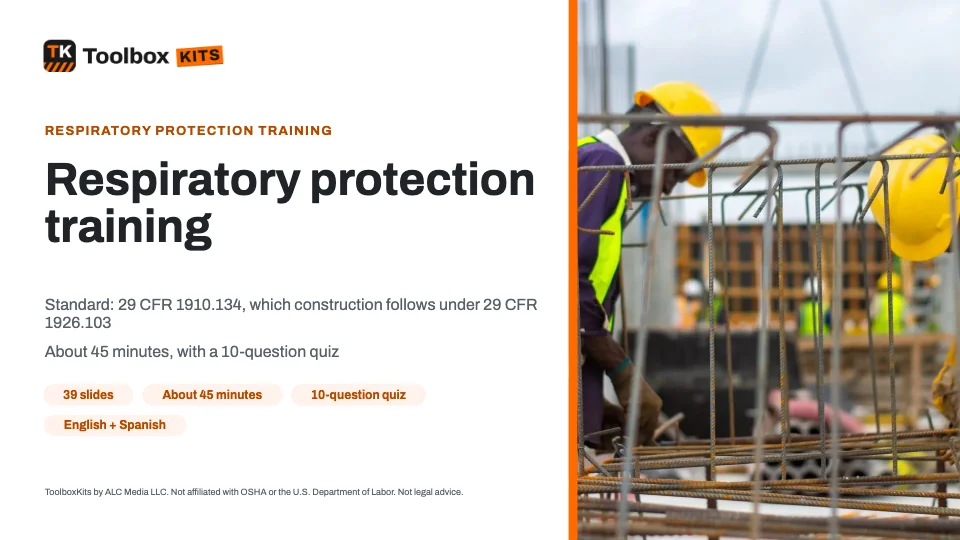 Editable PowerPoint
- Trainer guide
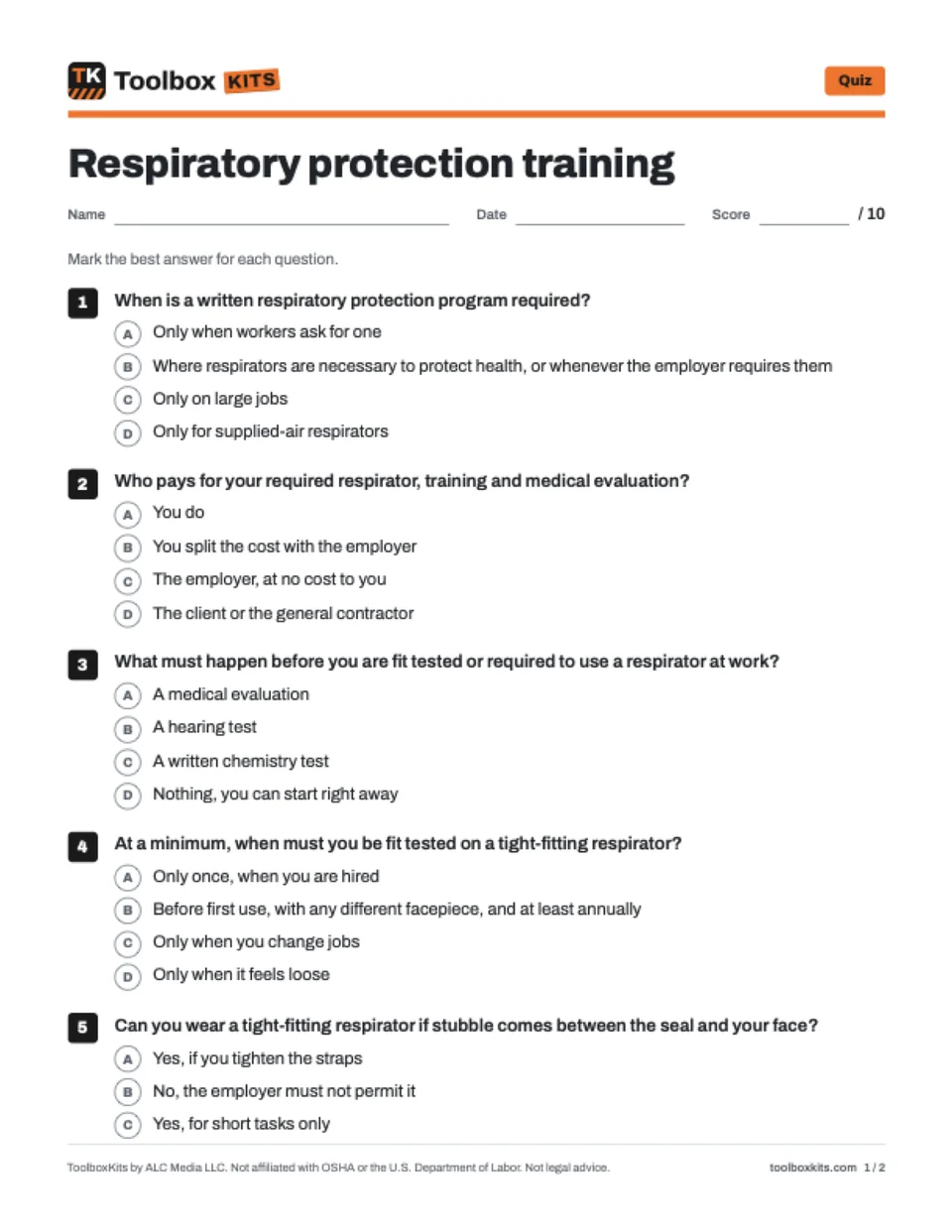 Quiz
- Answer key
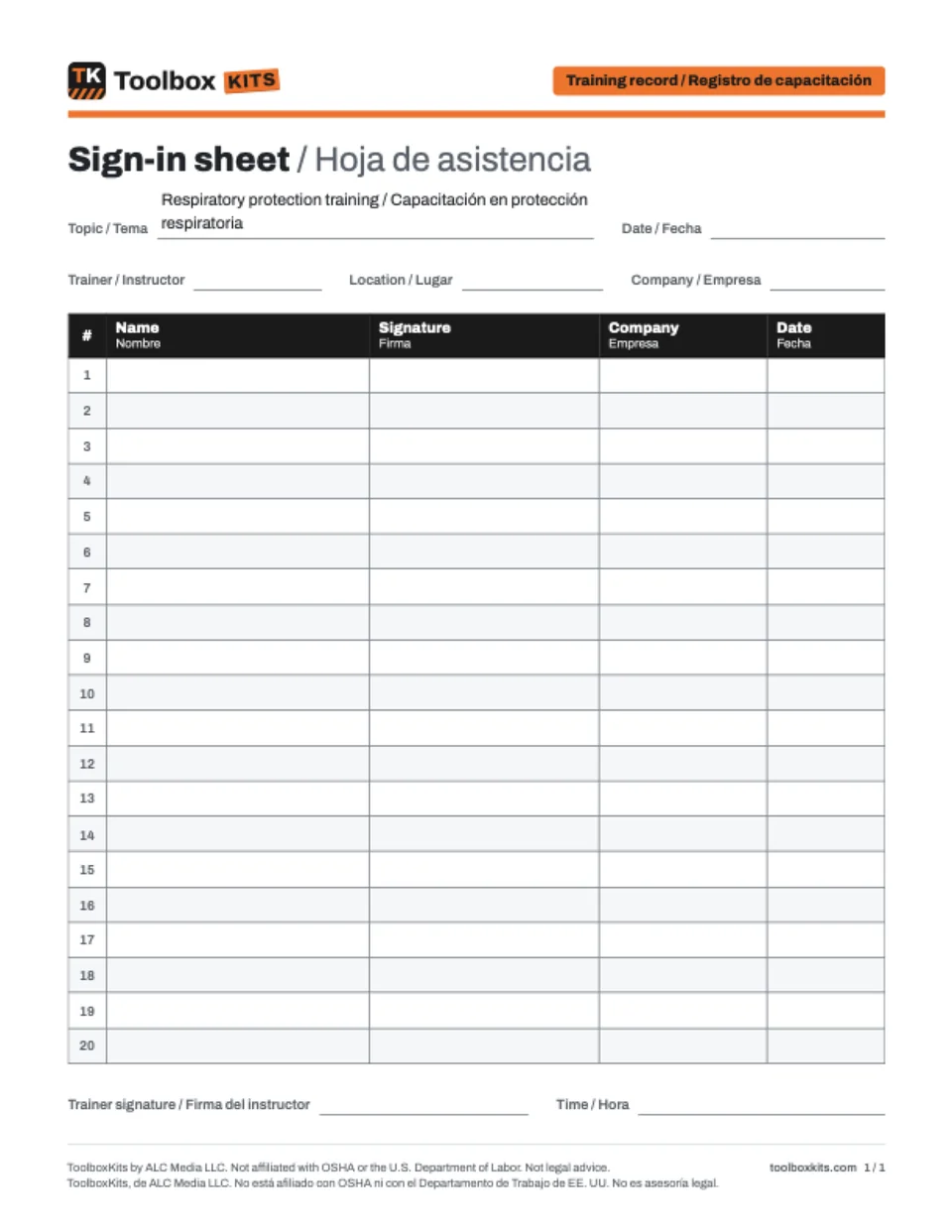 Sign-in sheet
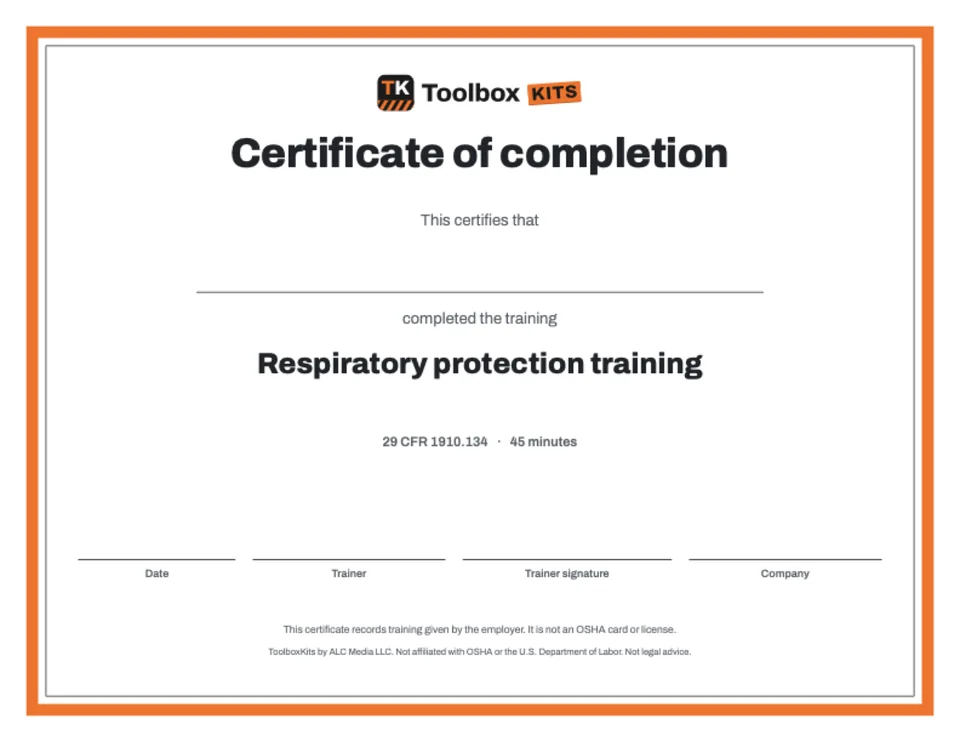 Certificate
- Crew handout
Try it
Try the quiz
Three questions from this topic. Pick an answer to see the right one and the OSHA paragraph.
Question 1 of 3
Before you can be fit tested for a respirator, what must your employer provide?
The rule
What OSHA requires
Plain-language summary. Each line links to the exact paragraph of the regulation.
Wherever respirators are necessary to protect employee health, or whenever the employer requires them, the employer must set up and carry out a written respiratory protection program with worksite-specific procedures, and update it as needed when workplace conditions that affect respirator use change.
“the employer shall establish and implement a written respiratory protection program with worksite-specific procedures.”
The employer must designate a program administrator, qualified by training or experience that fits the complexity of the program, to run the program and evaluate how well it works.
“The employer shall designate a program administrator who is qualified by appropriate training or experience that is commensurate with the complexity of the program”
Respirators, training and medical evaluations must be provided at no cost to the employee.
“The employer shall provide respirators, training, and medical evaluations at no cost to the employee.”
The employer must select and provide an appropriate respirator based on the respiratory hazards the worker is exposed to and the workplace and user factors that affect how the respirator performs.
“The employer shall select and provide an appropriate respirator based on the respiratory hazard(s) to which the worker is exposed”
The employer must provide a medical evaluation to determine whether the employee can use a respirator, before the employee is fit tested or required to use it in the workplace.
“The employer shall provide a medical evaluation to determine the employee's ability to use a respirator, before the employee is fit tested or required to use the respirator in the workplace.”
Employees using a tight-fitting facepiece respirator must be fit tested before first use, whenever a different facepiece (size, style, model or make) is used, and at least annually after that.
“is fit tested prior to initial use of the respirator, whenever a different respirator facepiece (size, style, model or make) is used, and at least annually thereafter.”
Tight-fitting respirators must not be worn by employees who have facial hair that comes between the sealing surface of the facepiece and the face or interferes with valve function, or any other condition that interferes with the face-to-facepiece seal or valve function.
“The employer shall not permit respirators with tight-fitting facepieces to be worn by employees who have”
Employees must perform a user seal check each time they put on a tight-fitting respirator, using the procedures in appendix B-1 of the standard or manufacturer procedures shown to be as effective.
“the employer shall ensure that employees perform a user seal check each time they put on the respirator”
Respirators used in routine situations must be inspected before each use and during cleaning.
“All respirators used in routine situations shall be inspected before each use and during cleaning”
Each employee who must use a respirator must be able to demonstrate knowledge of why it is needed and how poor fit, use or maintenance weakens it, its limits and capabilities, how to use it in emergencies, how to inspect, put on, remove, use and seal check it, how to maintain and store it, medical signs that limit its use, and the general requirements of the standard.
“The employer shall ensure that each employee can demonstrate knowledge of at least the following”
Who must be trained
Every employee who is required to use a respirator must be trained before being required to use it in the workplace (29 CFR 1910.134(k)(3)). Each one must be able to demonstrate knowledge of why the respirator is needed and how poor fit, use or maintenance weakens it, its limits and capabilities, emergency use, how to inspect, put on, remove, use and seal check it, maintenance and storage, medical signs that limit its use, and the general requirements of the standard (29 CFR 1910.134(k)(1)). Employees who wear respirators when not required must be given the basic advisory information in appendix D of the standard (29 CFR 1910.134(k)(6)).
When to retrain
Retraining is required annually, and also when changes in the workplace or the type of respirator make earlier training obsolete, when an employee's knowledge or use of the respirator shows they have not kept the needed understanding or skill, or in any other situation where retraining appears necessary for safe respirator use (29 CFR 1910.134(k)(5)).

Common questions
Questions people ask
Does OSHA require a written respiratory protection program?
Yes, in any workplace where respirators are necessary to protect employee health or whenever the employer requires them. The program must be written, include worksite-specific procedures, be updated as conditions that affect respirator use change, and be run by a qualified program administrator (29 CFR 1910.134(c)(1) and (c)(3)). Construction work follows the same requirements (29 CFR 1926.103).
What must a written respiratory program include?
As they apply to your workplace, the program must cover procedures for selecting respirators, medical evaluations, fit testing for tight-fitting respirators, use in routine and reasonably foreseeable emergencies, and cleaning, disinfecting, storing, inspecting, repairing, discarding and maintaining respirators. It must also cover breathing air quality for atmosphere-supplying respirators, training on the respiratory hazards and on proper respirator use, and regular evaluation of how well the program works (29 CFR 1910.134(c)(1)(i) to (ix)).
Is there a sample written respiratory protection program template?
The standard notes that OSHA's Small Entity Compliance Guide contains a sample program that meets the program requirements (29 CFR 1910.134(c)). A template is only a starting point, because the program must have procedures specific to your worksite, your hazards and the respirators you use (29 CFR 1910.134(c)(1)). This page is a toolbox talk for your crew, not a fill-in program.
Can I use this as a dust mask toolbox talk?
Yes. The standard defines a dust mask (filtering facepiece) as a particulate respirator (29 CFR 1910.134(b)), so it does not protect against gases or vapors. If dust masks are required by the employer or needed to protect health, the full program applies, including medical evaluation, fit testing and training (29 CFR 1910.134(c)(1)). If workers wear dust masks only voluntarily, the employer must give them the information in appendix D of the standard, but they do not have to be included in the written program (29 CFR 1910.134(c)(2)).
Is there a respiratory protection training PowerPoint?
This free talk is written to be read aloud, so you do not need slides to run it. The training kit for this topic adds an editable PowerPoint in English and Spanish with trainer notes, a quiz and a sign-in sheet, and you can request it from this page if it is not ready to buy yet. Slides alone do not finish the job, because each worker must be able to demonstrate knowledge of the items in 29 CFR 1910.134(k)(1), and retraining is required annually (29 CFR 1910.134(k)(5)). The kit is not produced or endorsed by OSHA.
Free to share
Use this talk for free
You can print, share and adapt this talk at no cost under the Creative Commons BY-NC-SA 4.0 license. Please credit ToolboxKits with a link.