

Free 5-minute toolbox talkFalls and heightsEnglish and Spanish
Slips, trips and falls safety talk
Slips, trips and falls happen on every kind of job, not just up high. What OSHA requires: In general industry, all places of employment, passageways, storerooms, service rooms and walking-working surfaces must be kept clean, orderly and sanitary (29 CFR 1910.22(a)(1)).
This free slips, trips and falls safety talk takes about five minutes to read to your crew. It helps everyone spot and fix the everyday hazards that make people slip, trip and fall, with the OSHA rules behind them.
Updated October 31, 2026 · Based on 29 CFR 1910.22, 29 CFR 1926.25
Read it out loud
Free 5-minute toolbox talk
Read it out loud to your crew. It takes about 5 minutes.
Start with a question
What is the last thing you tripped over on this job, and is it still there?
Why it matters
Slips, trips and falls happen on every kind of job, not just up high. A fall on a flat floor can still break a wrist, hurt your back or cause a head injury. Spills, cords and clutter are easy to spot and easy to fix if someone takes a minute to deal with them.
Key points
Slips: keep floors clean and dry
A slip happens when your shoe loses its grip on water, oil, grease, mud, ice or sawdust. In general industry, workroom floors must be kept clean and, to the extent feasible, dry.
More
Where wet processes are used, drainage must be maintained and, to the extent feasible, dry places to stand, like mats or platforms, must be provided. Clean up spills right away and wear footwear with good tread for the surface.
Trips: clear the path
A trip happens when your foot hits something and your body keeps going. On construction sites, scrap lumber with protruding nails and all other debris must be kept cleared from work areas, passageways and stairs.
More
Run cords and hoses along walls or overhead instead of across walkways, and stack materials out of the path.
Fix it or guard it right away
When you find a hazard, deal with it now. In general industry, a hazardous condition on a walking-working surface must be corrected or repaired before anyone uses that surface again. If it cannot be fixed right away, it must be guarded to keep people off that surface until it is fixed.
More
Then report it so it gets fixed for good.
Cover and mark holes
An open hole is a trip hazard and a fall hazard. On construction sites, workers must be protected from tripping in or stepping into or through holes by covers. Make sure covers are secured and clearly marked, and never lift or move one unless you are told to and the hole is protected.
Take care on stairs, ramps and ice
On construction sites, slippery conditions on stairways must be eliminated before anyone uses the stairs to reach another level. Use the handrail and do not carry loads that block your view of the steps.
More
In cold weather, clear and treat snow and ice on walkways, steps and ramps before the crew arrives, and take short steps.
See where you are going
Construction areas, ramps, runways, corridors and storage areas must be lighted to at least the minimum levels in the OSHA rule while work is in progress. Report burned-out lights, especially on stairs and walkways. Keep your eyes on your path, not your phone, and do not run on site.
Scenario
Picture this: it is the first cold morning of the season and a thin layer of ice has formed on the steps of the job trailer. A worker comes out carrying a box of fittings with both hands while checking the plans on his phone. Nobody has salted the steps yet. What could go wrong, and what should the crew have done before the shift started?
Ask the crew
- Where on this site do you see clutter, cords or hoses in walkways, and who will clear them?
- What wet or slippery spots do we have, and how should we handle them?
- Which holes or openings need covers, and are the covers we have secured and marked?
- What will we do differently when it rains, snows or freezes?
Takeaway
If you see a slip or trip hazard, fix it or guard it now, and report it so it gets fixed for good.
Trainer: ______________________ Date: ____________
Credit: ToolboxKits, https://toolboxkits.com/topics/slips-trips-falls/ (CC BY-NC-SA 4.0)
The poster is also inside the paid kits.
Audit-ready records in 60 seconds
Fill in your crew and download a filled sign-in sheet for this talk. Everything is made in your browser. Names are never uploaded or stored.
Start a sign-off
Crew scan a QR code on their own phones, type their name and sign with a finger. You see the names arrive and download the signed sheet. Free, no account.
Kits
Get the kit
No subscription needed. Buy only the kit you need.
Toolbox talk kit
$4.99
- 5-minute talk, English PDF
- 5-minute talk, Spanish PDF
- Editable mini-deck (English and Spanish)
- One-page crew handout (English and Spanish)
- Bilingual sign-in sheet
- 3-question quiz with answer key (English and Spanish)
- One-page bilingual poster
- Audit-ready records in 60 seconds: fill in your crew and get a sign-in sheet and a certificate for every worker
Training kit
$9
Editable PowerPoint, 38 slides
- Editable PowerPoint with trainer notes on every slide
- Trainer guide PDF with timing and discussion tips
- 10-question quiz and answer key
- Sign-in sheet and certificate of completion with fillable fields
- One-page crew handout
- Full Spanish version of everything
- One-page bilingual poster
- Audit-ready records in 60 seconds: fill in your crew and get a sign-in sheet and a certificate for every worker
- Instant download
- Secure checkout by Stripe
- 30-day refund, no questions
Need many topics? All Access gives you every kit for $99 a year.
Inside the kit
See what is in the kit
What is in the kit
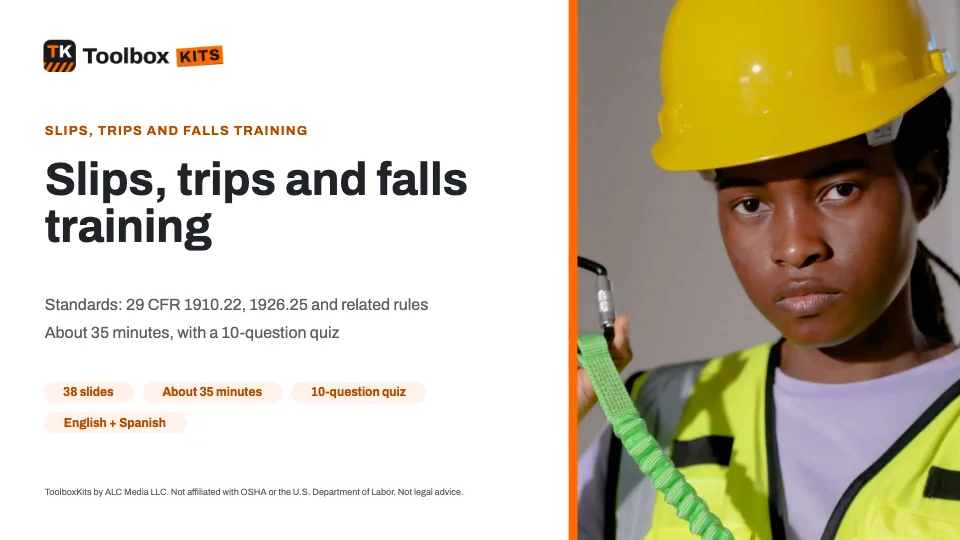 Editable PowerPoint
- Trainer guide
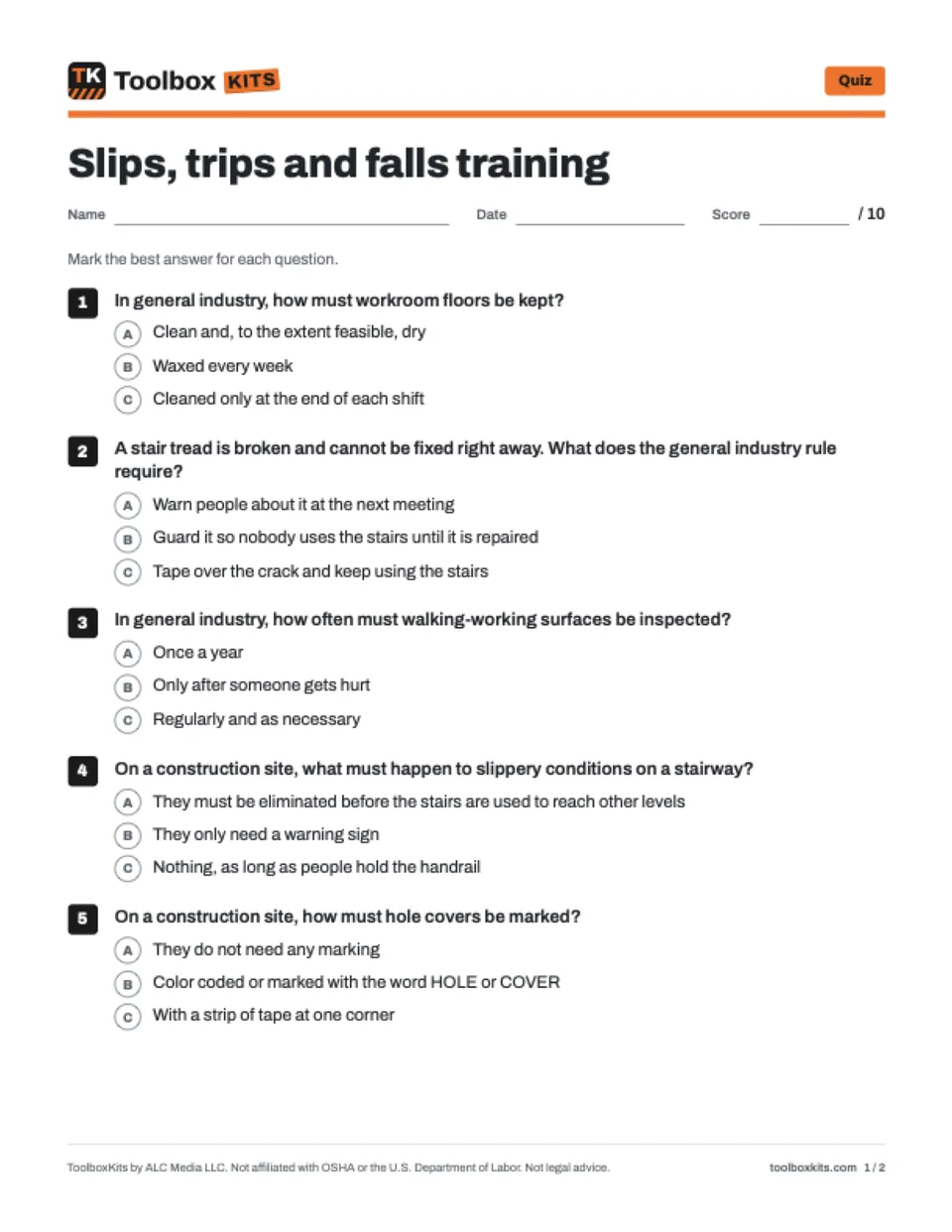 Quiz
- Answer key
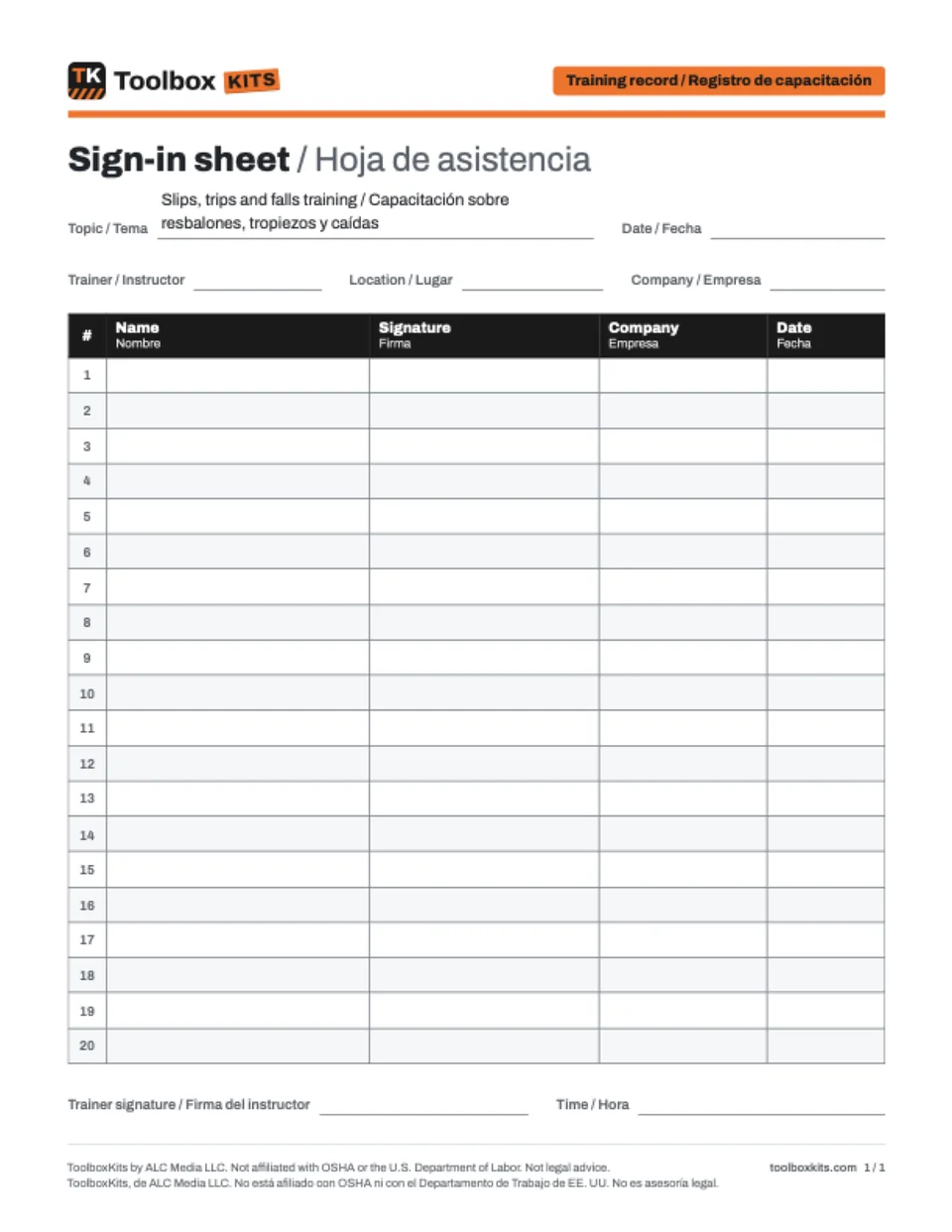 Sign-in sheet
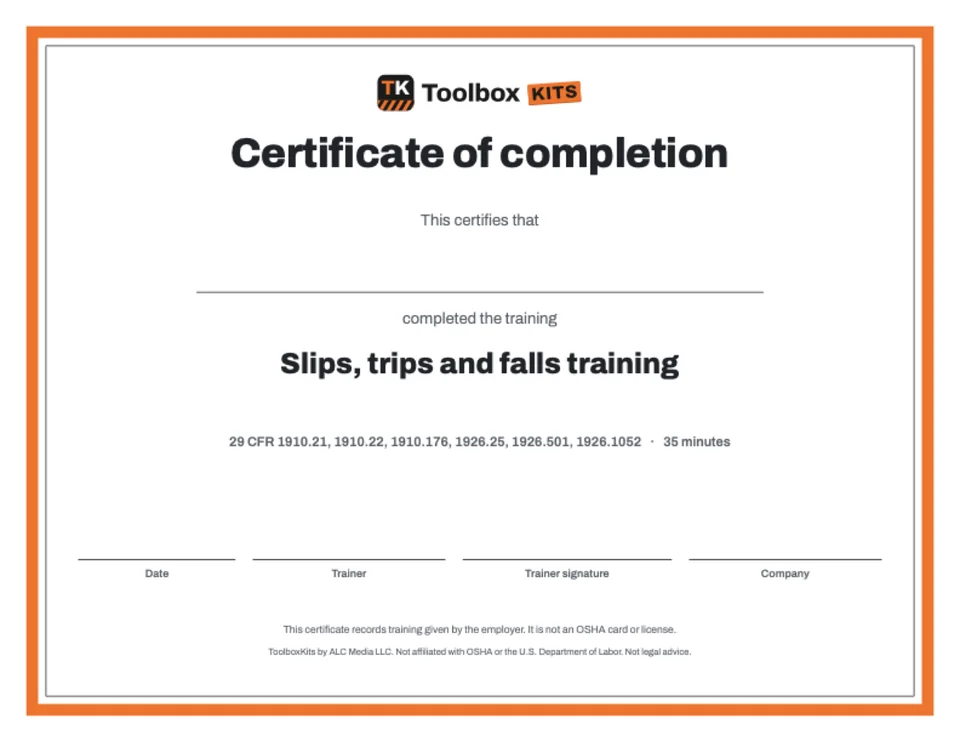 Certificate
- Crew handout
Try it
Try the quiz
Three questions from this topic. Pick an answer to see the right one and the OSHA paragraph.
Question 1 of 3
You find a spill that you cannot clean up right away. What should you do?
The rule
What OSHA requires
Plain-language summary. Each line links to the exact paragraph of the regulation.
In general industry, all places of employment, passageways, storerooms, service rooms and walking-working surfaces must be kept clean, orderly and sanitary.
“All places of employment, passageways, storerooms, service rooms, and walking-working surfaces are kept in a clean, orderly, and sanitary condition.”
Workroom floors must be kept clean and, to the extent feasible, dry. Where wet processes are used, drainage must be maintained and dry standing places, such as false floors, platforms and mats, provided to the extent feasible.
“The floor of each workroom is maintained in a clean and, to the extent feasible, in a dry condition.”
Walking-working surfaces must be kept free of hazards such as sharp or protruding objects, loose boards, corrosion, leaks, spills, snow and ice.
“Walking-working surfaces are maintained free of hazards such as sharp or protruding objects, loose boards, corrosion, leaks, spills, snow, and ice.”
Walking-working surfaces must be inspected regularly and as necessary, and kept in a safe condition.
“Walking-working surfaces are inspected, regularly and as necessary, and maintained in a safe condition”
Hazardous conditions must be corrected or repaired before the surface is used again. If that cannot be done immediately, the hazard must be guarded to keep employees off the surface until it is corrected or repaired.
“If the correction or repair cannot be made immediately, the hazard must be guarded to prevent employees from using the walking-working surface until the hazard is corrected or repaired”
During construction, alteration or repairs, form and scrap lumber with protruding nails and all other debris must be kept cleared from work areas, passageways and stairs.
“form and scrap lumber with protruding nails, and all other debris, shall be kept cleared from work areas, passageways, and stairs”
On construction sites, working spaces, walkways and similar locations must be kept clear of cords so they do not create a hazard.
“Working spaces, walkways, and similar locations shall be kept clear of cords so as not to create a hazard to employees.”
On construction sites, each worker on a walking/working surface must be protected from tripping in or stepping into or through holes, including skylights, by covers.
“Each employee on a walking/working surface shall be protected from tripping in or stepping into or through holes (including skylights) by covers.”
On construction sites, slippery conditions on stairways must be eliminated before the stairways are used to reach other levels.
“Slippery conditions on stairways shall be eliminated before the stairways are used to reach other levels.”
Construction areas, ramps, runways, corridors, offices, shops and storage areas must be lighted to at least the minimum levels in the standard's table while any work is in progress.
“shall be lighted to not less than the minimum illumination intensities listed in Table D-3 while any work is in progress”
Common questions
Questions people ask
Is there a printable slips, trips and falls toolbox talk?
Yes. This slips, trips and falls talk is free to download as a printable PDF in English and Spanish. It includes a sign-in table so you can record who attended.
What are common slip, trip and fall hazards?
Slip hazards include wet, oily or icy surfaces, loose mats and freshly waxed floors. Trip hazards include cords, hoses, scrap, open holes, uneven ground and clutter in walkways. On construction sites, scrap lumber with protruding nails and all other debris must be kept cleared from work areas, passageways and stairs.
What should a winter slips, trips and falls safety talk cover?
Cover snow and ice on parking areas, walkways, steps and trailer stairs, plus wet floors at entrances. In general industry, walking-working surfaces must be kept free of hazards such as spills, snow and ice. Clear and treat paths before the shift, wear footwear with good tread, and keep your hands out of your pockets so you can catch yourself.
What OSHA rules apply to slips, trips and falls?
OSHA has no single standard called slips, trips and falls, but several rules cover these hazards. In general industry, walking-working surfaces must be kept clean, orderly and free of hazards such as spills, snow and ice (29 CFR 1910.22(a)). In construction, debris must be kept cleared from work areas, passageways and stairs (29 CFR 1926.25(a)). In general industry, a hazard that cannot be corrected right away must be guarded until it is repaired.
Can I use this as a slips, trips and falls safety moment or safety meeting topic?
Yes. For a quick safety moment, ask the opening question and have everyone point out one hazard to fix before work starts. For a full safety meeting, read the whole talk, run the scenario and finish with the quiz.
Free to share
Use this talk for free
You can print, share and adapt this talk at no cost under the Creative Commons BY-NC-SA 4.0 license. Please credit ToolboxKits with a link.