

Free 5-minute toolbox talkPPEEnglish and Spanish
Hand safety toolbox talk
A crushed finger, a deep cut or a chemical burn can keep you off work and change how you live at home. What OSHA requires: Glove selection must be based on an evaluation of how the hand protection performs for the tasks to be done, the conditions present, the duration of use and the hazards identified (29 CFR 1910.138(b)).
A free hand safety toolbox talk you can read in about five minutes, or use as a quick hand safety moment. It covers pinch points, cuts, the right gloves and what OSHA requires for hand protection.
Updated October 31, 2026 · Based on 29 CFR 1910.138, 29 CFR 1910.132
Read it out loud
Free 5-minute toolbox talk
Read it out loud to your crew. It takes about 5 minutes.
Start with a question
Hold up your hands. Which task today could cost you a finger?
Why it matters
Your hands are in almost every task, so they are close to the hazard all day long. A crushed finger, a deep cut or a chemical burn can keep you off work and change how you live at home. Hand injuries can be prevented when we plan where our hands go, use the right tool and wear the right glove.
Key points
Know what can hurt your hands
Hands get cut, punctured, crushed, scraped and burned, and some chemicals soak right through the skin. Under OSHA's general industry hand protection rule, employers must select and require appropriate hand protection when hands are exposed to hazards.
More
The rule lists hazards such as harmful substances absorbed through the skin, severe cuts, severe abrasions, punctures, chemical burns, thermal burns and harmful temperature extremes.
Match the glove to the job
No single glove protects against everything. A cut-resistant glove may not stop a solvent, and a thin chemical glove will not stop a blade. Employers must base glove selection on the task, the conditions, how long the gloves are worn and the hazards identified.
More
Gloves should fit snugly, since a loose glove can catch or slip.
Stay out of pinch points
A pinch point is anywhere two objects come together: doors, tailgates, chains and sprockets, rollers, and loads being set down. Keep your hands where you can see them and pull them back before the load lands. Use push sticks, tag lines or a tool instead of your fingers to guide or steady material.
Keep guards on and lock out first
Machines must have guarding that protects the operator and others from hazards such as the point of operation, ingoing nip points and rotating parts. Never remove or bypass a guard. Shut down and lock out the machine before you clear a jam or reach in.
More
Loose gloves, rings and sleeves can get caught in spinning parts like drill chucks, so keep them clear.
Use the right tool in good shape
Damaged tools can cause hand injuries: a cracked handle, a mushroomed chisel head or a dull blade that needs extra force. Employers are responsible for the safe condition of tools used on the job, including tools workers supply themselves.
More
Inspect tools before use, take bad ones out of service and always cut away from your body. Pick tools that fit your hand, and report tingling or numbness after using vibrating tools.
Check your gloves every time
Before each use, look for holes, cuts, worn spots, stiffness or swelling, and replace gloves that are damaged. Defective or damaged PPE must not be used. Report every hand injury, even a small cut, so it gets cleaned and treated.
Scenario
Picture this: the crew is setting a precast step with a skid steer. As the load comes down, a worker reaches under it to nudge a wood block into place. The operator cannot see his hand from the seat. What should the crew do instead, and who should call stop?
Ask the crew
- Which task on this job puts our hands closest to a pinch point?
- Are the gloves we have right for the work we are doing this week?
- Which tools or guards here need repair or replacement?
- Who has a close call with their hands they are willing to share?
Takeaway
Plan where your hands will go, use the right tool and the right glove, and never put a hand where you cannot see it or pull it back.
Trainer: ______________________ Date: ____________
Credit: ToolboxKits, https://toolboxkits.com/topics/hand-safety/ (CC BY-NC-SA 4.0)
The poster is also inside the paid kits.
Audit-ready records in 60 seconds
Fill in your crew and download a filled sign-in sheet for this talk. Everything is made in your browser. Names are never uploaded or stored.
Start a sign-off
Crew scan a QR code on their own phones, type their name and sign with a finger. You see the names arrive and download the signed sheet. Free, no account.
Kits
Get the kit
No subscription needed. Buy only the kit you need.
Toolbox talk kit
$4.99
- 5-minute talk, English PDF
- 5-minute talk, Spanish PDF
- Editable mini-deck (English and Spanish)
- One-page crew handout (English and Spanish)
- Bilingual sign-in sheet
- 3-question quiz with answer key (English and Spanish)
- One-page bilingual poster
- Audit-ready records in 60 seconds: fill in your crew and get a sign-in sheet and a certificate for every worker
Training kit
$9
Editable PowerPoint, 38 slides
- Editable PowerPoint with trainer notes on every slide
- Trainer guide PDF with timing and discussion tips
- 10-question quiz and answer key
- Sign-in sheet and certificate of completion with fillable fields
- One-page crew handout
- Full Spanish version of everything
- One-page bilingual poster
- Audit-ready records in 60 seconds: fill in your crew and get a sign-in sheet and a certificate for every worker
- Instant download
- Secure checkout by Stripe
- 30-day refund, no questions
Need many topics? All Access gives you every kit for $99 a year.
Inside the kit
See what is in the kit
What is in the kit
 Editable PowerPoint
- Trainer guide
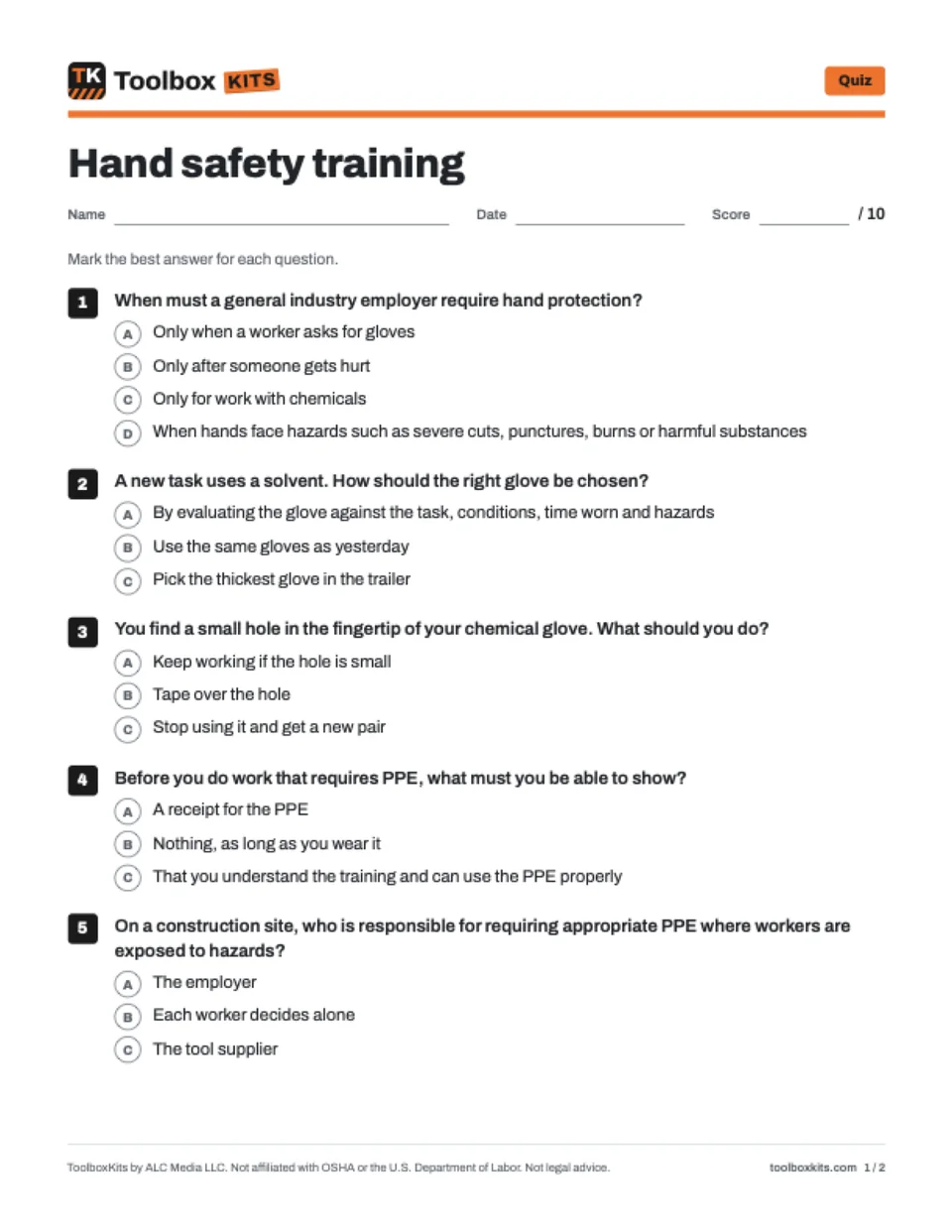 Quiz
- Answer key
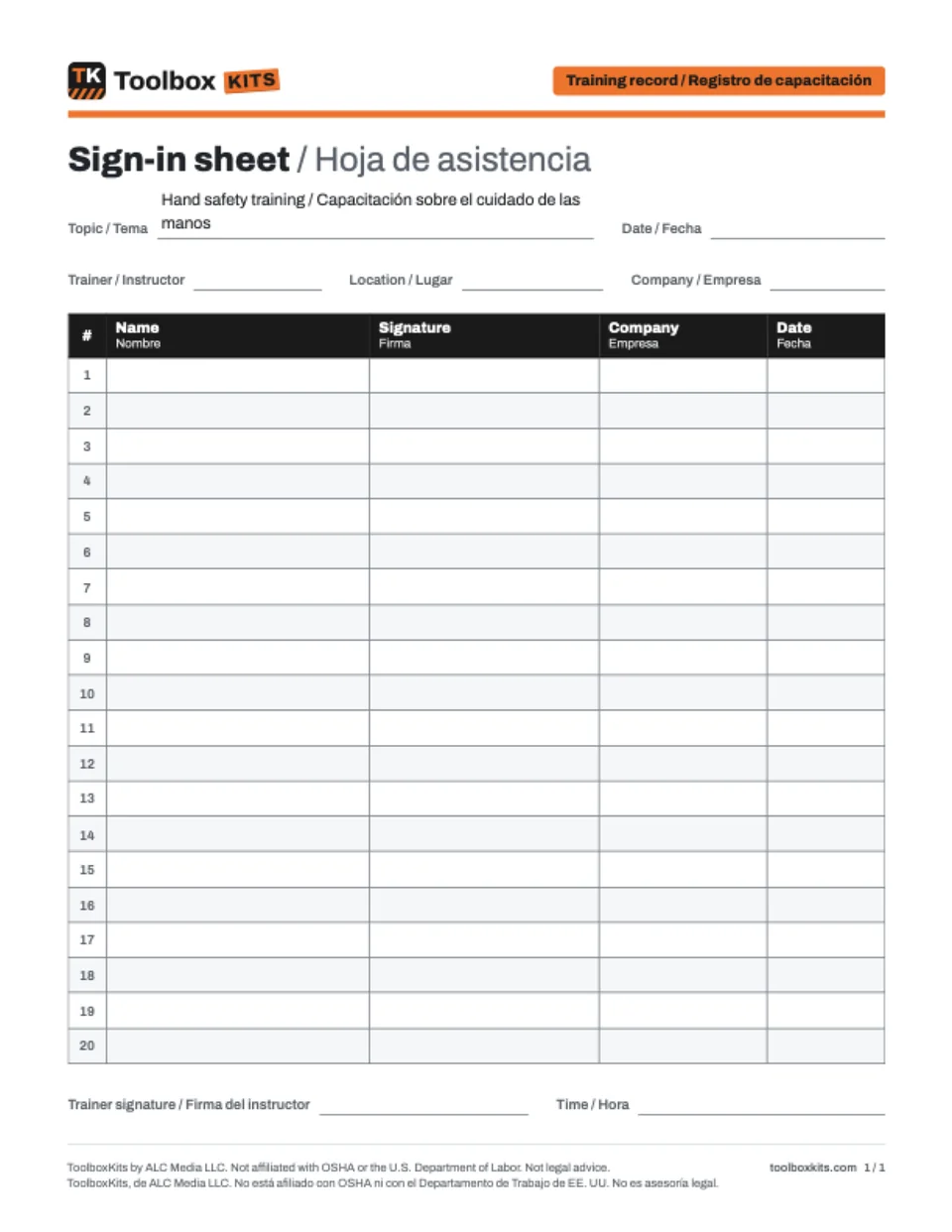 Sign-in sheet
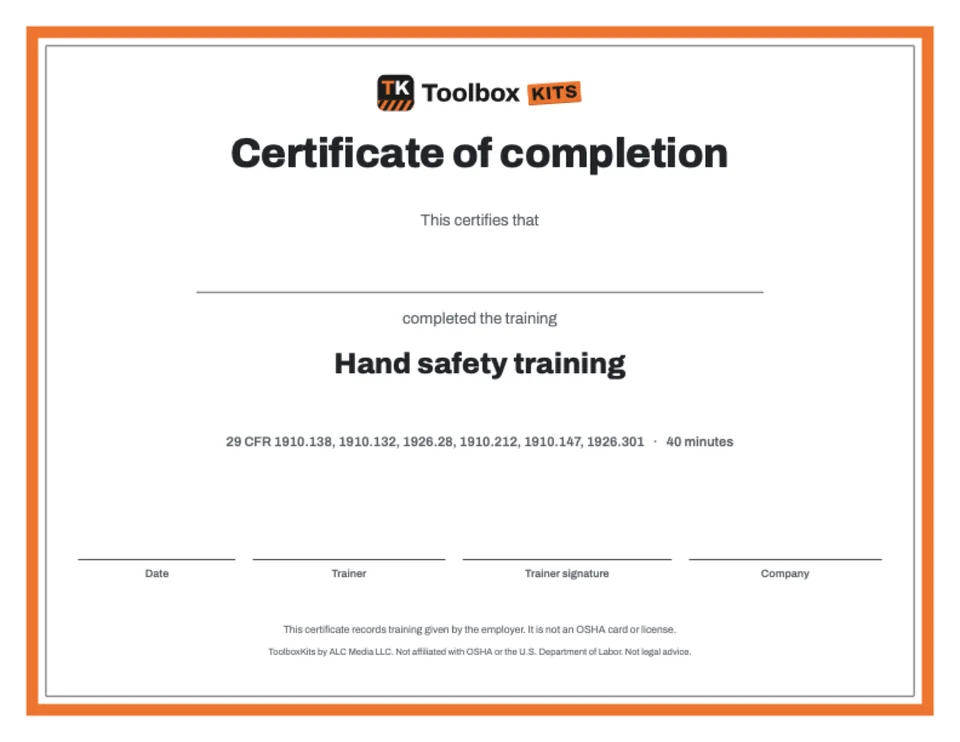 Certificate
- Crew handout
Try it
Try the quiz
Three questions from this topic. Pick an answer to see the right one and the OSHA paragraph.
Question 1 of 3
Under OSHA's hand protection rule, what must glove selection be based on?
The rule
What OSHA requires
Plain-language summary. Each line links to the exact paragraph of the regulation.
In general industry, employers must select and require employees to use appropriate hand protection when their hands are exposed to hazards such as skin absorption of harmful substances, severe cuts or lacerations, severe abrasions, punctures, chemical burns, thermal burns and harmful temperature extremes.
“Employers shall select and require employees to use appropriate hand protection when employees' hands are exposed to hazards”
Glove selection must be based on an evaluation of how the hand protection performs for the tasks to be done, the conditions present, the duration of use and the hazards identified.
“Employers shall base the selection of the appropriate hand protection on an evaluation of the performance characteristics of the hand protection relative to the task(s) to be performed, conditions present, duration of use, and the hazards and potential hazards identified.”
Employers must assess the workplace for hazards that call for PPE. If hazards are present or likely, they must select PPE that protects each affected employee, communicate the selection to each one and select PPE that properly fits.
Defective or damaged PPE, including damaged gloves, must not be used.
“Defective or damaged personal protective equipment shall not be used.”
Each employee who must use PPE must be trained on when it is necessary, what is necessary, how to put it on, take it off, adjust and wear it, its limitations, and its proper care, maintenance, useful life and disposal.
Before doing work that requires PPE, each affected employee must show they understand the training and can use the PPE properly.
“Each affected employee shall demonstrate an understanding of the training specified in paragraph (f)(1) of this section, and the ability to use PPE properly, before being allowed to perform work requiring the use of PPE.”
PPE used to comply with OSHA's general industry rules must be provided by the employer at no cost to employees, except as provided in paragraphs (h)(2) through (h)(6).
“the protective equipment, including personal protective equipment (PPE), used to comply with this part, shall be provided by the employer at no cost to employees.”
Machines must have one or more methods of guarding to protect the operator and other employees in the machine area from hazards such as the point of operation, ingoing nip points, rotating parts, flying chips and sparks.
“One or more methods of machine guarding shall be provided to protect the operator and other employees in the machine area from hazards such as those created by point of operation, ingoing nip points, rotating parts, flying chips and sparks.”
Employers are responsible for the safe condition of tools and equipment used by employees, including tools and equipment that employees supply themselves.
“Each employer shall be responsible for the safe condition of tools and equipment used by employees, including tools and equipment which may be furnished by employees.”
Construction has no separate hand protection standard. There, the employer is responsible for requiring appropriate PPE in all operations where employees are exposed to hazardous conditions.
“The employer is responsible for requiring the wearing of appropriate personal protective equipment in all operations where there is an exposure to hazardous conditions”
Who must be trained
In general industry, each employee who is required to use PPE, including hand protection, must be trained (29 CFR 1910.132(f)(1)); 1910.132(g) applies this training rule to hand protection under 1910.138. Each one must show they understand the training and can use the PPE properly before doing work that requires it (29 CFR 1910.132(f)(2)).
When to retrain
The employer must retrain any trained employee it has reason to believe no longer has the required understanding or skill, for example when changes in the workplace or in the types of PPE make earlier training obsolete, or when the employee's knowledge or use of assigned PPE shows they have not retained it (29 CFR 1910.132(f)(3)).

Common questions
Questions people ask
Is there a free hand safety toolbox talk PDF?
Yes. This hand safety talk is free to print in English and Spanish, with a sign-in table for your crew. You can share it under a Creative Commons BY-NC-SA license with a credit link back to this page.
What does OSHA require for hand protection?
In general industry, employers must select and require appropriate hand protection when workers' hands are exposed to hazards such as harmful substances absorbed through the skin, severe cuts, severe abrasions, punctures, chemical or thermal burns and harmful temperature extremes (29 CFR 1910.138(a)). The glove must be chosen based on the task, the conditions, how long it is worn and the hazards identified (29 CFR 1910.138(b)). In construction, the general PPE duty in 29 CFR 1926.28(a) applies.
How do you prevent hand and finger injuries?
Plan the task so your hands stay out of pinch points and away from blades and moving parts. Use push sticks, tag lines or tools instead of fingers, keep guards in place and lock out machines before reaching in. Wear the glove made for the hazard, and replace it when it is damaged.
What topics should a hand safety toolbox talk cover?
Cover the hand hazards on your job, such as pinch points, cuts, punctures, crush points, chemicals and burns. Then cover choosing the right glove, keeping tools in good shape, machine guards and lockout, and reporting every hand injury. A short hand safety moment each week keeps hand and finger safety in the conversation.
Is there a hand safety PowerPoint for training?
Yes. The paid training kit for this topic is an editable PowerPoint presentation in English and Spanish, with trainer notes, a quiz and a sign-in sheet. If the kit is not ready to buy yet, you can request it from this page.
Free to share
Use this talk for free
You can print, share and adapt this talk at no cost under the Creative Commons BY-NC-SA 4.0 license. Please credit ToolboxKits with a link.