

Free 5-minute toolbox talkPPEEnglish and Spanish
PPE toolbox talk: personal protective equipment
It is the last line of defense, after the hazard has been removed or controlled as far as possible. What OSHA requires: The employer must assess the workplace for hazards that call for PPE, select PPE that protects against them, tell each affected employee what was selected, and select PPE that properly fits each affected employee (29 CFR 1910.132(d)(1)).
This free personal protective equipment (PPE) toolbox talk takes about five minutes to read to your crew. It covers when PPE is needed, how to choose, fit and care for it, and the OSHA rules behind it, for construction and general industry.
Updated October 31, 2026 · Based on 29 CFR 1910.132, 29 CFR 1926.95
Read it out loud
Free 5-minute toolbox talk
Read it out loud to your crew. It takes about 5 minutes.
Start with a question
What piece of PPE are you most tempted to skip on a hot day, and why?
Why it matters
PPE is the gear you wear to protect your body from a hazard, like hard hats, safety glasses, hearing protection, gloves and safety-toe boots. It is the last line of defense, after the hazard has been removed or controlled as far as possible. PPE only works when it is the right gear for the hazard, fits, is in good shape and is actually worn. Gear left in the truck protects nobody.
Key points
The hazard decides the PPE
Under the general industry rule, the employer must assess the workplace for hazards that call for PPE. The employer then selects PPE that protects against those hazards and properly fits each worker, and tells each affected worker what was selected.
More
On construction sites, the employer must require appropriate PPE wherever workers are exposed to hazardous conditions. Your part is to wear what the task calls for, every time the hazard is there.
29 CFR 1910.132(d)(1) · 29 CFR 1926.28(a)
Match the gear to the hazard
Each piece of PPE is matched to a hazard: hard hats for falling objects, safety glasses or goggles for flying chips and dust, hearing protection for noise, the right gloves for cuts, burns or chemicals, and safety-toe boots for crushed toes.
More
When flying objects are a hazard, eye protection must have side protection, and clip-on or slide-on side shields that meet the rule are acceptable. Regular prescription glasses are not safety glasses.
It has to fit you
PPE must be selected so it properly fits each worker who uses it. Glasses that slide down your nose, gloves that are too big, or a hard hat that falls off when you bend over cannot protect you the way they should. If your gear does not fit, say so and get the right size.
Check it before you use it
Look over your PPE before each use. Check hard hats for cracks and a worn suspension, glasses for cracks and deep scratches, gloves for holes and tears, and boots for damage. Defective or damaged PPE must not be used, so turn it in and get a replacement.
Know how to wear it and what it cannot do
Under the general industry rule, workers who are required to use PPE must be trained in when it is needed, which PPE is needed, how to put it on, take it off, adjust and wear it, its limits, and how to care for it.
More
Every piece of PPE has limits: regular safety glasses do not seal out a chemical splash, and leather gloves are not chemical gloves. Clean your gear, store it away from sun, heat and dirt, and replace it when it wears out.
Your employer pays for required PPE
PPE used to comply with the OSHA construction rules must be provided by the employer at no cost to you. The general industry rules say the same. Both rules list a few exceptions, so ask your supervisor if you are not sure what is covered.
More
If your PPE wears out or gets damaged on the job, report it and ask for a replacement.
29 CFR 1926.95(d)(1) · 29 CFR 1910.132(h)(1)
Scenario
Picture this: a new helper is cutting pavers with a cut-off saw on a hot afternoon. His safety glasses keep fogging, so he pushes them up onto his hard hat. His gloves are too big, so he takes them off and keeps cutting. The job is almost done and nobody says anything. What should the crew do right now, and what should change before tomorrow?
Ask the crew
- What PPE does each of your tasks today call for, and why?
- Which piece of your PPE does not fit right or gets in your way, and what would fix it?
- What do you check on your PPE before you put it on?
- Where do we keep spare PPE, and who do you ask when yours is damaged?
Takeaway
Wear the right PPE for the hazard, make sure it fits and is in good shape, and speak up when it is not.
Trainer: ______________________ Date: ____________
Credit: ToolboxKits, https://toolboxkits.com/topics/ppe/ (CC BY-NC-SA 4.0)
The poster is also inside the paid kits.
Audit-ready records in 60 seconds
Fill in your crew and download a filled sign-in sheet for this talk. Everything is made in your browser. Names are never uploaded or stored.
Start a sign-off
Crew scan a QR code on their own phones, type their name and sign with a finger. You see the names arrive and download the signed sheet. Free, no account.
Kits
Get the kit
No subscription needed. Buy only the kit you need.
Toolbox talk kit
$4.99
- 5-minute talk, English PDF
- 5-minute talk, Spanish PDF
- Editable mini-deck (English and Spanish)
- One-page crew handout (English and Spanish)
- Bilingual sign-in sheet
- 3-question quiz with answer key (English and Spanish)
- One-page bilingual poster
- Audit-ready records in 60 seconds: fill in your crew and get a sign-in sheet and a certificate for every worker
Training kit
$9
Editable PowerPoint, 39 slides
- Editable PowerPoint with trainer notes on every slide
- Trainer guide PDF with timing and discussion tips
- 10-question quiz and answer key
- Sign-in sheet and certificate of completion with fillable fields
- One-page crew handout
- Full Spanish version of everything
- One-page bilingual poster
- Audit-ready records in 60 seconds: fill in your crew and get a sign-in sheet and a certificate for every worker
- Instant download
- Secure checkout by Stripe
- 30-day refund, no questions
Need many topics? All Access gives you every kit for $99 a year.
Inside the kit
See what is in the kit
What is in the kit
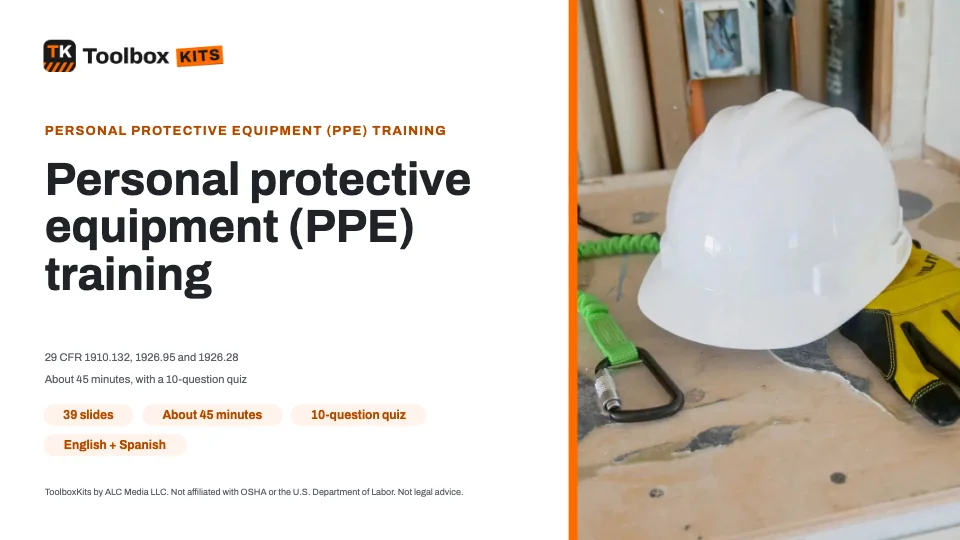 Editable PowerPoint
- Trainer guide
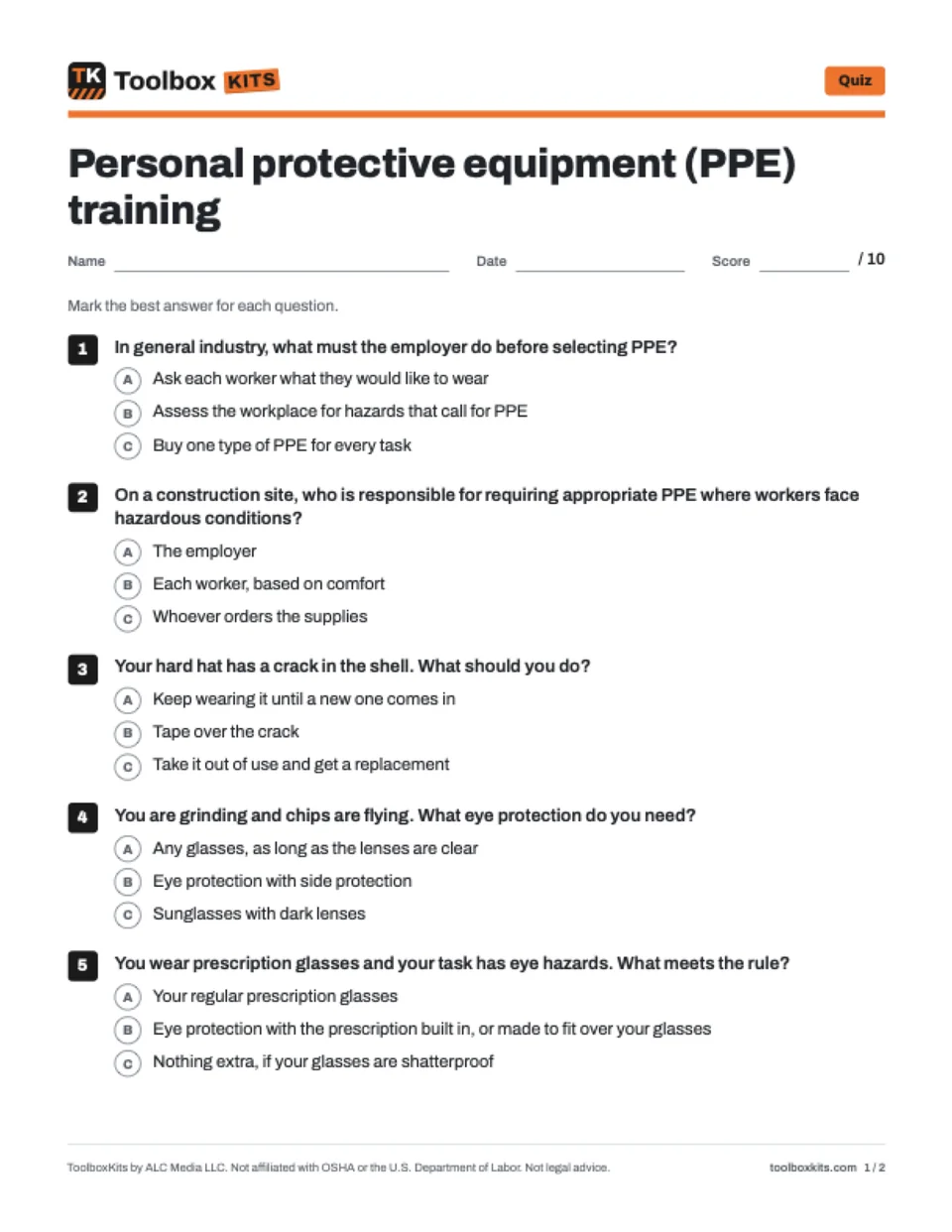 Quiz
- Answer key
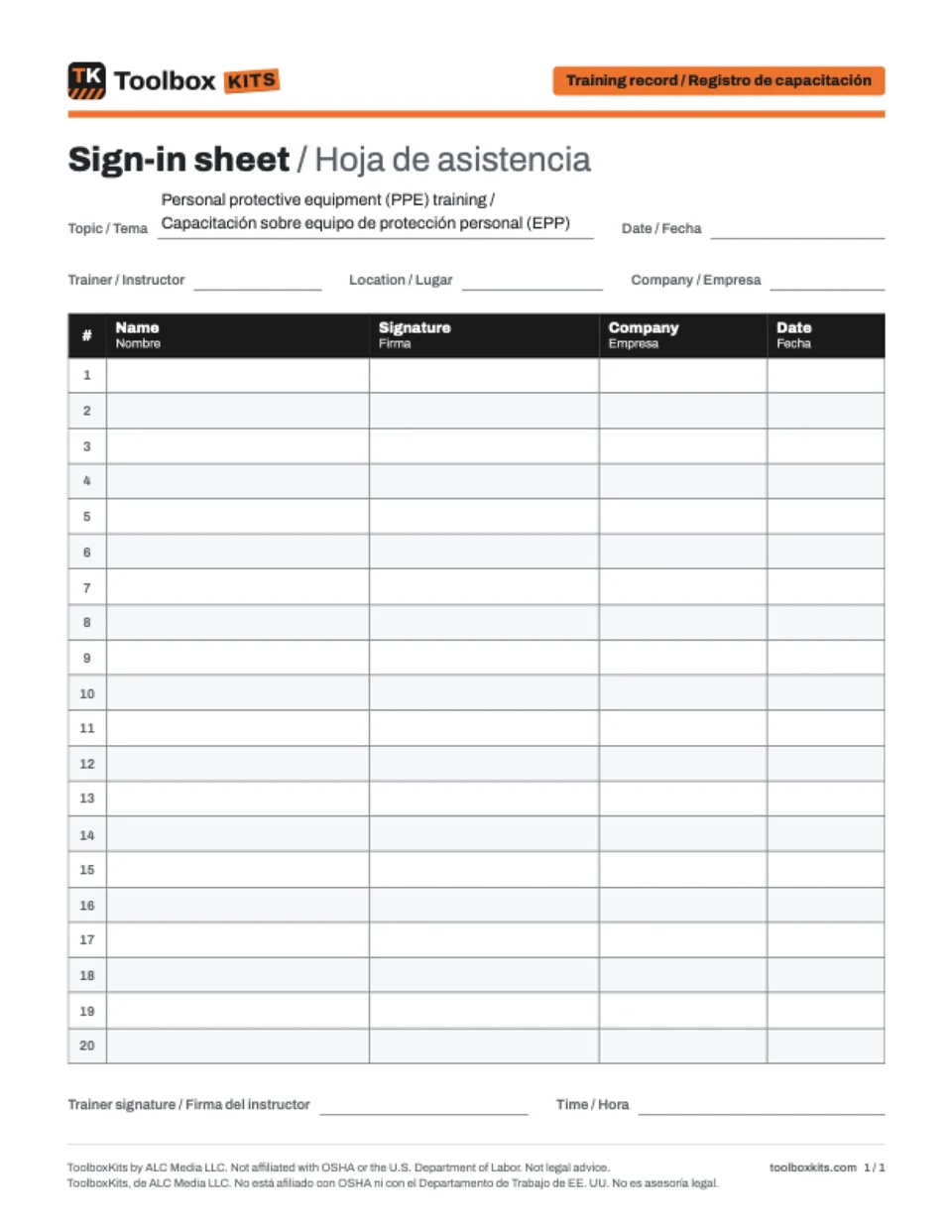 Sign-in sheet
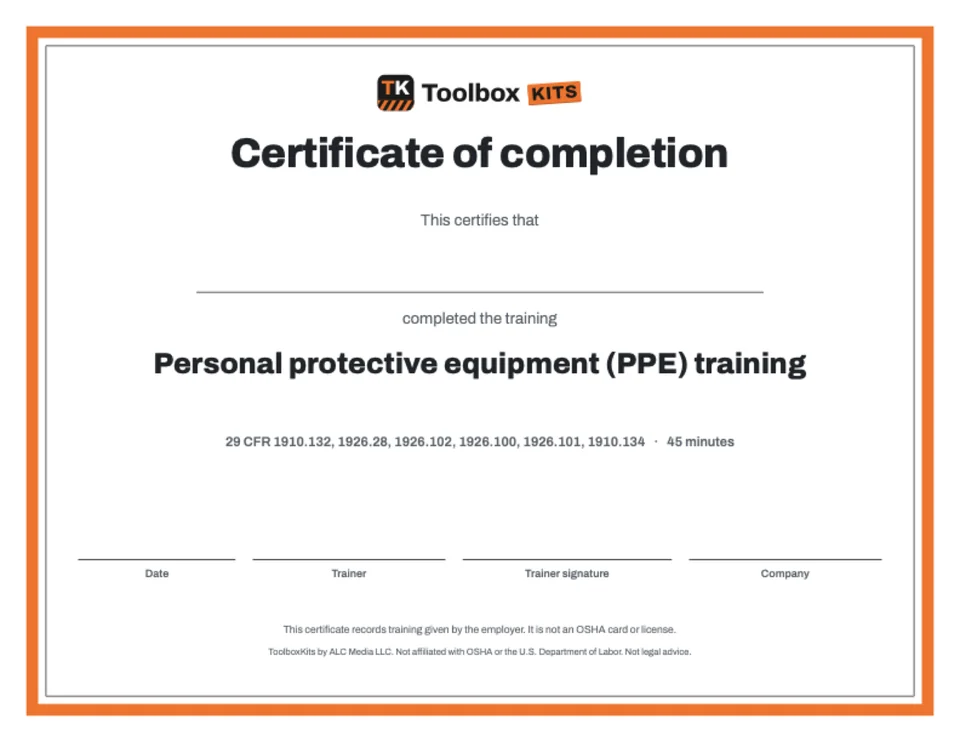 Certificate
- Crew handout
Try it
Try the quiz
Three questions from this topic. Pick an answer to see the right one and the OSHA paragraph.
Question 1 of 3
Who decides what PPE a task needs?
The rule
What OSHA requires
Plain-language summary. Each line links to the exact paragraph of the regulation.
The employer must assess the workplace for hazards that call for PPE, select PPE that protects against them, tell each affected employee what was selected, and select PPE that properly fits each affected employee.
“The employer shall assess the workplace to determine if hazards are present, or are likely to be present, which necessitate the use of personal protective equipment (PPE).”
The hazard assessment must be verified with a written certification that identifies the workplace evaluated, the person certifying it, the date of the assessment, and the document as a certification of hazard assessment.
“The employer shall verify that the required workplace hazard assessment has been performed through a written certification”
Defective or damaged PPE must not be used.
“Defective or damaged personal protective equipment shall not be used.”
Each employee who is required to use PPE must be trained to know when PPE is necessary, what PPE is necessary, how to put it on, take it off, adjust and wear it, its limitations, and its proper care, maintenance, useful life and disposal.
“The employer shall provide training to each employee who is required by this section to use PPE.”
Before doing work that requires PPE, each affected employee must show they understand the training and can use the PPE properly.
“Each affected employee shall demonstrate an understanding of the training specified in paragraph (f)(1) of this section, and the ability to use PPE properly, before being allowed to perform work requiring the use of PPE.”
In general industry, the hazard assessment and training rules apply only to the eye and face, head, foot, hand and personal fall protection standards (29 CFR 1910.133, 1910.135, 1910.136, 1910.138 and 1910.140). They do not apply to the respirator and electrical protective equipment standards (29 CFR 1910.134 and 1910.137), which have their own rules.
“Paragraphs (d) and (f) of this section apply only to §§ 1910.133, 1910.135, 1910.136, 1910.138, and 1910.140.”
On construction sites, the employer is responsible for requiring workers to wear appropriate PPE wherever they are exposed to hazardous conditions or the construction rules call for it.
“The employer is responsible for requiring the wearing of appropriate personal protective equipment in all operations where there is an exposure to hazardous conditions”
In construction, the employer must make sure all PPE is selected so it properly fits each affected employee.
“Is selected to ensure that it properly fits each affected employee.”
When flying objects are a hazard, eye protection must provide side protection. Detachable clip-on or slide-on side shields that meet the rule are acceptable.
“The employer shall ensure that each affected employee uses eye protection that provides side protection when there is a hazard from flying objects.”
PPE used to comply with the OSHA construction rules must be provided by the employer at no cost to employees, except for the limited items listed in the rule.
“shall be provided by the employer at no cost to employees”
Who must be trained
In general industry, each employee who is required by 29 CFR 1910.132 to use PPE must be trained (29 CFR 1910.132(f)(1)), and must show they understand the training and can use the PPE properly before doing work that requires it (29 CFR 1910.132(f)(2)).
When to retrain
The employer must retrain any trained employee it has reason to believe lacks the needed understanding and skill, including when changes in the workplace or in the types of PPE make earlier training obsolete, or when gaps in the employee's knowledge or use of PPE show the training was not retained (29 CFR 1910.132(f)(3)).

Common questions
Questions people ask
What should a PPE toolbox talk cover?
Cover the same topics the OSHA general industry PPE rule requires in training: when PPE is necessary, what PPE is necessary, how to put it on, take it off, adjust and wear it, its limitations, and its care, maintenance, useful life and disposal. Then tie each point to the tasks your crew is doing this week. A short talk is a good refresher, not a full training program.
Is there a free PPE toolbox talk PDF?
Yes. You can download this PPE toolbox talk as a free printable PDF in English and Spanish. It includes a sign-in table so you can record who attended.
Is there a PPE training PowerPoint?
Yes. The PPE training kit includes PowerPoint slides in English and Spanish with trainer notes, a trainer guide, a quiz with an answer key, a handout and a sign-in sheet. Use it when you need a longer training session than a toolbox talk.
Does OSHA require a written PPE program?
The general industry PPE rule requires a written certification that the workplace hazard assessment was done, naming the workplace evaluated, the person certifying it and the date. Respirators are different: where they are needed or required, the employer must have a written respiratory protection program with worksite-specific procedures (29 CFR 1910.134(c)(1)). Keep both where supervisors and crews can find them.
Can I use this for a PPE safety moment or tailgate meeting?
Yes. For a quick safety moment, ask the opening question and cover one key point, like checking PPE before use. For a tailgate meeting, read the full talk, run the scenario and finish with the quiz.
Free to share
Use this talk for free
You can print, share and adapt this talk at no cost under the Creative Commons BY-NC-SA 4.0 license. Please credit ToolboxKits with a link.