

Free 5-minute toolbox talkPPEEnglish and Spanish
Hard hat safety toolbox talk: head protection
A tool, a bolt or a piece of debris falling from above can seriously hurt your head in a moment. What OSHA requires: In general industry, the employer must make sure each affected employee wears a protective helmet when working in areas where there is a potential for injury to the head from falling objects (29 CFR 1910.135(a)(1)).
A free head protection toolbox talk for crews who work under falling objects or near electrical hazards. Read it aloud in about five minutes before work starts.
Updated October 29, 2026 · Based on 29 CFR 1910.135, 29 CFR 1926.100, 29 CFR 1910.132
Read it out loud
Free 5-minute toolbox talk
Read it out loud to your crew. It takes about 5 minutes.
Start with a question
Is your hard hat on your head right now, and when did you last look at the shell and the suspension?
Why it matters
A tool, a bolt or a piece of debris falling from above can seriously hurt your head in a moment. A hard hat is built to take that hit, but only if it is the right type, fits you and is in good shape. A cracked shell or a worn suspension will not protect you.
Key points
Wear it where something can hit your head
In general industry, the employer must make sure each affected employee wears a protective helmet when working where there is a potential for head injury from falling objects.
More
In construction, employees working where there is a possible danger of head injury from impact, falling or flying objects, or electrical shock and burns must be protected by protective helmets. Put it on before you enter the area, and keep it on.
29 CFR 1926.100(a) · 29 CFR 1910.135(a)(1)
Use the right hat for the hazard
1 standards, or the employer must show it is at least as effective. Check the label inside the shell. Near exposed electrical conductors, you need a helmet designed to reduce electrical shock hazard. A bump cap protects against bumps only. Do not use one where objects can fall.
29 CFR 1926.100(b)(1) · 29 CFR 1926.100(b)(1) and (b)(3) · 29 CFR 1910.135(a)(2)
Get a proper fit
The employer must select PPE that properly fits each affected employee. Adjust the headband so the hat sits level and does not slide when you bend. Wear the brim forward unless the hat is made to be worn another way. Do not put anything between your head and the suspension that changes the fit.
Inspect it before each use
Look for cracks, dents, chips, gouges, brittle or chalky spots and worn straps or suspension. Flex the shell gently. Check the date on the hat if there is one, and follow the manufacturer on how long it lasts. PPE must be maintained in a sanitary and reliable condition.
More
Replace a hard hat after a heavy hit, even if it looks fine.
Care for it and do not alter it
Clean the shell with mild soap and water. Store it away from direct sun, heat and chemicals, and do not leave it on a hot dashboard. Do not drill, paint or stick things on it unless the manufacturer says it is okay, because that can weaken the shell or hide damage.
More
Only use accessories made for your model.
Know what training covers
Employees who must use PPE must be trained to know when PPE is necessary, what PPE is necessary, how to put it on, adjust and wear it, its limitations and its care, maintenance, useful life and disposal. If you are not sure about any of these for your hard hat, ask.
Scenario
Picture this: A worker walks under a scaffold carrying a bucket and does not wear his hard hat because it is hot and uncomfortable. Another worker wears a bump cap he bought online. Above them, a coworker kicks a loose fitting off a platform edge. What should each person have done differently?
Ask the crew
- Where on this site could something fall on us, and where do we need a hard hat?
- What type and label is on the hard hat you are wearing today?
- What do you check on your hard hat before each shift?
- How do we handle someone who is not wearing head protection in a required area?
Takeaway
Wear the right hard hat, fit it well, check it before each use and replace it when it is damaged.
Trainer: ______________________ Date: ____________
Credit: ToolboxKits, https://toolboxkits.com/topics/head-protection/ (CC BY-NC-SA 4.0)
The poster is also inside the paid kits.
Audit-ready records in 60 seconds
Fill in your crew and download a filled sign-in sheet for this talk. Everything is made in your browser. Names are never uploaded or stored.
Start a sign-off
Crew scan a QR code on their own phones, type their name and sign with a finger. You see the names arrive and download the signed sheet. Free, no account.
Kits
Get the kit
No subscription needed. Buy only the kit you need.
Toolbox talk kit
$4.99
- 5-minute talk, English PDF
- 5-minute talk, Spanish PDF
- Editable mini-deck (English and Spanish)
- One-page crew handout (English and Spanish)
- Bilingual sign-in sheet
- 3-question quiz with answer key (English and Spanish)
- One-page bilingual poster
- Audit-ready records in 60 seconds: fill in your crew and get a sign-in sheet and a certificate for every worker
Training kit
$9
Editable PowerPoint, 29 slides
- Editable PowerPoint with trainer notes on every slide
- Trainer guide PDF with timing and discussion tips
- 10-question quiz and answer key
- Sign-in sheet and certificate of completion with fillable fields
- One-page crew handout
- Full Spanish version of everything
- One-page bilingual poster
- Audit-ready records in 60 seconds: fill in your crew and get a sign-in sheet and a certificate for every worker
- Instant download
- Secure checkout by Stripe
- 30-day refund, no questions
Need many topics? All Access gives you every kit for $99 a year.
Inside the kit
See what is in the kit
What is in the kit
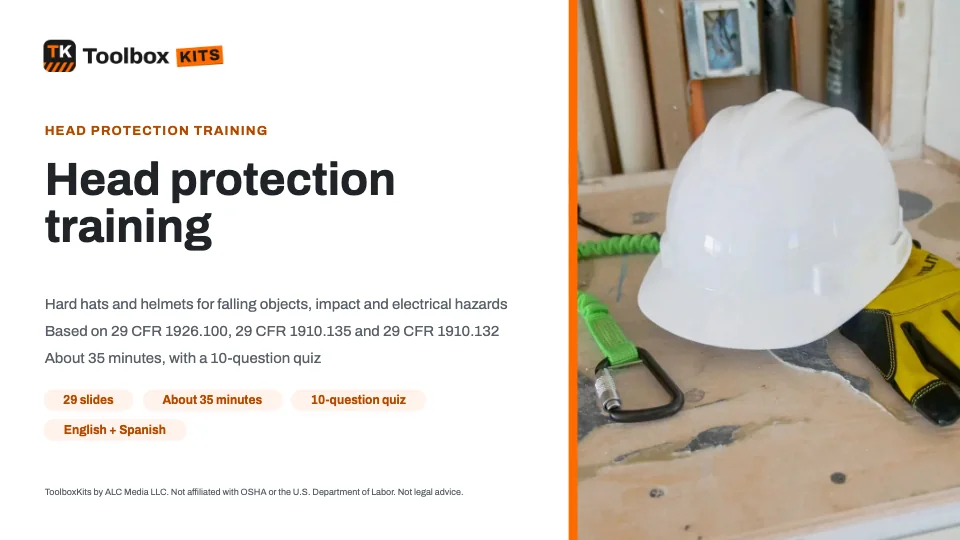 Editable PowerPoint
- Trainer guide
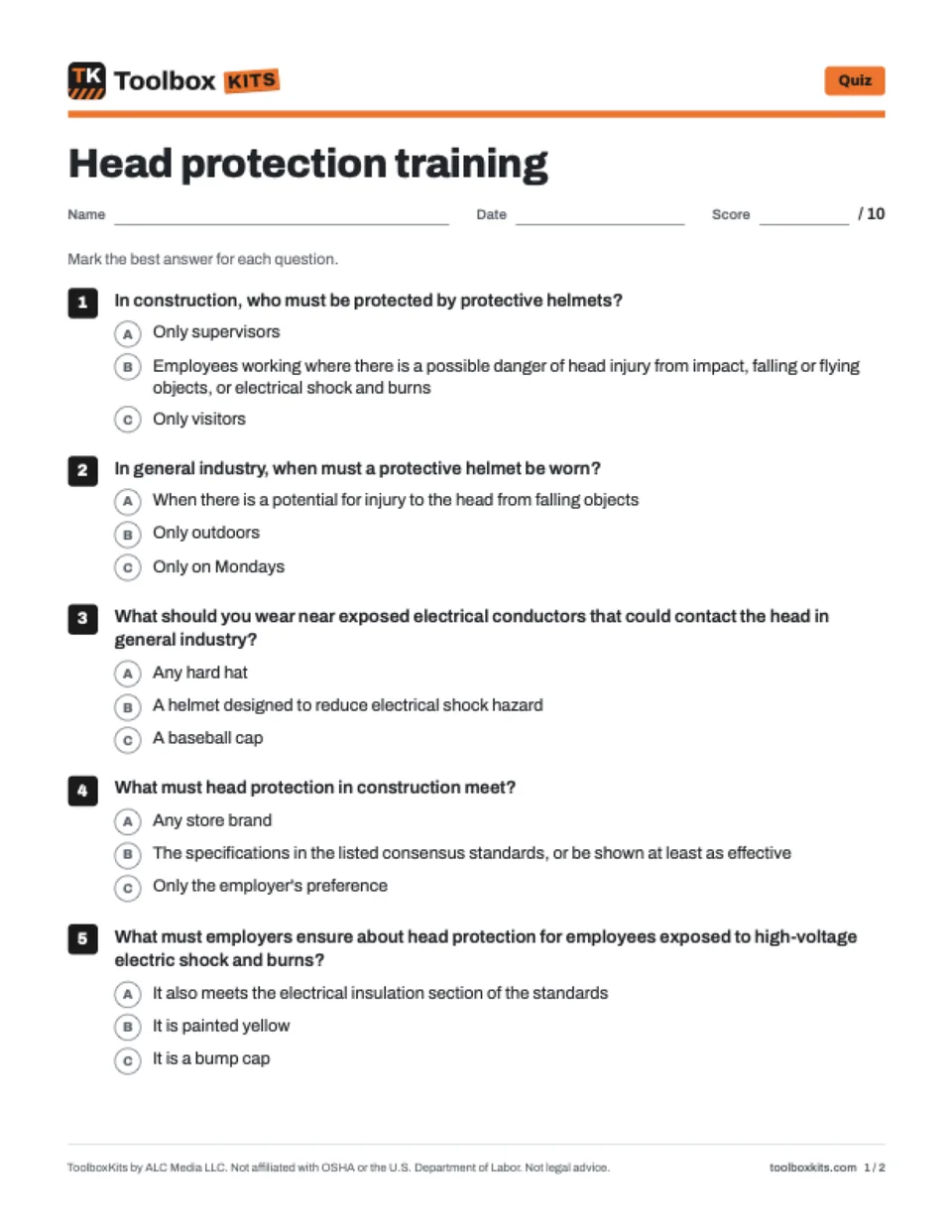 Quiz
- Answer key
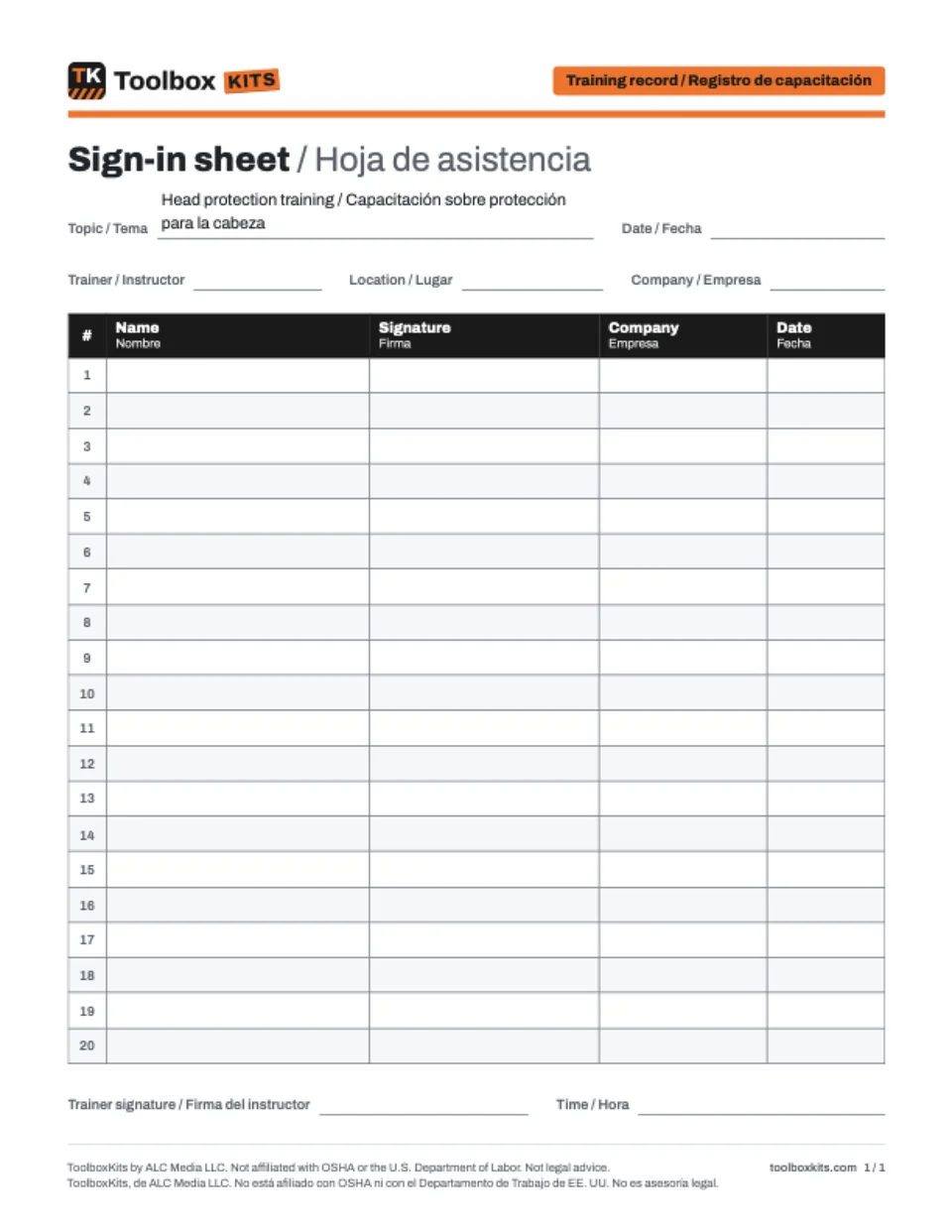 Sign-in sheet
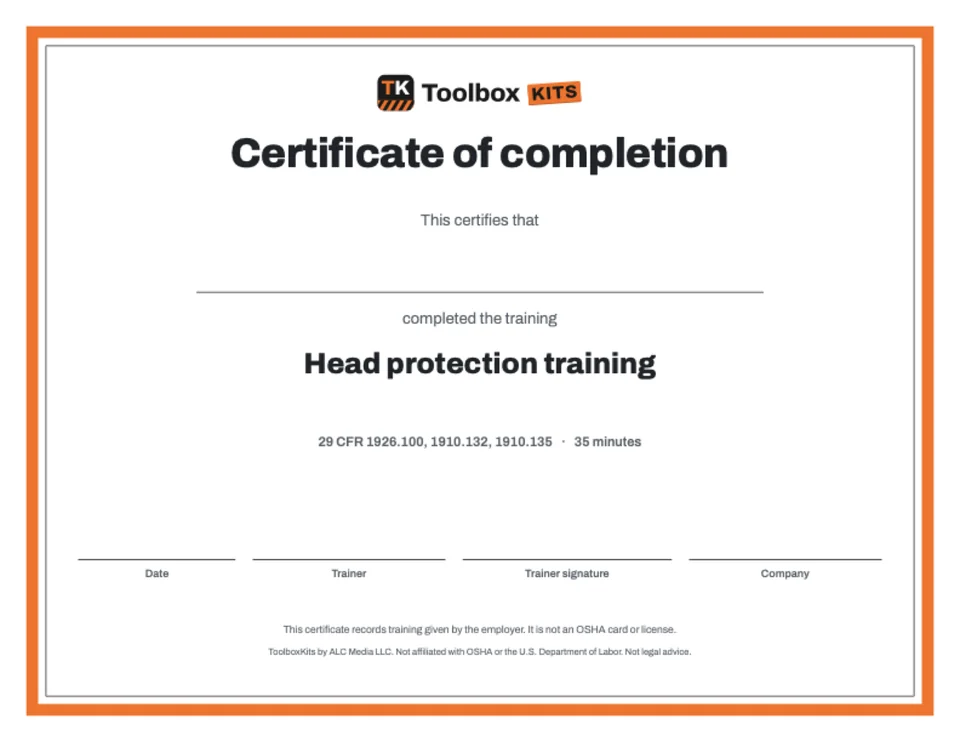 Certificate
- Crew handout
Try it
Try the quiz
Three questions from this topic. Pick an answer to see the right one and the OSHA paragraph.
Question 1 of 3
What must head protection in construction meet?
The rule
What OSHA requires
Plain-language summary. Each line links to the exact paragraph of the regulation.
In general industry, the employer must make sure each affected employee wears a protective helmet when working in areas where there is a potential for injury to the head from falling objects.
“The employer shall ensure that each affected employee wears a protective helmet when working in areas where there is a potential for injury to the head from falling objects.”
In general industry, a helmet designed to reduce electrical shock hazard must be worn when near exposed electrical conductors that could contact the head.
In construction, employees working where there is a possible danger of head injury from impact, falling or flying objects, or from electrical shock and burns must be protected by protective helmets.
“Employees working in areas where there is a possible danger of head injury from impact, or from falling or flying objects, or from electrical shock and burns, shall be protected by protective helmets.”
In construction, the employer must provide head protection that meets one of the listed ANSI Z89.1 consensus standards.
“The employer must provide each employee with head protection that meets the specifications contained in any of the following consensus standards:”
In construction, head protection for employees exposed to high-voltage electric shock and burns must also meet the electrical insulation section of those standards.
Head protection that the employer can show is at least as effective as one built to the listed standards is deemed to comply.
The employer must select PPE that properly fits each affected employee.
“Select PPE that properly fits each affected employee.”
PPE, including head protection, must be provided, used and maintained in a sanitary and reliable condition wherever it is necessary.
“shall be provided, used, and maintained in a sanitary and reliable condition”
The employer must train each employee who must use PPE to know when and what PPE is necessary, how to put it on, adjust and wear it, its limits, and its care, maintenance, useful life and disposal.
“The employer shall provide training to each employee who is required by this section to use PPE.”
Who must be trained
The employer must train each employee who is required to use PPE, including head protection (29 CFR 1910.132(f)(1)). Each employee must show understanding and the ability to use the PPE properly before doing work that requires it (29 CFR 1910.132(f)(2)).
When to retrain
The employer must retrain an employee who has not kept the needed understanding or skill, including when changes in the workplace or in the type of PPE make earlier training obsolete (29 CFR 1910.132(f)(3)).

Common questions
Questions people ask
Is there a printable hard hat toolbox talk?
Yes. This hard hat toolbox talk is free to print as a PDF in English and Spanish, with a sign-in table for your crew. Read it aloud in about five minutes, and keep the signed sheet with your safety records.
When must head protection be worn?
In general industry, a protective helmet must be worn where there is a potential for head injury from falling objects (29 CFR 1910.135(a)(1)). In construction, helmets are required where there is possible danger of head injury from impact, falling or flying objects, or from electrical shock and burns (29 CFR 1926.100(a)).
What standard must a hard hat meet?
Head protection must meet one of the listed ANSI Z89.1 standards, or the employer must show it is at least as effective as one built to those standards (29 CFR 1926.100(b)(1) and (b)(3), and 29 CFR 1910.135(b)(1) and (b)(2)). Check the label inside the shell for the ANSI marking and the type and class.
How long is a hard hat good for and how often should it be inspected?
The OSHA rules cited here do not set a replacement date. They require PPE to be maintained in a reliable condition, so check your hard hat before each use and follow the manufacturer's guidance for service life (29 CFR 1910.132(a)). Replace it if it is cracked, damaged or has taken a hard hit.
Is a bump cap the same as a hard hat?
No. A bump cap protects against bumping your head on fixed objects. Head protection used where objects can fall must meet one of the listed ANSI Z89.1 standards or be shown to be at least as effective (29 CFR 1926.100(b)(1) and (b)(3)). Check the label and ask your supervisor which one your job needs.
Free to share
Use this talk for free
You can print, share and adapt this talk at no cost under the Creative Commons BY-NC-SA 4.0 license. Please credit ToolboxKits with a link.