

Free 5-minute toolbox talkPPEEnglish and Spanish
Eye safety toolbox talk: eye and face protection
An eye injury can change your life in a second. What OSHA requires: The employer must make sure each affected employee uses appropriate eye or face protection when exposed to flying particles, molten metal, liquid chemicals, acids or caustic liquids, chemical gases or vapors, or potentially injurious light radiation (29 CFR 1910.133(a)(1)).
A free eye protection toolbox talk you can read to your crew in about five minutes, in English and Spanish. Use it as a safety glasses talk or a quick eye safety moment at the start of the shift.
Updated October 29, 2026 · Based on 29 CFR 1910.133, 29 CFR 1926.102, 29 CFR 1910.132
Read it out loud
Free 5-minute toolbox talk
Read it out loud to your crew. It takes about 5 minutes.
Start with a question
Who here has ever had something in their eye at work, even just a speck of dust?
Why it matters
An eye injury can change your life in a second. Flying chips, dust, chemical splashes and welding light are part of a lot of jobs. The right eye protection, worn the whole time you are exposed, keeps those hazards out of your eyes.
Key points
Know the hazards
Eye or face protection is required when you are exposed to flying particles, molten metal, liquid chemicals, acids or caustic liquids, chemical gases or vapors, or light radiation that can injure your eyes.
More
Grinding, cutting, chipping, sanding, spraying, pouring chemicals and welding all put you in that zone. If you are not sure what a task needs, ask before you start.
Side protection for flying objects
When there is a hazard from flying objects, your eye protection must have side protection. Clip-on or slide-on side shields are acceptable if they meet the requirements of the standard. Open sides leave a gap that chips and sparks can get through.
Match the protector to the job
Safety glasses guard against impact. Goggles fit tight around your eyes to keep out dust and splashes. A face shield protects your face and should be worn over safety glasses or goggles, not instead of them. For welding light, you must use filter lenses with a shade number that fits the work.
Prescription glasses and contacts
If you wear prescription glasses around eye hazards, you need eye protection with your prescription built in, or protection that fits over your glasses without pushing them out of place. Regular glasses are not safety glasses.
More
Contact lenses are not eye protection either, so wear the right safety eyewear over them.
Inspect it, clean it, replace it
Check and clean your eyewear before each use. Scratched or pitted lenses make it hard to see, and cracked lenses or broken frames can fail when you need them. Defective or damaged PPE must not be used, so get a replacement instead of making do.
Know where the eyewash is
Where anyone may be exposed to injurious corrosive materials, there must be facilities for quick flushing of the eyes and body within the work area. Know where yours is and keep the path to it clear. If dust or a chemical gets in your eye, do not rub it. Flush it and tell your supervisor.
Scenario
Picture this: A worker is cutting a steel bracket with an angle grinder. Their safety glasses kept fogging up, so they pushed them up on their head to see better. A spray of sparks and metal chips comes off the wheel toward their face. What could they have done about the fogging instead of taking the glasses off?
Ask the crew
- Which tasks here need safety glasses, and which need goggles or a face shield too?
- Where is the nearest eyewash, and could you find it with your eyes closed?
- What makes people take their eye protection off, and how can we fix that?
- Who wears prescription glasses or contacts, and do they have protection that works with them?
Takeaway
Match your eye protection to the hazard, and keep it on the whole time you are exposed.
Trainer: ______________________ Date: ____________
Credit: ToolboxKits, https://toolboxkits.com/topics/eye-protection/ (CC BY-NC-SA 4.0)
The poster is also inside the paid kits.
Audit-ready records in 60 seconds
Fill in your crew and download a filled sign-in sheet for this talk. Everything is made in your browser. Names are never uploaded or stored.
Start a sign-off
Crew scan a QR code on their own phones, type their name and sign with a finger. You see the names arrive and download the signed sheet. Free, no account.
Kits
Get the kit
No subscription needed. Buy only the kit you need.
Toolbox talk kit
$4.99
- 5-minute talk, English PDF
- 5-minute talk, Spanish PDF
- Editable mini-deck (English and Spanish)
- One-page crew handout (English and Spanish)
- Bilingual sign-in sheet
- 3-question quiz with answer key (English and Spanish)
- One-page bilingual poster
- Audit-ready records in 60 seconds: fill in your crew and get a sign-in sheet and a certificate for every worker
Training kit
$9
Editable PowerPoint, 37 slides
- Editable PowerPoint with trainer notes on every slide
- Trainer guide PDF with timing and discussion tips
- 10-question quiz and answer key
- Sign-in sheet and certificate of completion with fillable fields
- One-page crew handout
- Full Spanish version of everything
- One-page bilingual poster
- Audit-ready records in 60 seconds: fill in your crew and get a sign-in sheet and a certificate for every worker
- Instant download
- Secure checkout by Stripe
- 30-day refund, no questions
Need many topics? All Access gives you every kit for $99 a year.
Inside the kit
See what is in the kit
What is in the kit
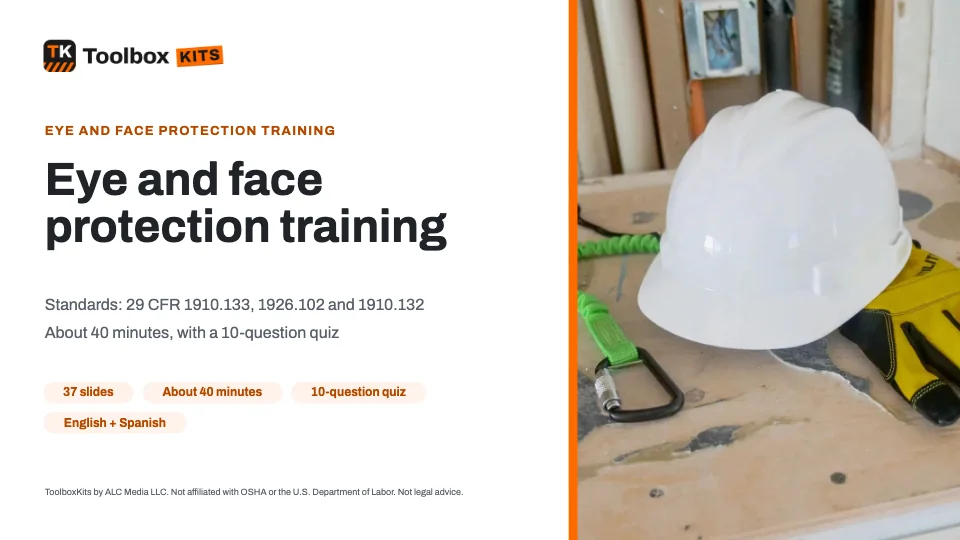 Editable PowerPoint
- Trainer guide
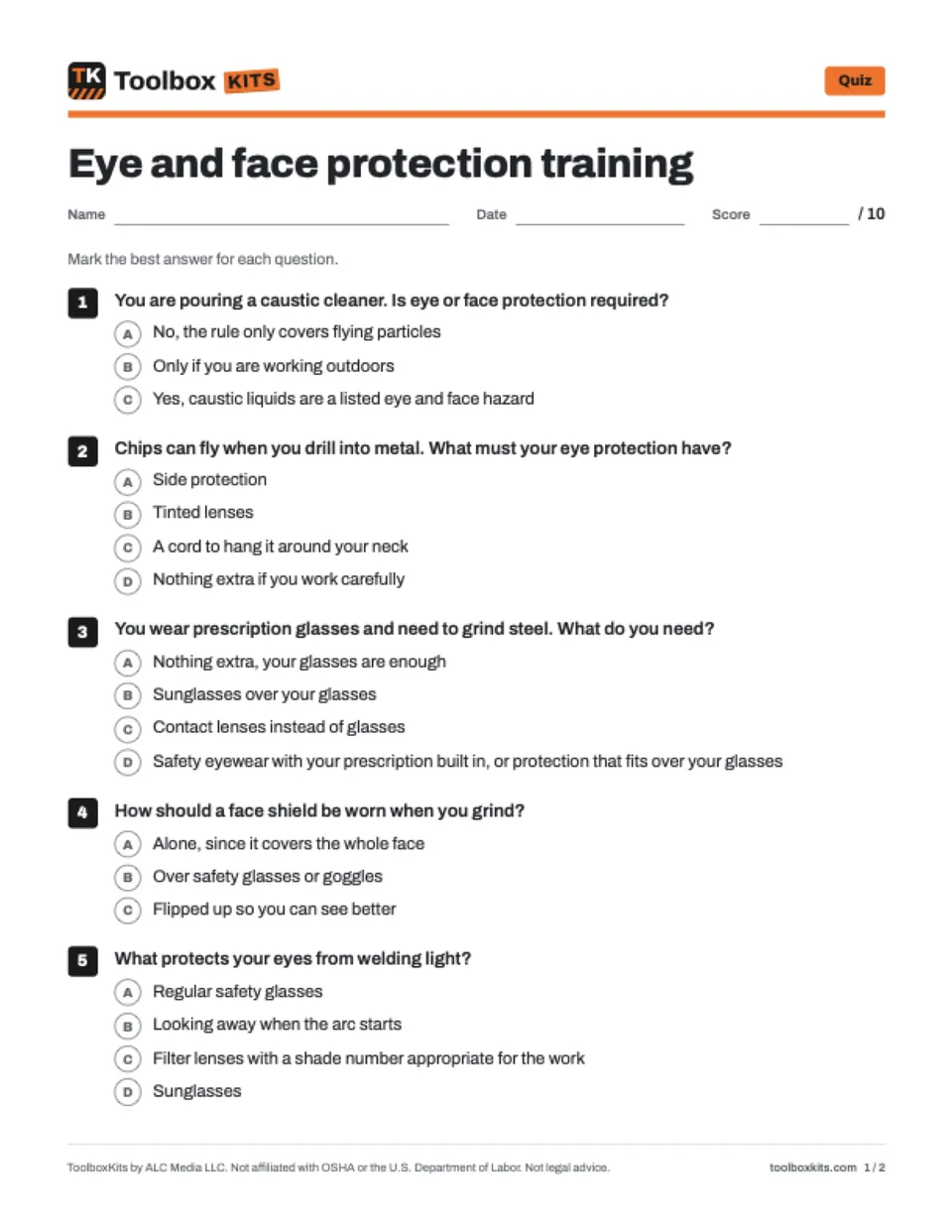 Quiz
- Answer key
 Sign-in sheet
 Certificate
- Crew handout
Try it
Try the quiz
Three questions from this topic. Pick an answer to see the right one and the OSHA paragraph.
Question 1 of 3
When must eye protection have side protection?
The rule
What OSHA requires
Plain-language summary. Each line links to the exact paragraph of the regulation.
The employer must make sure each affected employee uses appropriate eye or face protection when exposed to flying particles, molten metal, liquid chemicals, acids or caustic liquids, chemical gases or vapors, or potentially injurious light radiation.
“uses appropriate eye or face protection when exposed to eye or face hazards from flying particles, molten metal, liquid chemicals, acids or caustic liquids, chemical gases or vapors, or potentially injurious light radiation”
The construction standard has the same rule for construction work.
Eye protection must provide side protection when there is a hazard from flying objects. Detachable clip-on or slide-on side shields that meet the standard are acceptable.
“eye protection that provides side protection when there is a hazard from flying objects”
Workers who wear prescription lenses around eye hazards must wear eye protection with the prescription built in, or protection that can be worn over their glasses without disturbing them.
“wears eye protection that incorporates the prescription in its design, or wears eye protection that can be worn over the prescription lenses”
Eye and face protection must be distinctly marked to identify the manufacturer.
“Eye and face PPE shall be distinctly marked to facilitate identification of the manufacturer.”
For protection from injurious light radiation, such as welding light, workers must use filter lenses with a shade number appropriate for the work being done.
“filter lenses that have a shade number appropriate for the work being performed”
Eye and face protection devices must comply with one of the listed consensus standards: ANSI/ISEA Z87.1-2010, ANSI Z87.1-2003 or ANSI Z87.1-1989 (R-1998).
The employer must assess the workplace to determine if hazards are present, or likely to be present, that call for PPE.
“The employer shall assess the workplace to determine if hazards are present, or are likely to be present, which necessitate the use of personal protective equipment (PPE).”
Defective or damaged PPE must not be used.
“Defective or damaged personal protective equipment shall not be used.”
Where eyes or body may be exposed to injurious corrosive materials, facilities for quick drenching or flushing must be provided within the work area. Construction has the same rule in 29 CFR 1926.50(g).
“suitable facilities for quick drenching or flushing of the eyes and body shall be provided within the work area for immediate emergency use”
Who must be trained
In general industry, the employer must train each employee who is required to use eye or face protection. Training covers when it is needed, what kind is needed, how to put it on, take it off, adjust and wear it, its limits, and its care, maintenance, useful life and disposal. Each worker must show they understand the training and can use the protection properly before doing work that requires it. (29 CFR 1910.132(f)(1), (f)(2) and (g)) On construction sites, the employer must instruct each employee in recognizing and avoiding unsafe conditions. (29 CFR 1926.21(b)(2))
When to retrain
In general industry, the employer must retrain any trained worker it has reason to believe no longer has the understanding or skill to use eye protection properly. That includes when changes in the workplace or in the type of eye protection make earlier training obsolete, or when gaps in a worker's knowledge or use of it show the training did not stick. (29 CFR 1910.132(f)(3))

Common questions
Questions people ask
Is there an eye protection toolbox talk PDF I can print?
Yes. This talk is a free printable PDF in English and Spanish, with a sign-in sheet for your crew. It works as a five minute safety talk on eye protection or as a safety glasses toolbox talk. You can share it under a Creative Commons BY-NC-SA license with a credit link back to this page.
What does OSHA require for eye protection on the job?
Employers must make sure each affected worker uses appropriate eye or face protection when exposed to flying particles, molten metal, liquid chemicals, acids or caustic liquids, chemical gases or vapors, or injurious light radiation (29 CFR 1910.133(a)(1) and 1926.102(a)(1)). Eye protection must have side protection when there is a hazard from flying objects (29 CFR 1910.133(a)(2)). Devices must meet one of the ANSI Z87.1 consensus standards listed in 29 CFR 1910.133(b)(1).
What should you do after an eye injury at work?
For a chemical splash, flush the eye with clean water at the eyewash right away, keep flushing, and get medical care. For dust or a particle, do not rub the eye; try to flush it out and get help if it stays. For a blow to the eye, use a cold compress without pressing, and get it checked. For a cut or an object stuck in the eye, do not wash it or pull the object out, shield the eye and get emergency care.
What should a prescription safety glasses program cover?
Workers who wear prescription lenses around eye hazards need eye protection with the prescription built in, or protection that fits over their glasses without disturbing them (29 CFR 1910.133(a)(3)). The employer does not have to pay for non-specialty prescription safety eyewear if workers may wear it off the job site (29 CFR 1910.132(h)(2)). Write down who needs them, how to order them, and how damaged pairs get replaced.
Is there an eye safety PowerPoint presentation?
Yes. The ToolboxKits eye and face protection training kit includes a PowerPoint deck in English and Spanish with trainer notes, plus a quiz with an answer key, a handout and a sign-in sheet. It is built from the text of 29 CFR 1910.133 and 1926.102 and is not produced or endorsed by OSHA.
Free to share
Use this talk for free
You can print, share and adapt this talk at no cost under the Creative Commons BY-NC-SA 4.0 license. Please credit ToolboxKits with a link.