

Free 5-minute toolbox talkFalls and heightsEnglish and Spanish
Ladder safety toolbox talk
A ladder fall can start with one quick choice: grabbing the wrong ladder, skipping the setup, or reaching too far. What OSHA requires: When a portable ladder is used to reach an upper landing, the side rails must extend at least 3 feet above the landing (29 CFR 1926.1053(b)(1)).
This free ladder safety toolbox talk takes about five minutes to read to your crew. It walks through picking, inspecting, setting up and climbing a ladder, with the OSHA rules behind each point.
Updated October 31, 2026 · Based on 29 CFR 1926.1053, 29 CFR 1926.1060, 29 CFR 1910.23
Read it out loud
Free 5-minute toolbox talk
Read it out loud to your crew. It takes about 5 minutes.
Start with a question
Have you ever stood on the top of a stepladder because the right ladder was too far away?
Why it matters
We use ladders so often that it is easy to stop thinking about them. A ladder fall can start with one quick choice: grabbing the wrong ladder, skipping the setup, or reaching too far. Even a short fall can cause a serious injury.
Key points
Pick the right ladder for the job
Use a ladder tall enough to reach the work without standing on the top or overreaching. Check the label for its rated capacity, and remember that the load includes you, your tools and your materials. A ladder must not be loaded beyond its maximum intended load or the manufacturer's rated capacity.
More
If you or the ladder could contact exposed energized electrical equipment, the ladder must have nonconductive side rails, such as fiberglass.
29 CFR 1926.1053(b)(3) · 29 CFR 1926.1053(b)(12)
Inspect it before you climb
Check the ladder every time before you use it. Look for cracked, bent or split rails, broken or missing rungs or steps, loose parts, worn feet, and grease or mud.
More
A portable ladder with structural defects must be marked as defective or tagged "Do Not Use" and withdrawn from service until it is repaired.
Set it up on firm, level ground
Ladders must be used only on stable and level surfaces unless they are secured so they cannot be knocked out of place. Keep the area around the top and bottom clear.
More
In a doorway, aisle or driveway, secure the ladder or barricade traffic away from it, and never move or extend a ladder while someone is on it.
Get the angle and the height right
Set an extension ladder at a safe angle, not too steep and not too flat: with your toes against the ladder feet and your arms straight out, you should be able to grab a rung. When you use a portable ladder to reach an upper level, the side rails must extend at least 3 feet above the landing.
More
If the ladder is too short for that, the top must be secured to a rigid support that will not deflect, and a grasping device, such as a grab rail, must be provided to help you get on and off.
Face the ladder and keep a hand on it
Face the ladder when you go up or down, and use at least one hand to grip it while you climb. Do not carry anything that could throw off your balance. Use a tool belt, or raise tools and materials with a hand line.
Stepladders have their own rules
Open a stepladder all the way and lock the spreaders before you climb. Never use the top or the top step as a step. Do not climb the back cross-bracing unless the ladder has steps on both sides, and never lean a closed stepladder against a wall to climb it.
Scenario
Picture this: a painter is finishing a ceiling and the last spot is just out of reach. The taller ladder is on the other side of the building, so he steps onto the top cap of his stepladder to get the last few inches. His helper is holding a bucket and is not watching. What should he have done, and what would you say if you saw it?
Ask the crew
- Which ladders on this job are the right height for the work we are doing this week?
- What would make you take a ladder out of service?
- Where on this site is it hard to set a ladder on firm, level ground, and how should we handle it?
- How will you get your tools and materials up without carrying them in your hands?
Takeaway
Pick the right ladder, check it, set it up right, and keep a hand on it every time you climb.
Trainer: ______________________ Date: ____________
Credit: ToolboxKits, https://toolboxkits.com/topics/ladder-safety/ (CC BY-NC-SA 4.0)
The poster is also inside the paid kits.
Audit-ready records in 60 seconds
Fill in your crew and download a filled sign-in sheet for this talk. Everything is made in your browser. Names are never uploaded or stored.
Start a sign-off
Crew scan a QR code on their own phones, type their name and sign with a finger. You see the names arrive and download the signed sheet. Free, no account.
Kits
Get the kit
No subscription needed. Buy only the kit you need.
Toolbox talk kit
$4.99
- 5-minute talk, English PDF
- 5-minute talk, Spanish PDF
- Editable mini-deck (English and Spanish)
- One-page crew handout (English and Spanish)
- Bilingual sign-in sheet
- 3-question quiz with answer key (English and Spanish)
- One-page bilingual poster
- Audit-ready records in 60 seconds: fill in your crew and get a sign-in sheet and a certificate for every worker
Training kit
$9
Editable PowerPoint, 37 slides
- Editable PowerPoint with trainer notes on every slide
- Trainer guide PDF with timing and discussion tips
- 10-question quiz and answer key
- Sign-in sheet and certificate of completion with fillable fields
- One-page crew handout
- Full Spanish version of everything
- One-page bilingual poster
- Audit-ready records in 60 seconds: fill in your crew and get a sign-in sheet and a certificate for every worker
- Instant download
- Secure checkout by Stripe
- 30-day refund, no questions
Need many topics? All Access gives you every kit for $99 a year.
Inside the kit
See what is in the kit
What is in the kit
 Editable PowerPoint
- Trainer guide
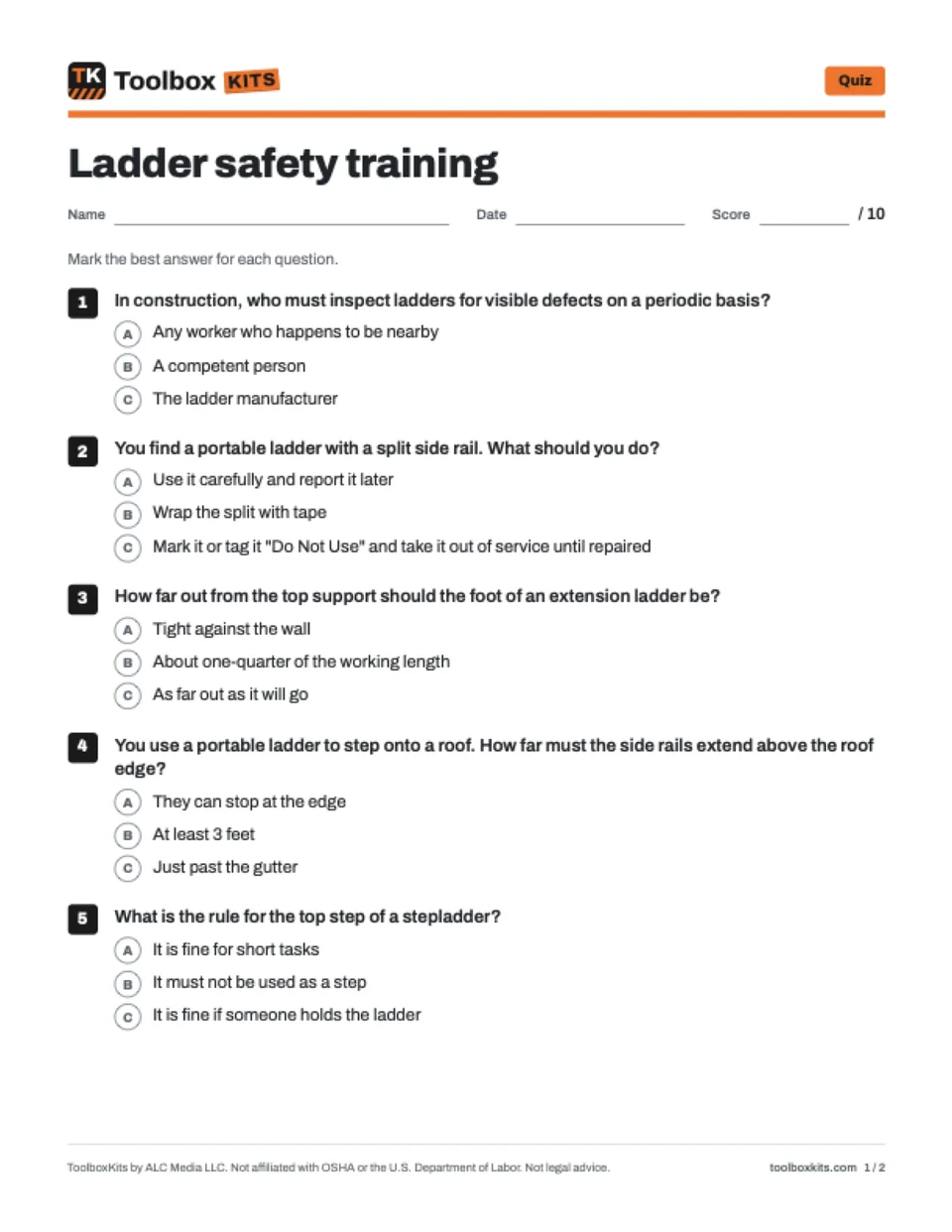 Quiz
- Answer key
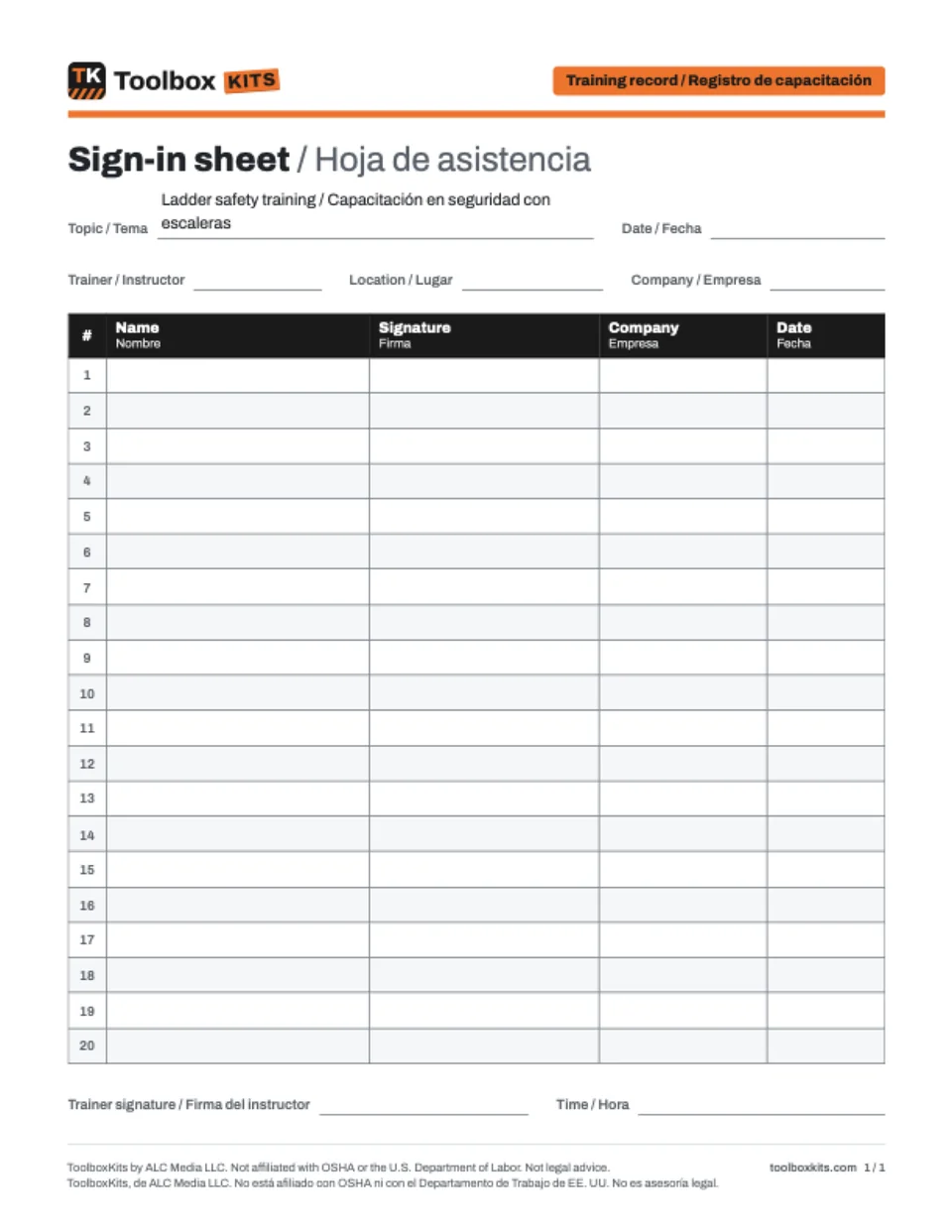 Sign-in sheet
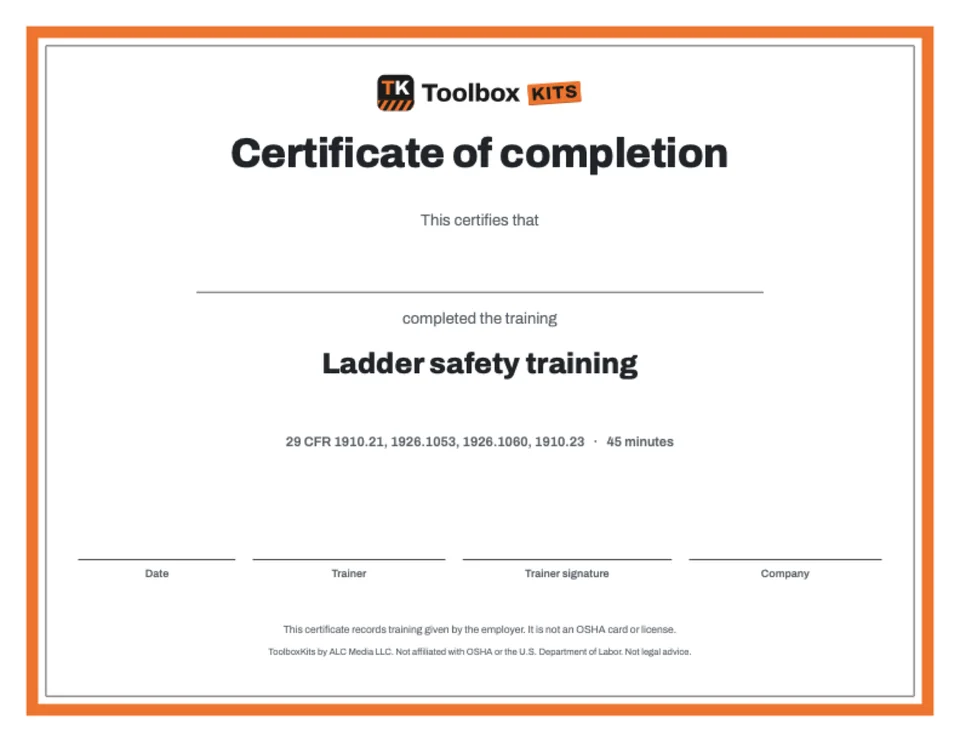 Certificate
- Crew handout
Try it
Try the quiz
Three questions from this topic. Pick an answer to see the right one and the OSHA paragraph.
Question 1 of 3
When you use a portable ladder to reach a roof or other upper landing, how far must the side rails extend above it?
The rule
What OSHA requires
Plain-language summary. Each line links to the exact paragraph of the regulation.
When a portable ladder is used to reach an upper landing, the side rails must extend at least 3 feet above the landing. If that is not possible because of the ladder's length, the top must be secured to a rigid support and a grasping device, such as a grab rail, provided.
“the ladder side rails shall extend at least 3 feet (.9 m) above the upper landing surface to which the ladder is used to gain access”
Ladders must not be loaded beyond the maximum intended load they were built for or beyond the manufacturer's rated capacity.
“Ladders shall not be loaded beyond the maximum intended load for which they were built, nor beyond their manufacturer's rated capacity.”
A non-self-supporting ladder, like an extension ladder, must be set so the horizontal distance from the top support to the foot is about one-quarter of the ladder's working length.
“the horizontal distance from the top support to the foot of the ladder is approximately one-quarter of the working length of the ladder”
Ladders must be used only on stable and level surfaces unless they are secured to prevent accidental displacement.
“Ladders shall be used only on stable and level surfaces unless secured to prevent accidental displacement.”
Ladders must have nonconductive side rails if the worker or the ladder could contact exposed energized electrical equipment, except in certain power line and high-voltage work covered by 29 CFR 1926.955(b) and (c).
“Ladders shall have nonconductive siderails if they are used where the employee or the ladder could contact exposed energized electrical equipment”
The top or top step of a stepladder must not be used as a step.
“The top or top step of a stepladder shall not be used as a step.”
In construction, a competent person must inspect ladders for visible defects on a periodic basis and after any occurrence that could affect their safe use.
“Ladders shall be inspected by a competent person for visible defects on a periodic basis and after any occurrence that could affect their safe use.”
In general industry, ladders must be inspected before first use in each work shift, and more often as necessary, for visible defects that could cause injury.
“Ladders are inspected before initial use in each work shift, and more frequently as necessary, to identify any visible defects that could cause employee injury”
Portable ladders with structural defects, such as broken or missing rungs or split rails, must be marked as defective or tagged "Do Not Use" and withdrawn from service until repaired.
“shall either be immediately marked in a manner that readily identifies them as defective, or be tagged with “Do Not Use” or similar language, and shall be withdrawn from service until repaired”
Each worker must use at least one hand to grasp the ladder when going up or down it.
“Each employee shall use at least one hand to grasp the ladder when progressing up and/or down the ladder.”
Who must be trained
In construction, the employer must provide a training program for each employee using ladders and stairways, as necessary, and make sure each employee has been trained by a competent person (29 CFR 1926.1060(a) and (a)(1)). In general industry, each employee must be trained in the proper care, inspection, storage and use of the equipment covered by the walking-working surfaces rules, which include ladders, before using it (29 CFR 1910.30(b)(1)).
When to retrain
In construction, retraining must be provided for each employee as necessary so the employee keeps the understanding and knowledge from the training (29 CFR 1926.1060(b)). In general industry, retrain when changes in the workplace or equipment make earlier training obsolete or inadequate, or when an employee no longer has the needed understanding or skill (29 CFR 1910.30(c)).

Common questions
Questions people ask
Is there a printable ladder safety toolbox talk?
Yes. This ladder safety toolbox talk is free to download as a printable PDF in English and Spanish. It includes a sign-in table so you can record who attended.
Is there a ladder safety PowerPoint for training?
Yes. The ladder safety training kit includes PowerPoint slides in English and Spanish with trainer notes, a trainer guide, a quiz with an answer key, a handout and a sign-in sheet. The free talk on this page works without slides for a quick meeting.
What does OSHA require for ladder safety training?
In construction, each employee who uses ladders must be trained by a competent person, as applicable, in the nature of fall hazards in the work area, the proper construction, use, placement and care in handling of ladders, the maximum intended load-carrying capacities of the ladders used, and the standards in the stairways and ladders subpart. Retraining must be provided as necessary so workers keep that knowledge (29 CFR 1926.1060(b)). A short toolbox talk is a good refresher, not a full training program.
Can I use this as a ladder safety moment or tailgate meeting?
Yes. For a quick ladder safety moment, ask the opening question and cover one key point, such as inspecting the ladder before you climb. For a tailgate meeting, read the whole talk, walk through the scenario and finish with the quiz.
What should a portable ladder safety toolbox talk cover?
Cover choosing the right ladder, inspecting it, setting it up on stable ground at the right angle, and climbing it safely. Also cover what to do with a damaged ladder. A portable ladder with structural defects, such as broken rungs or split rails, must be marked as defective or tagged "Do Not Use" and withdrawn from service until it is repaired.
Free to share
Use this talk for free
You can print, share and adapt this talk at no cost under the Creative Commons BY-NC-SA 4.0 license. Please credit ToolboxKits with a link.