

Free 5-minute toolbox talkBehavior and attitudeEnglish and Spanish
Pinch points toolbox talk
It happens in a split second, and a caught hand can be crushed before you can pull it back. What OSHA requires: OSHA has no specific standard for pinch points; the general duty to train still applies (29 CFR 1926.21(b)(2)).
A free pinch points toolbox talk you can read to your crew in about five minutes, or use as a short pinch point safety talk. It covers how to spot pinch points on machines, equipment and loads, how to keep your hands and body out of them, and the OSHA rules that apply.
Updated October 29, 2026 · Based on 29 CFR 1910.212, 29 CFR 1926.21
Read it out loud
Free 5-minute toolbox talk
Read it out loud to your crew. It takes about 5 minutes.
Start with a question
What is the closest spot to you right now where a finger or hand could get caught between two things?
Why it matters
A pinch point is any spot where part of your body can get caught between a moving part and something solid, or between two moving parts. They are everywhere on the job: gears, rollers, belts, doors, tailgates, chains, loads being set down and machines that swing. It happens in a split second, and a caught hand can be crushed before you can pull it back.
Key points
Spot the pinch points first
Before you start a task, look for anything that moves, closes, rolls, swings or turns, and anything that moves toward a fixed object. Common ones are rollers and belts, chains and sprockets, doors and hinges, tailgates and dump bodies, and the gap between a load and a wall.
More
Point them out to the crew, especially to new workers.
Keep guards in place
Machines must have guarding that protects the operator and others nearby from hazards such as the point of operation, ingoing nip points and rotating parts. On construction sites, exposed belts, gears, pulleys, chains and other moving parts of equipment must be guarded too.
More
Never remove, bypass or tie back a guard to work faster, and report any guard that is missing or damaged.
29 CFR 1910.212(a)(1) · 29 CFR 1926.300(b)(2)
Lock it out before you reach in
Never reach into a machine to clear a jam or make an adjustment while it can still move.
More
In general industry, the lockout rule covers servicing during normal production when you have to remove or bypass a guard, or put any part of your body where the machine does its work or into a danger zone during its operating cycle. Shut it down, lock it out and make sure it cannot start before your hands go in.
Use tools, not hands
Use push sticks, hooks, pliers or tongs to feed, place or remove material near a pinch point. Special hand tools for placing and removing material can only add to the protection a guard gives; they never replace the guard.
More
When you set down a load, use tag lines and keep your fingers off the bottom edges.
Dress for moving parts
Loose sleeves, untucked shirts, jewelry, long hair and dangling cords can get pulled into rollers, belts and spinning parts, and they drag your hand or arm in with them. Tie back long hair, take off rings and watches, and keep sleeves buttoned near moving parts.
More
Ask whether gloves are safe for the machine you are running, because a glove can get caught too.
Stay out of swing and crush zones
On construction sites, where a crane's rotating superstructure could strike a worker or pinch a worker against something, the hazard area must be marked with barriers such as warning lines or railings, or with warning signs and markings where barriers are not feasible.
More
Never cut between a swinging machine and a wall, truck or another machine. Before you go into the hazard area out of the operator's view, make sure the operator knows you are going there.
29 CFR 1926.1424(a)(2)(ii) · 29 CFR 1926.1424(a)(3)(i)
Scenario
Picture this: Two crew members are lowering a stack of steel plates onto wood blocks with a forklift. One of them reaches under the edge to nudge a block into place while the load is still moving, and the operator cannot see his hand. Across the shop, a helper leans into a running conveyor to pull out a jammed box. What pinch points do you see, and what should each person do differently?
Ask the crew
- What are the pinch points on the tools, machines and equipment we are using this week?
- Which guards on our machines are missing, damaged or hard to keep in place?
- When do we lock out a machine before reaching in, and who is authorized to do it?
- How do we keep hands clear when we set down loads or line up materials?
Takeaway
If something moves, find the pinch point and keep every part of your body out of it.
Trainer: ______________________ Date: ____________
Credit: ToolboxKits, https://toolboxkits.com/topics/pinch-points/ (CC BY-NC-SA 4.0)
The poster is also inside the paid kits.
Audit-ready records in 60 seconds
Fill in your crew and download a filled sign-in sheet for this talk. Everything is made in your browser. Names are never uploaded or stored.
Start a sign-off
Crew scan a QR code on their own phones, type their name and sign with a finger. You see the names arrive and download the signed sheet. Free, no account.
Kits
Get the kit
No subscription needed. Buy only the kit you need.
Toolbox talk kit
$4.99
- 5-minute talk, English PDF
- 5-minute talk, Spanish PDF
- Editable mini-deck (English and Spanish)
- One-page crew handout (English and Spanish)
- Bilingual sign-in sheet
- 3-question quiz with answer key (English and Spanish)
- One-page bilingual poster
- Audit-ready records in 60 seconds: fill in your crew and get a sign-in sheet and a certificate for every worker
Training kit
$9
Editable PowerPoint, 37 slides
- Editable PowerPoint with trainer notes on every slide
- Trainer guide PDF with timing and discussion tips
- 10-question quiz and answer key
- Sign-in sheet and certificate of completion with fillable fields
- One-page crew handout
- Full Spanish version of everything
- One-page bilingual poster
- Audit-ready records in 60 seconds: fill in your crew and get a sign-in sheet and a certificate for every worker
- Instant download
- Secure checkout by Stripe
- 30-day refund, no questions
Need many topics? All Access gives you every kit for $99 a year.
Inside the kit
See what is in the kit
What is in the kit
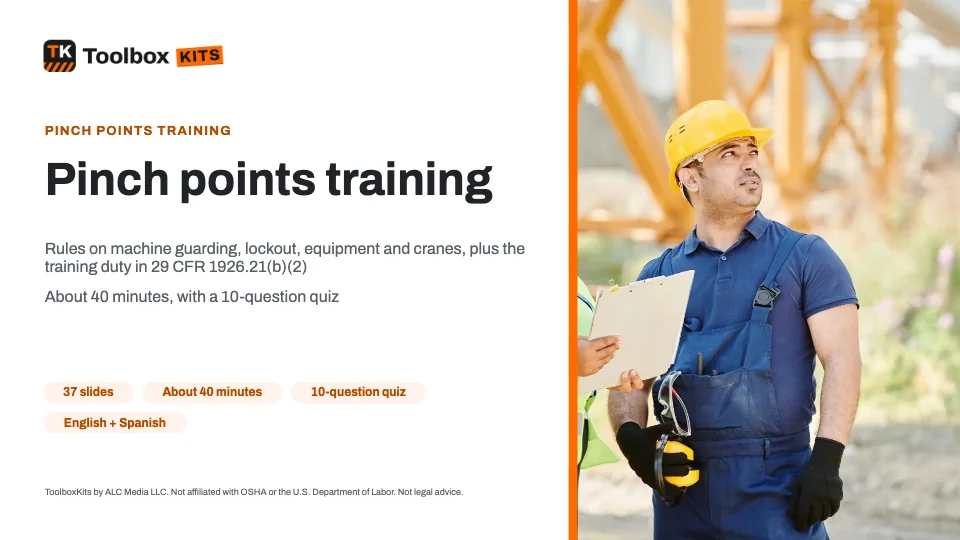 Editable PowerPoint
- Trainer guide
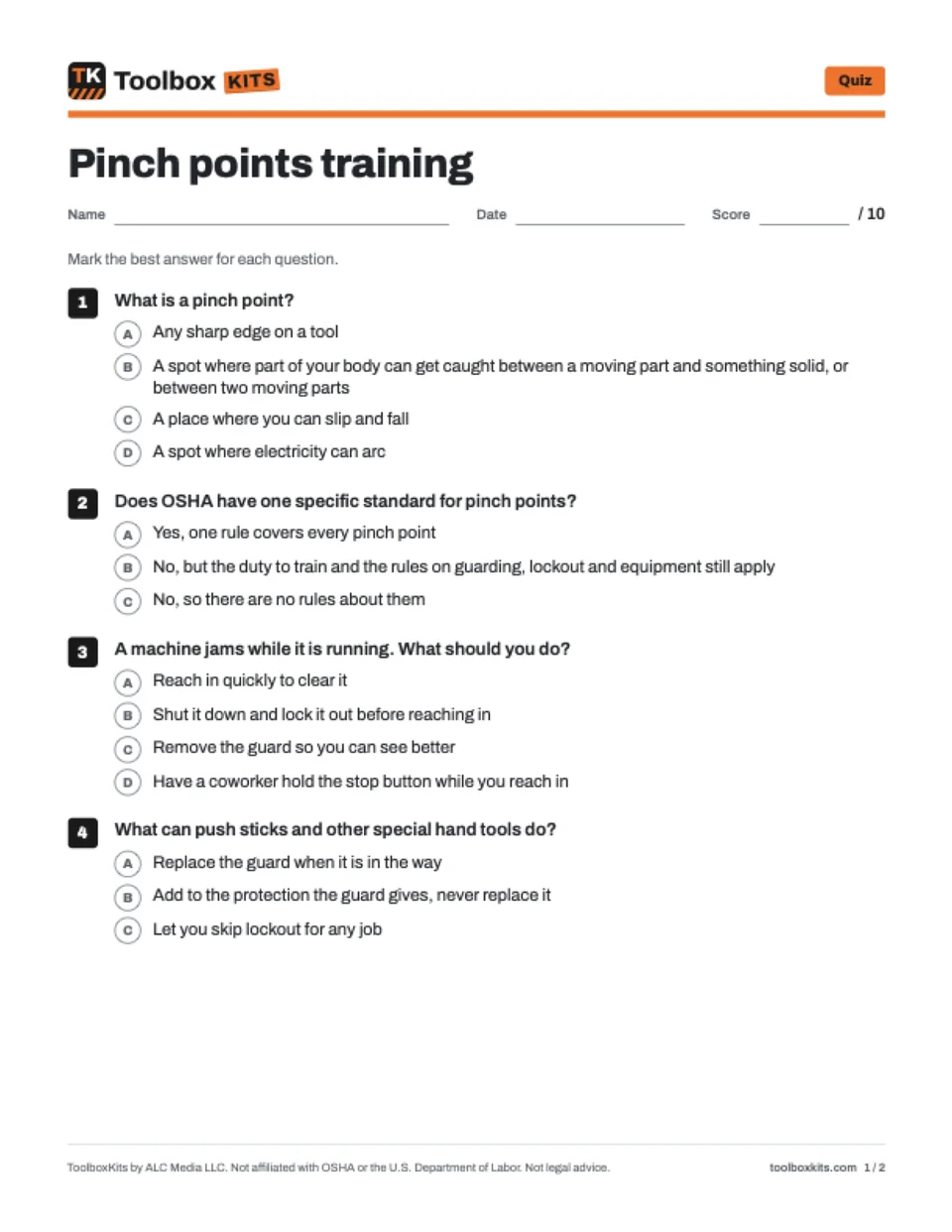 Quiz
- Answer key
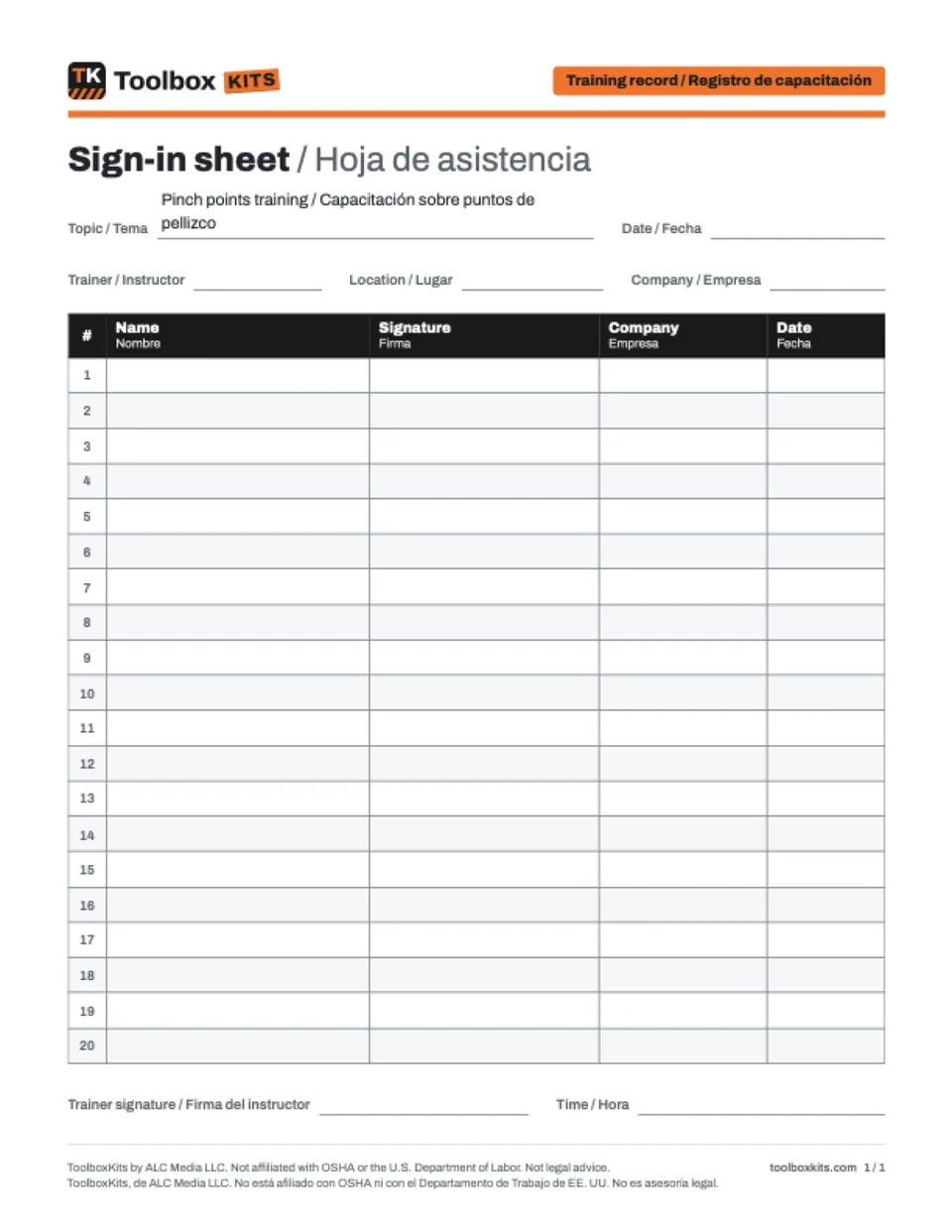 Sign-in sheet
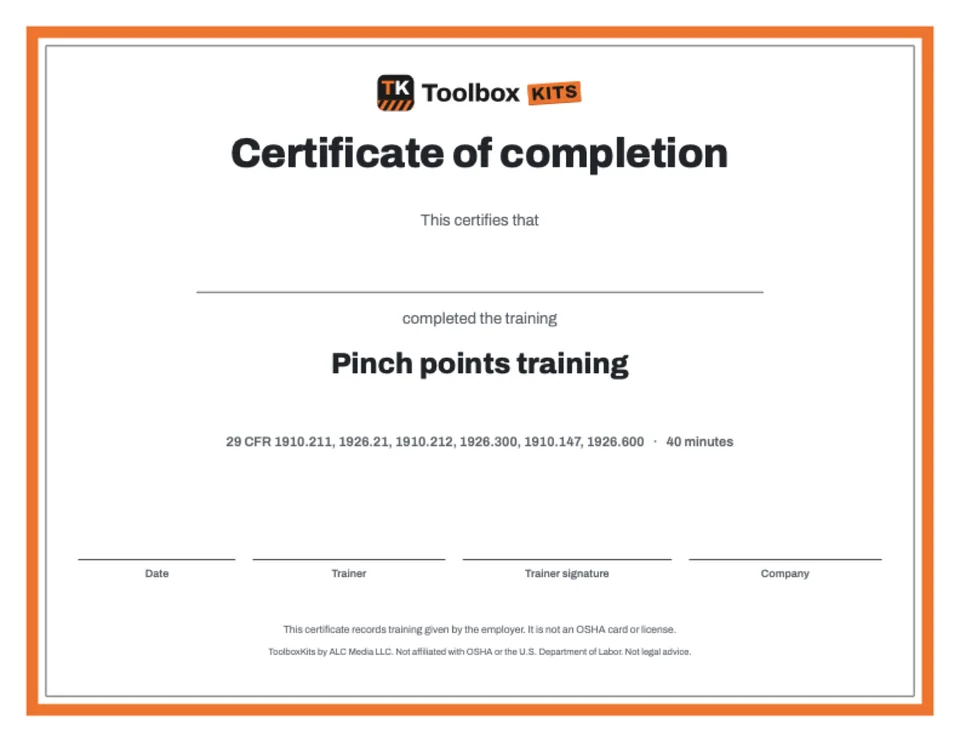 Certificate
- Crew handout
Try it
Try the quiz
Three questions from this topic. Pick an answer to see the right one and the OSHA paragraph.
Question 1 of 3
What is a pinch point?
The rule
What OSHA requires
Plain-language summary. Each line links to the exact paragraph of the regulation.
OSHA has no specific standard for pinch points; the general duty to train still applies. In construction, the employer must instruct each employee in recognizing and avoiding unsafe conditions and in the regulations that apply to their work environment.
“The employer shall instruct each employee in the recognition and avoidance of unsafe conditions and the regulations applicable to his work environment to control or eliminate any hazards or other exposure to illness or injury.”
In general industry, one or more methods of machine guarding must protect the operator and other employees in the machine area from hazards such as the point of operation, ingoing nip points and rotating parts.
“One or more methods of machine guarding shall be provided to protect the operator and other employees in the machine area from hazards such as those created by point of operation, ingoing nip points, rotating parts”
Guards must be attached to the machine where possible, or secured elsewhere if attaching them to the machine is not possible, and a guard must not create a hazard of its own.
“The guard shall be such that it does not offer an accident hazard in itself.”
The point of operation of any machine that exposes an employee to injury must be guarded. Where no specific standard applies, the guard must be designed and built to keep the operator from having any part of the body in the danger zone during the operating cycle.
“prevent the operator from having any part of his body in the danger zone during the operating cycle”
Special hand tools for placing and removing material must let the operator handle material without putting a hand in the danger zone, and they may only add to guarding, never replace it.
“Such tools shall not be in lieu of other guarding required by this section, but can only be used to supplement protection provided.”
On construction sites, belts, gears, shafts, pulleys, sprockets, spindles, drums, flywheels, chains and other reciprocating, rotating or moving parts of equipment must be guarded if they are exposed to contact by employees or otherwise create a hazard.
“Belts, gears, shafts, pulleys, sprockets, spindles, drums, fly wheels, chains, or other reciprocating, rotating or moving parts of equipment shall be guarded if such parts are exposed to contact by employees or otherwise create a hazard.”
In general industry, the lockout/tagout rule covers servicing during normal production when a worker must place any part of the body into the point of operation or into an associated danger zone during a machine operating cycle. Minor tool changes and adjustments that are routine, repetitive and integral to production are excepted only when other measures give effective protection.
“An employee is required to place any part of his or her body into an area on a machine or piece of equipment where work is actually performed upon the material being processed (point of operation)”
On construction sites, where a crane's rotating superstructure could strike a worker or pinch or crush a worker against another object, the employer must erect and maintain control lines, warning lines, railings or similar barriers to mark the hazard area. If barriers are not feasible, the area must be clearly marked with warning signs and high visibility markings.
“Erect and maintain control lines, warning lines, railings or similar barriers to mark the boundaries of the hazard areas.”
On construction sites, each employee assigned to work on or near a crane must be trained to recognize the struck-by and pinch/crush hazard areas posed by its rotating superstructure.
“Train each employee assigned to work on or near the equipment (“authorized personnel”) in how to recognize struck-by and pinch/crush hazard areas posed by the rotating superstructure.”
On construction sites, heavy machinery or parts held up by slings, hoists or jacks must be blocked or cribbed before anyone works under or between them. Blades, buckets, dump bodies and similar equipment must be fully lowered or blocked when being repaired or not in use.
“shall be substantially blocked or cribbed to prevent falling or shifting before employees are permitted to work under or between them.”
Who must be trained
In construction, each employee must be instructed in recognizing and avoiding unsafe conditions and the regulations that apply to their work environment (29 CFR 1926.21(b)(2)). On construction sites where a crane's rotating superstructure creates a struck-by or pinch/crush hazard, each employee assigned to work on or near the equipment must be trained to recognize those hazard areas (29 CFR 1926.1424(a)(2)(i)).

Common questions
Questions people ask
Is there a printable pinch points toolbox talk PDF?
Yes. This pinch points toolbox talk is a free printable PDF in English and Spanish, with a sign-in table for your crew. Print it, read it aloud in about five minutes, and keep the signed sheet with your safety records.
What is a pinch point?
A pinch point is any place where part of your body can get caught between a moving part and a fixed object, or between two moving parts. Common examples are gears, rollers, belts and pulleys, chains and sprockets, doors, tailgates, and the gap between a load and a wall or the ground. OSHA's general machine guarding rule lists ingoing nip points among the hazards that machine guarding must protect against (29 CFR 1910.212(a)(1)).
Does OSHA have a standard for pinch points?
OSHA has no specific standard for pinch points; the general duty to train still applies (in construction, 29 CFR 1926.21(b)(2)). Several rules cover pinch point hazards directly: machine guarding must protect workers from hazards such as ingoing nip points and rotating parts (29 CFR 1910.212(a)(1)), and moving parts of construction equipment must be guarded when workers can contact them (29 CFR 1926.300(b)(2)).
What should a pinch point safety talk cover?
Cover how to spot pinch points, keeping guards in place, locking out before reaching into a machine, using tools instead of hands, dressing for moving parts and staying out of swing and crush zones around equipment. Walk the crew to a real machine or piece of equipment and have them point out the pinch points. End with the quiz to check what stuck.
How do you prevent pinch point injuries?
Keep guards on, and never reach into a machine that can move; shut it down and lock it out first. Use push sticks, hooks or tag lines so your hands stay clear, keep rings, loose sleeves and long hair away from moving parts, and talk with your partner before you move or set down a load. Never put yourself between a moving load or machine and something solid.
Free to share
Use this talk for free
You can print, share and adapt this talk at no cost under the Creative Commons BY-NC-SA 4.0 license. Please credit ToolboxKits with a link.