

Free 5-minute toolbox talkBehavior and attitudeEnglish and Spanish
Teamwork safety toolbox talk: building a safety culture
A close call is a free lesson, so report it the same day, along with every injury, even small ones. What OSHA requires: In construction, the employer is responsible for starting and maintaining the safety programs needed to comply with OSHA's construction standards (29 CFR 1926.20(b)(1)).
A free 5-minute teamwork safety toolbox talk on safety culture, which is how a crew really works when nobody is watching. Use it as a brother's keeper safety talk or as a quick leadership safety moment.
Updated October 29, 2026 · Based on 29 CFR 1926.20
Read it out loud
Free 5-minute toolbox talk
Read it out loud to your crew. It takes about 5 minutes.
Start with a question
If you saw a coworker about to get hurt, would you say something, and would they thank you for it?
Why it matters
Safety culture is how a crew really works when nobody is watching. Rules and training matter, but they work best when people look out for each other, speak up and report problems without fear. A strong safety culture is built one conversation at a time, by every person on the crew.
Key points
Culture is what we do, not what we say
Safety rules on paper are only a start. Culture is whether we follow them when we are behind schedule, tired or out of sight of the boss. It shows up in small things, like doing the full equipment check, wearing PPE for a quick job and cleaning up as we go.
More
Each of us adds to it or takes away from it every day.
Be your brother's keeper
Being your brother's keeper means watching out for the people around you, not just yourself. If you see someone step into a blind spot, work near an edge without protection or reach toward a moving part, say something right away. A short, respectful 'Hey, hold up' can prevent a serious injury.
More
When someone does it for you, thank them, even if you think you had it handled.
Anyone can stop the job
If something looks wrong, anyone on the crew should feel free to stop the work and ask, from the newest helper to the foreman. Stopping for a few minutes costs far less than an injury. Leaders back this up by thanking the person who called stop, not by asking why the work slowed down.
Report injuries and close calls
A close call is a free lesson, so report it the same day, along with every injury, even small ones.
More
Under OSHA's recordkeeping rule, employers must set up a reasonable procedure for employees to report work-related injuries and illnesses promptly and accurately, and a procedure that would discourage a reasonable employee from reporting is not reasonable. Section 11(c) of the OSH Act also prohibits discriminating against an employee for reporting a work-related injury or illness.
29 CFR 1904.35(b)(1) · 29 CFR 1904.36
Leaders set the tone
Crews copy what their leaders do. Foremen and supervisors build safety culture by wearing their own PPE, fixing reported hazards quickly and asking the crew for input before work starts.
More
In construction, the employer must start and maintain the safety programs needed to meet OSHA's construction rules. Those programs must provide for frequent and regular inspections of job sites, materials and equipment by competent persons the employer designates.
29 CFR 1926.20(b)(2) · 29 CFR 1926.20(b)(1)
Help each other get trained
Teamwork does not mean letting a buddy run a machine they have not been trained on. In construction, the employer may permit only employees qualified by training or experience to operate equipment and machinery. If you are asked to do a task you have not been trained for, say so.
More
If a new crew member is struggling, show them the right way, not the fast way.
Scenario
Picture this: A crew is racing to finish a concrete pour before rain moves in. A newer worker sees a coworker at the deck edge unclip from their lanyard to move a hose, but stays quiet because the coworker has many more years on the job. The foreman is busy on the phone, and nobody else seems to notice. What should the newer worker do, and what would make it easier for them to speak up?
Ask the crew
- When did someone on a crew last stop you from doing something unsafe, and how did you react?
- What makes it hard to speak up on a jobsite, and how can we make it easier here?
- How do we report a close call on this job, and what happens after someone reports one?
- What is one thing our leaders could do this week to show that safety comes first?
Takeaway
Safety culture is every one of us looking out for each other, speaking up and reporting problems, every day.
Trainer: ______________________ Date: ____________
Credit: ToolboxKits, https://toolboxkits.com/topics/safety-culture/ (CC BY-NC-SA 4.0)
The poster is also inside the paid kits.
Audit-ready records in 60 seconds
Fill in your crew and download a filled sign-in sheet for this talk. Everything is made in your browser. Names are never uploaded or stored.
Start a sign-off
Crew scan a QR code on their own phones, type their name and sign with a finger. You see the names arrive and download the signed sheet. Free, no account.
Kits
Get the kit
No subscription needed. Buy only the kit you need.
Toolbox talk kit
$4.99
- 5-minute talk, English PDF
- 5-minute talk, Spanish PDF
- Editable mini-deck (English and Spanish)
- One-page crew handout (English and Spanish)
- Bilingual sign-in sheet
- 3-question quiz with answer key (English and Spanish)
- One-page bilingual poster
- Audit-ready records in 60 seconds: fill in your crew and get a sign-in sheet and a certificate for every worker
Training kit
$9
Editable PowerPoint, 36 slides
- Editable PowerPoint with trainer notes on every slide
- Trainer guide PDF with timing and discussion tips
- 10-question quiz and answer key
- Sign-in sheet and certificate of completion with fillable fields
- One-page crew handout
- Full Spanish version of everything
- One-page bilingual poster
- Audit-ready records in 60 seconds: fill in your crew and get a sign-in sheet and a certificate for every worker
- Instant download
- Secure checkout by Stripe
- 30-day refund, no questions
Need many topics? All Access gives you every kit for $99 a year.
Inside the kit
See what is in the kit
What is in the kit
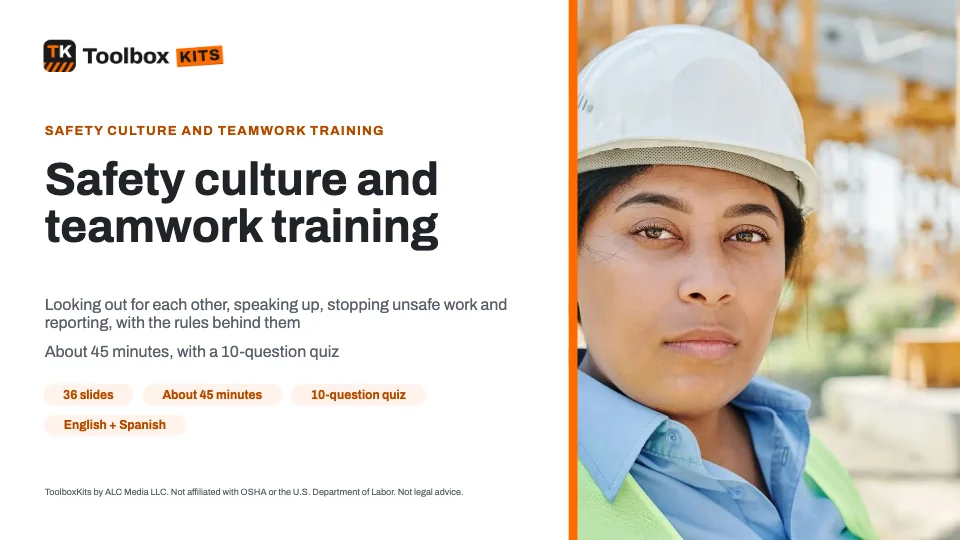 Editable PowerPoint
- Trainer guide
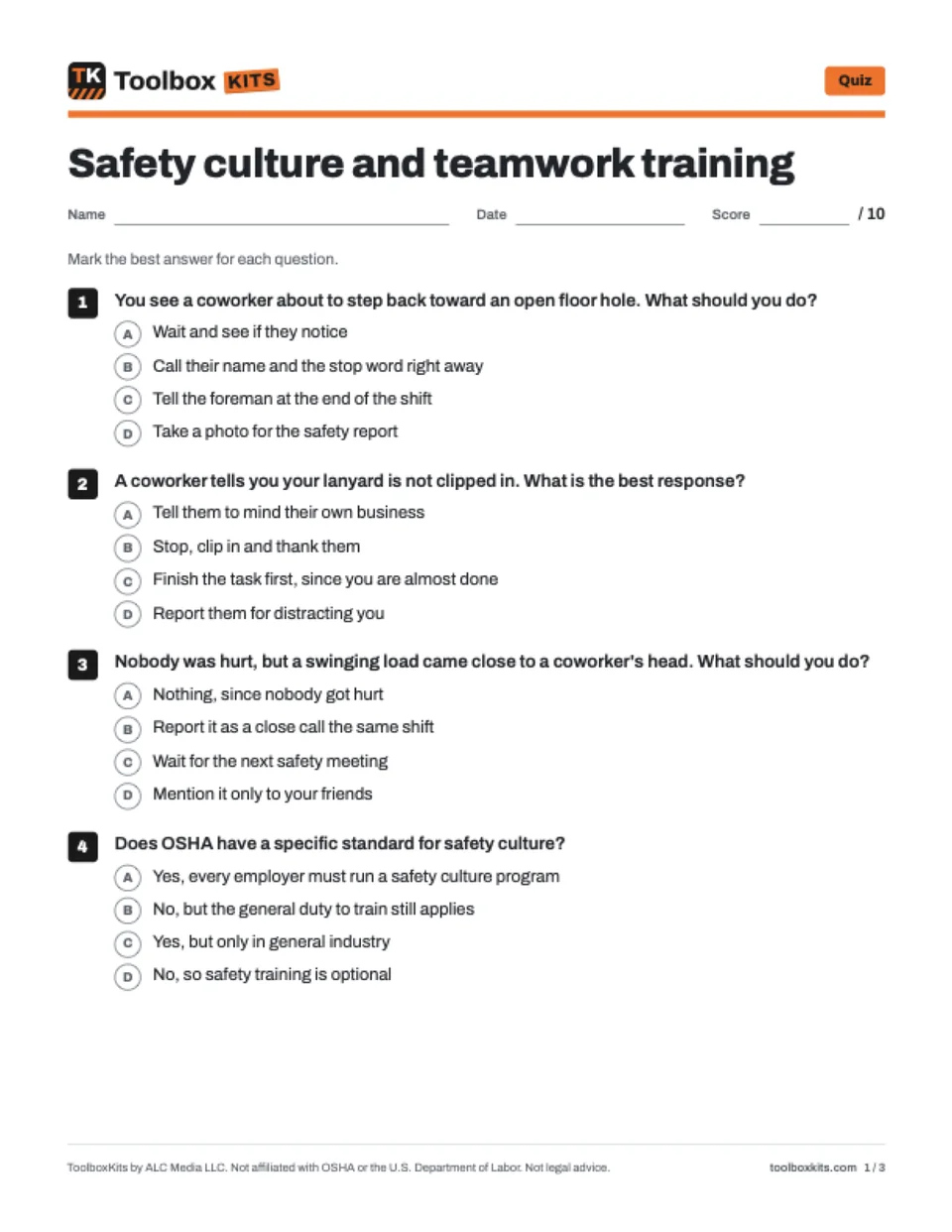 Quiz
- Answer key
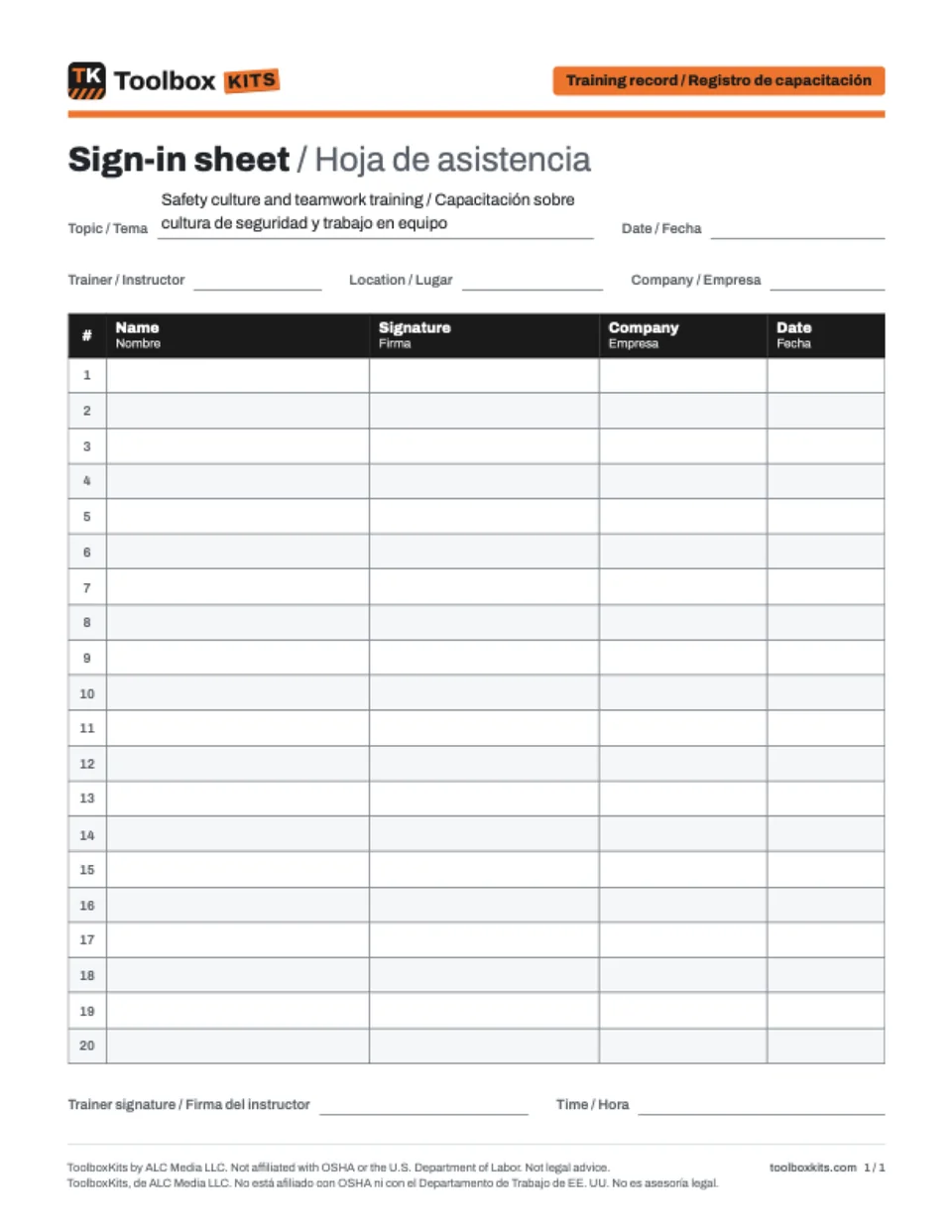 Sign-in sheet
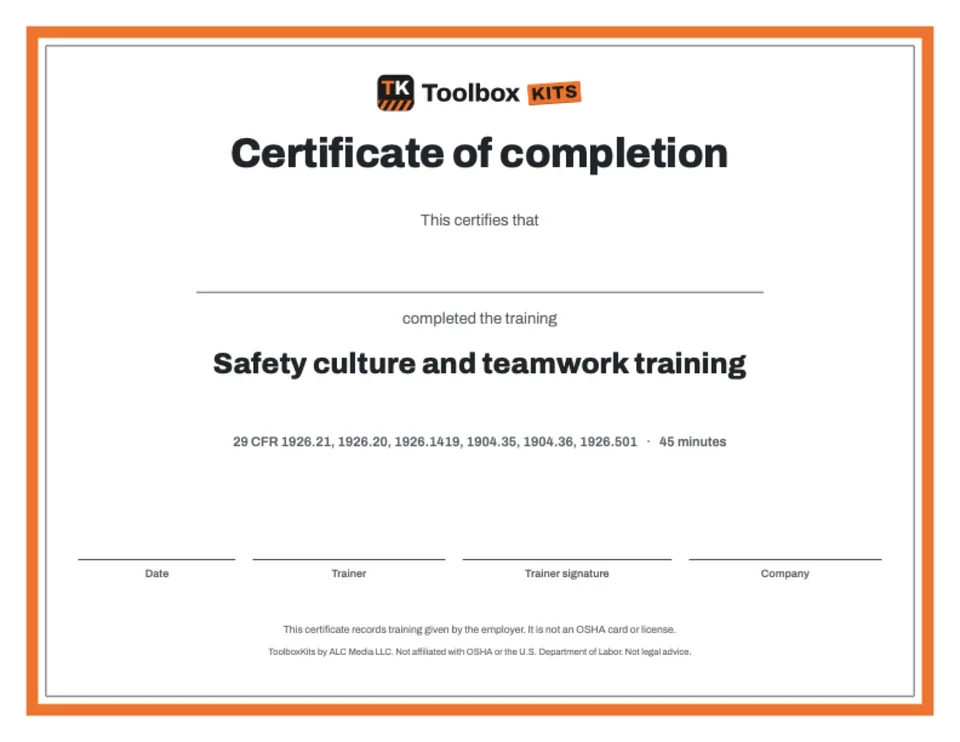 Certificate
- Crew handout
Try it
Try the quiz
Three questions from this topic. Pick an answer to see the right one and the OSHA paragraph.
Question 1 of 3
You see a coworker about to walk behind a truck that is backing up. What should you do?
The rule
What OSHA requires
Plain-language summary. Each line links to the exact paragraph of the regulation.
OSHA has no specific standard for safety culture, but the general duty to train still applies: in construction, the employer must instruct each employee in the recognition and avoidance of unsafe conditions and the regulations that apply to their work environment.
“The employer shall instruct each employee in the recognition and avoidance of unsafe conditions and the regulations applicable to his work environment”
In construction, the employer is responsible for starting and maintaining the safety programs needed to comply with OSHA's construction standards.
“It shall be the responsibility of the employer to initiate and maintain such programs as may be necessary to comply with this part.”
Those programs must provide for frequent and regular inspections of job sites, materials and equipment by competent persons the employer designates.
“Such programs shall provide for frequent and regular inspections of the job sites, materials, and equipment to be made by competent persons designated by the employers.”
In construction, the employer may permit only employees qualified by training or experience to operate equipment and machinery.
“The employer shall permit only those employees qualified by training or experience to operate equipment and machinery.”
In construction, a standard that requires training creates a separate duty for each employee it covers. The employer must train each affected employee in the manner the standard requires, and each failure to train an employee may be considered a separate violation.
“The employer must train each affected employee in the manner required by the standard, and each failure to train an employee may be considered a separate violation.”
Under OSHA's recordkeeping rule, the employer must set up a reasonable procedure for employees to report work-related injuries and illnesses promptly and accurately. A procedure that would deter or discourage a reasonable employee from accurately reporting is not reasonable.
“A procedure is not reasonable if it would deter or discourage a reasonable employee from accurately reporting a workplace injury or illness”
The employer must not discharge or in any manner discriminate against an employee for reporting a work-related injury or illness.
“You must not discharge or in any manner discriminate against any employee for reporting a work-related injury or illness.”
Section 11(c) of the OSH Act also prohibits discrimination against an employee for reporting a work-related fatality, injury or illness. It also protects an employee who files a safety and health complaint or otherwise exercises rights under the OSH Act.
“That provision of the Act also protects the employee who files a safety and health complaint, asks for access to the part 1904 records, or otherwise exercises any rights afforded by the OSH Act.”
Who must be trained
OSHA has no training rule specific to safety culture. In construction, the employer must instruct each employee in recognizing and avoiding unsafe conditions and the regulations that apply to their work environment (29 CFR 1926.21(b)(2)), and may permit only employees qualified by training or experience to operate equipment and machinery (29 CFR 1926.20(b)(4)).
Common questions
Questions people ask
Is there a printable safety culture toolbox talk PDF?
Yes. This safety culture toolbox talk is free to print as a PDF in English and Spanish, with a sign-in table to record who attended. It works for construction crews, plants, warehouses and any team that wants to talk about teamwork and speaking up.
What is a brother's keeper safety talk?
A brother's keeper safety talk is about looking out for the people around you, not just yourself. It covers warning a coworker who is at risk, taking a warning without getting defensive and helping new workers learn the safe way. This talk works as a brother's keeper toolbox talk or as a general teamwork safety talk.
What is a good leadership safety moment?
Pick one leadership habit and talk about it for a few minutes, such as thanking someone who stopped the job, fixing a reported hazard quickly or asking the crew what worries them about today's work. Then do it in front of the crew that same day. A safety leadership toolbox talk lands best when the leader shows it instead of just saying it.
Is there a safety culture or safety leadership PowerPoint presentation?
This free talk is written to be read aloud, so you can run it without slides. If you want a safety culture presentation with slides for a longer session, such as supervisor safety leadership training, use the training kit option on this page. Add a real example from your own site so it does not feel like a lecture.
What does a positive safety culture look like?
In a positive safety culture, people speak up, report close calls and stop work when something looks wrong, and leaders thank them for it. OSHA has no specific standard for safety culture, but construction employers must instruct each employee in recognizing and avoiding unsafe conditions (29 CFR 1926.21(b)(2)). Under OSHA's recordkeeping rule, an injury reporting procedure that would deter or discourage a reasonable employee from accurately reporting is not reasonable (29 CFR 1904.35(b)(1)).
Free to share
Use this talk for free
You can print, share and adapt this talk at no cost under the Creative Commons BY-NC-SA 4.0 license. Please credit ToolboxKits with a link.