

Free 5-minute toolbox talkBehavior and attitudeEnglish and Spanish
Line of fire toolbox talk
The line of fire is the path an object or released energy will take if something moves, falls, breaks or lets go. What OSHA requires: OSHA has no single standard called line of fire; the general duty to train still applies (29 CFR 1926.21(b)(2)).
A free 5-minute talk on staying out of the line of fire, the path something takes when it moves, falls, swings or lets go. It covers loads, equipment, tools and stored energy, with citations to the OSHA rules that apply.
Updated October 29, 2026 · Based on 29 CFR 1926.21
Read it out loud
Free 5-minute toolbox talk
Read it out loud to your crew. It takes about 5 minutes.
Start with a question
If the strap or hose nearest you let go right now, where would it go, and are you in its path?
Why it matters
The line of fire is the path an object or released energy will take if something moves, falls, breaks or lets go. Getting struck by a load or a whipping hose, or caught between a moving object and something solid, can happen in a split second. There is usually no time to react, so your protection is where you choose to stand.
Key points
Stay out from under suspended loads
Never walk under a suspended or raised load. On crane work in construction, while the operator is not moving a suspended load, only workers hooking, unhooking or guiding the load, making its initial attachment, or operating a concrete hopper or bucket may be in the fall zone.
More
In general industry, no one may stand or pass under the elevated portion of a forklift, loaded or empty.
29 CFR 1926.1425(b) · 29 CFR 1910.178(m)(2)
Respect swing and crush zones
A crane's rotating upper works can strike you or pin you against another object.
More
On construction sites, where that hazard exists, the employer must mark the hazard area with control lines, warning lines, railings or similar barriers, or with warning signs and high visibility markings where barriers are not feasible. Stay outside the barricade, and before you go to a spot in the hazard area the operator cannot see, make sure the operator is told.
29 CFR 1926.1424(a)(2)(ii) · 29 CFR 1926.1424(a)(3)(i)
Never stand behind backing equipment
Blind spots behind trucks, loaders and rollers put people on foot in the line of fire.
More
On construction sites, earthmoving or compacting equipment with an obstructed view to the rear may back up only with a reverse signal alarm that stands out from the surrounding noise, or when a worker signals that it is safe. Make eye contact with the operator before you cross behind a machine, and stay away from trucks being loaded or unloaded.
Get out of line with tension and pressure
Straps, chains, cables and hoses under tension can snap back or whip when they break or come loose. Stand to the side of a load being pulled, pushed or tightened, never in line with it or on the far side of a load that could shift or tip.
More
On construction sites, pneumatic tools must be secured to the hose so they cannot accidentally disconnect, and air hoses over 1/2-inch inside diameter need a safety device at the source of supply or branch line to reduce pressure if the hose fails.
29 CFR 1926.302(b)(7) · 29 CFR 1926.302(b)(1)
Keep clear of moving parts and flying debris
Rotating equipment and power tools can grab clothing, kick back or throw chips and sparks. In general industry, machine guarding must protect the operator and other employees in the machine area from hazards such as ingoing nip points, rotating parts, flying chips and sparks.
More
Keep guards in place, and stand out of the path a blade or wheel would take if it kicked back or broke.
Plan where you stand before the work starts
Before each task, ask what could move, fall, swing, roll or let go, and where it would go. Add line of fire hazards to your job safety analysis or pre-task plan, and set up barricades or exclusion zones before work begins.
More
If someone steps into the line of fire, speak up and stop the work until they are clear.
Scenario
Picture this: A crew is pulling a pump skid onto a trailer with a come-along and a chain. One worker stands in line with the chain to watch the hook. Another steps under a forklift's raised forks to grab a dropped shackle. Nobody talked about where to stand. Where is the line of fire in each case, and where should each person be?
Ask the crew
- What on our job today could move, fall, swing or let go?
- If a strap or cable broke during a pull or a lift, where should we be standing?
- When we push or load material, who could be on the far side if it shifts or tips?
Takeaway
Before every task, find the path that loads, machines, tools and stored energy could take, and keep your body out of it.
Trainer: ______________________ Date: ____________
Credit: ToolboxKits, https://toolboxkits.com/topics/line-of-fire/ (CC BY-NC-SA 4.0)
The poster is also inside the paid kits.
Audit-ready records in 60 seconds
Fill in your crew and download a filled sign-in sheet for this talk. Everything is made in your browser. Names are never uploaded or stored.
Start a sign-off
Crew scan a QR code on their own phones, type their name and sign with a finger. You see the names arrive and download the signed sheet. Free, no account.
Kits
Get the kit
No subscription needed. Buy only the kit you need.
Toolbox talk kit
$4.99
- 5-minute talk, English PDF
- 5-minute talk, Spanish PDF
- Editable mini-deck (English and Spanish)
- One-page crew handout (English and Spanish)
- Bilingual sign-in sheet
- 3-question quiz with answer key (English and Spanish)
- One-page bilingual poster
- Audit-ready records in 60 seconds: fill in your crew and get a sign-in sheet and a certificate for every worker
Training kit
$9
Editable PowerPoint, 32 slides
- Editable PowerPoint with trainer notes on every slide
- Trainer guide PDF with timing and discussion tips
- 10-question quiz and answer key
- Sign-in sheet and certificate of completion with fillable fields
- One-page crew handout
- Full Spanish version of everything
- One-page bilingual poster
- Audit-ready records in 60 seconds: fill in your crew and get a sign-in sheet and a certificate for every worker
- Instant download
- Secure checkout by Stripe
- 30-day refund, no questions
Need many topics? All Access gives you every kit for $99 a year.
Inside the kit
See what is in the kit
What is in the kit
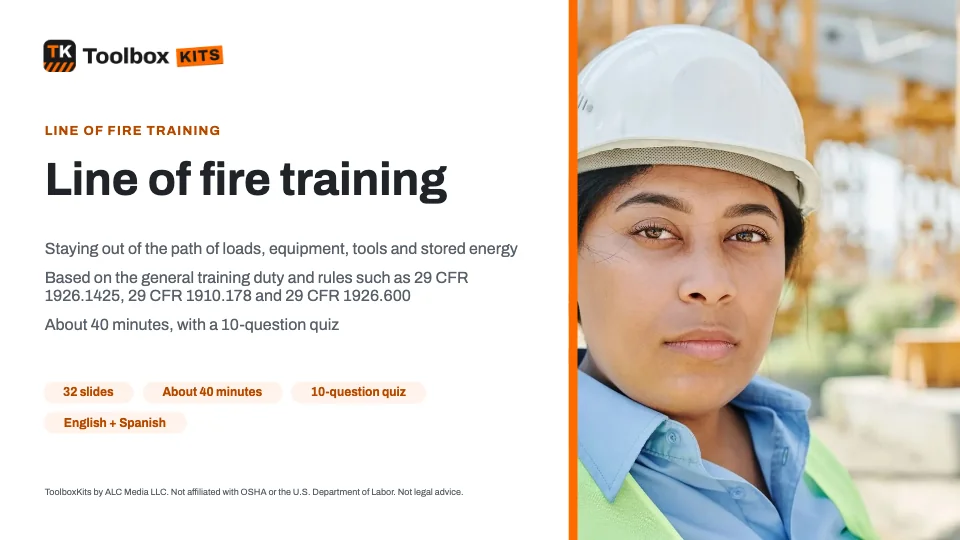 Editable PowerPoint
- Trainer guide
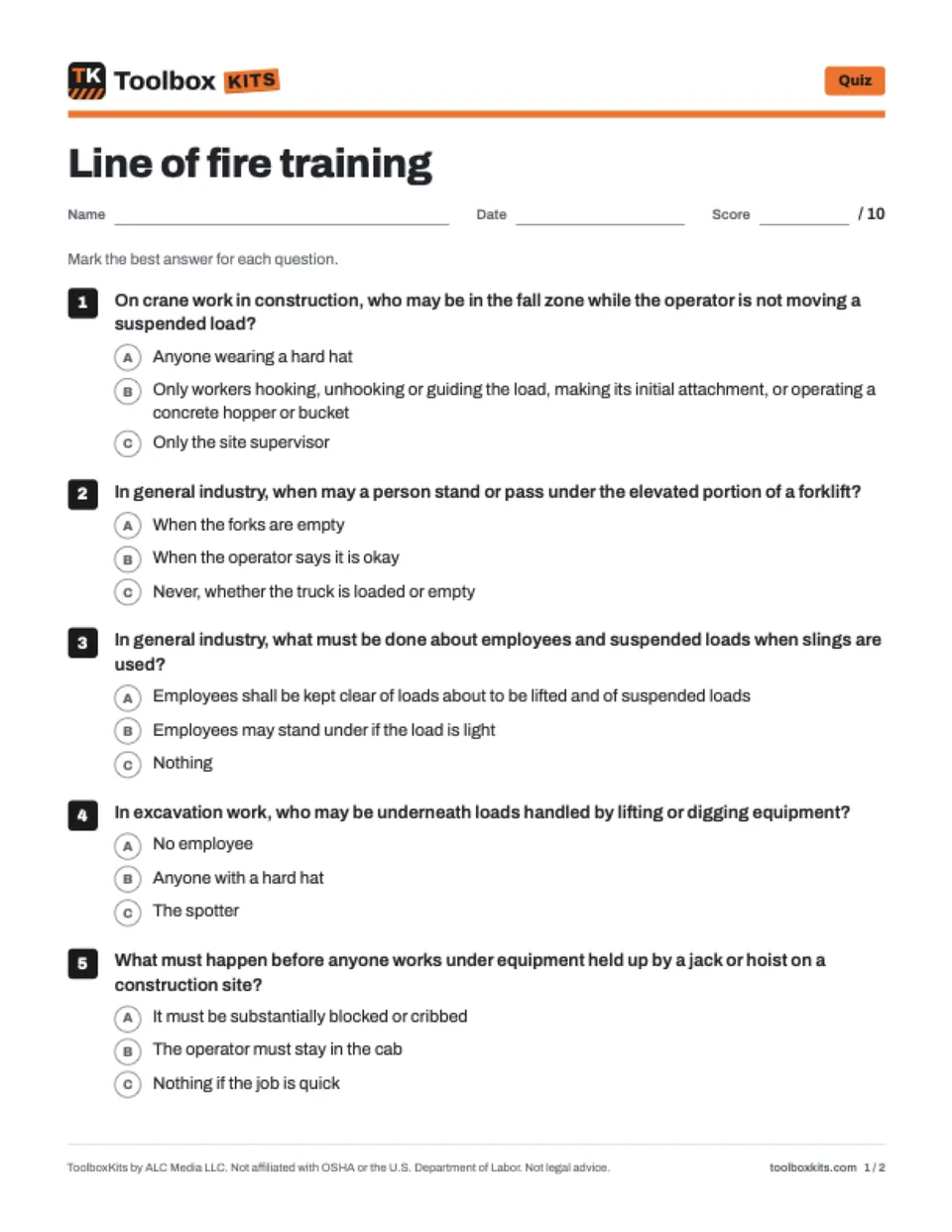 Quiz
- Answer key
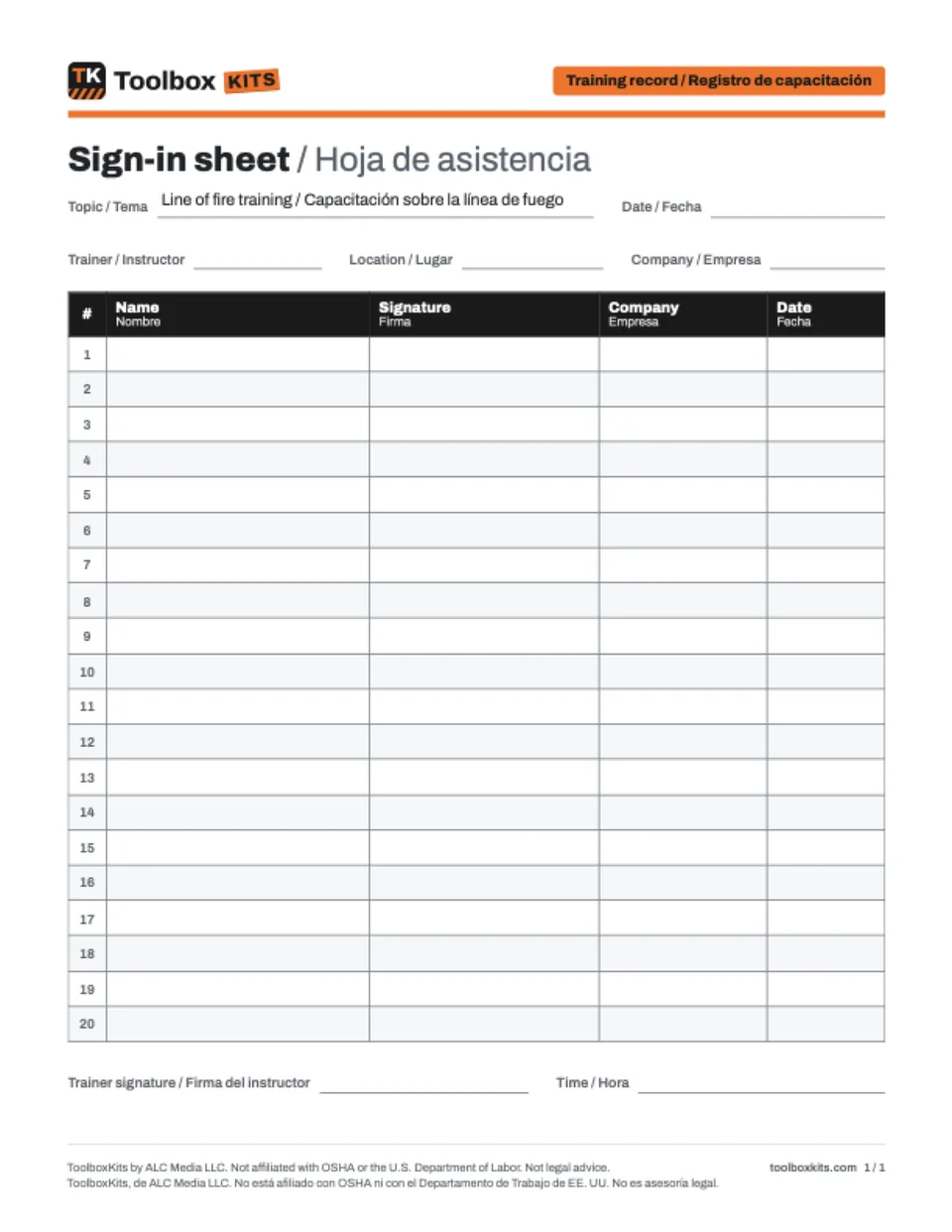 Sign-in sheet
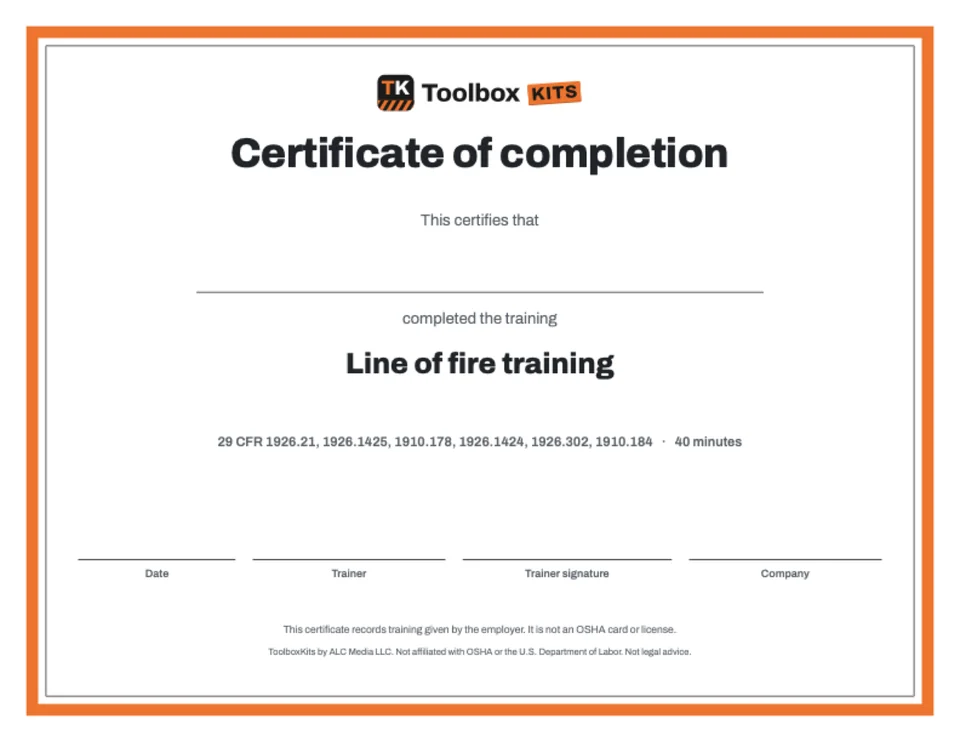 Certificate
- Crew handout
Try it
Try the quiz
Three questions from this topic. Pick an answer to see the right one and the OSHA paragraph.
Question 1 of 3
On crane work in construction, who may be in the fall zone while the operator is not moving a suspended load?
The rule
What OSHA requires
Plain-language summary. Each line links to the exact paragraph of the regulation.
OSHA has no single standard called line of fire; the general duty to train still applies. In construction, the employer must instruct each employee in recognizing and avoiding unsafe conditions and the regulations that apply to their work environment.
“The employer shall instruct each employee in the recognition and avoidance of unsafe conditions and the regulations applicable to his work environment to control or eliminate any hazards or other exposure to illness or injury.”
On crane work in construction, while the operator is not moving a suspended load, no employee may be within the fall zone except employees hooking, unhooking or guiding the load, making the initial attachment of the load to a component or structure, or operating a concrete hopper or concrete bucket. Where available, hoisting routes that minimize employee exposure to hoisted loads must be used, to the extent consistent with public safety (29 CFR 1926.1425(a)).
“While the operator is not moving a suspended load, no employee must be within the fall zone”
On construction sites, where a crane's rotating superstructure poses a reasonably foreseeable risk of striking an employee or pinching or crushing an employee against another part of the equipment or another object, the employer must train each employee assigned to work on or near the equipment to recognize those hazard areas (29 CFR 1926.1424(a)(2)(i)). The employer must also erect and maintain control lines, warning lines, railings or similar barriers to mark the boundaries of the hazard areas, or, where the employer can show that barriers are not feasible on the ground or on the equipment, mark the areas clearly with a combination of warning signs and high visibility markings.
“Erect and maintain control lines, warning lines, railings or similar barriers to mark the boundaries of the hazard areas.”
In excavation work, no employee may be permitted underneath loads handled by lifting or digging equipment. Employees must stand away from any vehicle being loaded or unloaded to avoid being struck by spillage or falling materials. Operators may remain in the cabs of vehicles being loaded or unloaded when the vehicles are equipped to protect them.
“No employee shall be permitted underneath loads handled by lifting or digging equipment.”
On construction sites, earthmoving or compacting equipment with an obstructed view to the rear may not be used in reverse gear unless it has a reverse signal alarm distinguishable from the surrounding noise level in operation, or an employee signals that it is safe to do so. A truck or other motor vehicle with an obstructed view to the rear may not be used unless it has a reverse signal alarm audible above the surrounding noise level, or it is backed up only when an observer signals that it is safe (29 CFR 1926.601(b)(4)).
“No employer shall permit earthmoving or compacting equipment which has an obstructed view to the rear to be used in reverse gear unless the equipment has in operation a reverse signal alarm distinguishable from the surrounding noise level”
On construction sites, heavy machinery, equipment or parts suspended or held up by slings, hoists or jacks must be substantially blocked or cribbed to prevent falling or shifting before employees work under or between them. Bulldozer and scraper blades, end-loader buckets, dump bodies and similar equipment must be fully lowered or blocked when being repaired or not in use.
“shall be substantially blocked or cribbed to prevent falling or shifting before employees are permitted to work under or between them”
In general industry, when slings are used to hoist loads, all employees must be kept clear of loads about to be lifted and of suspended loads. Hands or fingers must not be placed between the sling and its load while the sling is being tightened around the load (29 CFR 1910.184(c)(10)), and construction has the same rule (29 CFR 1926.251(c)(10)).
“All employees shall be kept clear of loads about to be lifted and of suspended loads.”
In general industry, no person may stand or pass under the elevated portion of any powered industrial truck, such as a forklift, whether it is loaded or empty. Trucks must not be driven up to anyone standing in front of a bench or other fixed object (29 CFR 1910.178(m)(1)).
“No person shall be allowed to stand or pass under the elevated portion of any truck, whether loaded or empty.”
On construction sites, pneumatic power tools must be secured to the hose or whip by some positive means to prevent the tool from accidentally disconnecting. All hoses exceeding 1/2-inch inside diameter must have a safety device at the source of supply or branch line to reduce pressure in case of hose failure (29 CFR 1926.302(b)(7)).
“Pneumatic power tools shall be secured to the hose or whip by some positive means to prevent the tool from becoming accidentally disconnected.”
On construction sites, during concrete post-tensioning, no employee except those essential to the post-tensioning operations may be behind the jack during tensioning, and signs and barriers must limit employee access to the post-tensioning area (29 CFR 1926.701(c)(2)). No employee may work under concrete buckets while they are being raised or lowered into position (29 CFR 1926.701(e)(1)).
“No employee (except those essential to the post-tensioning operations) shall be permitted to be behind the jack during tensioning operations.”
Who must be trained
In construction, the employer must instruct each employee in recognizing and avoiding unsafe conditions and the regulations that apply to their work environment (29 CFR 1926.21(b)(2)). Where a crane's rotating superstructure creates struck-by or pinch/crush hazard areas, each employee assigned to work on or near the equipment must be trained to recognize them (29 CFR 1926.1424(a)(2)(i)).

Common questions
Questions people ask
Is there a printable line of fire toolbox talk PDF?
Yes. This line of fire talk is free, and you can print it as a PDF in English or Spanish with a sign-in table. Read it aloud in about five minutes before lifting, rigging, pulling, equipment work or any task where something could move, fall or let go.
What is the line of fire?
The line of fire is the path an object, a machine or released energy will take if something moves, falls, swings, breaks or lets go. Common examples are suspended loads, a crane's swing area, backing equipment, straps and cables under tension, air hoses and spinning tools. Being in the line of fire means your body is in that path, where you could be struck or caught between objects.
Does OSHA have a line of fire standard?
OSHA has no single standard called line of fire; the general duty to train still applies, and in construction the employer must instruct each employee in recognizing and avoiding unsafe conditions (29 CFR 1926.21(b)(2)). Many specific rules address line of fire hazards, such as limits on who may be in a crane's fall zone (29 CFR 1926.1425(b)), keeping workers out from under loads in excavation work (29 CFR 1926.651(e)) and keeping people from standing or passing under the elevated portion of a forklift in general industry (29 CFR 1910.178(m)(2)).
How do you run a line of fire safety moment or tailgate talk?
Keep it short and tied to the work in front of you. Pick one task, ask the crew what could move, fall, swing or let go, and agree on where each person will stand. Walk the area if you can, and point out barricades, swing zones and blind spots before the work starts.
Is there a line of fire safety presentation or PowerPoint?
This talk is written to be read aloud, so you do not need slides. For a longer training session, the paid training kit for this topic is an editable PowerPoint in English and Spanish with trainer notes, a quiz and a sign-in sheet. If the kit is not ready to buy yet, you can request it from this page.
Free to share
Use this talk for free
You can print, share and adapt this talk at no cost under the Creative Commons BY-NC-SA 4.0 license. Please credit ToolboxKits with a link.