

Free 5-minute toolbox talkBehavior and attitudeEnglish and Spanish
Behavior-based safety toolbox talk
BBS only works if people speak up about injuries and close calls, so reward safe work and reporting, not a clean injury log. What OSHA requires: In construction, the employer is responsible for starting and maintaining the safety programs needed to comply with OSHA's construction standards (29 CFR 1926.20(b)(1)).
This free behavior-based safety toolbox talk takes about five minutes to read aloud. It explains how behavioral safety observations work, how to give feedback that helps, and why fixing the cause beats blaming the worker.
Updated October 29, 2026 · Based on 29 CFR 1926.20
Read it out loud
Free 5-minute toolbox talk
Read it out loud to your crew. It takes about 5 minutes.
Start with a question
When was the last time someone stopped to tell you that you did a job the safe way?
Why it matters
A lot of what we do on the job is habit, and habits can be safe or risky. Behavior-based safety means watching how work really gets done, talking about it, and fixing what pushes people toward shortcuts. Done right, it is coaching between coworkers. Done wrong, it turns into blame, and people stop speaking up.
Key points
Know what behavior-based safety is
Behavior-based safety, or BBS, looks at what people actually do on the job, not just what the rules say. A coworker watches a task for a few minutes, notes the safe and risky actions, and talks about them with the person right away. The point is to learn why risky habits happen and fix the cause.
More
It is coaching, not policing.
Start with what went right
' Specific praise tells people exactly what to keep doing. It also makes the next conversation easier when you need to point out a risk.
Talk about the risk, not the person
If you see a risky action, say what you saw and why it worries you, then ask what got in the way of doing it safely. Maybe the right tool was not there, or the crew was rushing to finish. Keep names off observation cards, and never use an observation to discipline someone.
More
If people feel watched and judged, they hide problems instead of fixing them.
Fix the cause, not just the habit
Risky behavior often has a reason behind it, like a missing guardrail, a broken tool or a schedule that rewards shortcuts. Behavior-based safety does not replace fixing hazards.
More
On construction sites, any machinery, tool, material or equipment that does not meet an applicable OSHA construction requirement must not be used, and it must be tagged as unsafe, have its controls locked so it cannot run, or be physically removed from its place of operation. The employer's safety program must also provide for frequent and regular inspections of job sites, materials and equipment by competent persons designated by the employer.
29 CFR 1926.20(b)(3) · 29 CFR 1926.20(b)(2)
Keep injury reporting open
BBS only works if people speak up about injuries and close calls, so reward safe work and reporting, not a clean injury log.
More
Under OSHA's recordkeeping rule, employers must have a reasonable procedure for employees to report work-related injuries and illnesses promptly and accurately, and a procedure is not reasonable if it would deter or discourage a reasonable employee from accurately reporting. Employers must not discharge or in any manner discriminate against an employee for reporting a work-related injury or illness.
29 CFR 1904.35(b)(1)(iv) · 29 CFR 1904.35(b)(1)
Make training part of it
OSHA has no specific standard for behavior-based safety, but the general duty to train still applies. In construction, the employer must instruct each employee in the recognition and avoidance of unsafe conditions and the regulations that apply to their work environment.
More
If observations keep finding the same risky habit, the crew may need more training or a better setup.
Scenario
Picture this: During an observation, you see a laborer cutting pavers with a wet saw and no eye protection. When you ask about it, he says the only face shield on site is cracked and the supply house is an hour away, so the crew has gone without all week. What do you say to him, what goes on the observation card, and what should the supervisor fix today?
Ask the crew
- What is one safe habit you have seen on this crew this week that we should keep?
- Which shortcut do people take most on this job, and what pushes them to take it?
- How would you want a coworker to tell you they saw you doing something risky?
- What would make you more comfortable reporting an injury or a close call?
Takeaway
Watch the work, praise what is safe, ask why when it is not, and fix the cause instead of blaming the person.
Trainer: ______________________ Date: ____________
Credit: ToolboxKits, https://toolboxkits.com/topics/behavior-based-safety/ (CC BY-NC-SA 4.0)
The poster is also inside the paid kits.
Audit-ready records in 60 seconds
Fill in your crew and download a filled sign-in sheet for this talk. Everything is made in your browser. Names are never uploaded or stored.
Start a sign-off
Crew scan a QR code on their own phones, type their name and sign with a finger. You see the names arrive and download the signed sheet. Free, no account.
Kits
Get the kit
No subscription needed. Buy only the kit you need.
Toolbox talk kit
$4.99
- 5-minute talk, English PDF
- 5-minute talk, Spanish PDF
- Editable mini-deck (English and Spanish)
- One-page crew handout (English and Spanish)
- Bilingual sign-in sheet
- 3-question quiz with answer key (English and Spanish)
- One-page bilingual poster
- Audit-ready records in 60 seconds: fill in your crew and get a sign-in sheet and a certificate for every worker
Training kit
$9
Editable PowerPoint, 34 slides
- Editable PowerPoint with trainer notes on every slide
- Trainer guide PDF with timing and discussion tips
- 10-question quiz and answer key
- Sign-in sheet and certificate of completion with fillable fields
- One-page crew handout
- Full Spanish version of everything
- One-page bilingual poster
- Audit-ready records in 60 seconds: fill in your crew and get a sign-in sheet and a certificate for every worker
- Instant download
- Secure checkout by Stripe
- 30-day refund, no questions
Need many topics? All Access gives you every kit for $99 a year.
Inside the kit
See what is in the kit
What is in the kit
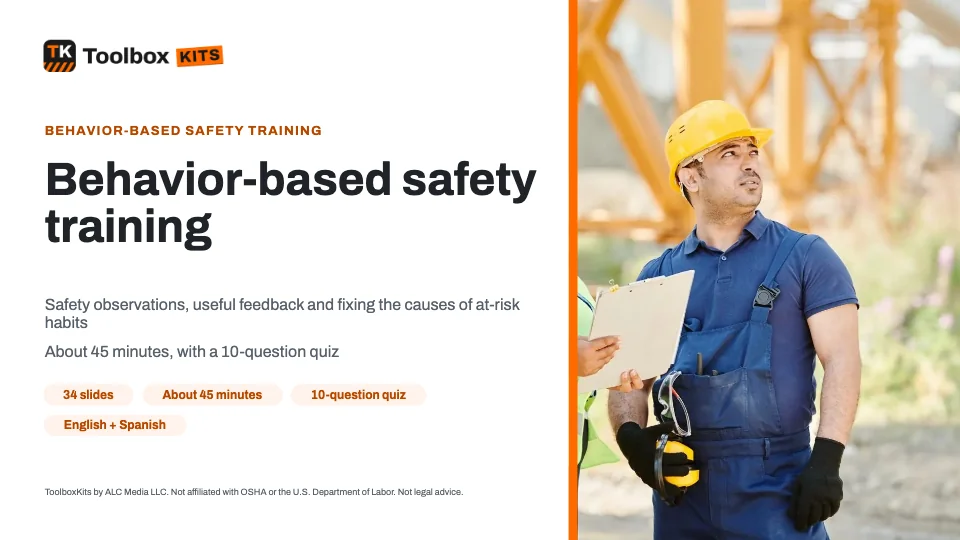 Editable PowerPoint
- Trainer guide
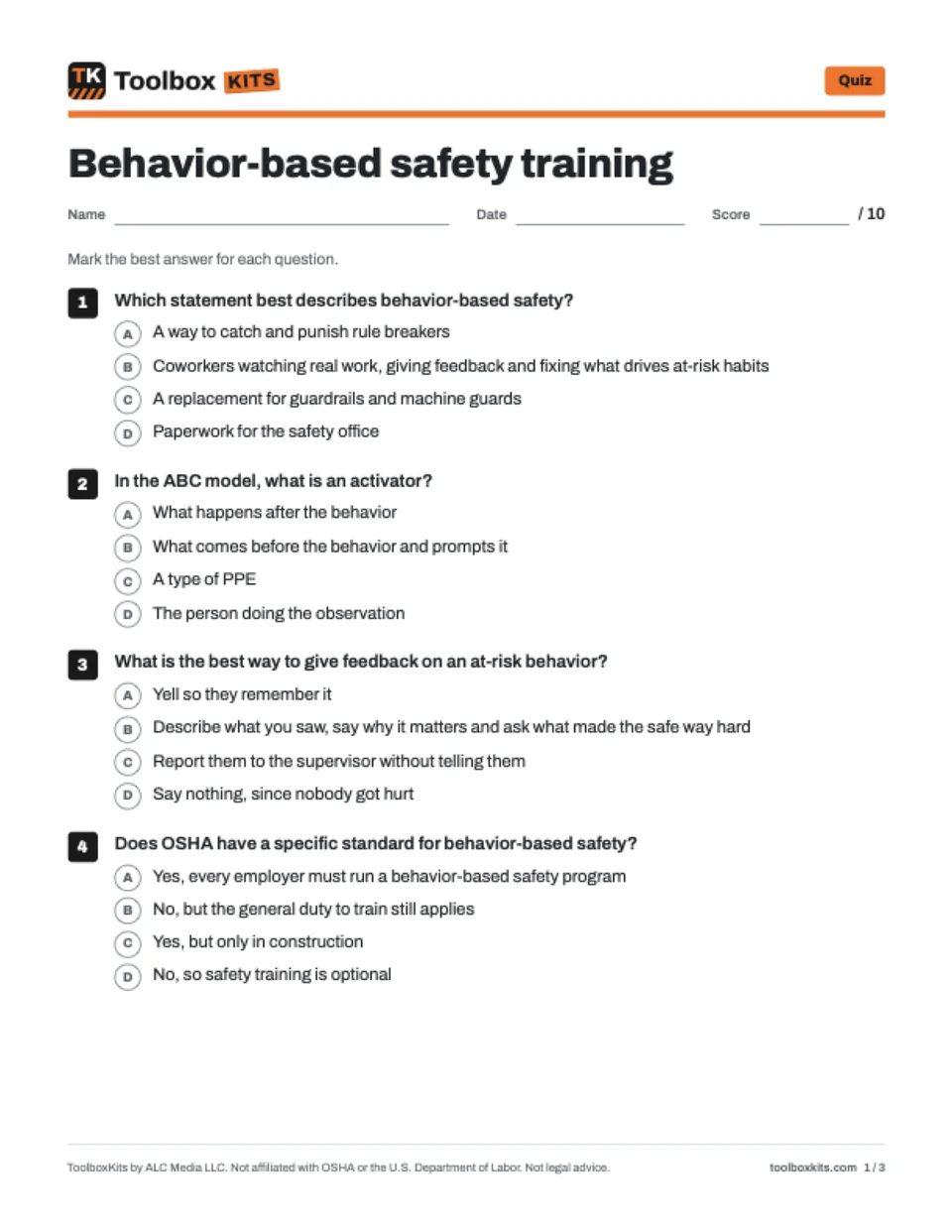 Quiz
- Answer key
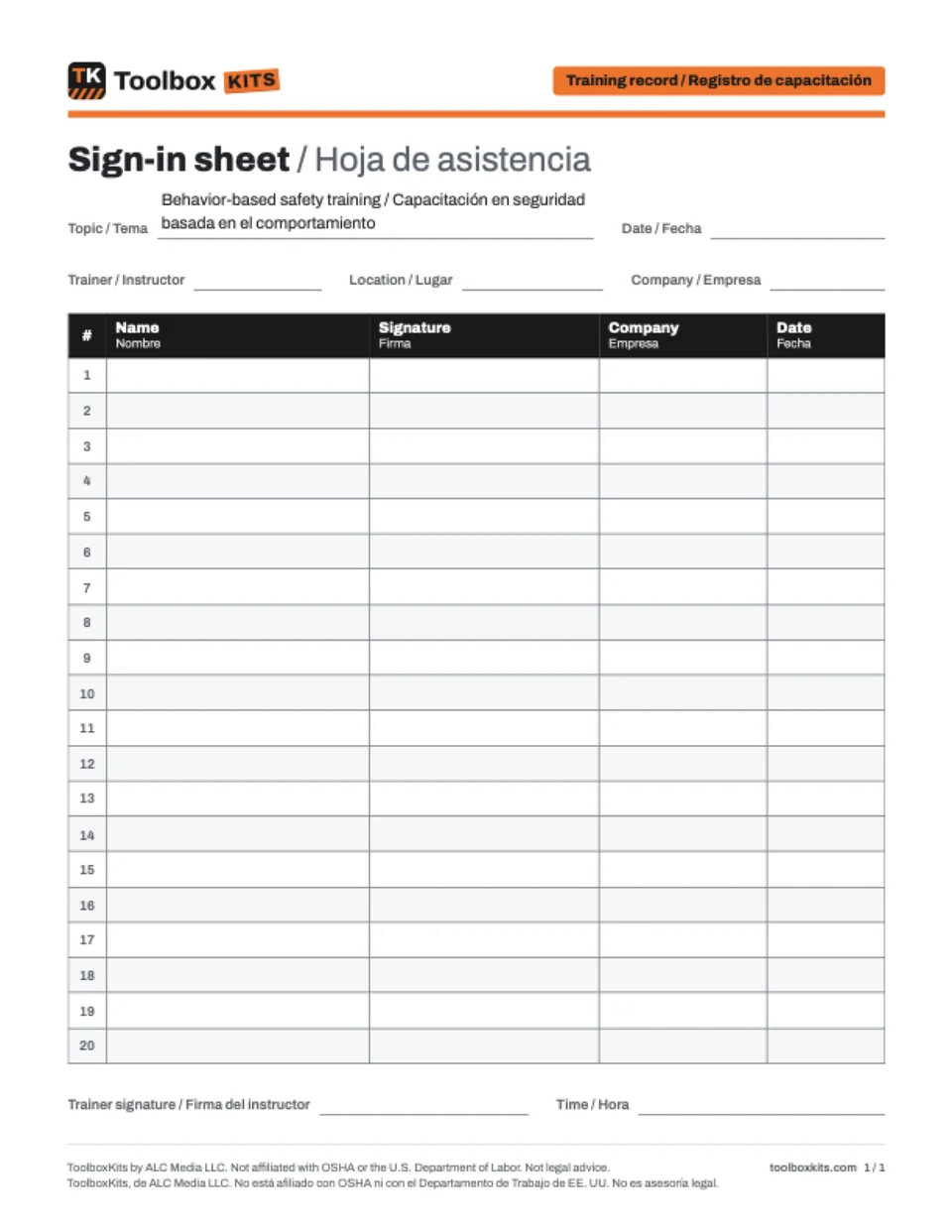 Sign-in sheet
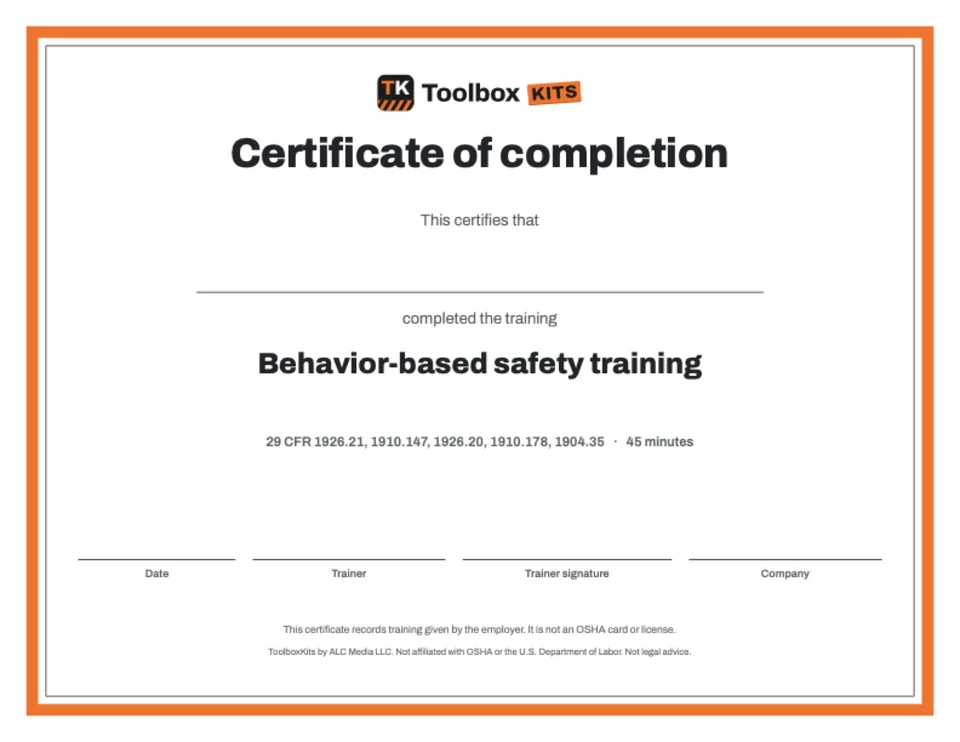 Certificate
- Crew handout
Try it
Try the quiz
Three questions from this topic. Pick an answer to see the right one and the OSHA paragraph.
Question 1 of 3
What is the main goal of a behavior-based safety observation?
The rule
What OSHA requires
Plain-language summary. Each line links to the exact paragraph of the regulation.
OSHA has no specific standard for behavior-based safety, but the general duty to train still applies: in construction, the employer must instruct each employee in the recognition and avoidance of unsafe conditions and the regulations applicable to their work environment.
“The employer shall instruct each employee in the recognition and avoidance of unsafe conditions and the regulations applicable to his work environment to control or eliminate any hazards or other exposure to illness or injury.”
In construction, the employer is responsible for starting and maintaining the safety programs needed to comply with OSHA's construction standards.
“It shall be the responsibility of the employer to initiate and maintain such programs as may be necessary to comply with this part.”
Those safety programs must provide for frequent and regular inspections of job sites, materials and equipment by competent persons designated by the employer.
“Such programs shall provide for frequent and regular inspections of the job sites, materials, and equipment to be made by competent persons designated by the employers.”
In construction, using any machinery, tool, material or equipment that does not comply with an applicable requirement is prohibited. It must be tagged as unsafe, have its controls locked so it is inoperable, or be physically removed from its place of operation.
“The use of any machinery, tool, material, or equipment which is not in compliance with any applicable requirement of this part is prohibited.”
In construction, only employees qualified by training or experience may operate equipment and machinery.
“The employer shall permit only those employees qualified by training or experience to operate equipment and machinery.”
In construction, a standard that requires training creates a separate duty for each employee it covers. The employer must train each affected employee in the manner the standard requires, and each failure to train an employee may be considered a separate violation.
“The employer must train each affected employee in the manner required by the standard, and each failure to train an employee may be considered a separate violation.”
Under OSHA's recordkeeping rule, the employer must set up a reasonable procedure for employees to report work-related injuries and illnesses promptly and accurately. A procedure that would deter or discourage a reasonable employee from accurately reporting is not reasonable.
“A procedure is not reasonable if it would deter or discourage a reasonable employee from accurately reporting a workplace injury or illness”
Employers must not discharge or in any manner discriminate against an employee for reporting a work-related injury or illness. Section 11(c) of the OSH Act also prohibits discriminating against an employee for reporting a work-related fatality, injury or illness (29 CFR 1904.36).
“You must not discharge or in any manner discriminate against any employee for reporting a work-related injury or illness.”
Who must be trained
OSHA has no training rule specific to behavior-based safety. In construction, the employer must instruct each employee in the recognition and avoidance of unsafe conditions and the regulations applicable to their work environment (29 CFR 1926.21(b)(2)). A construction standard that requires training creates a separate duty for each employee it covers (29 CFR 1926.20(f)(2)).
Common questions
Questions people ask
Is there a printable behavior-based safety toolbox talk PDF?
Yes. This behavior-based safety talk is free to download as a printable PDF in English and Spanish, with a sign-in table to record who attended. It works for construction crews, warehouses, plants and any team starting safety observations.
What are good behavior-based safety meeting topics?
Good topics include giving useful feedback, safe habits worth keeping, shortcuts and what drives them, staying out of the line of fire, PPE habits and reporting close calls. Pick one behavior your crew sees every day and spend the whole meeting on it. Rotate who leads so the talks do not get stale.
Is there a behavior-based safety training PowerPoint or presentation?
This free talk is written to be read aloud, so you can run it without slides. If you want a behavior-based safety presentation with slides for observation training, use the training kit option on this page. Pair it with a few minutes of practice observations on a real task.
What goes in a safety observation program template?
Keep the card short: the date, the area, the task watched, the safe actions seen, the risky actions seen, what was discussed and any fix that follows. Leave names off so the card is about learning, not blame. Review the cards together as a crew to spot patterns and decide what to fix first.
Does OSHA require behavior-based safety training for employees?
No. OSHA has no specific standard for behavior-based safety, but in construction the employer must still instruct each employee in the recognition and avoidance of unsafe conditions and the regulations that apply to their work environment (29 CFR 1926.21(b)(2)). A behavior-based program can support that training, but it does not replace it or any other duty under OSHA's standards.
Free to share
Use this talk for free
You can print, share and adapt this talk at no cost under the Creative Commons BY-NC-SA 4.0 license. Please credit ToolboxKits with a link.