

Free 5-minute toolbox talkBehavior and attitudeEnglish and Spanish
Complacency toolbox talk: stay alert on routine work
OSHA has no specific standard for complacency, but the general duty to train still applies. What OSHA requires: OSHA has no specific standard for complacency, but the general duty to train still applies: in construction, the employer must instruct each employee in the recognition and avoidance of unsafe conditions and the regulations applicable to their work environment (29 CFR 1926.21(b)(2)).
A free 5-minute talk on complacency, the habit of doing routine work on autopilot until something goes wrong. Use it as a full toolbox talk or as a quick complacency safety moment.
Updated October 29, 2026 · Based on 29 CFR 1926.21
Read it out loud
Free 5-minute toolbox talk
Read it out loud to your crew. It takes about 5 minutes.
Start with a question
Think of a task you have done so many times you could do it in your sleep. When was the last time you stopped and really looked at the hazards in it?
Why it matters
Complacency is not laziness. It catches skilled, experienced people, because doing a job over and over without getting hurt makes the danger feel smaller than it is. The hazards have not changed, only our attention has. That gap is where shortcuts, missed steps and nasty surprises happen.
Key points
Know what complacency looks like
Complacency is feeling so comfortable with a task that you stop paying attention to the risks. It looks like skipping a step because it is always fine, leaving off PPE for a quick job or not checking equipment because it worked yesterday.
More
If you catch yourself thinking 'I could do this in my sleep,' that is your cue to slow down.
Watch for the warning signs
Rushing, daydreaming, shortcuts, ignoring small problems and feeling that the rules are only for new people are all warning signs. Fatigue, long stretches of the same work and busy days make it worse.
More
Speak up when you see it in a coworker, expect them to do the same for you, and thank people who speak up.
Treat every job like a new job
Before you start, take a moment to look at what is different today: the weather, the ground, the people around you and the equipment. Walk the area and ask what could go wrong. Conditions change even when the task does not.
Do your checks for real
Pre-use checks and inspections catch what memory misses on routine work, so do them for real instead of just signing the sheet. In construction, the employer's safety program must provide for frequent and regular inspections of job sites, materials and equipment by competent persons.
More
On construction work, equipment that does not meet the rules must be tagged as unsafe, have its controls locked so it cannot be used, or be removed from where it operates.
29 CFR 1926.20(b)(2) · 29 CFR 1926.20(b)(3)
Break up the routine
Rotate tasks when you can, take your breaks and switch who leads the toolbox talk so it does not turn into background noise. Ask a newer worker to walk through the hazards of a job, because fresh eyes catch things the rest of us stop seeing.
More
Mix up the topics and get the crew talking instead of just listening.
Keep training fresh
OSHA has no specific standard for complacency, but the general duty to train still applies. In construction, the employer must instruct each employee in the recognition and avoidance of unsafe conditions and the regulations that apply to their work environment.
More
Refresher talks like this one keep the hazards in front of the crew, especially on jobs you have done for years.
Scenario
Picture this: A crew has set up the same way on job after job without a problem. On this job, the worker who usually guides the concrete truck is out, and nobody walks the backing path because 'we always set up the same way.' The truck starts backing toward a trench that was not there on the last job. What should the crew have done before the truck moved, and who should have spoken up?
Ask the crew
- Which jobs do we do so often that we might be running on autopilot?
- What shortcuts have you seen on routine work, and why do people take them?
- How can we remind each other to slow down without it feeling like criticism?
- What changed on this site today that could catch someone off guard?
Takeaway
The task may be routine, but the hazards never are, so look at every job like it is your first.
Trainer: ______________________ Date: ____________
Credit: ToolboxKits, https://toolboxkits.com/topics/complacency/ (CC BY-NC-SA 4.0)
The poster is also inside the paid kits.
Audit-ready records in 60 seconds
Fill in your crew and download a filled sign-in sheet for this talk. Everything is made in your browser. Names are never uploaded or stored.
Start a sign-off
Crew scan a QR code on their own phones, type their name and sign with a finger. You see the names arrive and download the signed sheet. Free, no account.
Kits
Get the kit
No subscription needed. Buy only the kit you need.
Toolbox talk kit
$4.99
- 5-minute talk, English PDF
- 5-minute talk, Spanish PDF
- Editable mini-deck (English and Spanish)
- One-page crew handout (English and Spanish)
- Bilingual sign-in sheet
- 3-question quiz with answer key (English and Spanish)
- One-page bilingual poster
- Audit-ready records in 60 seconds: fill in your crew and get a sign-in sheet and a certificate for every worker
Training kit
$9
Editable PowerPoint, 37 slides
- Editable PowerPoint with trainer notes on every slide
- Trainer guide PDF with timing and discussion tips
- 10-question quiz and answer key
- Sign-in sheet and certificate of completion with fillable fields
- One-page crew handout
- Full Spanish version of everything
- One-page bilingual poster
- Audit-ready records in 60 seconds: fill in your crew and get a sign-in sheet and a certificate for every worker
- Instant download
- Secure checkout by Stripe
- 30-day refund, no questions
Need many topics? All Access gives you every kit for $99 a year.
Inside the kit
See what is in the kit
What is in the kit
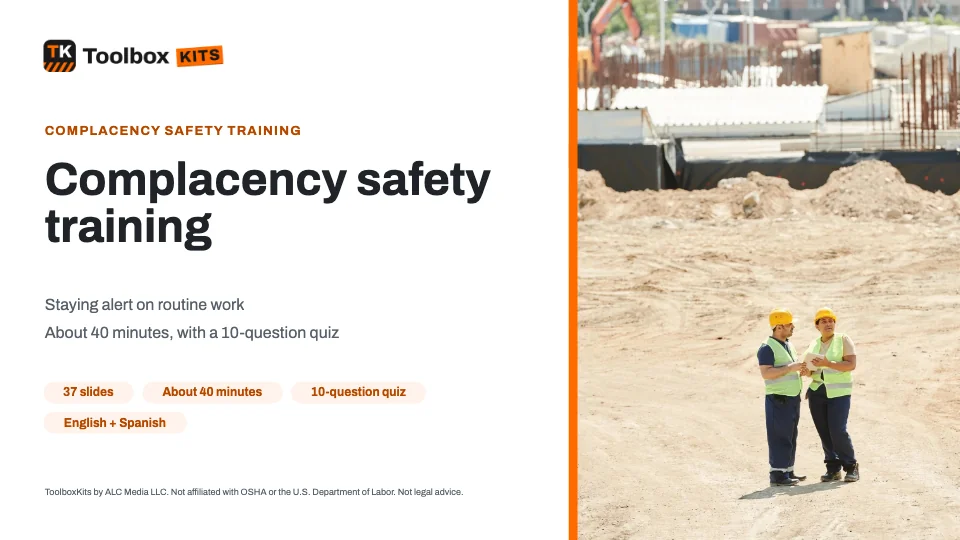 Editable PowerPoint
- Trainer guide
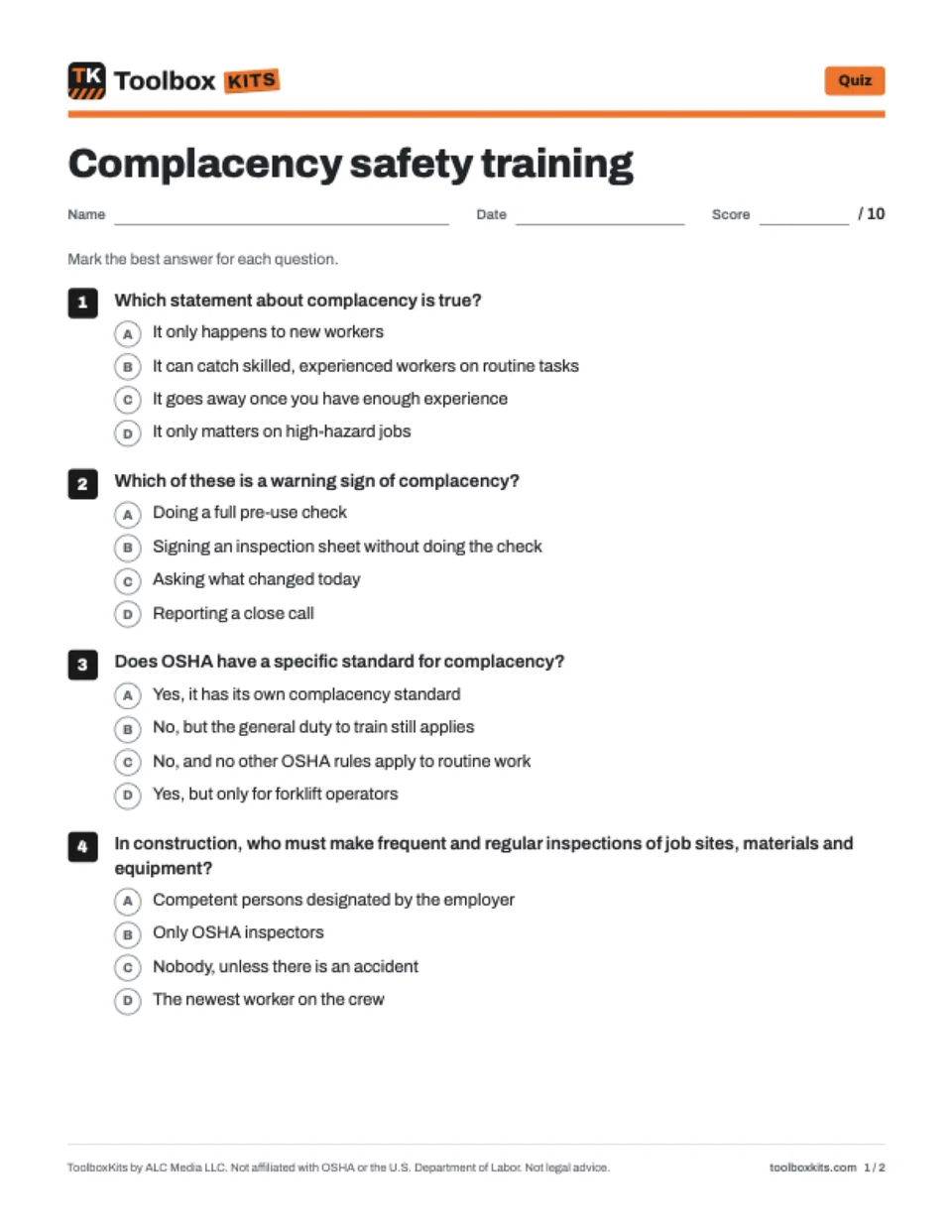 Quiz
- Answer key
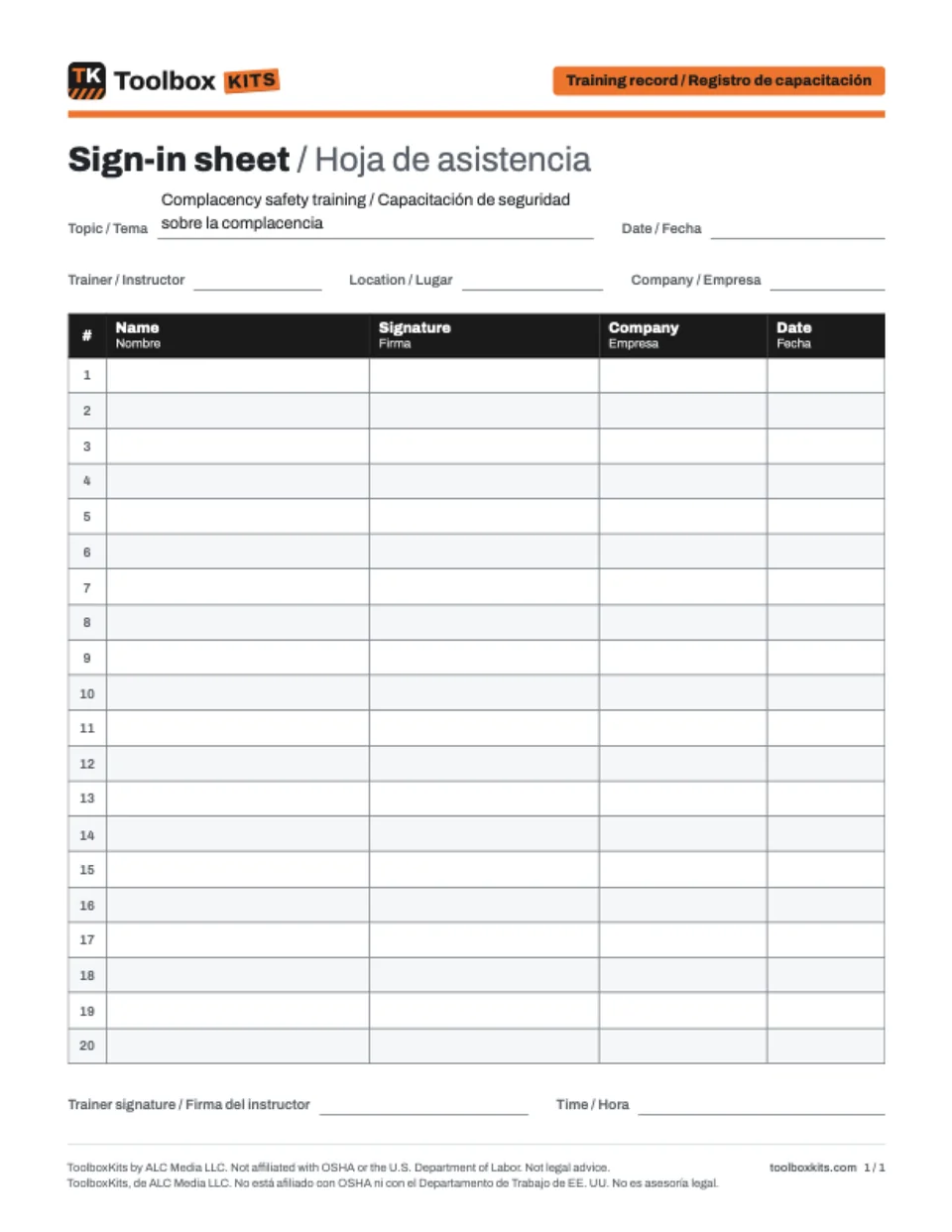 Sign-in sheet
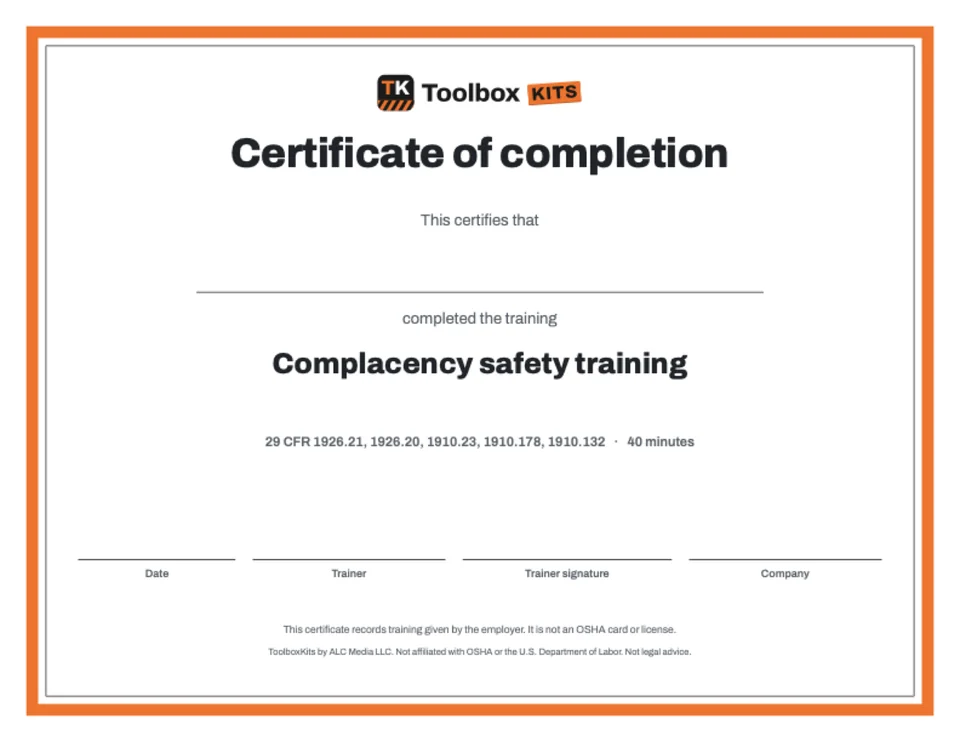 Certificate
- Crew handout
Try it
Try the quiz
Three questions from this topic. Pick an answer to see the right one and the OSHA paragraph.
Question 1 of 3
What is complacency?
The rule
What OSHA requires
Plain-language summary. Each line links to the exact paragraph of the regulation.
OSHA has no specific standard for complacency, but the general duty to train still applies: in construction, the employer must instruct each employee in the recognition and avoidance of unsafe conditions and the regulations applicable to their work environment.
“The employer shall instruct each employee in the recognition and avoidance of unsafe conditions and the regulations applicable to his work environment to control or eliminate any hazards or other exposure to illness or injury.”
In construction, the employer is responsible for starting and maintaining the safety programs needed to comply with the construction standards.
“It shall be the responsibility of the employer to initiate and maintain such programs as may be necessary to comply with this part.”
In construction, the employer's safety programs must provide for frequent and regular inspections of job sites, materials and equipment by competent persons designated by the employer.
“Such programs shall provide for frequent and regular inspections of the job sites, materials, and equipment to be made by competent persons designated by the employers.”
In construction, using any machinery, tool, material or equipment that does not comply with an applicable requirement is prohibited. It must be tagged as unsafe, have its controls locked so it is inoperable, or be physically removed from its place of operation.
“The use of any machinery, tool, material, or equipment which is not in compliance with any applicable requirement of this part is prohibited.”
In construction, only employees qualified by training or experience may operate equipment and machinery.
“The employer shall permit only those employees qualified by training or experience to operate equipment and machinery.”
In construction, the employer is responsible for requiring the wearing of appropriate personal protective equipment in all operations where there is an exposure to hazardous conditions.
“The employer is responsible for requiring the wearing of appropriate personal protective equipment in all operations where there is an exposure to hazardous conditions”
In general industry, defective or damaged personal protective equipment must not be used.
“Defective or damaged personal protective equipment shall not be used.”
In general industry, when the employer has reason to believe a trained employee no longer has the understanding and skill to use required PPE properly, the employer must retrain that employee. One example is when gaps in the employee's knowledge or use of assigned PPE show the skill was not retained (29 CFR 1910.132(f)(3)(iii)). This applies to the PPE sections listed in 29 CFR 1910.132(g), which include eye and face, head, foot and hand protection.
“When the employer has reason to believe that any affected employee who has already been trained does not have the understanding and skill required by paragraph (f)(2) of this section, the employer shall retrain each such employee.”
Common questions
Questions people ask
Is there a printable complacency toolbox talk PDF?
Yes. This complacency talk is free, and you can print it as a PDF in English or Spanish with a sign-in table. It works for construction crews and for any team that does the same tasks day after day.
What should a safety talk on complacency cover?
Explain what complacency is, the warning signs like rushing and skipped steps, and practical fixes like real pre-use checks and speaking up. Tie it to a routine task your crew does every week so it feels real. Leave time for people to share close calls from routine work.
Why is complacency a risk on construction sites?
Construction sites change every day, but crews repeat the same tasks, so it is easy to miss a new hazard like an open trench, a moved guardrail or a new crew working overhead. OSHA has no specific standard for complacency, but construction employers must instruct each employee to recognize and avoid unsafe conditions (29 CFR 1926.21(b)(2)). Their safety programs must also provide for frequent and regular inspections by competent persons (29 CFR 1926.20(b)(2)).
How do you run a quick complacency safety moment?
Pick one routine task the crew is doing today and ask what could go wrong with it. Have someone name a step that tends to get skipped, then agree to do it every time this week. It only takes a few minutes and works well at the start of a shift.
Is there a complacency safety presentation for a longer meeting?
This free talk is written to be read aloud, so you can run it without slides. If you want a slide presentation, use the training kit option on this page. Good safety meeting topics to pair with complacency include fatigue, housekeeping and pre-use equipment checks.
Free to share
Use this talk for free
You can print, share and adapt this talk at no cost under the Creative Commons BY-NC-SA 4.0 license. Please credit ToolboxKits with a link.