

Free 5-minute toolbox talkBehavior and attitudeEnglish and Spanish
Communication toolbox talk for bilingual crews
A tag on a valve, switch or piece of equipment is there to stop you before you get hurt. What OSHA requires: On construction sites, the employer must instruct each employee in recognizing and avoiding unsafe conditions and in the regulations that apply to their work environment (29 CFR 1926.21(b)(2)).
A 5-minute talk on making sure every safety message gets through on a crew that speaks more than one language. It covers training people understand, checking for understanding, labels and tags, signals and a shared stop word.
Updated October 29, 2026 · Based on 29 CFR 1926.21, 29 CFR 1910.1200
Read it out loud
Free 5-minute toolbox talk
Read it out loud to your crew. It takes about 5 minutes.
Start with a question
If you shouted a warning right now, would every person on this crew understand it in time to move?
Why it matters
A lot of the safety on a job depends on messages getting through: the morning plan, a shouted warning, a hand signal to an operator, a tag on a switch, a label on a drum. On a crew that speaks more than one language, any of those messages can get lost without anyone noticing. A nod does not always mean someone understood. Clear communication is a safety control, just like a guard or a harness.
Key points
Train in a way people understand
OSHA's general industry rules for walking-working surfaces put it plainly: the employer must provide information and training to each employee in a manner the employee understands. If a talk is only in English and part of the crew mostly speaks Spanish, the talk did not do its job.
More
Use both languages, short words and pictures, and show the task instead of only describing it.
Check for understanding, not nods
" and take silence as a yes. Ask people to say the plan back in their own words, or to show you the step. For important messages, use three-way communication: you say it, the other person repeats it back, and you confirm it or correct it.
More
If you do not understand something, say so, and nobody on this crew should give you a hard time for asking.
Labels and safety data sheets
Chemical labels in the workplace must be legible, in English, and prominently displayed on the container or readily available in the work area. Employers with employees who speak other languages may add the information in their language, as long as it is also presented in English.
More
If you cannot read a label or a safety data sheet, ask before you use the product, not after.
Tags only work if you can read them
A tag on a valve, switch or piece of equipment is there to stop you before you get hurt. In general industry, the signal word and main message on an accident prevention tag must be understandable to all employees who may be exposed to the hazard.
More
If you find a tag you cannot read, leave the equipment alone and ask before you touch it.
Agree on signals before the work starts
Hand signals and radio calls only work if everyone means the same thing. On crane work, the operator, signal person and lift director (if there is one) must be able to effectively communicate in the language used.
More
For any equipment, agree on the signals with the operator before work starts, and do not switch to new ones partway through the job.
Anyone can call stop
Pick one stop word and one stop hand signal that the whole crew knows in both languages, like "Stop" and "Alto," and practice them. On crane work, the operator must obey a stop or emergency stop signal, no matter who gives it.
More
Make it the crew's habit on every job: when anyone calls stop, everyone freezes until it is clear.
Scenario
Picture this: A crew is pouring a slab. At the start of the shift, the foreman runs through the plan fast, in English only, and two new laborers who mostly speak Spanish nod along. Later, the pump operator starts to swing the boom and someone shouts a warning in English. One of the new laborers keeps working right under the boom. Nobody had taught him the stop word or checked that he understood the plan. What should have happened at the start of the shift?
Ask the crew
- What is our stop word and stop signal, and does everyone here know it in English and Spanish?
- How can we check that someone understood the plan, not just nodded?
- Which labels, signs or tags on this job are hard for some of us to read?
- Who on this crew can help translate, and what do we do when that person is not here?
Takeaway
Say it simply, in a language each person understands, have them say it back, and make sure everyone knows the stop signal.
Trainer: ______________________ Date: ____________
Credit: ToolboxKits, https://toolboxkits.com/topics/safety-communication/ (CC BY-NC-SA 4.0)
The poster is also inside the paid kits.
Audit-ready records in 60 seconds
Fill in your crew and download a filled sign-in sheet for this talk. Everything is made in your browser. Names are never uploaded or stored.
Start a sign-off
Crew scan a QR code on their own phones, type their name and sign with a finger. You see the names arrive and download the signed sheet. Free, no account.
Kits
Get the kit
No subscription needed. Buy only the kit you need.
Toolbox talk kit
$4.99
- 5-minute talk, English PDF
- 5-minute talk, Spanish PDF
- Editable mini-deck (English and Spanish)
- One-page crew handout (English and Spanish)
- Bilingual sign-in sheet
- 3-question quiz with answer key (English and Spanish)
- One-page bilingual poster
- Audit-ready records in 60 seconds: fill in your crew and get a sign-in sheet and a certificate for every worker
Training kit
$9
Editable PowerPoint, 39 slides
- Editable PowerPoint with trainer notes on every slide
- Trainer guide PDF with timing and discussion tips
- 10-question quiz and answer key
- Sign-in sheet and certificate of completion with fillable fields
- One-page crew handout
- Full Spanish version of everything
- One-page bilingual poster
- Audit-ready records in 60 seconds: fill in your crew and get a sign-in sheet and a certificate for every worker
- Instant download
- Secure checkout by Stripe
- 30-day refund, no questions
Need many topics? All Access gives you every kit for $99 a year.
Inside the kit
See what is in the kit
What is in the kit
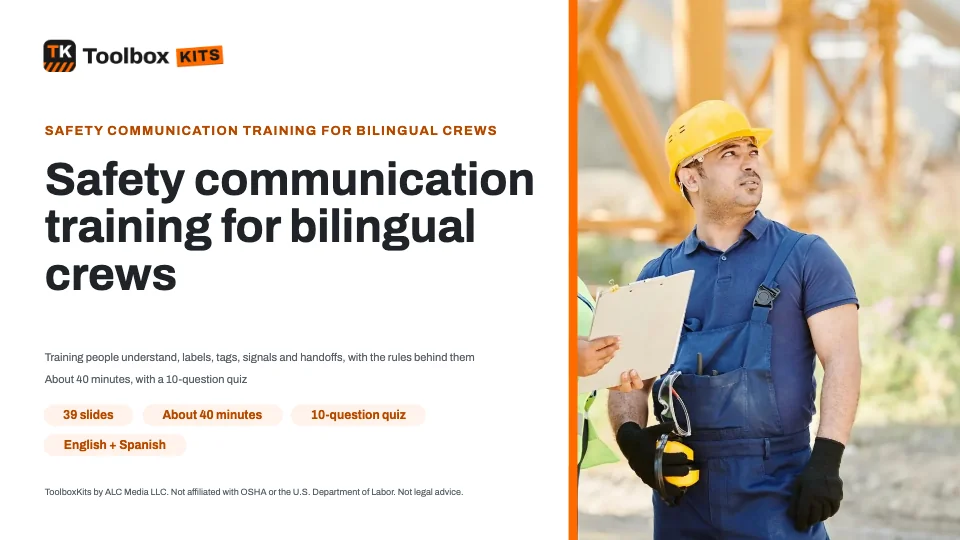 Editable PowerPoint
- Trainer guide
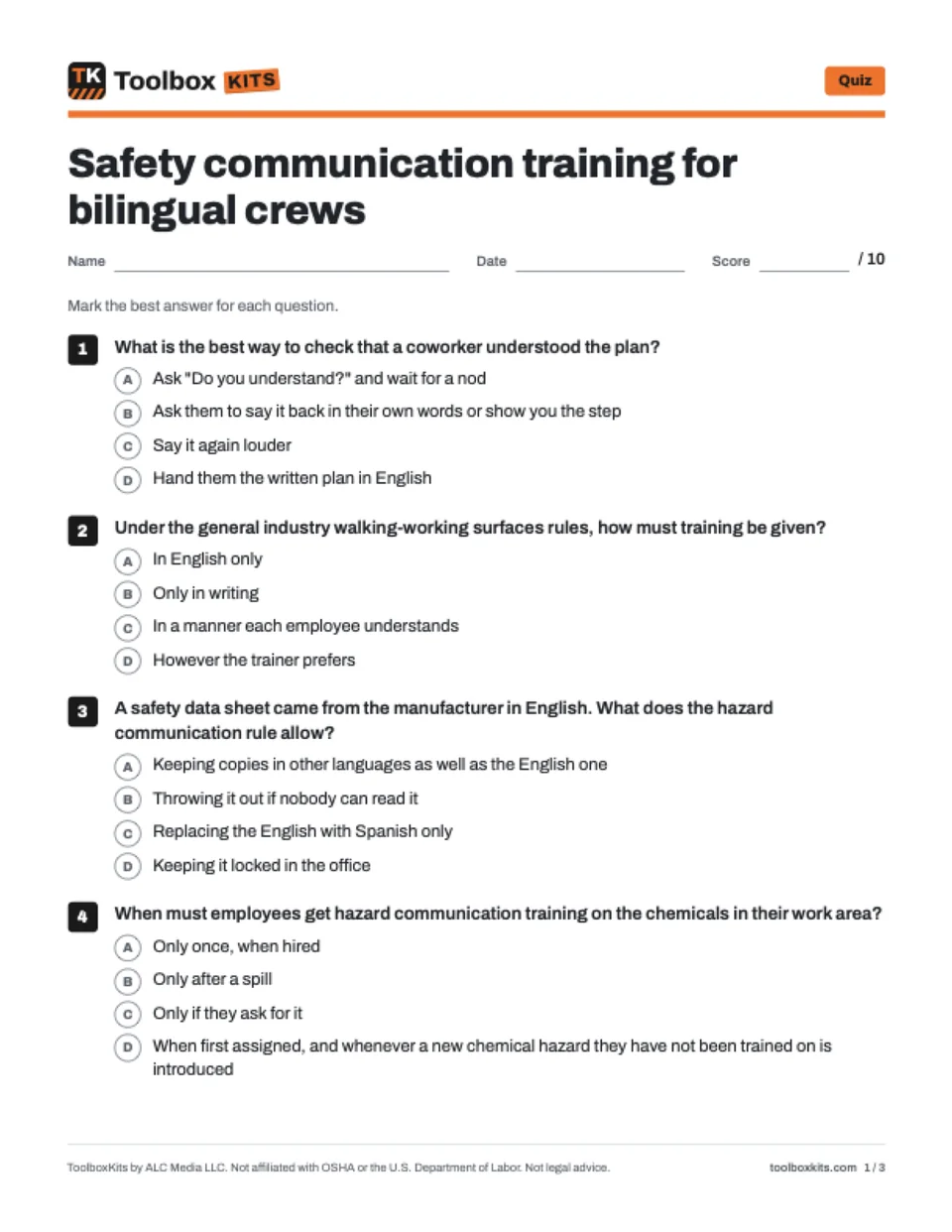 Quiz
- Answer key
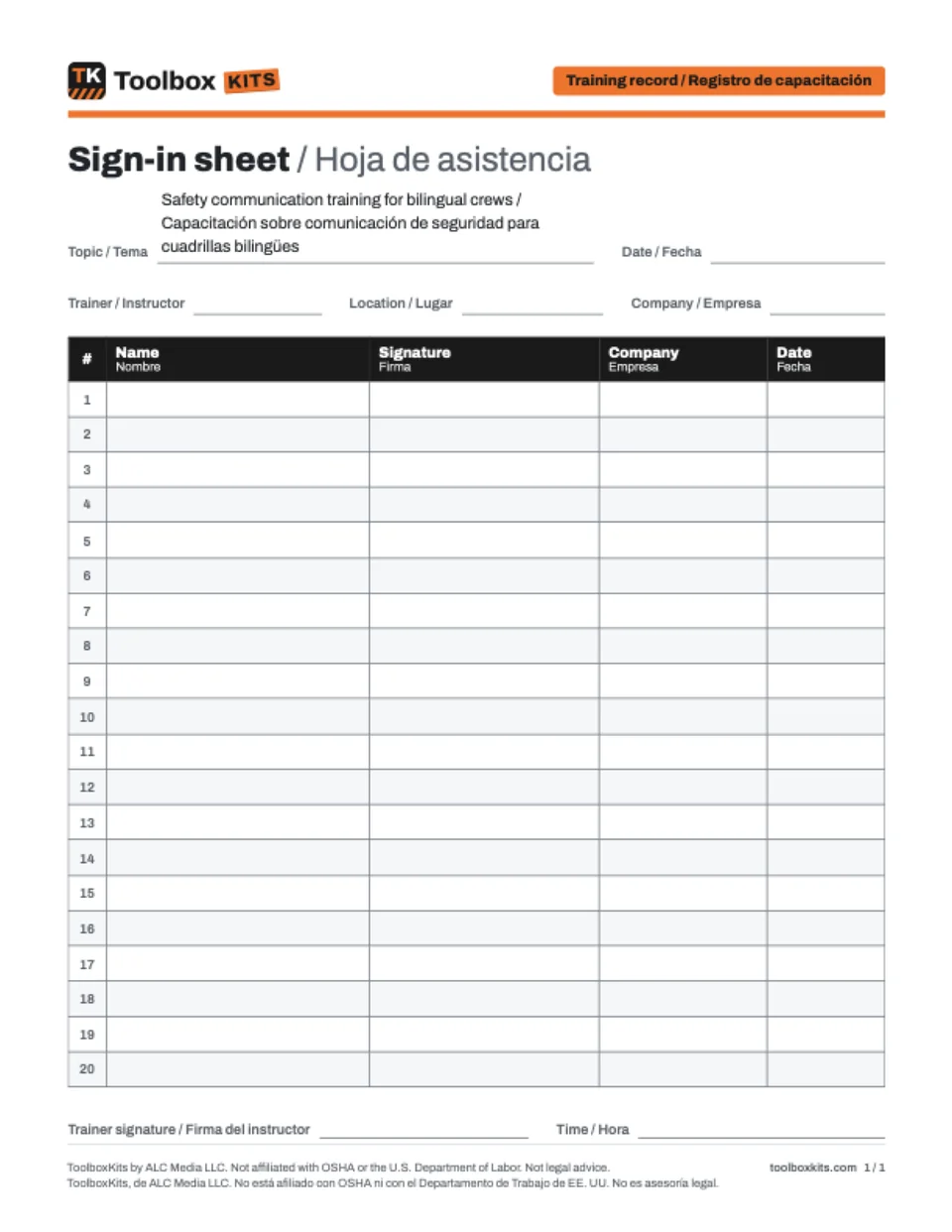 Sign-in sheet
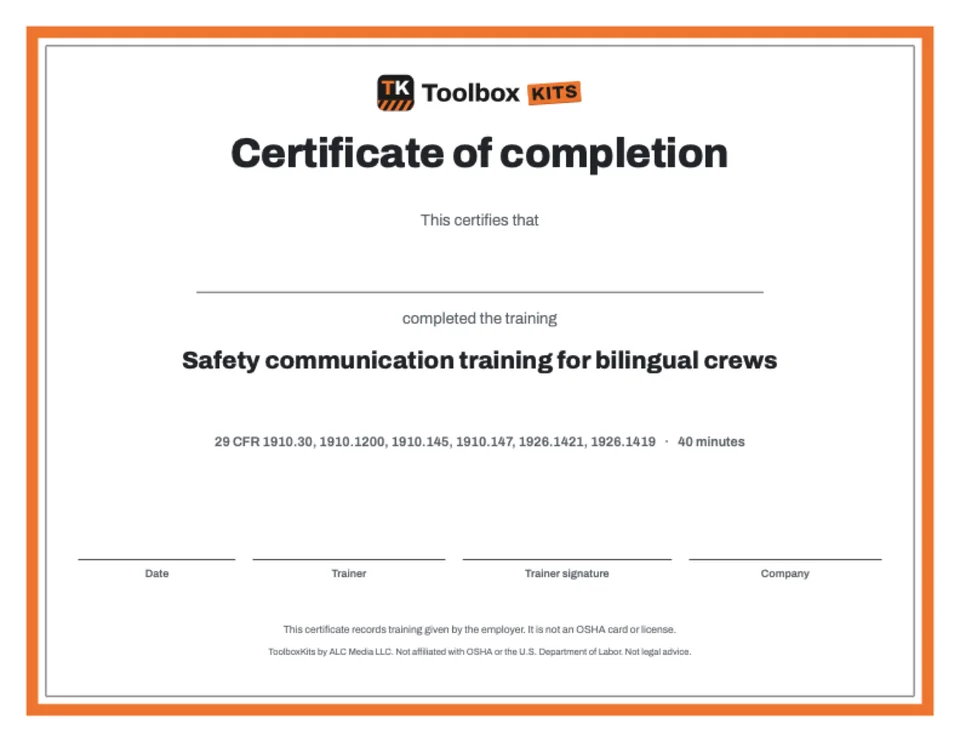 Certificate
- Crew handout
Try it
Try the quiz
Three questions from this topic. Pick an answer to see the right one and the OSHA paragraph.
Question 1 of 3
A coworker nods when you explain the lift plan, but you are not sure they understood. What is the best thing to do?
The rule
What OSHA requires
Plain-language summary. Each line links to the exact paragraph of the regulation.
On construction sites, the employer must instruct each employee in recognizing and avoiding unsafe conditions and in the regulations that apply to their work environment.
“The employer shall instruct each employee in the recognition and avoidance of unsafe conditions and the regulations applicable to his work environment to control or eliminate any hazards or other exposure to illness or injury.”
Under the general industry walking-working surfaces rules, the employer must provide information and training to each employee in a manner the employee understands.
“The employer must provide information and training to each employee in a manner that the employee understands.”
Confined space training in construction must be provided to each affected employee in both a language and vocabulary that the employee can understand.
“In both a language and vocabulary that the employee can understand”
Employees must get effective information and training on the hazardous chemicals in their work area when they are first assigned, and whenever a new chemical hazard they have not been trained on is introduced. Construction work follows the same hazard communication rule (29 CFR 1926.59).
“Employers shall provide employees with effective information and training on hazardous chemicals in their work area at the time of their initial assignment”
Workplace chemical labels must be legible, in English, and prominently displayed on the container or readily available in the work area throughout each shift. Employers with employees who speak other languages may add the information in their language, as long as it is also presented in English.
“Employers having employees who speak other languages may add the information in their language to the material presented, as long as the information is presented in English as well.”
Safety data sheets from the manufacturer or importer must be in English, and the employer may keep copies in other languages as well.
“although the employer may maintain copies in other languages as well”
In general industry, the signal word and main message on an accident prevention tag must be understandable to all employees who may be exposed to the hazard. This tag rule does not apply to construction or agriculture (29 CFR 1910.145(f)(1)(ii)).
“The signal word and the major message shall be understandable to all employees who may be exposed to the identified hazard.”
On crane work, the operator, signal person and lift director (if there is one) must be able to effectively communicate in the language used.
“The operator, signal person and lift director (if there is one), must be able to effectively communicate in the language used.”
On crane work, anyone who becomes aware of a safety problem must alert the operator or signal person by giving the stop or emergency stop signal.
“Anyone who becomes aware of a safety problem must alert the operator or signal person by giving the stop or emergency stop signal.”
The crane operator must obey a stop or emergency stop signal, no matter who gives it.
“The operator must obey a stop (or emergency stop) signal, irrespective of who gives it.”
Who must be trained
In construction, the employer must instruct each employee in recognizing and avoiding unsafe conditions and the regulations that apply to their work environment (29 CFR 1926.21(b)(2)). Employees must get effective information and training on hazardous chemicals in their work area at the time of their initial assignment (29 CFR 1910.1200(h)(1)); construction work follows the same rule (29 CFR 1926.59).
When to retrain
Additional hazard communication training is required whenever a new chemical hazard the employees have not previously been trained about is introduced into their work area (29 CFR 1910.1200(h)(1)).
Common questions
Questions people ask
What should a communication toolbox talk cover?
Cover how the crew gets the daily plan, how you check that people understood it, the stop word and hand signals everyone uses, and how to read the labels, signs and tags on your job. Make it a conversation, not a lecture, and tie it to the work the crew is doing today. Keep a sign-in sheet so you have a record of who attended.
What is three-way communication in a safety talk?
Three-way communication is a simple way to confirm a message. The sender gives the message, the receiver repeats it back in their own words, and the sender confirms it is right or corrects it. Use it for lockout steps, lift plans, traffic control and anything else where a misunderstanding could hurt someone.
Where can I find free bilingual safety meeting topics?
This talk, like the other free talks on ToolboxKits, comes in English and Spanish with a printable sign-in sheet. Good bilingual safety meeting topics to start with are this communication talk, hazard communication, lockout tagout, working around heavy equipment and heat stress. Give each talk in both languages, or hand out the English and Spanish versions so each person can read along in the language they know best.
Do safety meetings have to be bilingual?
If part of the crew does not understand the language a talk is given in, the talk is not doing its job. Some OSHA standards spell this out: training under the general industry walking-working surfaces rules must be given in a manner each employee understands (29 CFR 1910.30(d)), and construction confined space training must be in a language and vocabulary the employee can understand (29 CFR 1926.1207(b)(1)). If part of your crew mostly speaks Spanish, give the talk in both languages.
What is a good communication safety moment?
Pick one thing and practice it: the crew's stop word and stop hand signal in English and Spanish. Have everyone say the word and show the signal, then ask one person to explain today's plan back to the group. It is quick, and it shows right away whether the message is getting through.
Free to share
Use this talk for free
You can print, share and adapt this talk at no cost under the Creative Commons BY-NC-SA 4.0 license. Please credit ToolboxKits with a link.