

Free 5-minute toolbox talkBehavior and attitudeEnglish and Spanish
Situational awareness safety moment and toolbox talk
Jobsites change all day. What OSHA requires: OSHA has no specific standard for situational awareness, but the general duty to train still applies: in construction, the employer must instruct each employee in the recognition and avoidance of unsafe conditions and the regulations applicable to their work environment (29 CFR 1926.21(b)(2)).
This free situational awareness talk takes about five minutes to read aloud, or you can use one point as a quick safety moment. It covers how to notice what is around you, understand what it means and stay ahead of what could happen next.
Updated October 29, 2026 · Based on 29 CFR 1926.21
Read it out loud
Free 5-minute toolbox talk
Read it out loud to your crew. It takes about 5 minutes.
Start with a question
Without turning around, can you name everything that is moving behind you right now?
Why it matters
Jobsites change all day. Equipment moves, crews shift, materials pile up and the weather turns. Situational awareness means noticing those changes, understanding what they mean for you, and thinking ahead to what could happen next. When we lose track of what is around us, we can walk into danger without ever seeing it.
Key points
Notice, understand, think ahead
Situational awareness has three steps. First, notice what is around you: people, equipment, edges, loads and surfaces. Second, understand what it means for you, like a truck backing toward your work area. Third, think ahead about what could happen next and what you will do about it.
Scan before you start and when things change
Walk your area at the start of the shift and look up, down and all around. Look for what changed since yesterday: new holes, moved barricades, overhead work, new crews or wet surfaces. Scan again after breaks and whenever something new shows up.
More
Read the signs, too: on construction sites, required safety signs must be visible at all times when work is being performed and removed or covered promptly when the hazard no longer exists.
Watch moving equipment and blind spots
Never walk behind a backing vehicle, and make eye contact with the operator before you get close.
More
On off-highway jobsites, a truck or other motor vehicle with an obstructed view to the rear may be used only if it has a reverse signal alarm audible above the surrounding noise, or if it backs up only when an observer signals that it is safe. In warehouses and plants, forklift drivers must slow down and sound the horn at cross aisles and other places where vision is obstructed.
29 CFR 1926.601(b)(4) · 29 CFR 1910.178(n)(4)
Stay out of the line of fire
Know where you would be if something moved, swung, fell or let go. No one may stand or pass under the elevated portion of a forklift, whether it is loaded or empty.
More
Around cranes, swing radius hazard areas must be marked with control lines, warning lines, railings or similar barriers, or with warning signs and high-visibility markings where barriers are not feasible. Stay outside them unless your job puts you there.
29 CFR 1926.1424(a)(2)(ii) · 29 CFR 1910.178(m)(2)
Cut the distractions
Phones, earbuds, rushing, fatigue and stress all pull your attention away from the work. Put the phone away when you walk through an active area or run equipment. If you are worn out or your mind is somewhere else, tell your lead and take a minute to reset.
Speak up and keep training
If you see a coworker heading into danger, warn them right away, and expect them to do the same for you. OSHA has no specific standard for situational awareness, but the general duty to train still applies.
More
In construction, the employer must instruct each employee in the recognition and avoidance of unsafe conditions and the regulations that apply to their work environment.
Scenario
Picture this: A worker walks back from the parking area while reading a text. A loader is backing up to dump a bucket, and its backup alarm blends into the noise of a nearby saw. A coworker sees the worker step into the loader's path. What should the coworker do right now, and what could the worker have done differently?
Ask the crew
- What changed on this site since yesterday that could catch someone off guard?
- Where are the blind spots and swing zones on this job today?
- What distracts you most at work, and how can we cut it down?
- How should we warn each other when someone is about to walk into danger?
Takeaway
Keep your head up, notice what is changing, and stay one step ahead of the hazard.
Trainer: ______________________ Date: ____________
Credit: ToolboxKits, https://toolboxkits.com/topics/situational-awareness/ (CC BY-NC-SA 4.0)
The poster is also inside the paid kits.
Audit-ready records in 60 seconds
Fill in your crew and download a filled sign-in sheet for this talk. Everything is made in your browser. Names are never uploaded or stored.
Start a sign-off
Crew scan a QR code on their own phones, type their name and sign with a finger. You see the names arrive and download the signed sheet. Free, no account.
Kits
Get the kit
No subscription needed. Buy only the kit you need.
Toolbox talk kit
$4.99
- 5-minute talk, English PDF
- 5-minute talk, Spanish PDF
- Editable mini-deck (English and Spanish)
- One-page crew handout (English and Spanish)
- Bilingual sign-in sheet
- 3-question quiz with answer key (English and Spanish)
- One-page bilingual poster
- Audit-ready records in 60 seconds: fill in your crew and get a sign-in sheet and a certificate for every worker
Training kit
$9
Editable PowerPoint, 39 slides
- Editable PowerPoint with trainer notes on every slide
- Trainer guide PDF with timing and discussion tips
- 10-question quiz and answer key
- Sign-in sheet and certificate of completion with fillable fields
- One-page crew handout
- Full Spanish version of everything
- One-page bilingual poster
- Audit-ready records in 60 seconds: fill in your crew and get a sign-in sheet and a certificate for every worker
- Instant download
- Secure checkout by Stripe
- 30-day refund, no questions
Need many topics? All Access gives you every kit for $99 a year.
Inside the kit
See what is in the kit
What is in the kit
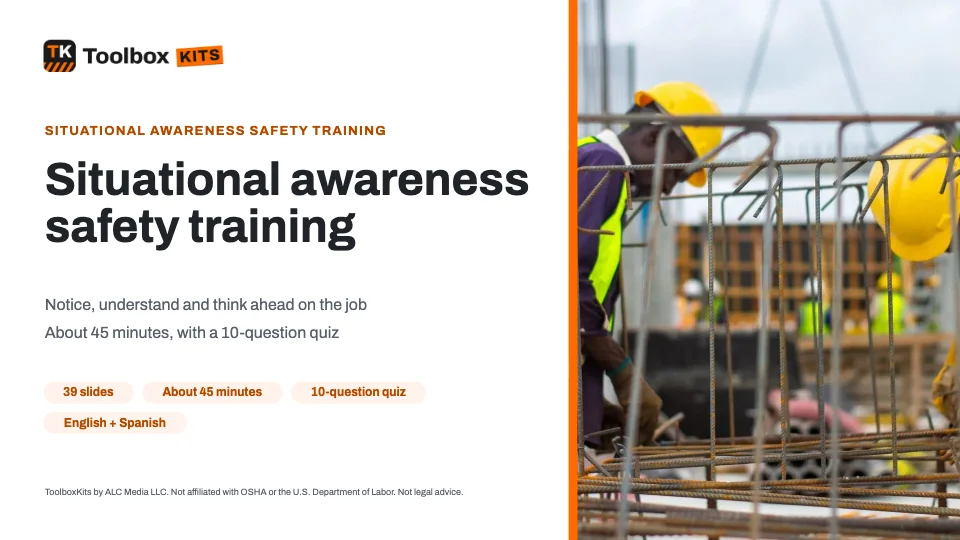 Editable PowerPoint
- Trainer guide
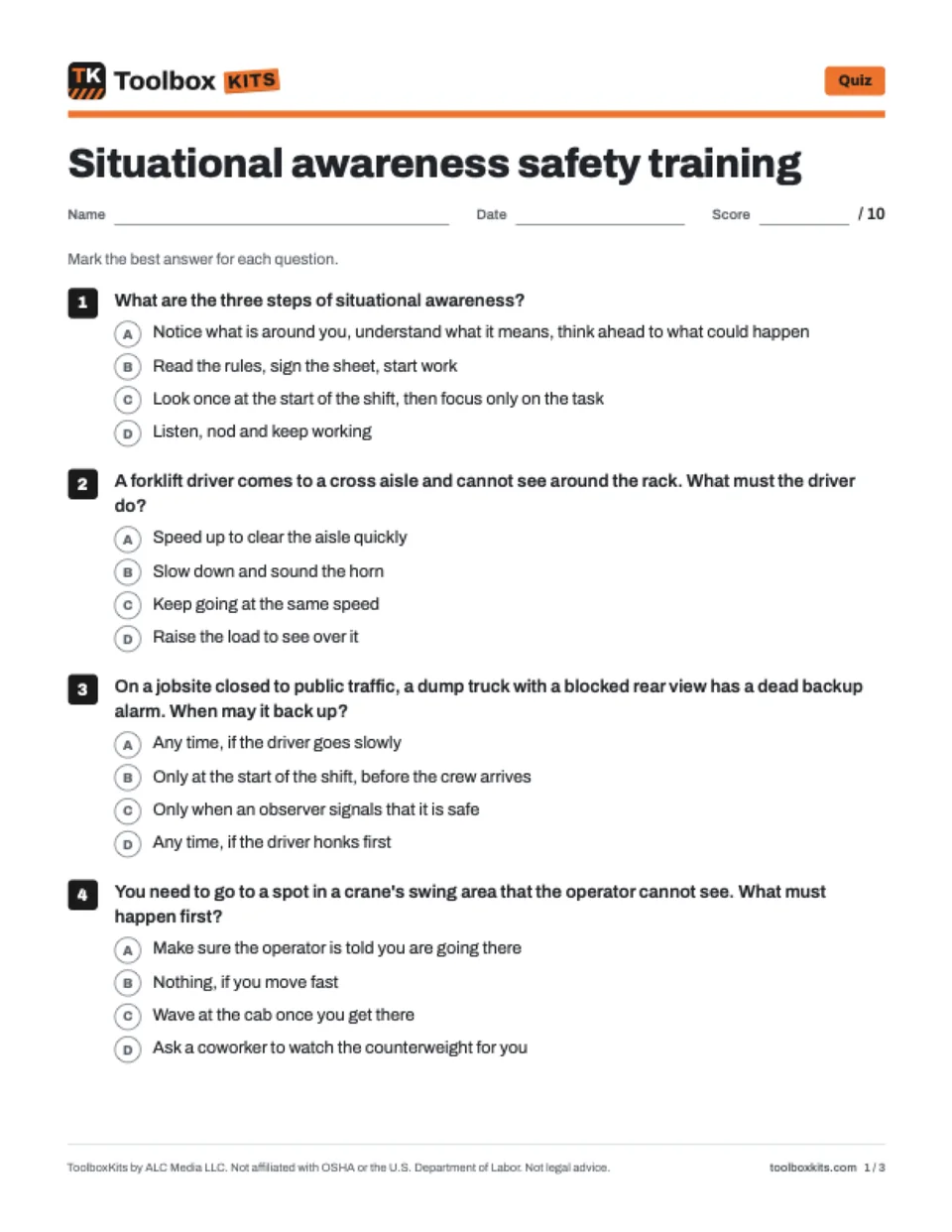 Quiz
- Answer key
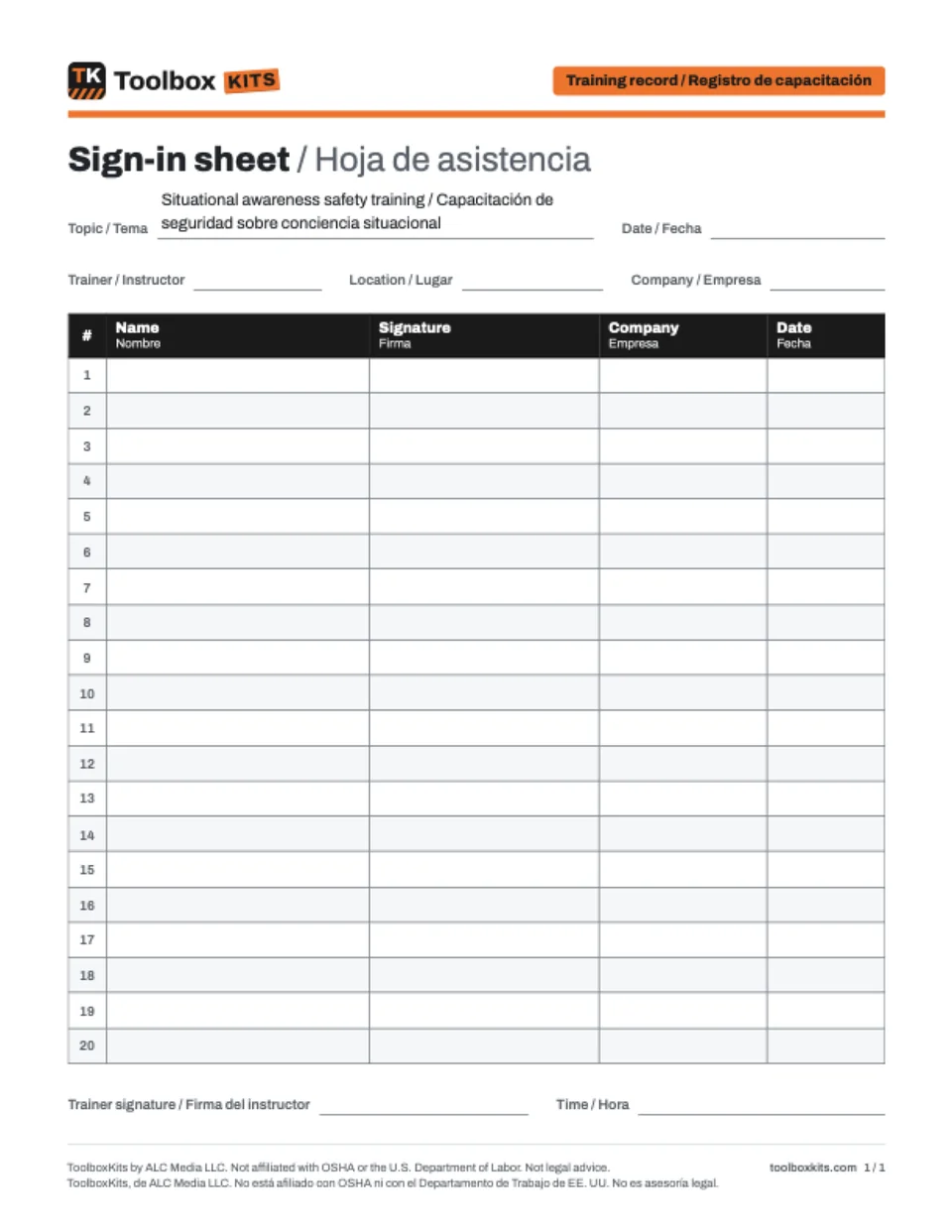 Sign-in sheet
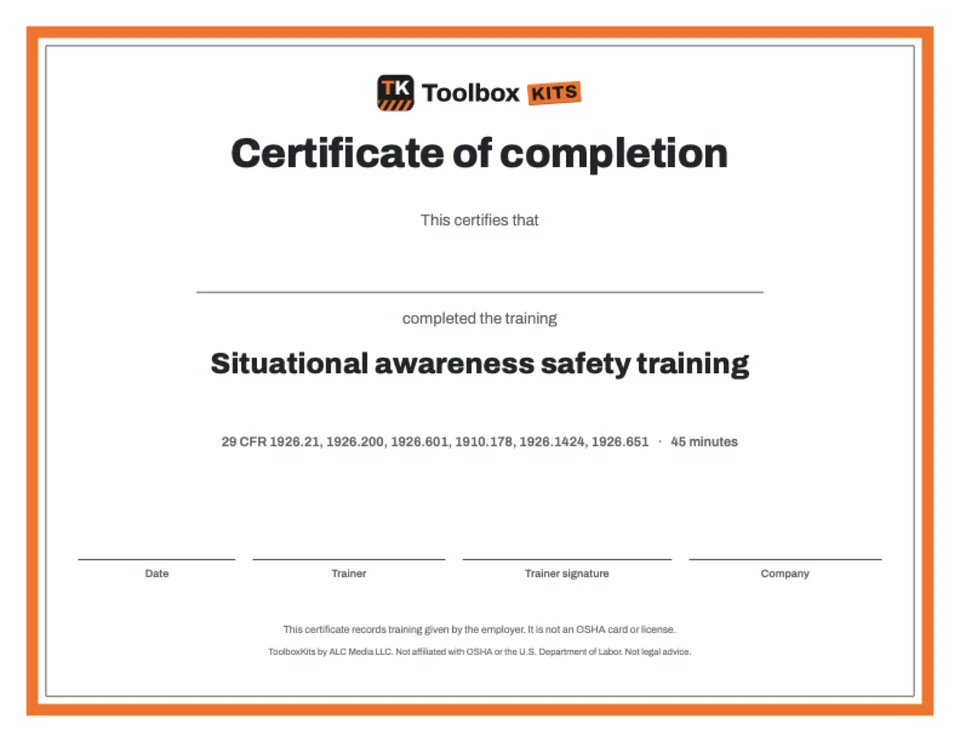 Certificate
- Crew handout
Try it
Try the quiz
Three questions from this topic. Pick an answer to see the right one and the OSHA paragraph.
Question 1 of 3
What are the three steps of situational awareness?
The rule
What OSHA requires
Plain-language summary. Each line links to the exact paragraph of the regulation.
OSHA has no specific standard for situational awareness, but the general duty to train still applies: in construction, the employer must instruct each employee in the recognition and avoidance of unsafe conditions and the regulations applicable to their work environment.
“The employer shall instruct each employee in the recognition and avoidance of unsafe conditions and the regulations applicable to his work environment to control or eliminate any hazards or other exposure to illness or injury.”
In construction, required accident prevention signs and symbols must be visible at all times when work is being performed, and removed or covered promptly when the hazards no longer exist.
“Signs and symbols required by this subpart shall be visible at all times when work is being performed, and shall be removed or covered promptly when the hazards no longer exist.”
On off-highway construction jobsites, a motor vehicle with an obstructed view to the rear may not be used unless it has a reverse signal alarm audible above the surrounding noise level, or it is backed up only when an observer signals that it is safe (29 CFR 1926.601(b)(4)(i) and (ii)).
“No employer shall use any motor vehicle equipment having an obstructed view to the rear unless:”
Drivers of forklifts and other powered industrial trucks must slow down and sound the horn at cross aisles and other locations where vision is obstructed. If the load blocks the forward view, the driver must travel with the load trailing.
“The driver shall be required to slow down and sound the horn at cross aisles and other locations where vision is obstructed.”
Powered industrial truck drivers must look in the direction of travel and keep a clear view of the path of travel.
“The driver shall be required to look in the direction of, and keep a clear view of the path of travel.”
No one may stand or pass under the elevated portion of any powered industrial truck, such as a forklift, whether it is loaded or empty.
“No person shall be allowed to stand or pass under the elevated portion of any truck, whether loaded or empty.”
On crane work, where the rotating superstructure creates struck-by or pinch/crush hazard areas, the employer must erect and maintain control lines, warning lines, railings or similar barriers to mark the boundaries of those areas. If barriers are not feasible, the areas must be clearly marked with warning signs and high-visibility markings on the equipment.
“Erect and maintain control lines, warning lines, railings or similar barriers to mark the boundaries of the hazard areas.”
Before construction work begins, the employer must find out whether any energized electric power circuit, exposed or concealed, is located where the work could bring a person, tool or machine into contact with it. The employer must post and maintain warning signs where such a circuit exists, and tell employees where the lines are, the hazards and the protective measures.
“The employer shall advise employees of the location of such lines, the hazards involved, and the protective measures to be taken.”
On excavation work, employees exposed to public vehicular traffic must be provided with, and must wear, warning vests or other suitable garments marked with or made of reflectorized or high-visibility material.
“Employees exposed to public vehicular traffic shall be provided with, and shall wear, warning vests or other suitable garments marked with or made of reflectorized or high-visibility material.”
Who must be trained
OSHA has no training rule specific to situational awareness. In construction, the employer must instruct each employee in the recognition and avoidance of unsafe conditions and the regulations applicable to their work environment (29 CFR 1926.21(b)(2)). Where a crane's rotating superstructure creates swing radius hazards, each employee assigned to work on or near the equipment must be trained to recognize the struck-by and pinch/crush hazard areas (29 CFR 1926.1424(a)(2)(i)).

Common questions
Questions people ask
How do you run a situational awareness safety moment?
A safety moment is a short talk of a few minutes on one point. Pick one point from this talk, like scanning for changes, and ask the crew what is different on site today. Have someone name one blind spot or swing zone they will avoid, and run it at the start of the shift or after a break.
Is there a printable situational awareness toolbox talk PDF?
Yes. This situational awareness toolbox talk is free to download as a printable PDF in English and Spanish. It includes a sign-in table so you can record who attended.
What should a 'be aware of your surroundings' safety talk cover?
Cover scanning your area before work and after changes, watching moving equipment and blind spots, staying out of the line of fire, cutting distractions and warning coworkers. Use real examples from your site, like a backing truck or a forklift at a cross aisle. On off-highway jobsites, a truck or other motor vehicle with an obstructed rear view may be used only with a reverse signal alarm audible above the surrounding noise, or by backing up only when an observer signals that it is safe (29 CFR 1926.601(b)(4)).
Is there a situational awareness safety presentation or PPT?
This free talk is written to be read aloud, so you can run it without slides. If you want a situational awareness safety presentation with slides, use the training kit option on this page. Walking the site together after the talk is a good way to practice.
Does OSHA require situational awareness safety training?
OSHA has no specific standard for situational awareness, but the general duty to train still applies. In construction, the employer must instruct each employee in the recognition and avoidance of unsafe conditions and the regulations that apply to their work environment (29 CFR 1926.21(b)(2)). Some standards also require awareness training for specific hazards, such as training each employee assigned to work on or near a crane to recognize its struck-by and pinch/crush hazard areas (29 CFR 1926.1424(a)(2)(i)).
Free to share
Use this talk for free
You can print, share and adapt this talk at no cost under the Creative Commons BY-NC-SA 4.0 license. Please credit ToolboxKits with a link.