

Free 5-minute toolbox talkHealth and wellnessEnglish and Spanish
Personal hygiene toolbox talk: hygiene on the job
Where the eyes or body may be exposed to injurious corrosive materials, suitable facilities for quick drenching or flushing must be provided within the work area for immediate emergency use (29 CFR 1910.151(c)). What OSHA requires: In construction, an adequate supply of potable water must be provided in all places of employment (29 CFR 1926.51(a)(1)).
A free hygiene toolbox talk for crews in construction, shops, kitchens and warehouses. Read it aloud in about five minutes before the shift.
Updated October 29, 2026 · Based on 29 CFR 1910.141, 29 CFR 1926.51
Read it out loud
Free 5-minute toolbox talk
Read it out loud to your crew. It takes about 5 minutes.
Start with a question
What was on your hands before your last meal, and when did you last wash them?
Why it matters
Dirt, dust, chemicals and germs follow you from the job to your lunch, your truck and your home. Good hygiene keeps you healthy, helps prevent skin problems and keeps contaminants out of your mouth and eyes. It also protects the people you live and work with. OSHA's sanitation rules set the basics your employer has to provide.
Key points
Wash your hands at the right times
Wash with soap and clean water before you eat, drink or smoke, after using the toilet and after handling dirt, trash, fuel, paint or chemicals. Lather, scrub, rinse and dry.
More
Employers must provide hand soap or similar cleansing agents at lavatories, and in construction must provide adequate washing facilities where contaminants may be harmful.
29 CFR 1910.141(d)(2)(iii) · 29 CFR 1926.51(f)(1)
Drink clean water, not from a shared cup
An adequate supply of potable water must be provided in all places of employment. The common drinking cup is prohibited. Keep water containers closed and marked, and never dip a cup into a water cooler.
29 CFR 1926.51(a)(1) · 29 CFR 1926.51(a)(4)
Keep food and drinks away from toilets and toxic areas
No employee may eat or drink in a toilet room or in any area exposed to a toxic material, and food or beverages must not be stored there either. Take your break away from the work area and wash before you eat.
29 CFR 1910.141(g)(2) · 29 CFR 1910.141(g)(2) and (g)(4)
Keep your clothes and PPE clean
Protective equipment must be provided, used and maintained in a sanitary and reliable condition. Wipe down safety glasses, gloves, hard hats and respirators as directed, and wash work clothes often. Take off contaminated clothing before you go home, and bag it separately.
29 CFR 1910.132(a)
Know where the eyewash is
Where the eyes or body may be exposed to injurious corrosive materials, suitable facilities for quick drenching or flushing must be provided within the work area for immediate emergency use.
More
Know where the eyewash station or drench shower is, keep the path clear, and check that it works as your employer requires.
Keep your work area clean and speak up
All places of employment must be kept clean to the extent that the nature of the work allows. Put trash and food waste in the right containers. If you are sick, tell your supervisor, and report broken toilets, missing soap or dirty water so they get fixed.
Scenario
Picture this: A painter finishes a long morning of spraying coatings. His hands are covered in paint and dust. At the break, he walks to the tailgate and eats his sandwich without washing, then rubs his eye. There is no hand soap at the portable sink, but nobody has told the supervisor. What should he and the crew do differently?
Ask the crew
- Where are the wash stations on this site, and do they always have soap and clean water?
- What contaminants do we handle that we should wash off before eating?
- Where is the nearest eyewash station, and could you find it with your eyes closed?
- What do you do if you feel sick at work?
Takeaway
Wash up before you eat, keep food away from contaminants and report anything that stops you from keeping clean.
Trainer: ______________________ Date: ____________
Credit: ToolboxKits, https://toolboxkits.com/topics/personal-hygiene/ (CC BY-NC-SA 4.0)
The poster is also inside the paid kits.
Audit-ready records in 60 seconds
Fill in your crew and download a filled sign-in sheet for this talk. Everything is made in your browser. Names are never uploaded or stored.
Start a sign-off
Crew scan a QR code on their own phones, type their name and sign with a finger. You see the names arrive and download the signed sheet. Free, no account.
Kits
Get the kit
No subscription needed. Buy only the kit you need.
Toolbox talk kit
$4.99
- 5-minute talk, English PDF
- 5-minute talk, Spanish PDF
- Editable mini-deck (English and Spanish)
- One-page crew handout (English and Spanish)
- Bilingual sign-in sheet
- 3-question quiz with answer key (English and Spanish)
- One-page bilingual poster
- Audit-ready records in 60 seconds: fill in your crew and get a sign-in sheet and a certificate for every worker
Training kit
$9
Editable PowerPoint, 30 slides
- Editable PowerPoint with trainer notes on every slide
- Trainer guide PDF with timing and discussion tips
- 10-question quiz and answer key
- Sign-in sheet and certificate of completion with fillable fields
- One-page crew handout
- Full Spanish version of everything
- One-page bilingual poster
- Audit-ready records in 60 seconds: fill in your crew and get a sign-in sheet and a certificate for every worker
- Instant download
- Secure checkout by Stripe
- 30-day refund, no questions
Need many topics? All Access gives you every kit for $99 a year.
Inside the kit
See what is in the kit
What is in the kit
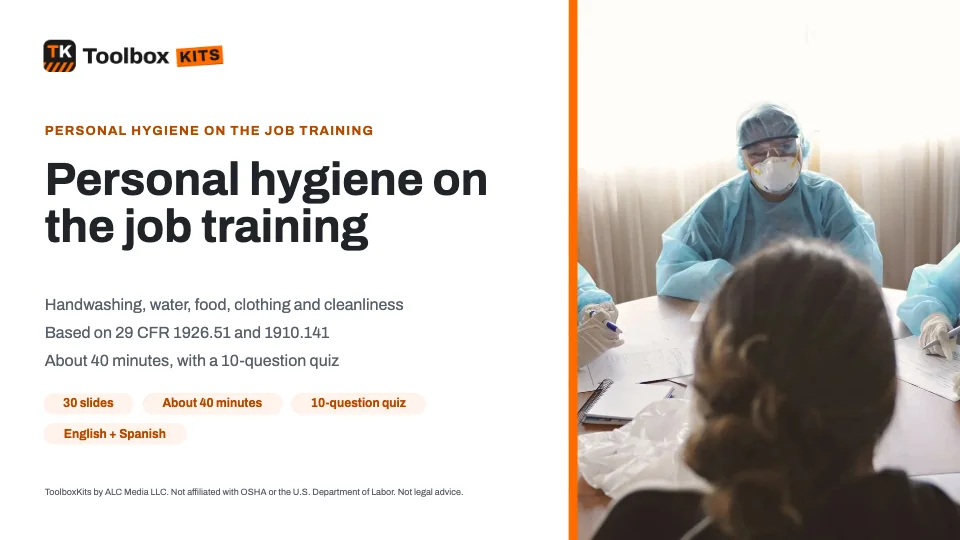 Editable PowerPoint
- Trainer guide
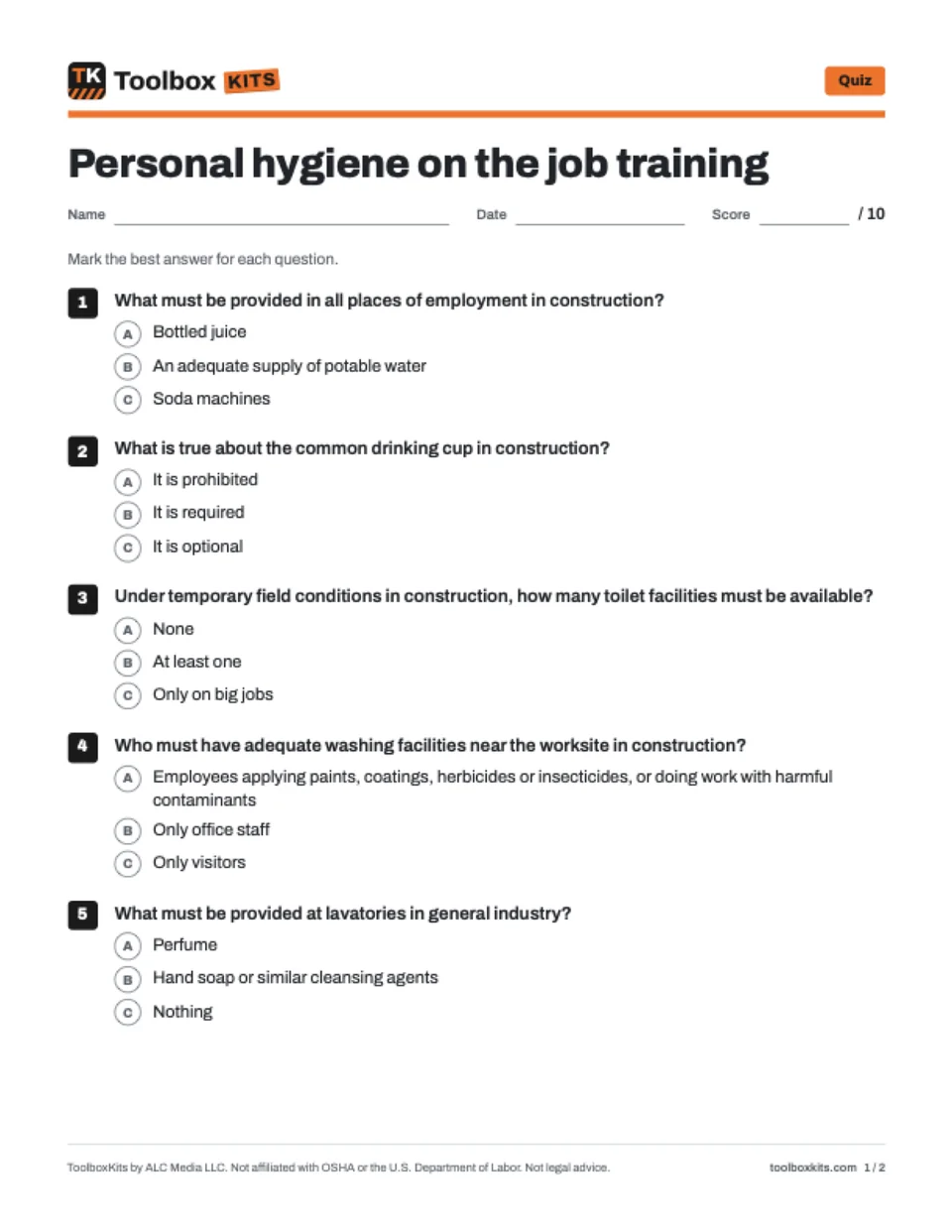 Quiz
- Answer key
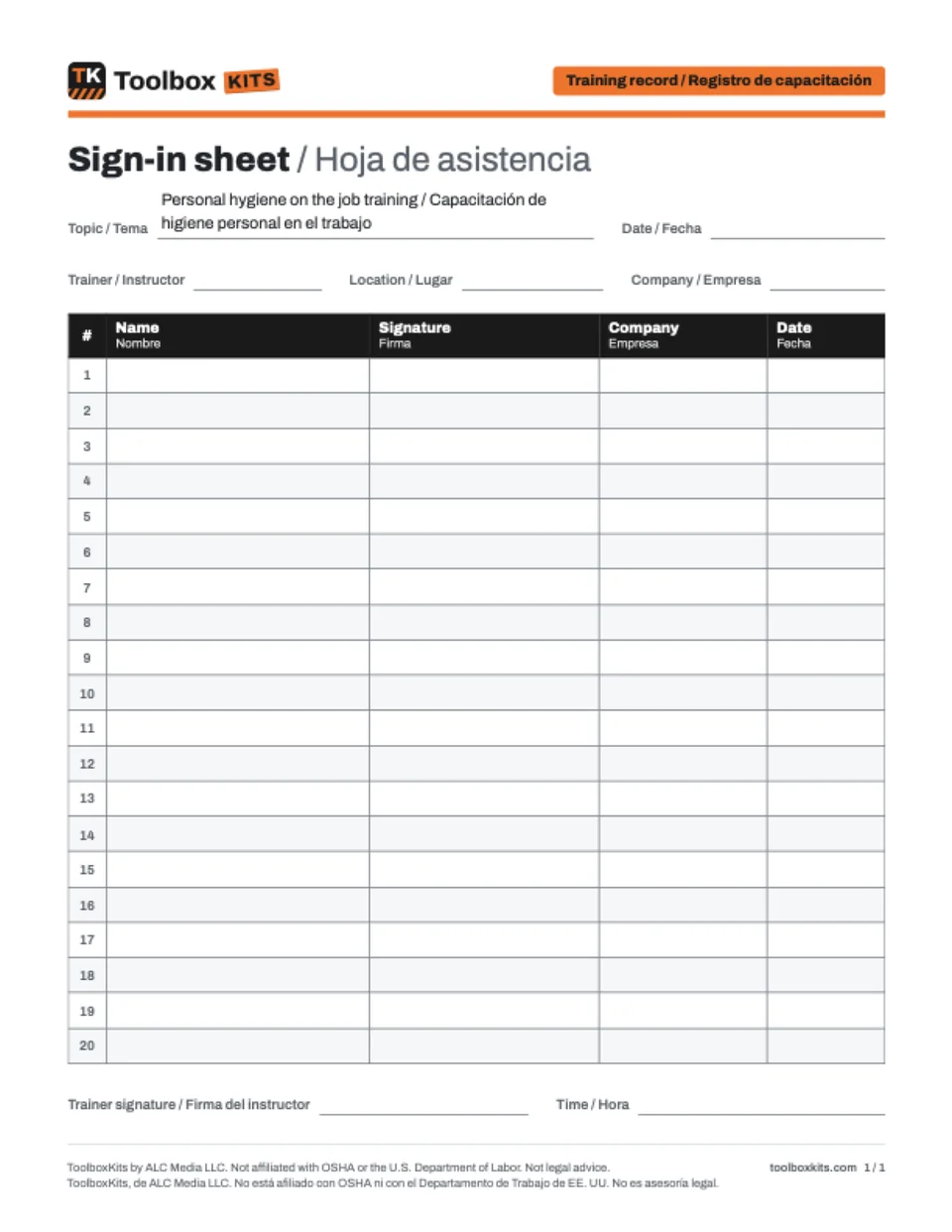 Sign-in sheet
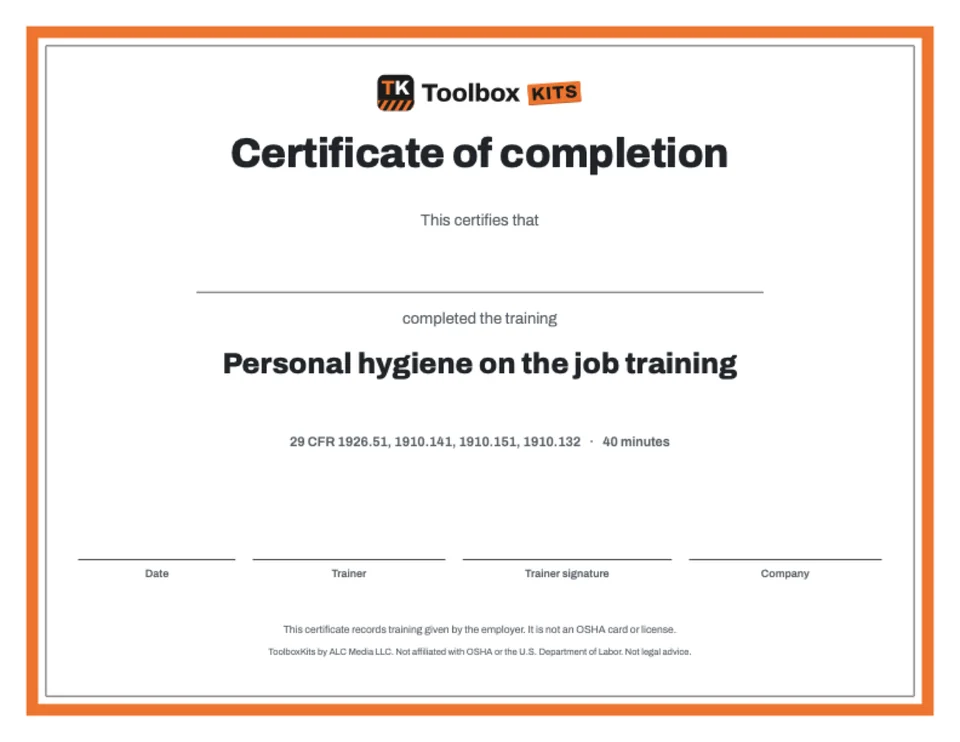 Certificate
- Crew handout
Try it
Try the quiz
Three questions from this topic. Pick an answer to see the right one and the OSHA paragraph.
Question 1 of 3
When should you wash your hands?
The rule
What OSHA requires
Plain-language summary. Each line links to the exact paragraph of the regulation.
In construction, an adequate supply of potable water must be provided in all places of employment.
“An adequate supply of potable water shall be provided in all places of employment.”
In construction, the common drinking cup is prohibited.
“The common drinking cup is prohibited.”
In construction, under temporary field conditions, at least one toilet facility must be available.
“Under temporary field conditions, provisions shall be made to assure not less than one toilet facility is available.”
In construction, the employer must provide adequate washing facilities for employees applying paints, coatings, herbicides or insecticides, or doing other work where contaminants may be harmful, near the worksite.
In general industry, hand soap or similar cleansing agents must be provided at lavatories.
“Hand soap or similar cleansing agents shall be provided.”
In general industry, no employee may consume food or beverages in a toilet room or in any area exposed to a toxic material.
“No employee shall be allowed to consume food or beverages in a toilet room nor in any area exposed to a toxic material.”
In general industry, all places of employment must be kept clean to the extent that the nature of the work allows.
“All places of employment shall be kept clean to the extent that the nature of the work allows.”
Protective equipment must be provided, used and maintained in a sanitary and reliable condition wherever it is needed.
“shall be provided, used, and maintained in a sanitary and reliable condition”
Where eyes or body may be exposed to injurious corrosive materials, suitable facilities for quick drenching or flushing must be provided within the work area for immediate emergency use.
“suitable facilities for quick drenching or flushing of the eyes and body shall be provided within the work area for immediate emergency use.”
Common questions
Questions people ask
Is there a printable personal hygiene toolbox talk PDF?
Yes. This personal hygiene toolbox talk is free to print as a PDF in English and Spanish, with a sign-in table for your crew. Read it aloud in about five minutes, and keep the signed sheet with your safety records.
What does OSHA require for washing facilities and soap?
In general industry, lavatories must be available with hand soap or similar cleansing agents (29 CFR 1910.141(d)(2)(i) and (iii)). In construction, the employer must provide adequate washing facilities where contaminants may be harmful (29 CFR 1926.51(f)(1)). Washing facilities must be kept in a sanitary condition (29 CFR 1910.141(d)(1)).
Where do OSHA's eyewash station rules come from?
Where the eyes or body may be exposed to injurious corrosive materials, suitable facilities for quick drenching or flushing must be provided within the work area for immediate emergency use (29 CFR 1910.151(c)). Workers should know where the eyewash is, keep the path clear and report problems.
Does OSHA cover food safety and hygiene?
OSHA's sanitation rules cover employee food service and eating areas. For example, food must be wholesome and handled in line with sound hygienic principles (29 CFR 1910.141(h)). Food safety rules for businesses that serve the public come from state and local food codes, so check with your local health department.
Do I need a written industrial hygiene program?
OSHA's sanitation rules (29 CFR 1910.141 and 1926.51) do not require a written hygiene program by that name. Some standards do require written plans: labs covered by the laboratory chemical standard need a written Chemical Hygiene Plan (29 CFR 1910.1450(e)(1)), and employers with hazardous chemicals need a written hazard communication program (29 CFR 1910.1200(e)(1)). A short written plan for washing, water and cleaning can still help your crew.
Free to share
Use this talk for free
You can print, share and adapt this talk at no cost under the Creative Commons BY-NC-SA 4.0 license. Please credit ToolboxKits with a link.