

Free 5-minute toolbox talkHealth and wellnessEnglish and Spanish
Hydration toolbox talk
When you fall behind, you get tired, dizzy and slow, and a tired, dizzy worker is more likely to slip, fall or make a mistake with a tool. What OSHA requires: Construction: an adequate supply of potable (safe to drink) water must be provided at every workplace (29 CFR 1926.51(a)(1)).
A five-minute hydration talk for your crew. It covers the OSHA drinking water rules, the signs of dehydration, and simple habits that keep everyone working safely in any season.
Updated October 29, 2026 · Based on 29 CFR 1926.51, 29 CFR 1910.141
Read it out loud
Free 5-minute toolbox talk
Read it out loud to your crew. It takes about 5 minutes.
Start with a question
How much water have you had since you got to the job this morning?
Why it matters
Your body loses water all day through sweat and breathing, even when you do not notice it. When you fall behind, you get tired, dizzy and slow, and a tired, dizzy worker is more likely to slip, fall or make a mistake with a tool. In hot weather, dehydration also raises the risk of serious heat illness.
Key points
Know the drinking water rules
In construction, an adequate supply of potable water must be provided at every workplace. Potable means safe to drink. General industry employers must also provide potable water at permanent workplaces. If the cooler is empty or the water looks or smells off, tell your foreman right away.
29 CFR 1926.51(a)(1) · 29 CFR 1910.141(b)(1)(i)
Drink before you feel thirsty
Thirst can lag behind what your body needs, so do not wait for it. Drink small amounts often through the shift instead of a lot at once at lunch. More is not always better: drinking a very large amount of plain water in a short time can also make you sick.
Know the signs of dehydration
Watch for thirst, dark urine, headache, dizziness, tiredness and muscle cramps. Confusion, fainting or strange behavior in the heat can mean a heat emergency. Do not leave that worker alone, and get help right away.
Keep the water clean
Portable drinking water containers must close tightly and have a tap, and nobody dips a cup or bottle into the cooler. Do not share cups. Use single-use cups or your own bottle, and keep the cooler out of dirty or dusty areas.
Only drink water you know is safe
Nonpotable water, such as water for industrial or firefighting use, is not safe to drink, and its outlets must be marked with signs saying so. Do not drink from hoses, tanks or taps unless you know the water is potable. Never eat or drink in areas exposed to toxic materials.
Make water breaks part of the work
Put water close to where people are working, not just at the trailer. Keep coolers in the shade and refill them before they run dry. Take breaks during the hottest and hardest work, and check on new workers who are not used to the conditions.
Scenario
Picture this: it is the first hot week of the season. A worker skips breakfast, drinks a large coffee and works all morning without water because the cooler is back at the trailer. By early afternoon they have a pounding headache and feel dizzy on a ladder, but they keep going so they do not slow the crew down. What should the worker, the crew and the foreman do differently?
Ask the crew
- Where is the closest drinking water to where we are working today?
- What signs would tell you a coworker is getting into trouble?
- How can we make water breaks part of the job instead of something people skip?
- Who refills the coolers, and what do we do if they run dry?
Takeaway
Drink water early and often, keep it clean and close to the work, and speak up when you or a coworker starts showing signs.
Trainer: ______________________ Date: ____________
Credit: ToolboxKits, https://toolboxkits.com/topics/hydration/ (CC BY-NC-SA 4.0)
The poster is also inside the paid kits.
Audit-ready records in 60 seconds
Fill in your crew and download a filled sign-in sheet for this talk. Everything is made in your browser. Names are never uploaded or stored.
Start a sign-off
Crew scan a QR code on their own phones, type their name and sign with a finger. You see the names arrive and download the signed sheet. Free, no account.
Kits
Get the kit
No subscription needed. Buy only the kit you need.
Toolbox talk kit
$4.99
- 5-minute talk, English PDF
- 5-minute talk, Spanish PDF
- Editable mini-deck (English and Spanish)
- One-page crew handout (English and Spanish)
- Bilingual sign-in sheet
- 3-question quiz with answer key (English and Spanish)
- One-page bilingual poster
- Audit-ready records in 60 seconds: fill in your crew and get a sign-in sheet and a certificate for every worker
Training kit
$9
Editable PowerPoint, 33 slides
- Editable PowerPoint with trainer notes on every slide
- Trainer guide PDF with timing and discussion tips
- 10-question quiz and answer key
- Sign-in sheet and certificate of completion with fillable fields
- One-page crew handout
- Full Spanish version of everything
- One-page bilingual poster
- Audit-ready records in 60 seconds: fill in your crew and get a sign-in sheet and a certificate for every worker
- Instant download
- Secure checkout by Stripe
- 30-day refund, no questions
Need many topics? All Access gives you every kit for $99 a year.
Inside the kit
See what is in the kit
What is in the kit
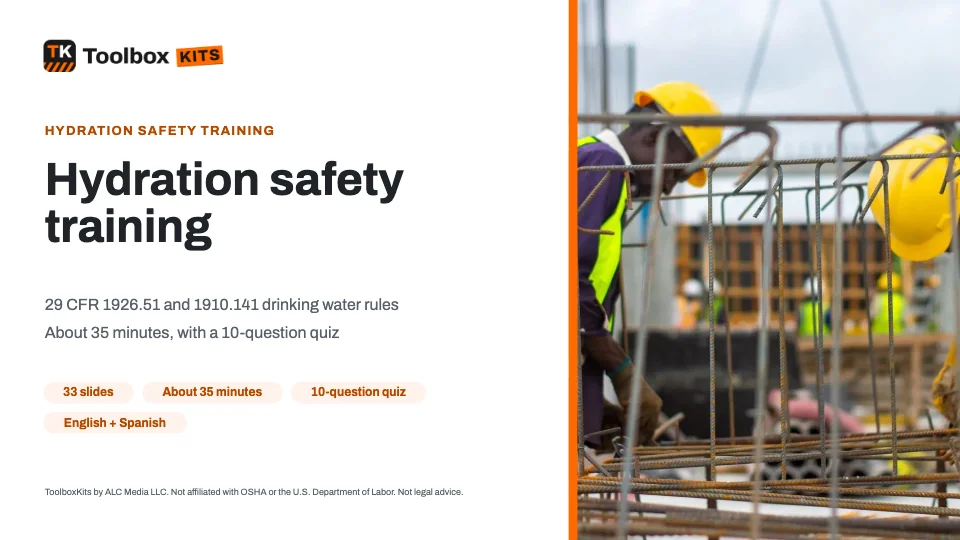 Editable PowerPoint
- Trainer guide
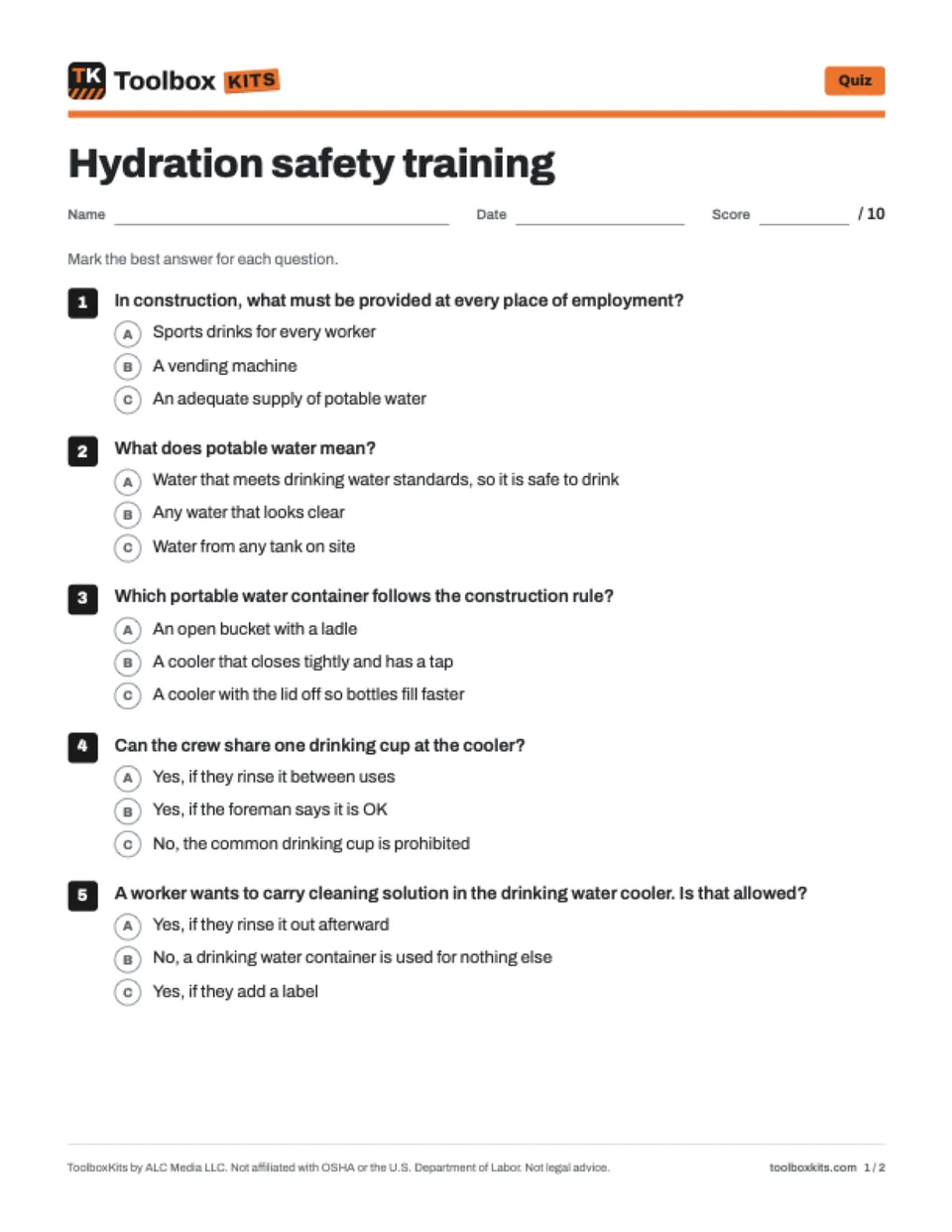 Quiz
- Answer key
 Sign-in sheet
 Certificate
- Crew handout
Try it
Try the quiz
Three questions from this topic. Pick an answer to see the right one and the OSHA paragraph.
Question 1 of 3
What must be provided at every construction workplace?
The rule
What OSHA requires
Plain-language summary. Each line links to the exact paragraph of the regulation.
Construction: an adequate supply of potable (safe to drink) water must be provided at every workplace.
“An adequate supply of potable water shall be provided in all places of employment.”
General industry (permanent workplaces): potable water must be provided for drinking and other personal uses such as washing and cooking.
“Potable water shall be provided in all places of employment, for drinking”
Portable drinking water containers must close tightly and have a tap, and water must not be dipped out of them.
“Portable containers used to dispense drinking water shall be capable of being tightly closed, and equipped with a tap. Water shall not be dipped from containers.”
Drinking water containers must be clearly marked and not used for anything else.
“Any container used to distribute drinking water shall be clearly marked as to the nature of its contents and not used for any other purpose.”
Shared drinking cups are not allowed.
“The common drinking cup is prohibited.”
Where single-use cups are supplied, there must be a sanitary container for unused cups and a receptacle for used ones.
“both a sanitary container for the unused cups and a receptacle for disposing of the used cups shall be provided”
Outlets for nonpotable water, such as water for industrial or firefighting use, must be marked with signs saying it is not for drinking.
“to indicate clearly that the water is unsafe and is not to be used for drinking, washing, or cooking purposes”
General industry (permanent workplaces): open containers such as barrels, pails or tanks that water must be dipped or poured from are not allowed for drinking water, even with a cover.
“Open containers such as barrels, pails, or tanks for drinking water from which the water must be dipped or poured, whether or not they are fitted with a cover, are prohibited.”
Workers must not eat or drink in a toilet room or in any area exposed to a toxic material.
“No employee shall be allowed to consume food or beverages in a toilet room nor in any area exposed to a toxic material.”
OSHA has no specific hydration standard. In construction, the general duty to instruct each worker in recognizing and avoiding unsafe conditions still applies.
“The employer shall instruct each employee in the recognition and avoidance of unsafe conditions and the regulations applicable to his work environment”
Common questions
Questions people ask
Is there a printable hydration toolbox talk PDF?
Yes. This talk is available as a free printable PDF in English and Spanish, with a sign-in table for your crew. Print it, read it aloud in about five minutes, and keep the signed sheet with your safety records.
Does OSHA require drinking water on the job?
Yes. In construction, an adequate supply of potable water must be provided in all places of employment. General industry employers must also provide potable water at permanent workplaces (29 CFR 1910.141(b)(1)(i)). OSHA has no specific rule on how much each worker must drink, so plan enough water for the crew, the work and the weather.
Can you get dehydrated in winter?
Yes. Cold air is dry, layers of clothing make you sweat, and thirst is easy to miss in the cold. Keep water handy and drink on a schedule, even when you do not feel thirsty.
What signs of dehydration should a safety talk cover?
Cover thirst, dark urine, headache, dizziness, tiredness and muscle cramps. Explain that confusion, fainting or strange behavior in the heat can mean a heat emergency that needs help right away. Ask the crew to watch out for each other, since it is hard to spot your own signs.
Can I use this as a hydration safety moment?
Yes. For a short safety moment, read the scenario and ask one discussion question at the start of the shift. It works well on the first hot days of the season, before heavy work, and when new workers join the crew.
Free to share
Use this talk for free
You can print, share and adapt this talk at no cost under the Creative Commons BY-NC-SA 4.0 license. Please credit ToolboxKits with a link.