

Free 5-minute toolbox talkHealth and wellnessEnglish and Spanish
Cold weather toolbox talk
Check the forecast and wind chill before the shift, and plan breaks in a warm, dry spot. What OSHA requires: OSHA has no specific standard for cold stress; the general duty to train still applies. Construction employers must instruct each employee in recognizing and avoiding unsafe conditions and in the rules that apply to their work environment (29 CFR 1926.21(b)(2)).
A free cold weather toolbox talk you can read to your crew in about five minutes, or use as a quick cold weather safety moment. It shows how to spot cold stress early and how to stay warm, dry and alert on the job.
Updated October 31, 2026 · Based on 29 CFR 1926.21
Read it out loud
Free 5-minute toolbox talk
Read it out loud to your crew. It takes about 5 minutes.
Start with a question
Who here has worked a cold, windy shift and felt your fingers stop doing what you told them to?
Why it matters
Cold weather can pull heat out of your body faster than you can make it, especially when you are wet or out in the wind. As you cool down, your hands get clumsy and your thinking slows. That makes every other task more dangerous, from climbing a ladder to running a saw. Hypothermia and frostbite can creep up on you, so we watch for them in ourselves and in each other.
Key points
Know the signs of hypothermia
Hypothermia means your body temperature has dropped too low. Early signs are shivering, tiredness, clumsy hands and confusion. A person getting hypothermia may not notice it, so check on each other at every break.
More
If someone stops shivering while still cold, slurs words or seems confused, get them somewhere warm, call for medical help and tell the foreman.
Watch for frostbite and trench foot
Frostbite is frozen skin and tissue, most often on fingers, toes, ears, nose and cheeks. Watch for numbness, tingling, aching, or skin that looks pale, gray or waxy. Do not rub the area; get to a warm place and get medical help.
More
Feet that stay wet in the cold can get trench foot even when it is not freezing, so change wet socks fast.
Dress in layers and stay dry
Wear loose layers: a base layer that pulls sweat off your skin, a warm middle layer and an outer shell that blocks wind and water. Avoid cotton next to your skin, because it holds sweat and stops keeping you warm once it is wet.
More
Cover your head, ears and hands, wear insulated waterproof boots, and keep spare dry socks and gloves in your truck.
Take warm-up breaks and refuel
Check the forecast and wind chill before the shift, and plan breaks in a warm, dry spot. Take them more often as it gets colder or windier. Drink warm, sweet drinks and eat during the day, because your body burns fuel to keep warm.
Heat warm-up areas safely
Fuel-burning heaters give off carbon monoxide, a gas you cannot see or smell. When temporary heaters are used, fresh air must be supplied in sufficient quantities to maintain workers' health and safety.
More
Never run a heater or generator in a closed trailer, tent or room without ventilation, and keep heaters away from tarps and anything that burns.
Watch for ice and frost
Cold mornings leave frost and ice on decks, ladders, scaffold planks and truck steps. Do not work on a scaffold covered with snow, ice or other slippery material, except to clear it off. Salt or sand walkways, and knock the snow off your boots before you climb.
Scenario
Picture this: it is a raw, windy morning and the crew is setting forms on an open deck. By mid-morning one worker's gloves are soaked, he has gone quiet and he keeps dropping his tools. He says he is fine and wants to finish before the break. What do you do, and who do you tell?
Ask the crew
- Where is our warm-up spot today, and when will we use it?
- What spare dry gear do you have in your truck or bag right now?
- What would you do if your buddy stopped shivering but still seemed cold and confused?
- Where do ice and standing water build up first on this site?
Takeaway
Stay dry, take your warm-up breaks and watch your buddy, because cold stress is much easier to stop early than to treat late.
Trainer: ______________________ Date: ____________
Credit: ToolboxKits, https://toolboxkits.com/topics/cold-stress/ (CC BY-NC-SA 4.0)
The poster is also inside the paid kits.
Audit-ready records in 60 seconds
Fill in your crew and download a filled sign-in sheet for this talk. Everything is made in your browser. Names are never uploaded or stored.
Start a sign-off
Crew scan a QR code on their own phones, type their name and sign with a finger. You see the names arrive and download the signed sheet. Free, no account.
Kits
Get the kit
No subscription needed. Buy only the kit you need.
Toolbox talk kit
$4.99
- 5-minute talk, English PDF
- 5-minute talk, Spanish PDF
- Editable mini-deck (English and Spanish)
- One-page crew handout (English and Spanish)
- Bilingual sign-in sheet
- 3-question quiz with answer key (English and Spanish)
- One-page bilingual poster
- Audit-ready records in 60 seconds: fill in your crew and get a sign-in sheet and a certificate for every worker
Training kit
$9
Editable PowerPoint, 39 slides
- Editable PowerPoint with trainer notes on every slide
- Trainer guide PDF with timing and discussion tips
- 10-question quiz and answer key
- Sign-in sheet and certificate of completion with fillable fields
- One-page crew handout
- Full Spanish version of everything
- One-page bilingual poster
- Audit-ready records in 60 seconds: fill in your crew and get a sign-in sheet and a certificate for every worker
- Instant download
- Secure checkout by Stripe
- 30-day refund, no questions
Need many topics? All Access gives you every kit for $99 a year.
Inside the kit
See what is in the kit
What is in the kit
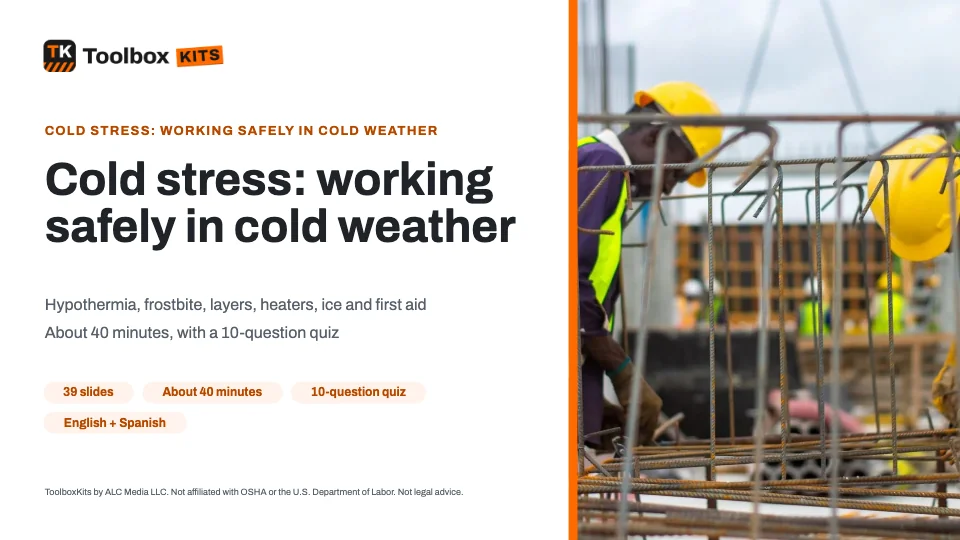 Editable PowerPoint
- Trainer guide
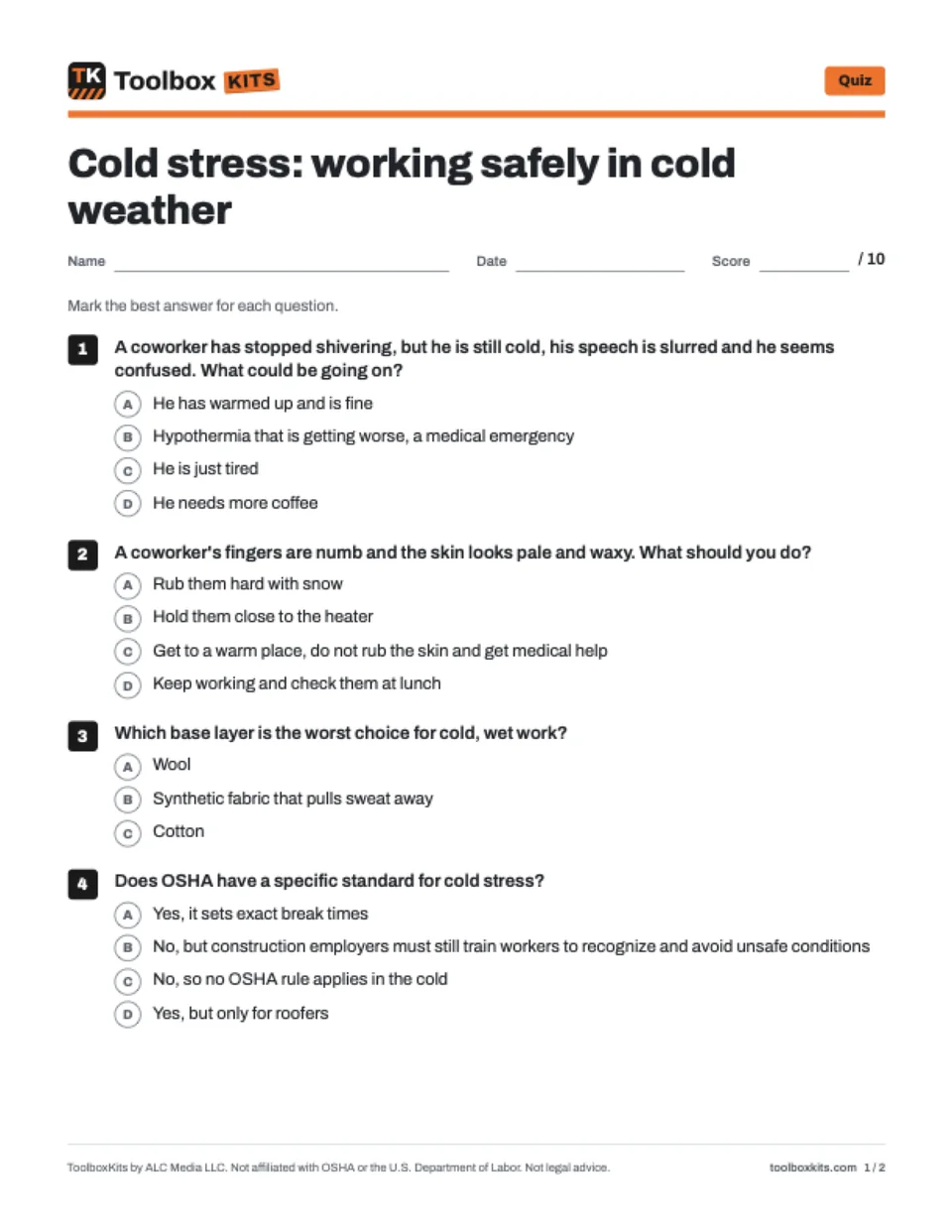 Quiz
- Answer key
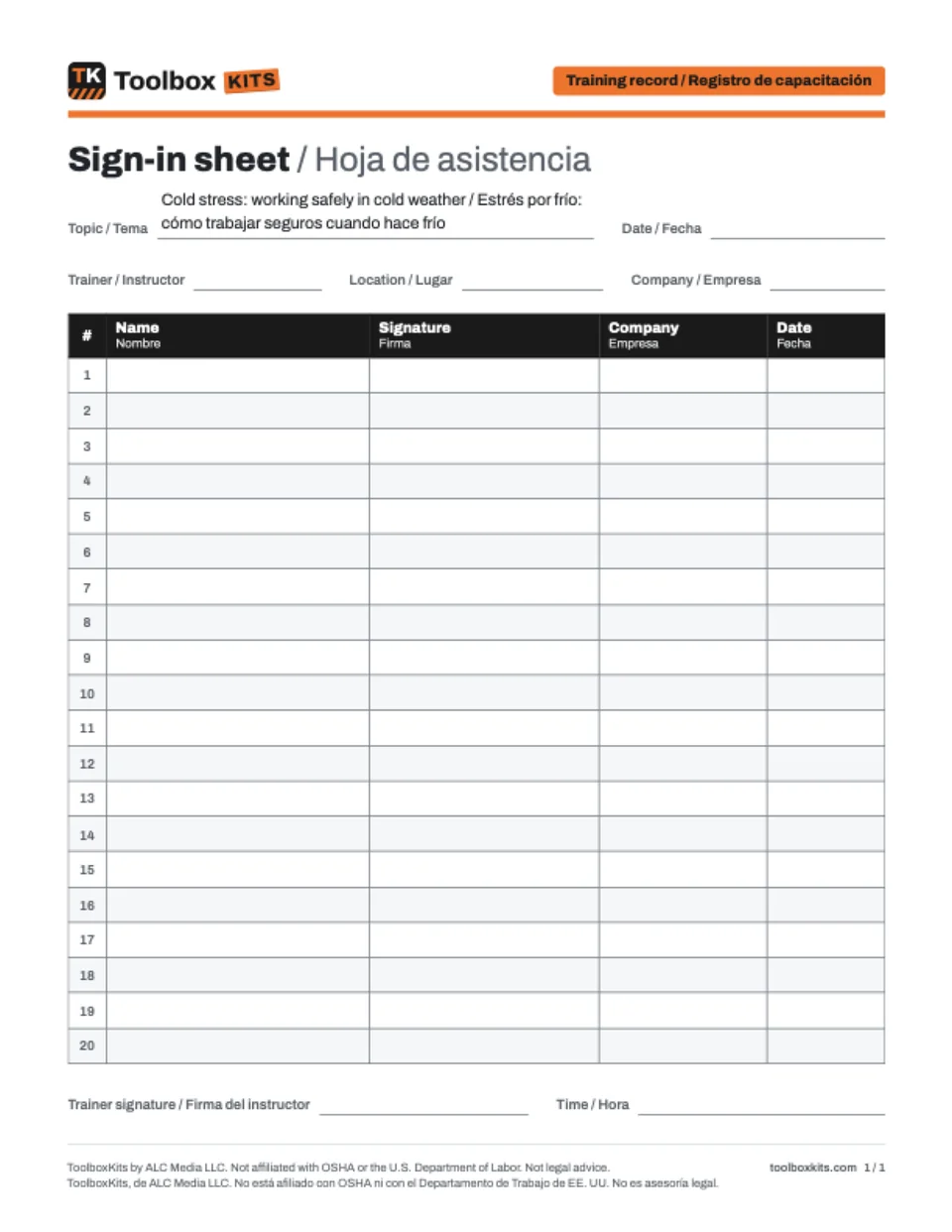 Sign-in sheet
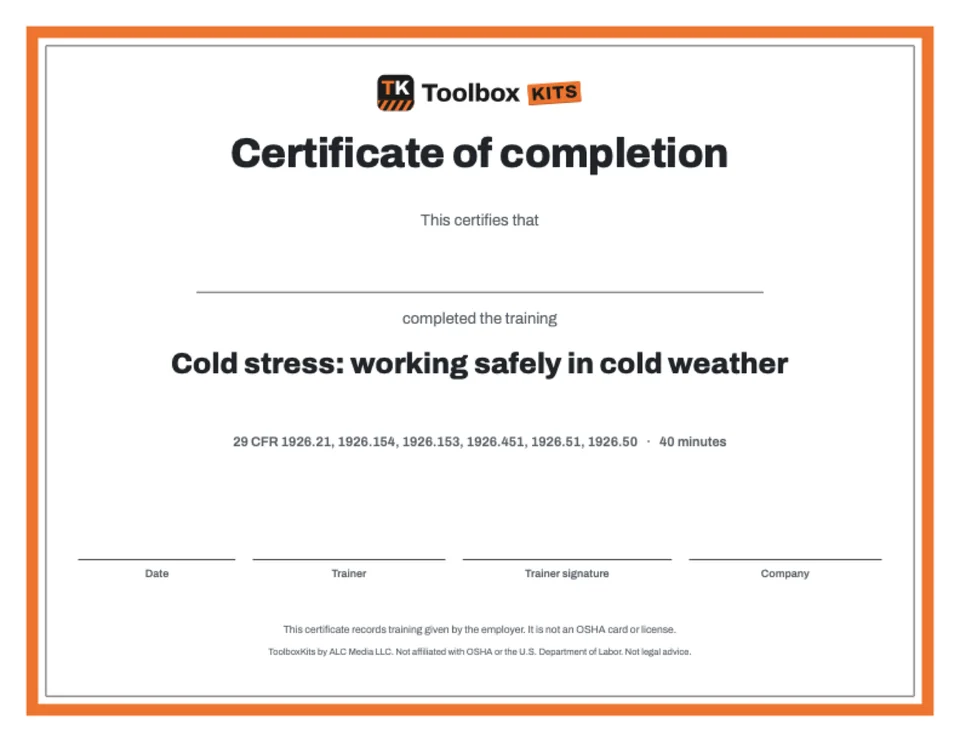 Certificate
- Crew handout
Try it
Try the quiz
Three questions from this topic. Pick an answer to see the right one and the OSHA paragraph.
Question 1 of 3
Which of these is an early sign of hypothermia?
The rule
What OSHA requires
Plain-language summary. Each line links to the exact paragraph of the regulation.
OSHA has no specific standard for cold stress; the general duty to train still applies. Construction employers must instruct each employee in recognizing and avoiding unsafe conditions and in the rules that apply to their work environment.
“The employer shall instruct each employee in the recognition and avoidance of unsafe conditions and the regulations applicable to his work environment to control or eliminate any hazards or other exposure to illness or injury.”
When temporary heaters are used, fresh air must be supplied in sufficient quantities to maintain workers' health and safety. Where natural fresh air is not enough, mechanical ventilation must be provided.
“Fresh air shall be supplied in sufficient quantities to maintain the health and safety of workmen.”
When heaters are used in confined spaces, special care must be taken to provide enough ventilation for proper combustion, to maintain workers' health and safety, and to limit temperature rise in the area.
Employees may not work on scaffolds covered with snow, ice or other slippery material, except as needed to remove it.
“Employees shall be prohibited from working on scaffolds covered with snow, ice, or other slippery material except as necessary for removal of such materials.”
Before a construction project starts, the employer must arrange for prompt medical attention in case of serious injury.
“Provisions shall be made prior to commencement of the project for prompt medical attention in case of serious injury.”
If no infirmary, clinic, hospital or physician is reasonably accessible in time and distance, a person with a valid first-aid training certificate must be available at the worksite to give first aid.
The employer must provide equipment to get an injured worker to a physician or hospital promptly, or a communication system to call an ambulance.
In general industry, if no infirmary, clinic or hospital is in near proximity to the workplace, a person must be adequately trained to give first aid. Adequate first aid supplies must be readily available.
Under the construction PPE payment rule, employers are not required to pay for ordinary clothing used solely for protection from weather, such as winter coats, jackets, gloves, parkas, rubber boots and hats.
“Ordinary clothing, skin creams, or other items, used solely for protection from weather, such as winter coats, jackets, gloves, parkas, rubber boots, hats, raincoats, ordinary sunglasses, and sunscreen.”
Common questions
Questions people ask
Is there a free cold weather toolbox talk PDF?
Yes. This cold stress talk is free to print in English and Spanish, with a sign-in table for your crew. You can share it under a Creative Commons BY-NC-SA license with a credit link back to this page.
Does OSHA have a cold weather standard?
OSHA has no specific standard for cold stress; the general duty to train still applies. Under 29 CFR 1926.21(b)(2), construction employers must instruct each employee in recognizing and avoiding unsafe conditions in their work environment. Other rules still apply in the cold, such as the ban on working on scaffolds covered with snow or ice except to remove it (29 CFR 1926.451(f)(8)).
What should a 5-minute cold weather safety talk cover?
Cover the early signs of hypothermia and frostbite, dressing in layers, staying dry, warm-up breaks, safe heaters and the buddy system. Then point out where ice and wind are worst on your site. Give the talk at the start of the cold season and again at a safety meeting before each cold snap.
What should an extreme cold toolbox talk add?
In extreme cold, schedule the heaviest outdoor work for the warmest part of the day, shorten work periods and add warm-up breaks. Check on each other more often and keep spare dry clothing close by. If you use heaters in tents or enclosures, fresh air must be supplied in sufficient quantities to maintain workers' health and safety (29 CFR 1926.154(a)(1)).
Is a winter weather toolbox talk the same as a cold stress talk?
They overlap. A cold stress talk focuses on what cold does to your body, like hypothermia, frostbite and trench foot. A winter weather talk also covers site hazards such as icy walkways, heaters and winter driving. This talk covers cold stress plus ice and heaters, so pair it with a winter driving talk if your crew is on the road.
Free to share
Use this talk for free
You can print, share and adapt this talk at no cost under the Creative Commons BY-NC-SA 4.0 license. Please credit ToolboxKits with a link.