

Free 5-minute toolbox talkHealth and wellnessEnglish and Spanish
Flu season safety moment: infection control at work
When a bug goes around, people feel miserable, work falls behind and whoever is left picks up the slack. What OSHA requires: Lavatories must be made available, with hot and cold or tepid running water, hand soap or similar cleansing agents, and individual hand towels or air blowers (29 CFR 1926.51(f)(3)(i)).
A free 5-minute talk on keeping colds, flu and other germs from spreading through the crew. Use it as a toolbox talk, a quick flu season safety moment or a COVID-19 refresher.
Updated October 29, 2026 · Based on 29 CFR 1910.141, 29 CFR 1910.1030
Read it out loud
Free 5-minute toolbox talk
Read it out loud to your crew. It takes about 5 minutes.
Start with a question
Think about the last time a cold or the flu went through the crew. How do you think it got started?
Why it matters
Colds, flu and other viruses spread fast when people work close together, share tools and trucks, and eat in the same break area. When a bug goes around, people feel miserable, work falls behind and whoever is left picks up the slack. For some people, like older workers or those with health problems, the flu can be serious. A few simple habits make a real difference.
Key points
Stay home when you are sick
Coming to work with a fever, cough or body aches puts everyone around you at risk. Tell your supervisor as early as you can, and follow your company's sick policy. Supervisors, send sick workers home instead of praising them for toughing it out.
Wash your hands the right way
Use soap and running water, scrub the backs of your hands, between your fingers and under your nails, then dry with a clean towel or air dryer. Wash before you eat, after the restroom and after you cough, sneeze or blow your nose.
More
Construction sites and permanent general industry workplaces generally must have lavatories with running water, hand soap and individual towels or air blowers.
29 CFR 1926.51(f)(3)(i) · 29 CFR 1926.51(f)(3)(i) to (iv) and 29 CFR 1910.141(d)(2)(i) to (iv)
Cover coughs and keep hands off your face
Cough or sneeze into a tissue or your elbow, not your hand, and throw the tissue away. Germs on your hands get in through your eyes, nose and mouth, so try not to touch your face with dirty gloves or hands. Give coworkers who are coughing a little extra space.
Clean what everyone touches
Tool handles, steering wheels, door handles, radios, microwaves and break tables pass germs from hand to hand. Wipe them down often during flu season, and do not share water bottles or cups. The common drinking cup is prohibited.
More
Permanent general industry workplaces must also be kept clean to the extent the nature of the work allows.
29 CFR 1926.51(a)(4) · 29 CFR 1926.51(a)(4) in construction, 29 CFR 1910.141(b)(1)(vi) in general industry · 29 CFR 1910.141(a)(3)(i)
Treat blood and body fluids as infectious
Giving first aid, cleaning up after an injury or handling used needles can expose you to blood. OSHA's general industry bloodborne pathogens standard requires universal precautions, which means treating all human blood and certain body fluids as if they are infectious.
More
If that exposure is part of your job, your employer must train you, provide protective equipment such as gloves at no cost and make the hepatitis B vaccine available. Wash your hands immediately or as soon as feasible after you take off your gloves.
29 CFR 1910.1030(d)(1) · 29 CFR 1910.1030(b) and (d)(1) · 29 CFR 1910.1030(g)(2)(i), (d)(3)(i) and (f)(1)(i) · 29 CFR 1910.1030(d)(2)(v)
Keep your defenses up
Sleep, food and water all help your body fight off germs, so try not to run yourself down during flu season. Ask your doctor or pharmacist whether a flu shot is right for you. If you do get sick, rest, and get medical help if you have trouble breathing or you are getting worse instead of better.
Scenario
Picture this: It is the middle of flu season. A carpenter shows up coughing and sneezing because he does not want to lose a day's pay. He drinks from the same cup as a couple of coworkers, passes his drill around and rides to the job in a packed crew truck. By the end of the week, several people are out sick and the job is falling behind. What could he, his coworkers and the foreman have done differently?
Ask the crew
- Where can we wash our hands on this job, and is there always soap and something to dry with?
- What does our sick policy say, and who do you call if you wake up sick?
- Which tools, vehicles or surfaces do we share that should be wiped down more often?
- If someone gets cut, who gives first aid, and what do they wear to protect themselves?
Takeaway
Stay home when you are sick, wash your hands often, cover your coughs and keep shared things clean.
Trainer: ______________________ Date: ____________
Credit: ToolboxKits, https://toolboxkits.com/topics/infection-control/ (CC BY-NC-SA 4.0)
The poster is also inside the paid kits.
Audit-ready records in 60 seconds
Fill in your crew and download a filled sign-in sheet for this talk. Everything is made in your browser. Names are never uploaded or stored.
Start a sign-off
Crew scan a QR code on their own phones, type their name and sign with a finger. You see the names arrive and download the signed sheet. Free, no account.
Kits
Get the kit
No subscription needed. Buy only the kit you need.
Toolbox talk kit
$4.99
- 5-minute talk, English PDF
- 5-minute talk, Spanish PDF
- Editable mini-deck (English and Spanish)
- One-page crew handout (English and Spanish)
- Bilingual sign-in sheet
- 3-question quiz with answer key (English and Spanish)
- One-page bilingual poster
- Audit-ready records in 60 seconds: fill in your crew and get a sign-in sheet and a certificate for every worker
Training kit
$9
Editable PowerPoint, 38 slides
- Editable PowerPoint with trainer notes on every slide
- Trainer guide PDF with timing and discussion tips
- 10-question quiz and answer key
- Sign-in sheet and certificate of completion with fillable fields
- One-page crew handout
- Full Spanish version of everything
- One-page bilingual poster
- Audit-ready records in 60 seconds: fill in your crew and get a sign-in sheet and a certificate for every worker
- Instant download
- Secure checkout by Stripe
- 30-day refund, no questions
Need many topics? All Access gives you every kit for $99 a year.
Inside the kit
See what is in the kit
What is in the kit
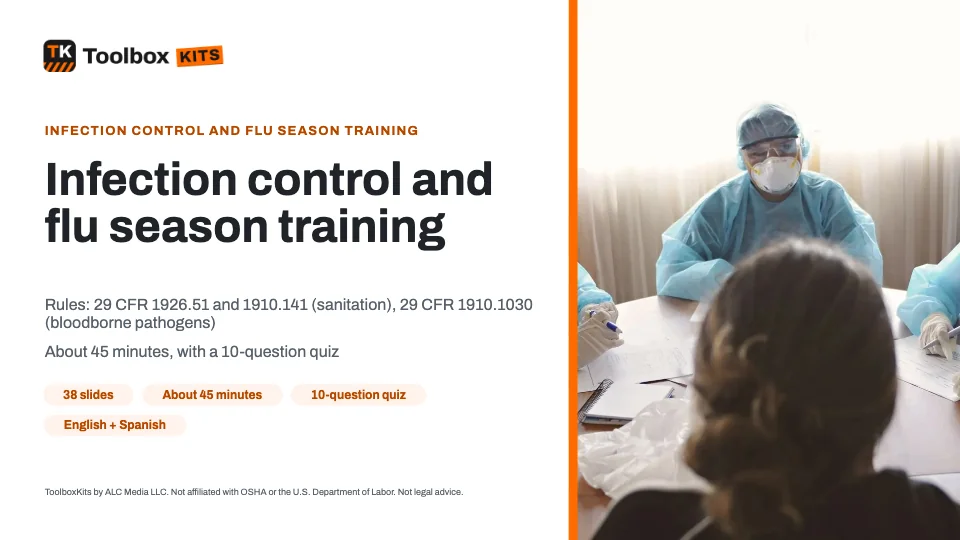 Editable PowerPoint
- Trainer guide
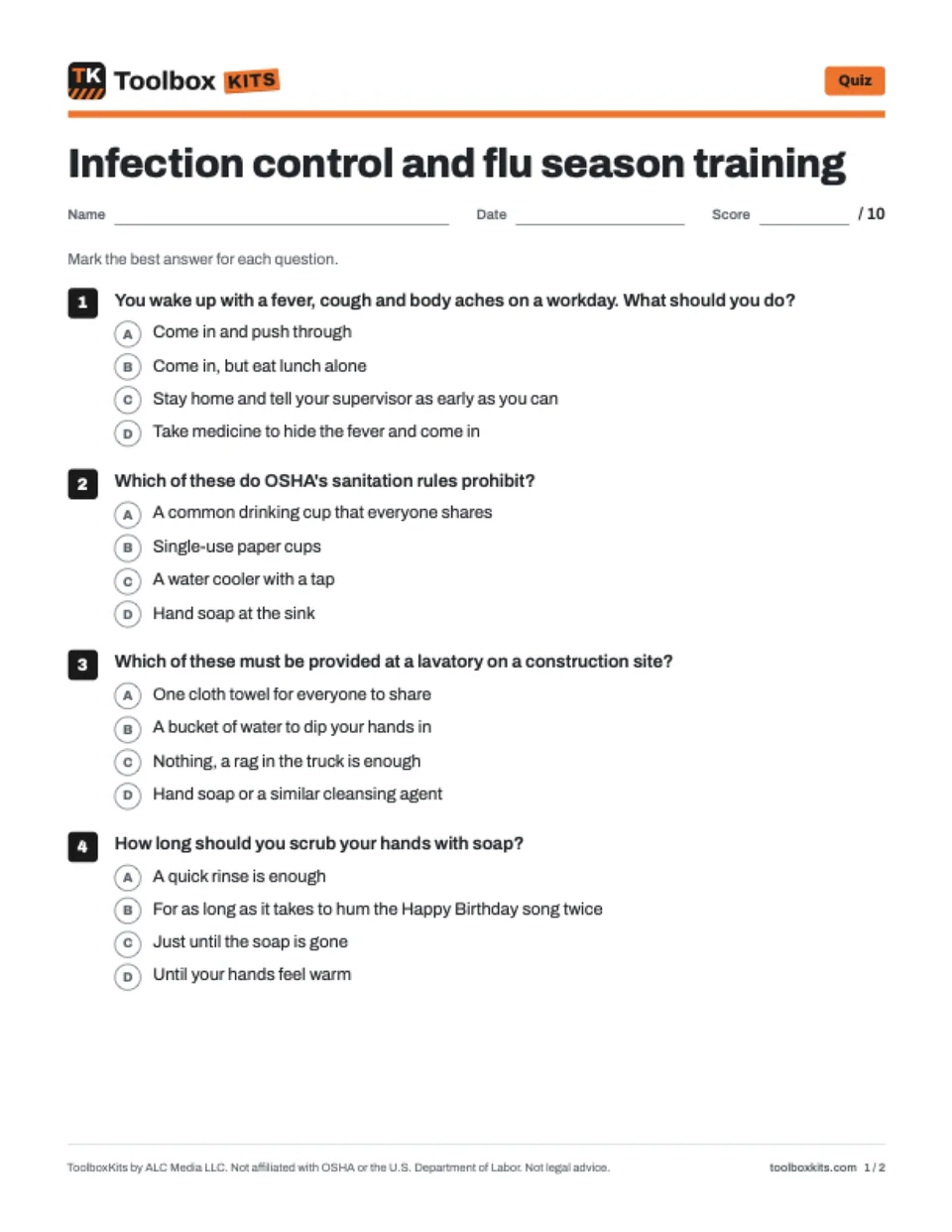 Quiz
- Answer key
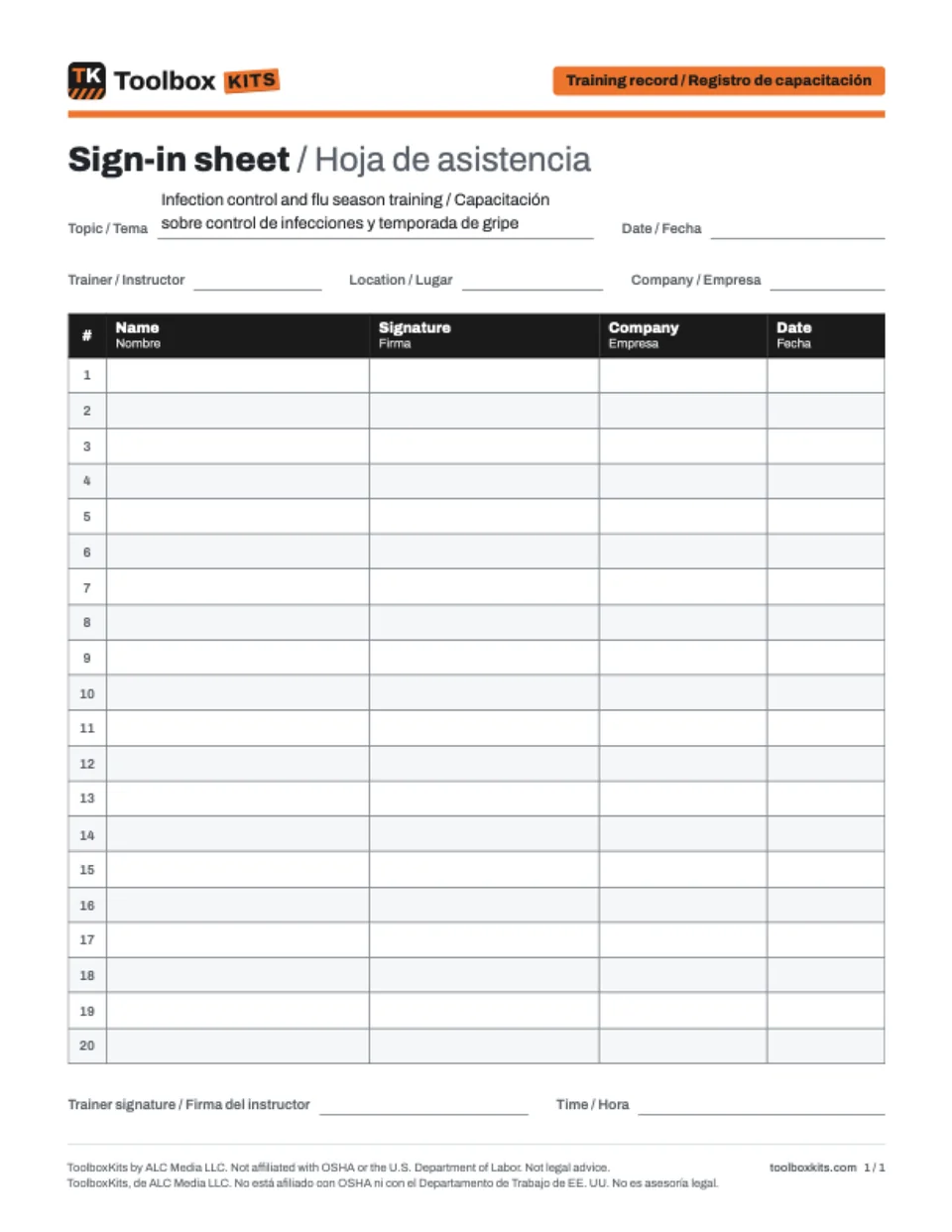 Sign-in sheet
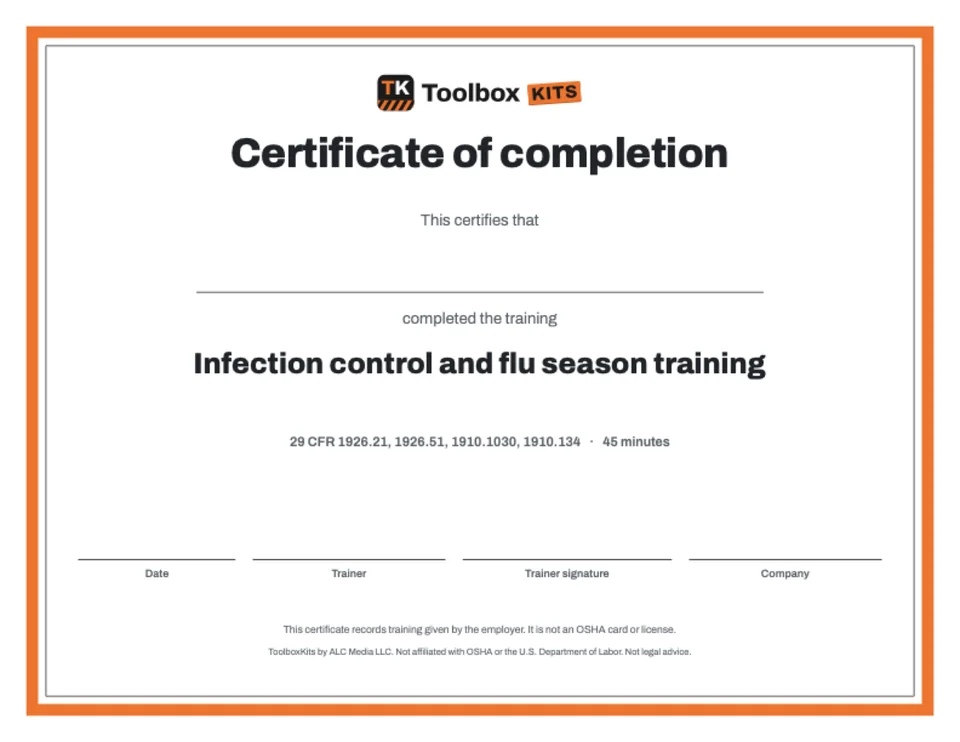 Certificate
- Crew handout
Try it
Try the quiz
Three questions from this topic. Pick an answer to see the right one and the OSHA paragraph.
Question 1 of 3
When should you stay home from work during flu season?
The rule
What OSHA requires
Plain-language summary. Each line links to the exact paragraph of the regulation.
OSHA has no specific standard for the flu or the common cold, but the general duty to train still applies: in construction, the employer must instruct each employee in the recognition and avoidance of unsafe conditions and the regulations applicable to their work environment.
“The employer shall instruct each employee in the recognition and avoidance of unsafe conditions and the regulations applicable to his work environment to control or eliminate any hazards or other exposure to illness or injury.”
Lavatories must be made available, with hot and cold or tepid running water, hand soap or similar cleansing agents, and individual hand towels or air blowers. This applies in construction (29 CFR 1926.51(f)(3)(i) to (iv)) and in permanent general industry workplaces (29 CFR 1910.141(d)(2)(i) to (iv)). Mobile crews and normally unattended work locations are exempt if workers have transportation readily available to nearby washing facilities.
“Lavatories shall be made available in all places of employment.”
In construction, the common drinking cup is prohibited. In permanent general industry workplaces, a common drinking cup and other common utensils are prohibited (29 CFR 1910.141(b)(1)(vi)).
“The common drinking cup is prohibited.”
No employee may be allowed to eat or drink in a toilet room or in any area exposed to a toxic material. This applies in construction and, where employees may eat or drink on the premises, in permanent general industry workplaces (29 CFR 1910.141(g)(1) and (g)(2)).
“No employee shall be allowed to consume food or beverages in a toilet room nor in any area exposed to a toxic material.”
In permanent general industry workplaces, all places of employment must be kept clean to the extent that the nature of the work allows.
“All places of employment shall be kept clean to the extent that the nature of the work allows.”
Each employer with employees who have occupational exposure to blood or other potentially infectious materials must establish a written exposure control plan designed to eliminate or minimize employee exposure. The plan must be reviewed and updated at least annually (29 CFR 1910.1030(c)(1)(iv)).
“shall establish a written Exposure Control Plan designed to eliminate or minimize employee exposure.”
Under the bloodborne pathogens standard, universal precautions must be observed to prevent contact with blood or other potentially infectious materials. When it is difficult or impossible to tell body fluid types apart, all body fluids must be considered potentially infectious materials.
“Universal precautions shall be observed to prevent contact with blood or other potentially infectious materials.”
Under the bloodborne pathogens standard, employers must provide handwashing facilities that are readily accessible to employees (29 CFR 1910.1030(d)(2)(iii)). They must make sure employees wash their hands immediately or as soon as feasible after removing gloves or other personal protective equipment.
“Employers shall ensure that employees wash their hands immediately or as soon as feasible after removal of gloves or other personal protective equipment.”
The hepatitis B vaccine and vaccination series must be made available to all employees who have occupational exposure, along with post-exposure evaluation and follow-up for any employee who has an exposure incident. These must be made available at no cost to the employee (29 CFR 1910.1030(f)(1)(ii)(A)).
“The employer shall make available the hepatitis B vaccine and vaccination series to all employees who have occupational exposure, and post-exposure evaluation and follow-up to all employees who have had an exposure incident.”
Each employee with occupational exposure must be trained at no cost and during working hours, at the time of initial assignment and at least annually after that (29 CFR 1910.1030(g)(2)(ii)).
“Such training must be provided at no cost to the employee and during working hours.”
Who must be trained
Under the bloodborne pathogens standard, each employee with occupational exposure to blood or other potentially infectious materials (29 CFR 1910.1030(g)(2)(i)). The training must be at no cost to the employee and during working hours, and the material must fit the employees' educational level, literacy and language (29 CFR 1910.1030(g)(2)(vi)).
When to retrain
Bloodborne pathogens training must be given at the time of initial assignment and at least annually after that, within one year of the previous training (29 CFR 1910.1030(g)(2)(ii) and (g)(2)(iv)). Additional training is required when new or changed tasks or procedures affect an employee's occupational exposure (29 CFR 1910.1030(g)(2)(v)).

Common questions
Questions people ask
What should a flu season safety moment cover?
Keep it short and pick one or two habits: stay home when sick, wash your hands, cover coughs or wipe down shared tools and trucks. Point out where the handwashing stations are and what the sick policy says. For a longer cold and flu safety meeting, add rest, flu shots and first aid with gloves.
Can we use this as a COVID-19 toolbox talk or safety moment?
Yes. COVID-19, the flu and colds spread in similar ways, so the same habits help: stay home when sick, wash your hands, cover coughs and clean shared surfaces. Check current guidance from your local health department, and follow any extra rules your state or industry has.
Is there an OSHA standard for infection control at work?
OSHA has no specific standard for the flu or the common cold. Its sanitation rules require handwashing facilities with soap and towels or air blowers, and prohibit the common drinking cup (29 CFR 1926.51 in construction, 29 CFR 1910.141 in general industry). Workers with occupational exposure to blood or other potentially infectious materials are covered by the bloodborne pathogens standard (29 CFR 1910.1030).
Do we need a written COVID-19 prevention program or pandemic plan?
Federal OSHA has no rule that requires every employer to keep a written pandemic plan. The COVID-19 plan rules in 29 CFR 1910.502 are written for healthcare settings, so healthcare employers should check which parts are still in force and apply to them, and states that run their own OSHA plans may have their own rules. If your workers have occupational exposure to blood or other potentially infectious materials, you need a written exposure control plan (29 CFR 1910.1030(c)(1)(i)). Even when no rule requires one, a short written plan for sick workers, cleaning and covering absences is good practice, and a sample or template can be a starting point.
Is there a free flu season toolbox talk we can print?
Yes. This flu season talk is free, and you can print it as a PDF in English or Spanish with a sign-in table. If you want slides for a longer COVID-19 or flu safety presentation, use the training kit option on this page.
Free to share
Use this talk for free
You can print, share and adapt this talk at no cost under the Creative Commons BY-NC-SA 4.0 license. Please credit ToolboxKits with a link.