

Free 5-minute toolbox talkHealth and wellnessEnglish and Spanish
Hearing protection toolbox talk: noise at work
Noise damage usually builds up slowly and does not hurt, so it is easy to miss until the damage is done. What OSHA requires: In construction, when sound levels exceed those listed in Table D-2, feasible administrative or engineering controls must be used (29 CFR 1926.52(b)).
A free 5-minute talk on noise and hearing protection, with the OSHA rules that apply. Use it as a full toolbox talk, or pick one point for a quick hearing protection safety moment.
Updated October 29, 2026 · Based on 29 CFR 1910.95, 29 CFR 1926.52, 29 CFR 1926.101
Read it out loud
Free 5-minute toolbox talk
Read it out loud to your crew. It takes about 5 minutes.
Start with a question
Has anyone here left work with ringing ears or muffled hearing, and what were you doing that day?
Why it matters
Noise damage usually builds up slowly and does not hurt, so it is easy to miss until the damage is done. Hearing lost to noise does not come back, and hearing aids cannot make it like new. Noise can also leave you with ringing in your ears that never goes away. The good news is that this kind of hearing loss can be prevented.
Key points
Know when noise is too loud
Rule of thumb: if you have to raise your voice to talk to someone an arm's length away, the noise is probably loud enough to hurt your hearing. Saws, grinders, jackhammers, compressors, generators and heavy equipment are common sources.
More
Ringing or muffled hearing after a shift is a warning sign that your ears took a hit.
Make it quieter first
When sound levels go over the limits in OSHA's noise tables, feasible engineering or administrative controls must be used first. If they do not bring the sound down far enough, hearing protection must be provided and used.
More
That can mean a quieter tool, a muffler, moving the generator farther away or less time near the noise.
29 CFR 1926.52(b) · 29 CFR 1926.52(b) in construction, 29 CFR 1910.95(b)(1) in general industry
Know the 85 decibel action level
In general industry, an 8-hour time-weighted average of 85 decibels is the action level, and at or above it the employer must run a hearing conservation program. At or above that level, hearing protectors must be made available at no cost and replaced as necessary.
More
In construction, a continuing, effective hearing conservation program is required wherever sound levels exceed the values in the noise table.
29 CFR 1910.95(c)(1) · 29 CFR 1910.95(c)(1) and (c)(2) · 29 CFR 1910.95(i)(1) · 29 CFR 1926.52(d)(1)
Wear protection the whole time
Earplugs and earmuffs both work when they fit well and stay on, so pick the type you will actually wear. In general industry, the employer must let you choose from a variety of suitable hearing protectors.
More
Keep them on the whole time you are in the noise, because even a few minutes without them adds up. In construction, plain cotton is not an acceptable protective device.
29 CFR 1910.95(i)(3) · 29 CFR 1926.101(c)
Fit earplugs and earmuffs right
Roll foam plugs into a thin tube, reach over your head to pull the top of your ear up and back, then slide the plug in deep and hold it while it expands. Earmuffs need a full seal, so hair, hats and the arms of safety glasses under the cushions can let noise leak in.
More
In construction, earplugs must be fitted or determined individually by competent persons. In general industry, the employer must ensure proper initial fitting and supervise correct use.
29 CFR 1926.101(b) · 29 CFR 1910.95(i)(5)
Get tested and trained every year
In general industry, employers must make hearing tests available at no cost to workers exposed at or above an 8-hour time-weighted average of 85 decibels. After a baseline test, a new test is required at least once a year.
More
Those workers must also be trained every year on the effects of noise, hearing protectors and why the tests are done.
29 CFR 1910.95(g)(1) · 29 CFR 1910.95(g)(1) and (g)(2) · 29 CFR 1910.95(g)(6) · 29 CFR 1910.95(k)(1), (k)(2) and (k)(3)
Scenario
Picture this: Your crew is working next to a generator and an air compressor while a coworker grinds steel. A new helper keeps his earmuffs around his neck because he wants to hear the radio and the foreman. By lunch, his ears are ringing and everyone sounds like they are talking through a wall. What should he have done, and what can the crew change before the afternoon?
Ask the crew
- Which tools or areas on this job make you raise your voice to be heard?
- Which hearing protection do you like best, and what makes people take it off?
- What could we change to make the work quieter?
- Where do we keep spare earplugs, and who do you tell when they run out?
Takeaway
If you have to shout to be heard, fit your hearing protection right and keep it on until you are out of the noise.
Trainer: ______________________ Date: ____________
Credit: ToolboxKits, https://toolboxkits.com/topics/noise-and-hearing/ (CC BY-NC-SA 4.0)
The poster is also inside the paid kits.
Audit-ready records in 60 seconds
Fill in your crew and download a filled sign-in sheet for this talk. Everything is made in your browser. Names are never uploaded or stored.
Start a sign-off
Crew scan a QR code on their own phones, type their name and sign with a finger. You see the names arrive and download the signed sheet. Free, no account.
Kits
Get the kit
No subscription needed. Buy only the kit you need.
Toolbox talk kit
$4.99
- 5-minute talk, English PDF
- 5-minute talk, Spanish PDF
- Editable mini-deck (English and Spanish)
- One-page crew handout (English and Spanish)
- Bilingual sign-in sheet
- 3-question quiz with answer key (English and Spanish)
- One-page bilingual poster
- Audit-ready records in 60 seconds: fill in your crew and get a sign-in sheet and a certificate for every worker
Training kit
$9
Editable PowerPoint, 39 slides
- Editable PowerPoint with trainer notes on every slide
- Trainer guide PDF with timing and discussion tips
- 10-question quiz and answer key
- Sign-in sheet and certificate of completion with fillable fields
- One-page crew handout
- Full Spanish version of everything
- One-page bilingual poster
- Audit-ready records in 60 seconds: fill in your crew and get a sign-in sheet and a certificate for every worker
- Instant download
- Secure checkout by Stripe
- 30-day refund, no questions
Need many topics? All Access gives you every kit for $99 a year.
Inside the kit
See what is in the kit
What is in the kit
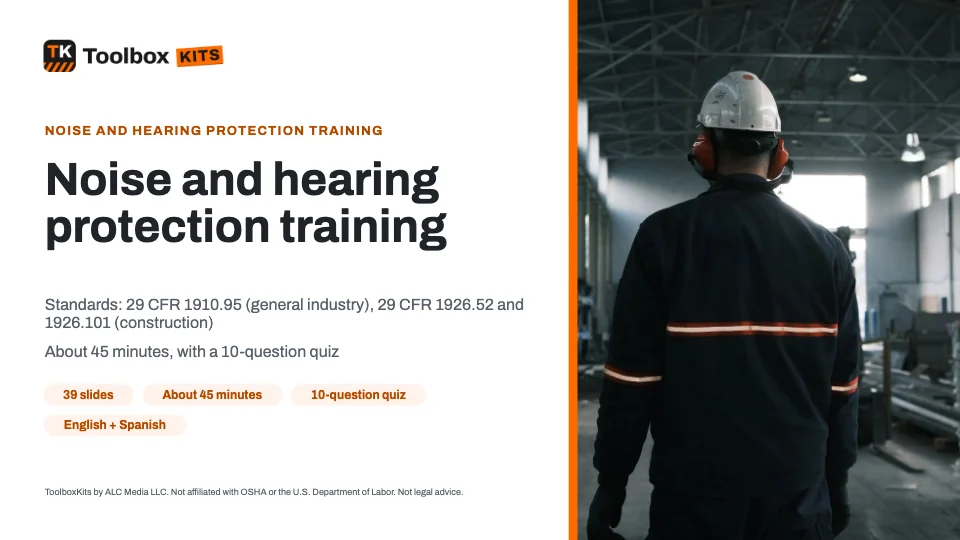 Editable PowerPoint
- Trainer guide
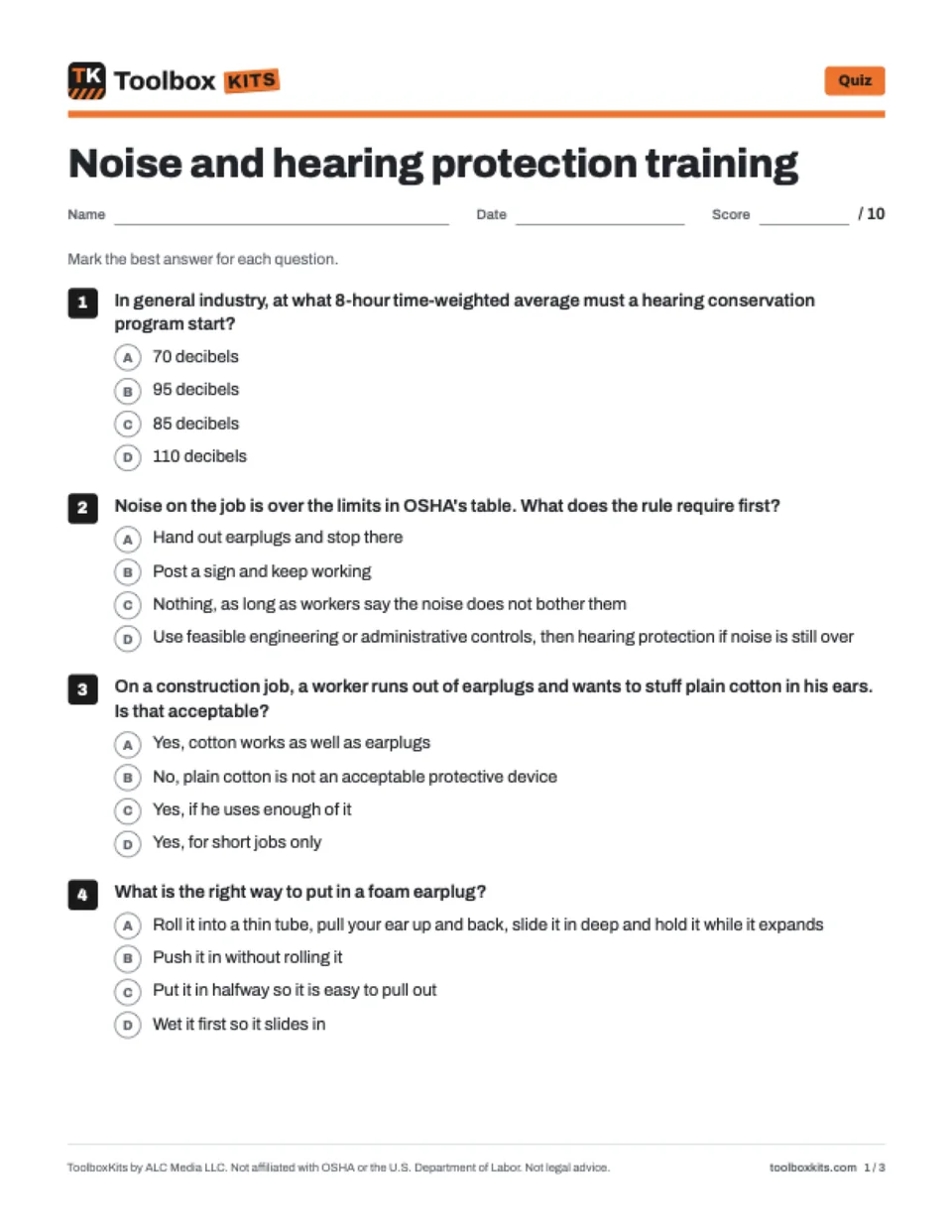 Quiz
- Answer key
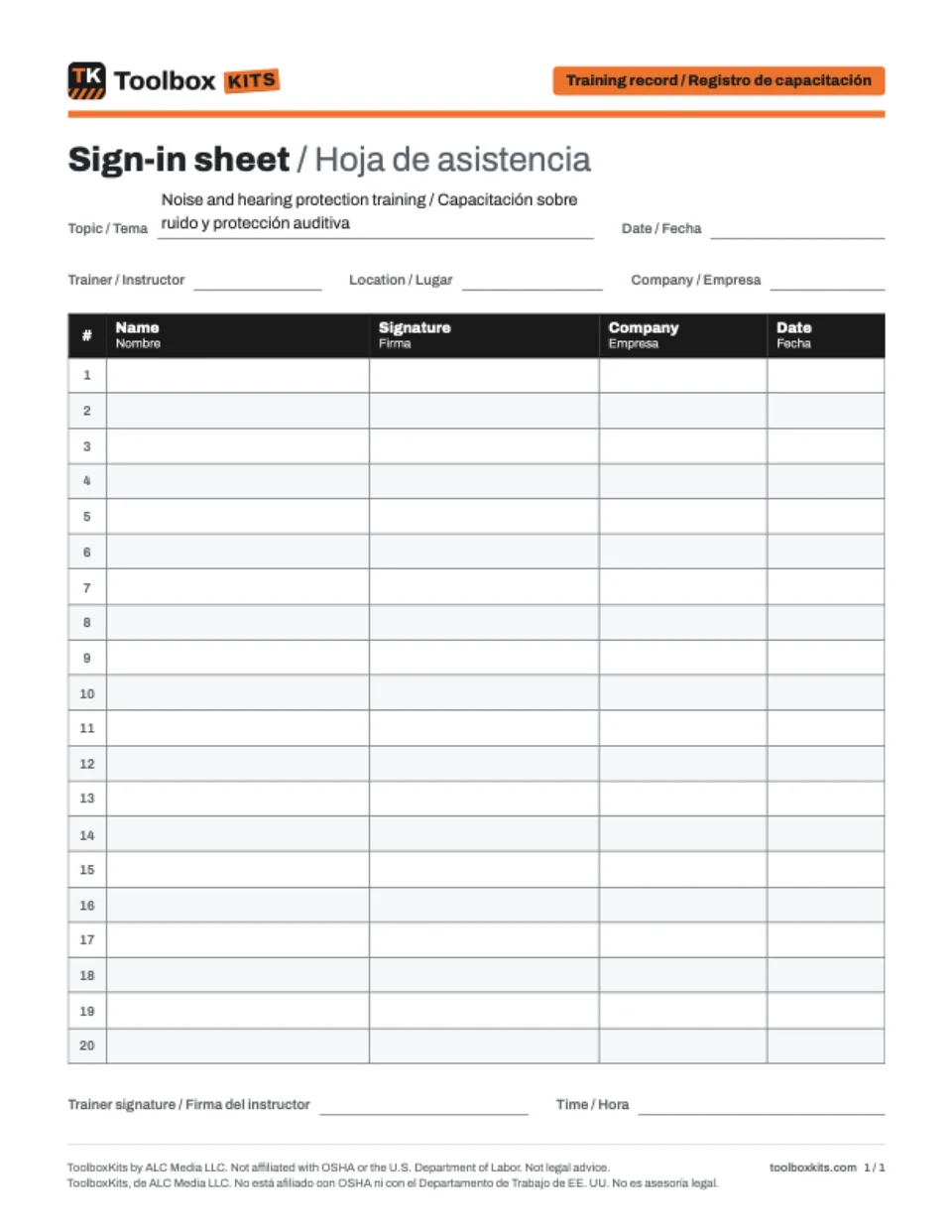 Sign-in sheet
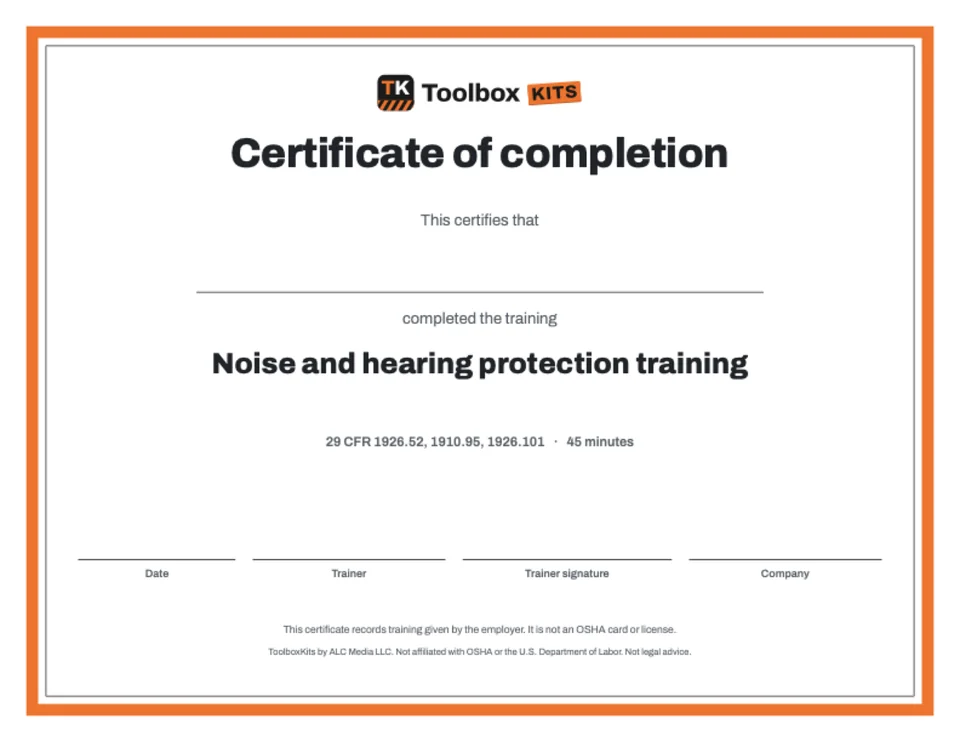 Certificate
- Crew handout
Try it
Try the quiz
Three questions from this topic. Pick an answer to see the right one and the OSHA paragraph.
Question 1 of 3
In general industry, at what 8-hour time-weighted average noise exposure must the employer run a hearing conservation program?
The rule
What OSHA requires
Plain-language summary. Each line links to the exact paragraph of the regulation.
In construction, when sound levels exceed those listed in Table D-2, feasible administrative or engineering controls must be used. If those controls fail to bring sound levels within the table, personal protective equipment must be provided and used.
“When employees are subjected to sound levels exceeding those listed in Table D-2 of this section, feasible administrative or engineering controls shall be utilized.”
In construction, a continuing, effective hearing conservation program must be administered in all cases where sound levels exceed the values in Table D-2.
“In all cases where the sound levels exceed the values shown herein, a continuing, effective hearing conservation program shall be administered.”
In construction, ear protective devices must be provided and used wherever it is not feasible to reduce noise levels or duration of exposures to those in Table D-2. Earplugs must be fitted or determined individually by competent persons, and plain cotton is not acceptable (29 CFR 1926.101(b) and (c)).
“Wherever it is not feasible to reduce the noise levels or duration of exposures to those specified in Table D-2, Permissible Noise Exposures, in § 1926.52, ear protective devices shall be provided and used.”
In general industry, when sound exceeds the levels in Table G-16, feasible administrative or engineering controls must be used. If they fail to reduce sound levels within the table, personal protective equipment must be provided and used.
“If such controls fail to reduce sound levels within the levels of Table G-16, personal protective equipment shall be provided and used to reduce sound levels within the levels of the table.”
In general industry, the employer must administer a continuing, effective hearing conservation program whenever employee noise exposures equal or exceed an 8-hour time-weighted average of 85 decibels, or a dose of fifty percent. These exposures are computed without regard to any hearing protection worn.
“whenever employee noise exposures equal or exceed an 8-hour time-weighted average sound level (TWA) of 85 decibels measured on the A scale (slow response) or, equivalently, a dose of fifty percent.”
In general industry, when information indicates any employee's exposure may equal or exceed an 8-hour time-weighted average of 85 decibels, the employer must develop and implement a monitoring program. Each employee exposed at or above that level must be told the monitoring results (29 CFR 1910.95(e)).
“When information indicates that any employee's exposure may equal or exceed an 8-hour time-weighted average of 85 decibels, the employer shall develop and implement a monitoring program.”
In general industry, hearing protectors must be made available at no cost to all employees exposed to an 8-hour time-weighted average of 85 decibels or greater, and replaced as necessary.
“Employers shall make hearing protectors available to all employees exposed to an 8-hour time-weighted average of 85 decibels or greater at no cost to the employees.”
In general industry, the employer must make sure hearing protectors are worn by employees required to use personal protective equipment under 29 CFR 1910.95(b)(1). They must also be worn by employees exposed to an 8-hour time-weighted average of 85 decibels or greater who have not yet had a baseline audiogram established under 29 CFR 1910.95(g)(5)(ii), or who have experienced a standard threshold shift.
In general industry, an audiometric testing program (hearing tests) must be made available to all employees exposed at or above an 8-hour time-weighted average of 85 decibels, at no cost to employees (29 CFR 1910.95(g)(2)). After the baseline audiogram, a new audiogram is required at least annually (29 CFR 1910.95(g)(6)).
“The employer shall establish and maintain an audiometric testing program as provided in this paragraph by making audiometric testing available to all employees whose exposures equal or exceed an 8-hour time-weighted average of 85 decibels.”
In general industry, the employer must train each employee exposed to noise at or above an 8-hour time-weighted average of 85 decibels, and repeat the training annually (29 CFR 1910.95(k)(2)). Training must cover the effects of noise on hearing, the purpose, advantages, disadvantages and attenuation of different hearing protectors along with how to select, fit, use and care for them, and the purpose of audiometric testing with an explanation of the test procedures (29 CFR 1910.95(k)(3)).
“The employer shall train each employee who is exposed to noise at or above an 8-hour time weighted average of 85 decibels in accordance with the requirements of this section.”
Who must be trained
In general industry, each employee exposed to noise at or above an 8-hour time-weighted average of 85 decibels (29 CFR 1910.95(k)(1)). The employer must also train employees in the use and care of all hearing protectors provided to them (29 CFR 1910.95(i)(4)). Paragraphs (c) through (n) of 29 CFR 1910.95, which include these training rules, do not apply to employers engaged in oil and gas well drilling and servicing operations (29 CFR 1910.95(o)).
When to retrain
Repeat the training annually for each employee in the hearing conservation program, and update it to match changes in protective equipment and work processes (29 CFR 1910.95(k)(2)). When a standard threshold shift occurs, unless a physician determines it is not work related or aggravated by occupational noise exposure, employees already using hearing protectors must be refitted and retrained, and given protectors with greater attenuation if necessary (29 CFR 1910.95(g)(8)(ii)(B)).

Common questions
Questions people ask
Is there a printable hearing protection toolbox talk PDF?
Yes. This hearing protection talk is free, and you can print it as a PDF in English or Spanish with a sign-in table. Hand out a few pairs of earplugs while you read it so everyone can practice the fit.
What is a hearing conservation program?
It is a program OSHA requires once noise on the job reaches certain levels. In general industry, it is required when exposures equal or exceed an 8-hour time-weighted average of 85 decibels, and it includes noise monitoring, hearing tests, hearing protectors, training and recordkeeping (29 CFR 1910.95(c)(1), (d)(1), (g)(1), (i)(1), (k)(1) and (m)(1)). In construction, a continuing, effective hearing conservation program is required wherever sound levels exceed the values in Table D-2 (29 CFR 1926.52(d)(1)).
How do you put in foam earplugs the right way?
Roll the plug between your fingers into a thin, tight tube. Reach over your head with your other hand, pull the top of your ear up and back, slide the plug in deep and hold it while it expands. A good fit feels snug and makes outside noise drop off clearly. Use clean hands, and throw away plugs that are dirty or will not expand.
What causes noise-induced hearing loss?
Loud noise damages tiny hair cells in the inner ear that turn sound into signals for the brain. It can come from loud noise day after day or from one very loud blast close to your ear, like a powder-actuated tool going off. Damaged hair cells do not grow back, which is why protection has to go in before the noise starts.
Is there a hearing protection safety training PowerPoint?
This free talk is written to be read aloud from a printout, so you do not need a projector. If you want slides for a longer hearing safety presentation, use the training kit option on this page. A hands-on fit check with real earplugs and earmuffs works well with either one.
Free to share
Use this talk for free
You can print, share and adapt this talk at no cost under the Creative Commons BY-NC-SA 4.0 license. Please credit ToolboxKits with a link.