

Free 5-minute toolbox talkHealth and wellnessEnglish and Spanish
Heat stress toolbox talk: working in hot weather
Heat illness can turn deadly, and it can come on fast. Someone with heat stroke may not realize anything is wrong, so the crew has to watch out for each other. What OSHA requires: Provide an adequate supply of potable (drinking) water at every construction place of employment (29 CFR 1926.51(a)(1)).
A free 5-minute heat stress talk for crews working in hot weather, indoors or out. It covers the warning signs, water, rest and shade, new workers and what to do if someone goes down.
Updated October 31, 2026 · Based on 29 CFR 1926.21, 29 CFR 1926.51, 29 CFR 1910.141
Read it out loud
Free 5-minute toolbox talk
Read it out loud to your crew. It takes about 5 minutes.
Start with a question
Have you ever felt dizzy, sick or confused while working in the heat, and what did you do about it?
Why it matters
Heat illness can turn deadly, and it can come on fast. Someone with heat stroke may not realize anything is wrong, so the crew has to watch out for each other. The good news is that heat illness is preventable with water, rest, shade and a plan.
Key points
Know what heat stress is
Your body cools itself by sweating and by sending blood to your skin. Heat stress builds up when heat, humidity, direct sun, still air, hard work or heavy clothing and PPE add heat faster than your body can get rid of it. When that happens, your core temperature rises and heat illness can set in.
Drink water before you are thirsty
In construction, an adequate supply of drinking water must be provided at every place of employment. Drink small amounts often through the whole shift, not just at lunch. Keep the water cool, clean and close to where people are working.
Rest in shade or a cool area
Take breaks out of the sun or in a cooler area, and take them more often when it is hotter or the work is harder. Schedule the heaviest work for the cooler part of the day when you can. Do not skip a break to finish a job.
Ease new and returning workers into the heat
Workers who are new, or back from time off, have not gotten used to the heat yet and are at higher risk. Give them lighter work and more breaks at first, then build up slowly. The same goes for everyone when a heat wave first hits.
Know the warning signs
Heat cramps and heat rash are early warnings. Heat exhaustion can bring heavy sweating, headache, dizziness, nausea, weakness and thirst, so stop, cool down and drink water. Confusion, slurred speech, fainting or seizures can mean heat stroke, which is a medical emergency.
Act fast on heat stroke
Call 911 and tell your supervisor right away. Move the worker to a cool, shaded place, cool them with cold water, ice or wet cloths and a fan, and stay with them until help arrives. Do not let them drive themselves anywhere or go home alone.
Scenario
Picture this: It is the first hot week of summer. A new laborer started on Monday and is pushing hard to keep up with the crew. After lunch he says he has a headache and feels sick to his stomach, but he says he is fine and keeps working. Later that afternoon he is stumbling and not making sense when you talk to him. What do you do right now, and what could the crew have done earlier in the day?
Ask the crew
- Where is the drinking water on this job, and is it close enough that people actually use it?
- Where can we take breaks in the shade or a cool spot today?
- Who on the crew is new or just back, and how will we ease them in?
- If someone shows signs of heat stroke, who calls 911, and what address do we give?
Takeaway
Drink water often, rest in the shade, watch each other for warning signs and call 911 for heat stroke.
Trainer: ______________________ Date: ____________
Credit: ToolboxKits, https://toolboxkits.com/topics/heat-stress/ (CC BY-NC-SA 4.0)
The poster is also inside the paid kits.
Audit-ready records in 60 seconds
Fill in your crew and download a filled sign-in sheet for this talk. Everything is made in your browser. Names are never uploaded or stored.
Start a sign-off
Crew scan a QR code on their own phones, type their name and sign with a finger. You see the names arrive and download the signed sheet. Free, no account.
Kits
Get the kit
No subscription needed. Buy only the kit you need.
Toolbox talk kit
$4.99
- 5-minute talk, English PDF
- 5-minute talk, Spanish PDF
- Editable mini-deck (English and Spanish)
- One-page crew handout (English and Spanish)
- Bilingual sign-in sheet
- 3-question quiz with answer key (English and Spanish)
- One-page bilingual poster
- Audit-ready records in 60 seconds: fill in your crew and get a sign-in sheet and a certificate for every worker
Training kit
$9
Editable PowerPoint, 34 slides
- Editable PowerPoint with trainer notes on every slide
- Trainer guide PDF with timing and discussion tips
- 10-question quiz and answer key
- Sign-in sheet and certificate of completion with fillable fields
- One-page crew handout
- Full Spanish version of everything
- One-page bilingual poster
- Audit-ready records in 60 seconds: fill in your crew and get a sign-in sheet and a certificate for every worker
- Instant download
- Secure checkout by Stripe
- 30-day refund, no questions
Need many topics? All Access gives you every kit for $99 a year.
Inside the kit
See what is in the kit
What is in the kit
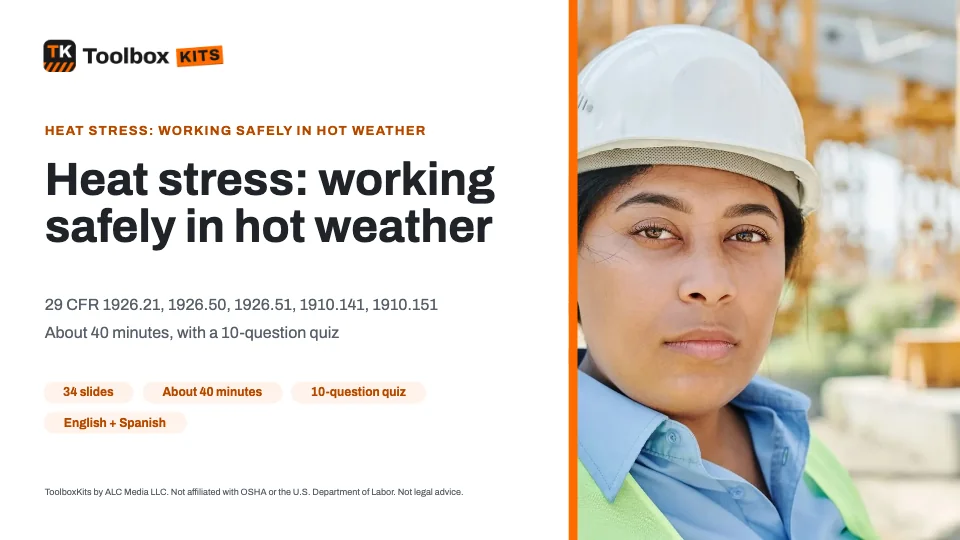 Editable PowerPoint
- Trainer guide
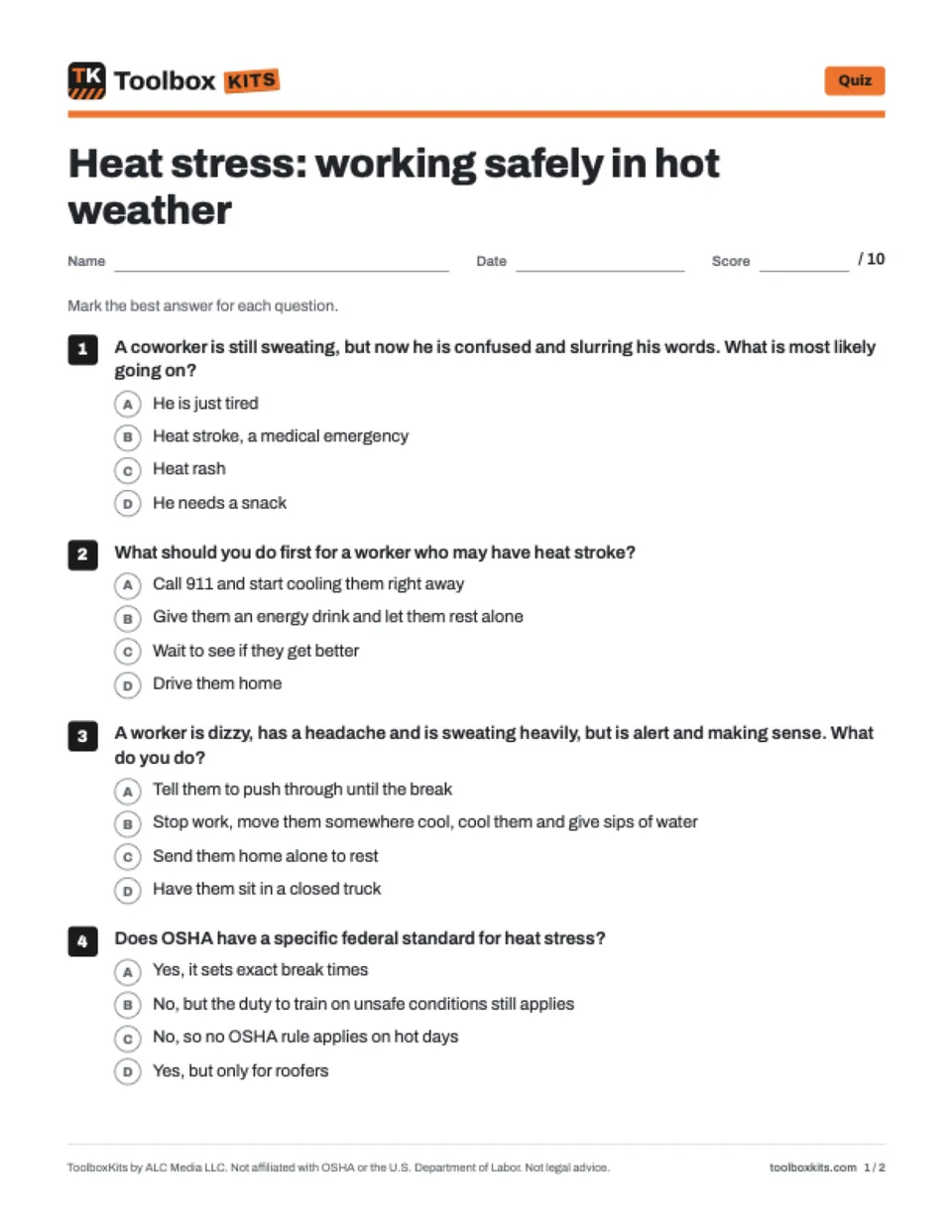 Quiz
- Answer key
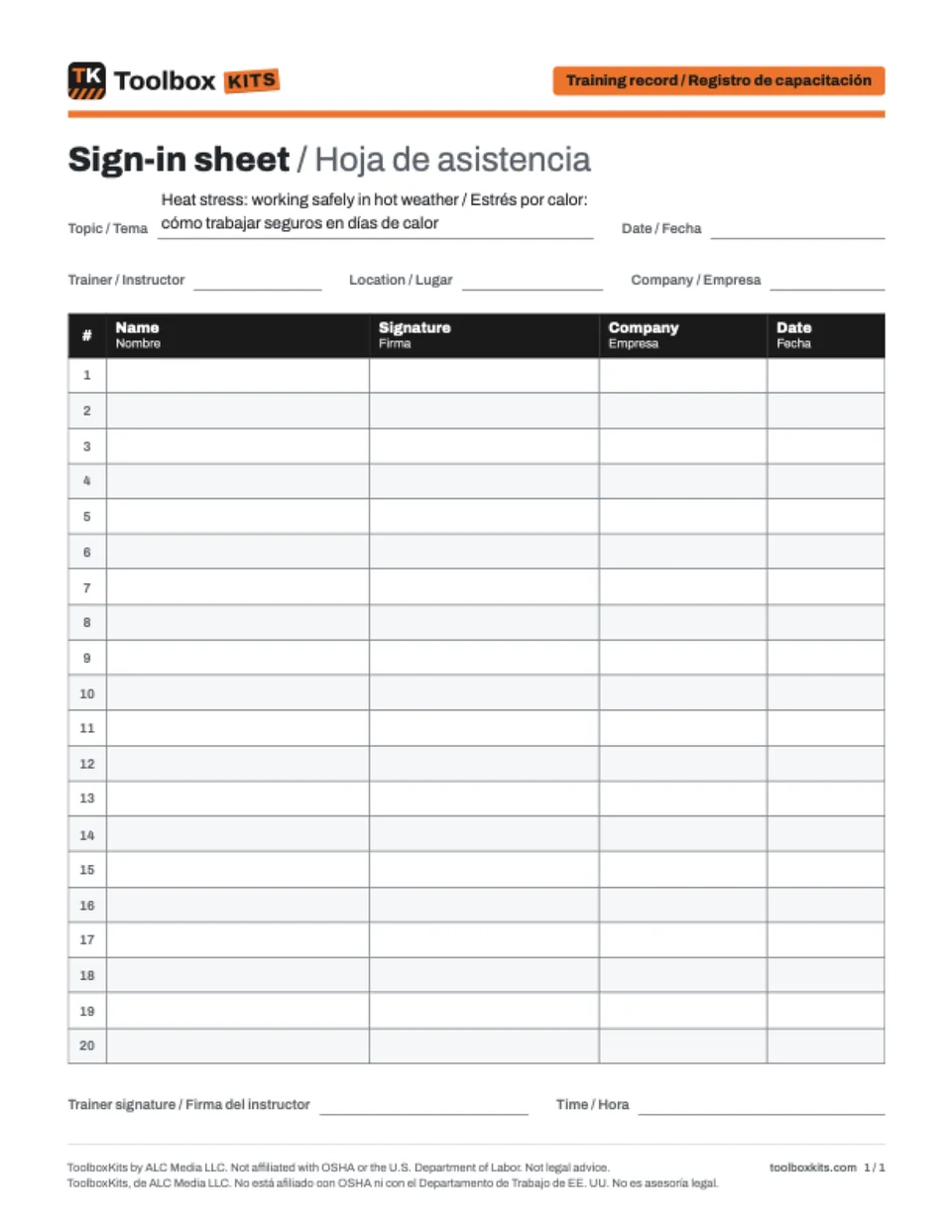 Sign-in sheet
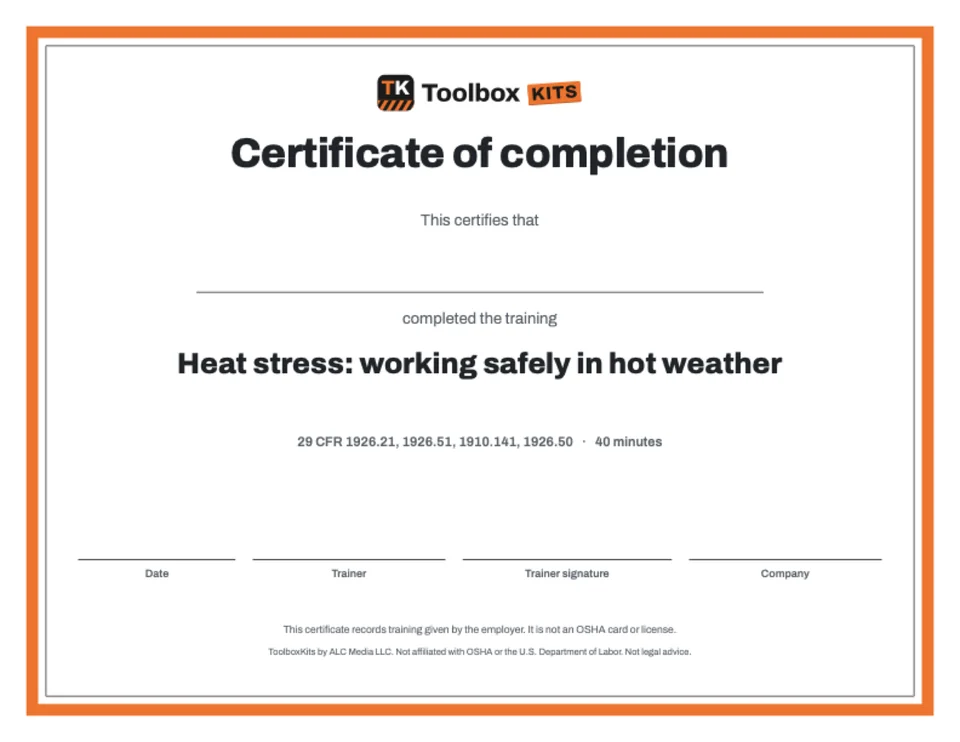 Certificate
- Crew handout
Try it
Try the quiz
Three questions from this topic. Pick an answer to see the right one and the OSHA paragraph.
Question 1 of 3
Which of these can be a sign of heat stroke, a medical emergency?
The rule
What OSHA requires
Plain-language summary. Each line links to the exact paragraph of the regulation.
OSHA has no specific federal standard for heat stress, but the general duty to train still applies: construction employers must instruct each employee to recognize and avoid unsafe conditions in their work environment.
“The employer shall instruct each employee in the recognition and avoidance of unsafe conditions and the regulations applicable to his work environment to control or eliminate any hazards or other exposure to illness or injury.”
Provide an adequate supply of potable (drinking) water at every construction place of employment.
“An adequate supply of potable water shall be provided in all places of employment.”
In construction, use portable drinking water containers that can be tightly closed and have a tap, and do not dip water from containers.
“Portable containers used to dispense drinking water shall be capable of being tightly closed, and equipped with a tap. Water shall not be dipped from containers.”
Do not use a common drinking cup.
“The common drinking cup is prohibited.”
In general industry, provide potable water in all places of employment for drinking, washing and cooking.
“Potable water shall be provided in all places of employment, for drinking, washing of the person, cooking, washing of foods, washing of cooking or eating utensils, washing of food preparation or processing premises, and personal service rooms.”
In general industry, portable drinking water dispensers must be kept sanitary, be capable of being closed and have a tap.
“Portable drinking water dispensers shall be designed, constructed, and serviced so that sanitary conditions are maintained, shall be capable of being closed, and shall be equipped with a tap.”
If no infirmary, clinic, hospital or physician is reasonably accessible to a construction worksite, a person with a valid certificate in first-aid training must be available at the worksite to render first aid.
In general industry, if there is no infirmary, clinic or hospital in near proximity, a person or persons must be adequately trained to render first aid. Adequate first aid supplies must be readily available.
“a person or persons shall be adequately trained to render first aid. Adequate first aid supplies shall be readily available.”
Common questions
Questions people ask
Is there a printable heat stress toolbox talk PDF?
Yes. This heat stress talk is free, and you can print it as a PDF in English or Spanish with a sign-in table. Use it at the start of the hot season and again during heat waves.
Does OSHA have a heat stress standard?
OSHA has no specific federal standard for heat stress. The general duty to train still applies: construction employers must instruct each employee to recognize and avoid unsafe conditions in their work environment (29 CFR 1926.21(b)(2)). Employers must also provide drinking water (29 CFR 1926.51(a)(1) in construction, 29 CFR 1910.141(b)(1)(i) in general industry). If your state runs its own OSHA plan, check its rules too.
Do we need a written heat stress program?
No federal OSHA standard requires a stand-alone written heat stress program. Writing one down is still good practice: who checks the forecast, where water and shade will be, how new workers get used to the heat and how to call for help. Go over it with the crew before the hot season starts.
What should a heat stress safety moment cover?
Keep it short and pick one or two points, like where the water and shade are today and the signs of heat stroke. Ask who is new or just back so the crew can keep an eye on them. End by naming who calls 911 if someone gets sick.
What are good safety meeting topics for hot weather?
Good hot weather topics include drinking water through the shift, rest breaks in shade, getting new workers used to the heat, the signs of heat exhaustion and heat stroke, and first aid steps. You can also cover how PPE and heavy clothing add to heat stress and how to plan heavy work for cooler hours.
Free to share
Use this talk for free
You can print, share and adapt this talk at no cost under the Creative Commons BY-NC-SA 4.0 license. Please credit ToolboxKits with a link.