

Free 5-minute toolbox talkHealth and wellnessEnglish and Spanish
Heat exhaustion toolbox talk
Heat exhaustion can start quietly. What OSHA requires: OSHA has no specific standard for heat exhaustion; the general duty to train still applies. In construction, the employer must instruct each employee in recognizing and avoiding unsafe conditions and the rules that apply to their work environment (29 CFR 1926.21(b)(2)).
A free heat exhaustion toolbox talk for hot weather. Read it aloud in about five minutes in English or Spanish. It covers the signs, first aid and prevention.
Updated October 29, 2026 · Based on 29 CFR 1926.21
Read it out loud
Free 5-minute toolbox talk
Read it out loud to your crew. It takes about 5 minutes.
Start with a question
How do you know when you or the person next to you has had too much heat?
Why it matters
Heat exhaustion can start quietly. A worker feels tired and sweaty, then dizzy and sick. If nobody acts, it can turn into heat stroke, which is an emergency. The good news is that heat exhaustion is preventable, and everyone on the crew can learn to spot it early.
Key points
Know the signs of heat exhaustion
Common signs are heavy sweating, cool and clammy skin, weakness, dizziness, headache, nausea, muscle cramps and a fast pulse. A person may feel faint or very tired. Watch yourself and your coworkers, especially on hot days or after a break from heat.
Know when it is heat stroke
Heat stroke is an emergency. Signs include confusion, slurred speech, fainting, seizures, hot and dry skin or a very high body temperature. If you see these, call emergency services right away and start cooling the person while you wait.
Act fast on heat exhaustion
Move the person to a cool or shaded place. Loosen or remove extra clothing. Give small sips of cool water if they are awake and can swallow. Put cool, wet cloths on the skin and fan them. Do not leave them alone. If they do not feel better quickly, or get worse, call emergency services.
Water, rest and shade
Drink water often, before you feel thirsty. In construction, an adequate supply of drinking water must be provided in all places of employment. Take breaks in the shade or a cool area. Wear light clothing and a hat.
Ease into the heat
New workers and people coming back from time off are at higher risk. Build up to a full day of hot work over several days, with extra breaks. A buddy system works well. Check on each other during the shift and speak up if you feel off.
Have a first aid plan
Know who is trained in first aid, where supplies are, and how to call for help from your worksite. Where no clinic or hospital is close enough, someone on site must be trained to give first aid.
Scenario
Picture this: It is a hot afternoon on a roofing job. A worker who started this week stops talking and is sweating heavily. His skin feels cool and damp, and he says he is dizzy and sick to his stomach. A coworker tells him to just finish the row. What should be done instead, and what would make you call for emergency help?
Ask the crew
- What are the signs of heat exhaustion and heat stroke, and how are they different?
- Where is our shade and drinking water on this site?
- Who is trained in first aid today, and how do we call for help?
- How can we make sure new workers are not pushed too hard in the heat?
Takeaway
Watch each other, drink water, rest in the shade, and call for help early if someone gets worse.
Trainer: ______________________ Date: ____________
Credit: ToolboxKits, https://toolboxkits.com/topics/heat-exhaustion/ (CC BY-NC-SA 4.0)
The poster is also inside the paid kits.
Audit-ready records in 60 seconds
Fill in your crew and download a filled sign-in sheet for this talk. Everything is made in your browser. Names are never uploaded or stored.
Start a sign-off
Crew scan a QR code on their own phones, type their name and sign with a finger. You see the names arrive and download the signed sheet. Free, no account.
Kits
Get the kit
No subscription needed. Buy only the kit you need.
Toolbox talk kit
$4.99
- 5-minute talk, English PDF
- 5-minute talk, Spanish PDF
- Editable mini-deck (English and Spanish)
- One-page crew handout (English and Spanish)
- Bilingual sign-in sheet
- 3-question quiz with answer key (English and Spanish)
- One-page bilingual poster
- Audit-ready records in 60 seconds: fill in your crew and get a sign-in sheet and a certificate for every worker
Training kit
$9
Editable PowerPoint, 30 slides
- Editable PowerPoint with trainer notes on every slide
- Trainer guide PDF with timing and discussion tips
- 10-question quiz and answer key
- Sign-in sheet and certificate of completion with fillable fields
- One-page crew handout
- Full Spanish version of everything
- One-page bilingual poster
- Audit-ready records in 60 seconds: fill in your crew and get a sign-in sheet and a certificate for every worker
- Instant download
- Secure checkout by Stripe
- 30-day refund, no questions
Need many topics? All Access gives you every kit for $99 a year.
Inside the kit
See what is in the kit
What is in the kit
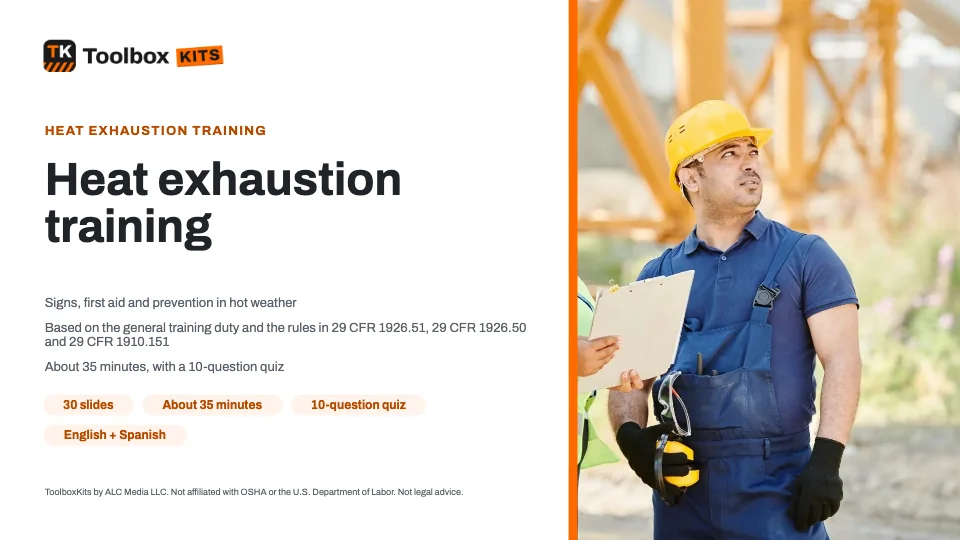 Editable PowerPoint
- Trainer guide
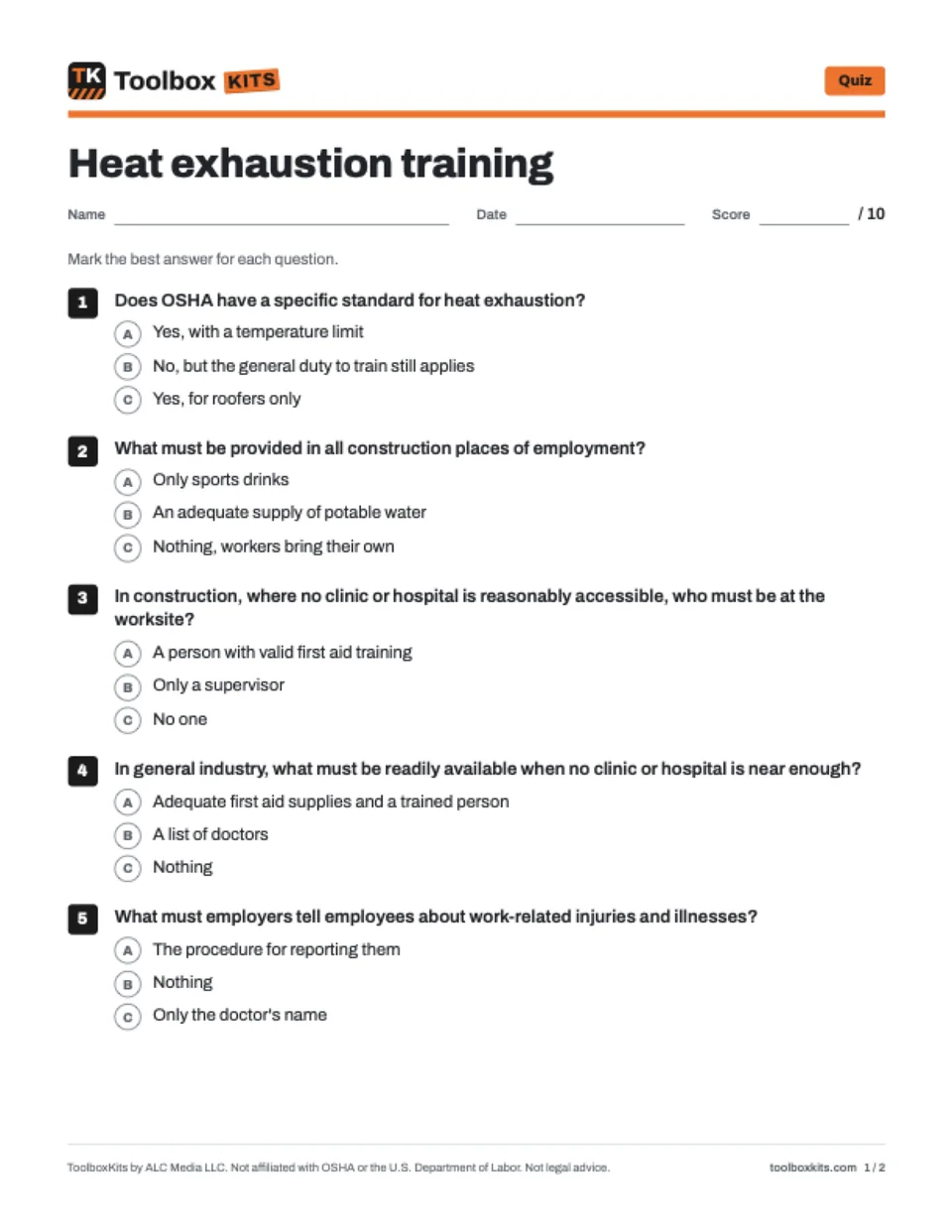 Quiz
- Answer key
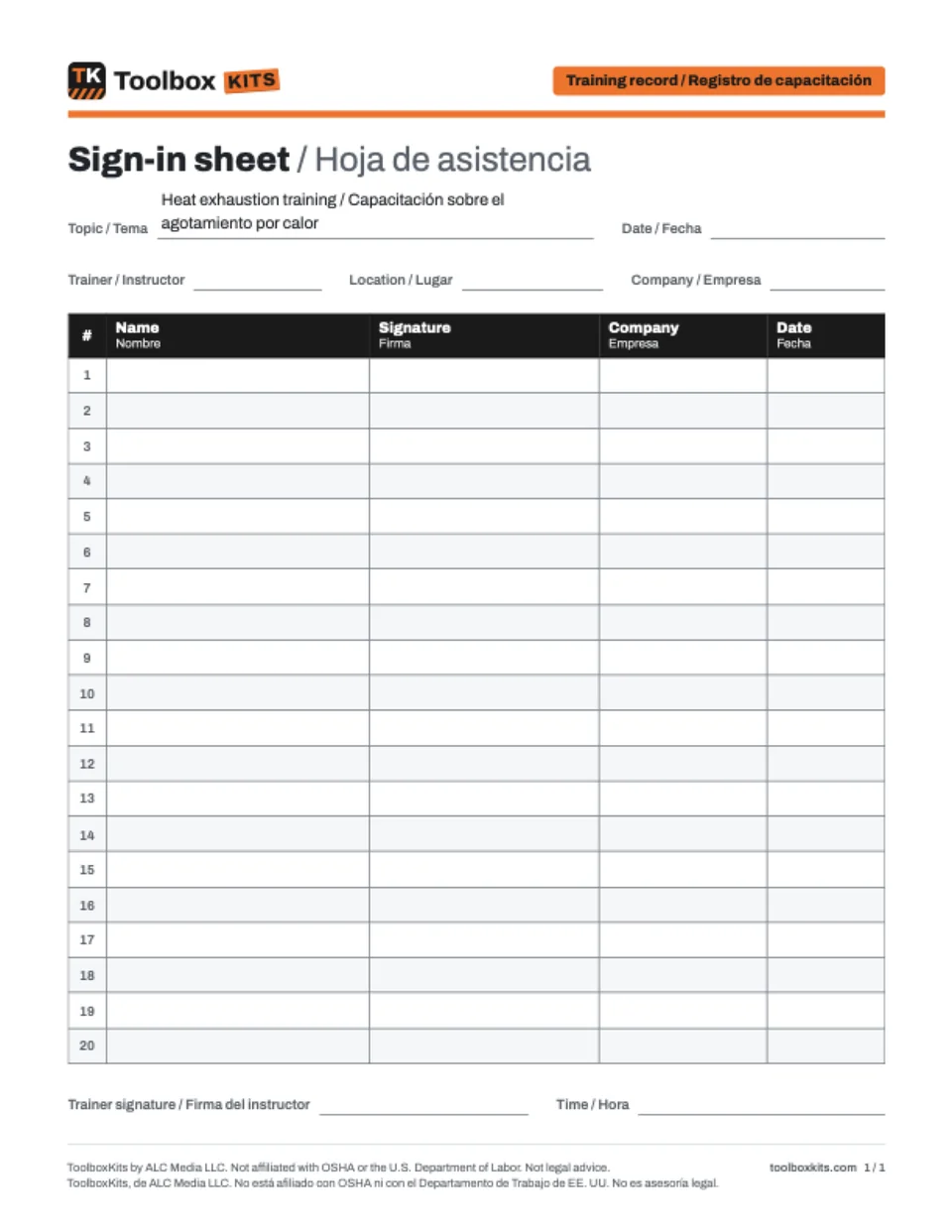 Sign-in sheet
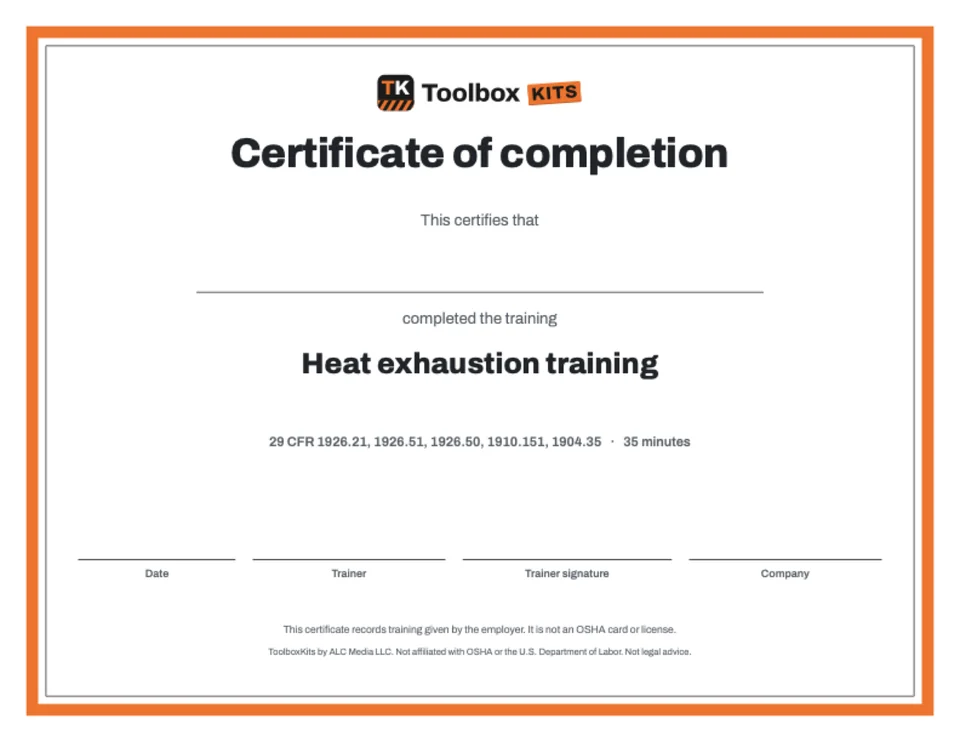 Certificate
- Crew handout
Try it
Try the quiz
Three questions from this topic. Pick an answer to see the right one and the OSHA paragraph.
Question 1 of 3
Which is a sign of heat exhaustion?
The rule
What OSHA requires
Plain-language summary. Each line links to the exact paragraph of the regulation.
OSHA has no specific standard for heat exhaustion; the general duty to train still applies. In construction, the employer must instruct each employee in recognizing and avoiding unsafe conditions and the rules that apply to their work environment.
“The employer shall instruct each employee in the recognition and avoidance of unsafe conditions and the regulations applicable to his work environment to control or eliminate any hazards or other exposure to illness or injury.”
An adequate supply of drinking water must be provided in all places of employment in construction. Check that coolers are full and clean before a hot day or a long weekend of overtime.
“An adequate supply of potable water shall be provided in all places of employment.”
In construction, where no infirmary, clinic, hospital or physician is reasonably accessible, a person with valid first aid training must be available at the worksite to render first aid.
“a person who has a valid certificate in first-aid training from the U.S. Bureau of Mines, the American Red Cross, or equivalent training that can be verified by documentary evidence, shall be available at the worksite to render first aid.”
In general industry, where no clinic or hospital is near enough to treat all injured employees, someone must be adequately trained to give first aid and supplies must be readily available.
“a person or persons shall be adequately trained to render first aid. Adequate first aid supplies shall be readily available.”
In construction, the safety program must provide for frequent and regular inspections of job sites, materials and equipment by competent persons the employer designates. On hot days, check water, shade and rest areas as part of those inspections.
“Such programs shall provide for frequent and regular inspections of the job sites, materials, and equipment to be made by competent persons designated by the employers.”
Employers must tell each employee how to report work-related injuries and illnesses. Know that procedure, and use it for small injuries and close calls too.
“You must inform each employee of your procedure for reporting work-related injuries and illnesses;”
Common questions
Questions people ask
What should a heat exhaustion toolbox talk cover?
Cover the signs of heat exhaustion, how it differs from heat stroke, first aid, and prevention with water, rest and shade. Add how to call for help from your site. Keep it to about five minutes and end with a question.
Is there a printable heat exhaustion toolbox talk?
Yes. This page is a free printable heat exhaustion toolbox talk in English and Spanish with a sign-in table. You can print it or read it from a phone.
What is a good heat exhaustion safety moment?
Ask the crew how they know someone has had too much heat. Then share one tip, such as drinking water before you feel thirsty or watching a buddy for dizziness and cool, clammy skin.
Is there a heat exhaustion safety presentation?
The free talk on this page works as a short spoken presentation. For slides, a trainer guide, a quiz and a sign-in sheet, order the training kit or request a custom one.
Does OSHA have a rule about heat exhaustion?
OSHA has no specific standard for heat exhaustion. The general duty to train still applies. In construction, adequate drinking water must be provided, and first aid must be available where no clinic or hospital is reasonably close.
Free to share
Use this talk for free
You can print, share and adapt this talk at no cost under the Creative Commons BY-NC-SA 4.0 license. Please credit ToolboxKits with a link.