

Free 5-minute toolbox talkHealth and wellnessEnglish and Spanish
Bloodborne pathogens toolbox talk
Bloodborne pathogens are germs in human blood that can cause disease, such as hepatitis B virus (HBV) and human immunodeficiency virus (HIV). What OSHA requires: Each employer with employees who have occupational exposure must establish a written exposure control plan designed to eliminate or minimize employee exposure (29 CFR 1910.1030(c)(1)(i)).
This free bloodborne pathogens toolbox talk takes about five minutes to read aloud. It covers universal precautions, PPE, sharps, cleanup and what to do after an exposure, with the OSHA rules behind each point.
Updated October 29, 2026 · Based on 29 CFR 1910.1030
Read it out loud
Free 5-minute toolbox talk
Read it out loud to your crew. It takes about 5 minutes.
Start with a question
If a coworker cut their hand badly right now, would you know what to put on before you help them?
Why it matters
Bloodborne pathogens are germs in human blood that can cause disease, such as hepatitis B virus (HBV) and human immunodeficiency virus (HIV). They can enter your body through a needlestick, a cut or broken skin, or a splash to the eyes, nose or mouth. You cannot tell by looking whether blood is infectious, so the same precautions apply every time.
Key points
Know if your job is covered
OSHA's bloodborne pathogens standard covers occupational exposure, meaning reasonably anticipated contact with blood or other potentially infectious materials while doing your job. That can include patient care, assigned first aid, cleaning up blood, or handling used needles and soiled laundry.
More
If that is you, your employer must train you at no cost and during working hours. A written exposure control plan is also required, and a copy must be accessible to employees.
29 CFR 1910.1030(g)(2)(i) · 29 CFR 1910.1030(a) and (b) · 29 CFR 1910.1030(c)(1)(i) and (c)(1)(iii)
Use universal precautions every time
Universal precautions must be observed to prevent contact with blood or other potentially infectious materials. When you cannot easily tell one body fluid from another, treat all body fluids as potentially infectious.
More
In practice, never decide who looks safe: protect yourself the same way with everyone.
Put a barrier between you and the blood
If you are covered, your employer must provide appropriate PPE at no cost to you, such as gloves, gowns, face shields or masks and eye protection.
More
Wear gloves when you can reasonably expect hand contact with blood, other potentially infectious materials, mucous membranes or non-intact skin, and when touching contaminated items or surfaces. Replace disposable gloves when they are contaminated, torn or punctured, and never wash them for reuse.
29 CFR 1910.1030(d)(3)(ix) · 29 CFR 1910.1030(d)(3)(i) · 29 CFR 1910.1030(d)(3)(ix)(A) and (B)
Wash up and take PPE off the right way
Wash your hands immediately or as soon as feasible after taking off gloves or other PPE. Wash blood off your skin with soap and water, and flush splashes to your eyes, nose or mouth with water, immediately or as soon as feasible. Remove all PPE before leaving the work area.
More
Do not eat, drink, smoke, apply cosmetics or lip balm, or handle contact lenses where exposure is reasonably likely.
29 CFR 1910.1030(d)(2)(v) · 29 CFR 1910.1030(d)(2)(vi) · 29 CFR 1910.1030(d)(3)(vii) · 29 CFR 1910.1030(d)(2)(ix)
Handle sharps and spills safely
Do not bend, recap or remove a used needle except in the narrow cases the standard allows, and never shear or break one. Put contaminated sharps immediately or as soon as feasible into a closable, puncture-resistant, labeled or color-coded container that is leakproof on the sides and bottom.
More
Use a brush and dust pan, tongs or forceps for broken glass that may be contaminated, never your hands. Decontaminate surfaces with an appropriate disinfectant immediately or as soon as feasible after a spill of blood.
29 CFR 1910.1030(d)(4)(ii)(D) · 29 CFR 1910.1030(d)(2)(vii) · 29 CFR 1910.1030(d)(4)(iii)(A)(1) · 29 CFR 1910.1030(d)(4)(ii)(A)
Report every exposure right away
A stick or cut from a contaminated needle or other sharp, or blood in your eyes, mouth or broken skin on the job, is an exposure incident. Wash the area and report it to your supervisor right away.
More
After a report, your employer must make a confidential medical evaluation and follow-up immediately available to you. The hepatitis B vaccine series must also be made available at no cost to employees with occupational exposure.
29 CFR 1910.1030(f)(3) · 29 CFR 1910.1030(b) · 29 CFR 1910.1030(f)(1)(i) and (f)(1)(ii)(A)
Scenario
Picture this: A custodian is emptying restroom trash on the night shift. He pushes the bag down with his hand, and something pokes through the plastic into his palm. Under the sink, he also notices a smear of dried blood. What should he do right away, who should he tell, and how should the area be cleaned?
Ask the crew
- Which tasks on our job could bring us into contact with blood or body fluids?
- Where do we keep gloves, face protection, the spill kit and sharps containers?
- Who do you report an exposure to, and how fast?
- Where can you find a copy of our exposure control plan?
Takeaway
Treat all blood as infectious, keep a barrier between you and it, and report every exposure right away.
Trainer: ______________________ Date: ____________
Credit: ToolboxKits, https://toolboxkits.com/topics/bloodborne-pathogens/ (CC BY-NC-SA 4.0)
The poster is also inside the paid kits.
Audit-ready records in 60 seconds
Fill in your crew and download a filled sign-in sheet for this talk. Everything is made in your browser. Names are never uploaded or stored.
Start a sign-off
Crew scan a QR code on their own phones, type their name and sign with a finger. You see the names arrive and download the signed sheet. Free, no account.
Kits
Get the kit
No subscription needed. Buy only the kit you need.
Toolbox talk kit
$4.99
- 5-minute talk, English PDF
- 5-minute talk, Spanish PDF
- Editable mini-deck (English and Spanish)
- One-page crew handout (English and Spanish)
- Bilingual sign-in sheet
- 3-question quiz with answer key (English and Spanish)
- One-page bilingual poster
- Audit-ready records in 60 seconds: fill in your crew and get a sign-in sheet and a certificate for every worker
Training kit
$9
Editable PowerPoint, 41 slides
- Editable PowerPoint with trainer notes on every slide
- Trainer guide PDF with timing and discussion tips
- 10-question quiz and answer key
- Sign-in sheet and certificate of completion with fillable fields
- One-page crew handout
- Full Spanish version of everything
- One-page bilingual poster
- Audit-ready records in 60 seconds: fill in your crew and get a sign-in sheet and a certificate for every worker
- Instant download
- Secure checkout by Stripe
- 30-day refund, no questions
Need many topics? All Access gives you every kit for $99 a year.
Inside the kit
See what is in the kit
What is in the kit
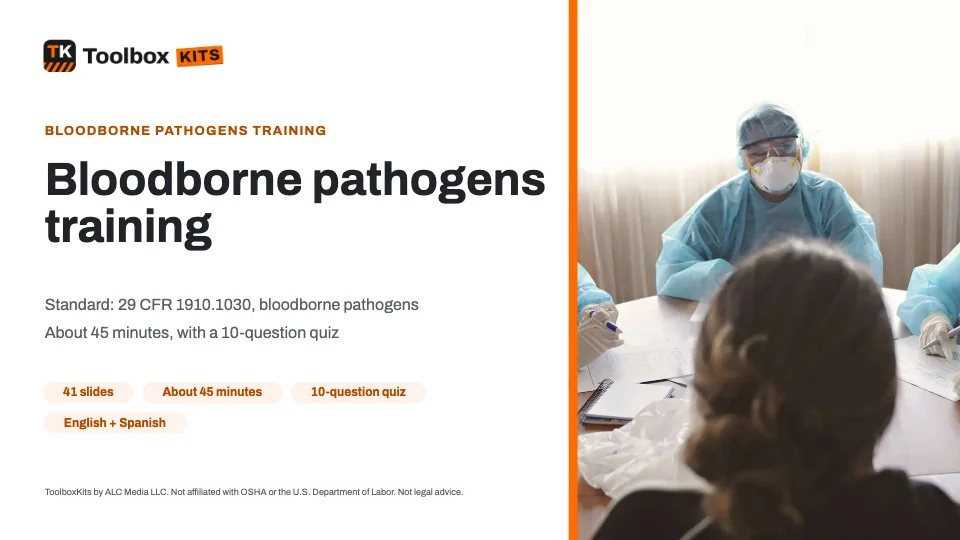 Editable PowerPoint
- Trainer guide
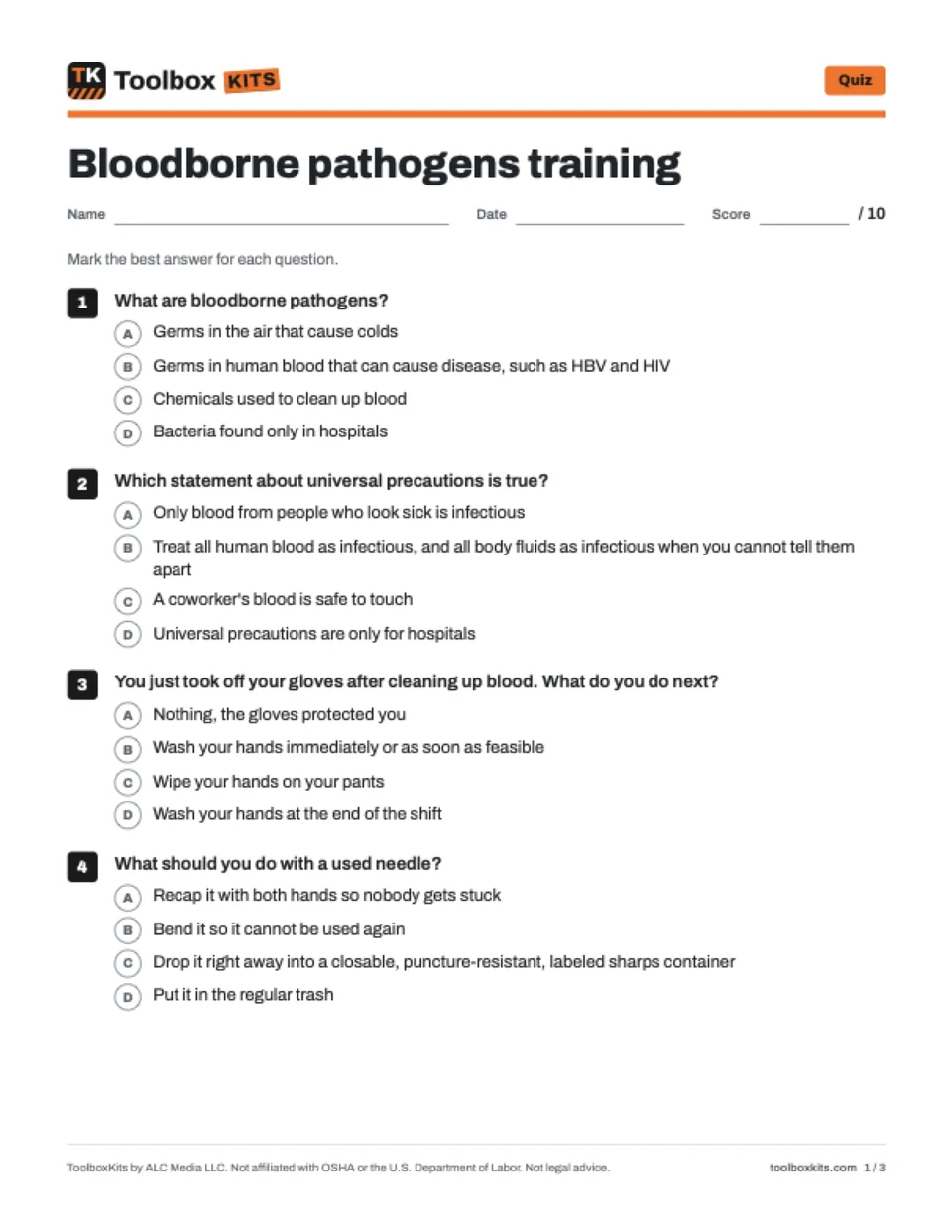 Quiz
- Answer key
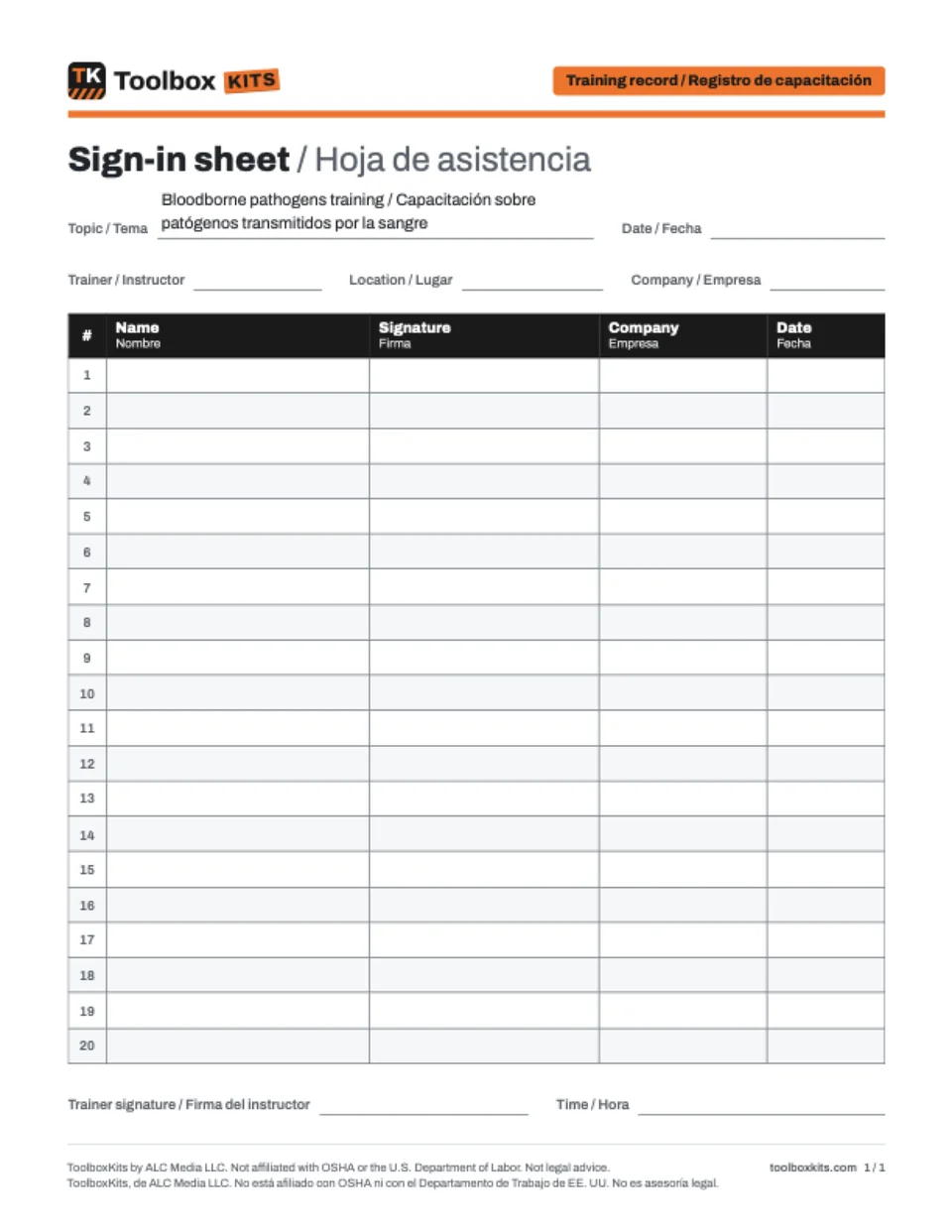 Sign-in sheet
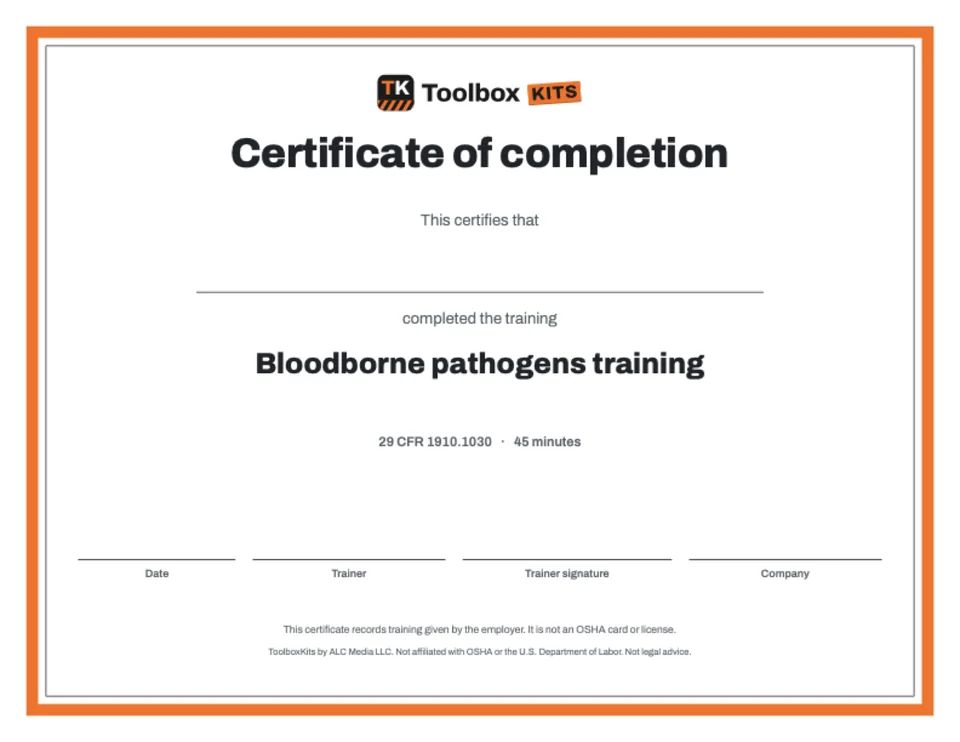 Certificate
- Crew handout
Try it
Try the quiz
Three questions from this topic. Pick an answer to see the right one and the OSHA paragraph.
Question 1 of 3
When must you wash your hands after taking off your gloves?
The rule
What OSHA requires
Plain-language summary. Each line links to the exact paragraph of the regulation.
Each employer with employees who have occupational exposure must establish a written exposure control plan designed to eliminate or minimize employee exposure. The plan must be reviewed and updated at least annually and whenever new or changed tasks, procedures or positions affect occupational exposure (29 CFR 1910.1030(c)(1)(iv)).
“shall establish a written Exposure Control Plan designed to eliminate or minimize employee exposure.”
Universal precautions must be observed to prevent contact with blood or other potentially infectious materials. When it is difficult or impossible to tell body fluid types apart, all body fluids must be considered potentially infectious materials.
“Universal precautions shall be observed to prevent contact with blood or other potentially infectious materials.”
When there is occupational exposure, the employer must provide appropriate personal protective equipment at no cost to the employee, such as gloves, gowns, face shields or masks and eye protection.
“the employer shall provide, at no cost to the employee, appropriate personal protective equipment such as, but not limited to, gloves, gowns, laboratory coats, face shields or masks and eye protection”
Employers must make sure employees wash their hands immediately or as soon as feasible after removing gloves or other personal protective equipment.
“Employers shall ensure that employees wash their hands immediately or as soon as feasible after removal of gloves or other personal protective equipment.”
Contaminated needles and other contaminated sharps must not be bent, recapped or removed except in the limited cases the standard allows, and then only with a mechanical device or a one-handed technique. Shearing or breaking contaminated needles is prohibited.
“Shearing or breaking of contaminated needles is prohibited.”
Contaminated sharps must be discarded immediately or as soon as feasible in containers that are closable, puncture resistant, leakproof on the sides and bottom, and labeled or color-coded.
“Contaminated sharps shall be discarded immediately or as soon as feasible in containers that are:”
Contaminated work surfaces must be decontaminated with an appropriate disinfectant, including immediately or as soon as feasible after any spill of blood or other potentially infectious materials.
“immediately or as soon as feasible when surfaces are overtly contaminated or after any spill of blood or other potentially infectious materials”
The employer must make the hepatitis B vaccine and vaccination series available to all employees with occupational exposure, and post-exposure evaluation and follow-up available to all employees who have had an exposure incident, at no cost to the employee (29 CFR 1910.1030(f)(1)(ii)(A)).
“The employer shall make available the hepatitis B vaccine and vaccination series to all employees who have occupational exposure”
After an exposure incident is reported, the employer must make a confidential medical evaluation and follow-up immediately available to the exposed employee.
“Following a report of an exposure incident, the employer shall make immediately available to the exposed employee a confidential medical evaluation and follow-up”
Each employee with occupational exposure must be trained at no cost and during working hours, at the time of initial assignment to tasks where exposure may take place and at least annually after that (29 CFR 1910.1030(g)(2)(ii)(A) and (B)).
“The employer shall train each employee with occupational exposure in accordance with the requirements of this section.”
Who must be trained
Each employee with occupational exposure to blood or other potentially infectious materials must be trained, at no cost to the employee and during working hours (29 CFR 1910.1030(g)(2)(i)). The training material must be appropriate in content and vocabulary to the employees' educational level, literacy and language (29 CFR 1910.1030(g)(2)(vi)), and the training must include an opportunity for interactive questions and answers with the person conducting it (29 CFR 1910.1030(g)(2)(vii)(N)).
When to retrain
Training must be given at the time of initial assignment and at least annually after that, within one year of the previous training (29 CFR 1910.1030(g)(2)(ii) and (g)(2)(iv)). Additional training is required when new or modified tasks or procedures affect an employee's occupational exposure, and it may be limited to the new exposures (29 CFR 1910.1030(g)(2)(v)).

Common questions
Questions people ask
Is there a printable bloodborne pathogens toolbox talk PDF?
Yes. This bloodborne pathogens toolbox talk is free to download as a printable PDF in English and Spanish, with a sign-in table to record who attended. It works for healthcare, custodial, restaurant and general industry crews.
What should a bloodborne pathogens safety talk cover?
Cover what bloodborne pathogens are, universal precautions, gloves and face protection, handwashing, safe handling of sharps, spill cleanup and how to report an exposure. Show the crew where the PPE, spill kit and sharps containers are kept. Leave time for questions about needlesticks and the hepatitis B vaccine.
Does a bloodborne pathogen awareness toolbox talk count as the annual training?
Not on its own. Each employee with occupational exposure must be trained at initial assignment and at least annually after that (29 CFR 1910.1030(g)(2)(ii)(A) and (B)), and the training must cover every element the standard lists, such as an accessible copy of the standard, the exposure control plan and the hepatitis B vaccine (29 CFR 1910.1030(g)(2)(vii)). It must also include a chance for interactive questions and answers with the person conducting the training (29 CFR 1910.1030(g)(2)(vii)(N)). Use this talk as a refresher between full training sessions.
What is a bloodborne pathogens written program?
The standard calls it an exposure control plan. Each employer with employees who have occupational exposure must have a written plan designed to eliminate or minimize exposure (29 CFR 1910.1030(c)(1)(i)). It must include the exposure determination, the schedule and method of implementation for key parts of the standard, and the procedure for evaluating the circumstances of exposure incidents (29 CFR 1910.1030(c)(1)(ii)). It must be reviewed and updated at least annually, and a copy must be accessible to employees (29 CFR 1910.1030(c)(1)(iv) and (c)(1)(iii)).
Can I use a bloodborne pathogens written program template?
You can start from a template, but the finished plan has to fit your own workplace. The exposure determination must list the job classifications in which all employees have occupational exposure, the job classifications in which some do, and, for those jobs where only some are exposed, the tasks and procedures where exposure occurs (29 CFR 1910.1030(c)(2)(i)). It must be made without regard to the use of personal protective equipment (29 CFR 1910.1030(c)(2)(ii)). Fill in your own jobs, tasks and procedures, and update the plan when they change.
Free to share
Use this talk for free
You can print, share and adapt this talk at no cost under the Creative Commons BY-NC-SA 4.0 license. Please credit ToolboxKits with a link.