

Free 5-minute toolbox talkChemicals and exposuresEnglish and Spanish
Chemical safety toolbox talk: handling chemicals safely
Wash your hands before you eat, drink or smoke, and keep food and drinks away from chemical work. What OSHA requires: A portable container does not have to be labeled when a chemical is transferred into it from a labeled container and it is intended only for the immediate use of the employee who did the transfer (29 CFR 1910.1200(f)(8)).
A free 5-minute chemical safety talk for any crew that works with hazardous substances, from fuel and solvents to cleaners and pesticides. It covers labels, safety data sheets, PPE, storage and what to do when a chemical spills or splashes, with OSHA citations.
Updated October 29, 2026 · Based on 29 CFR 1910.1200, 29 CFR 1910.132
Read it out loud
Free 5-minute toolbox talk
Read it out loud to your crew. It takes about 5 minutes.
Start with a question
Which chemicals did you handle this week, and do you know what each one can do to you?
Why it matters
Fuel, solvents, paint, cleaners, cement and pesticides are all chemicals, and they come as liquids, solids, dusts and gases. Some burn skin or eyes, some catch fire easily, and some cause harm you do not feel until later. Chemicals get into the body when you breathe them, swallow them, or get them on your skin or in your eyes.
Key points
Read the label every time
Labels on shipped containers must show the product identifier, a signal word, hazard statements, pictograms, precautionary statements and contact details for the manufacturer, importer or other responsible party.
More
“Danger” is the signal word for the more severe hazards and “Warning” for the less severe. Pictograms show the hazard at a glance, like a flame for chemicals that catch fire. No label, no use: find out what it is first.
29 CFR 1910.1200(f)(1) · 29 CFR 1910.1200(c)
Know where the safety data sheets are
Your employer must keep a safety data sheet (SDS) for each hazardous chemical and make sure it is readily accessible in your work area during each work shift.
More
Every SDS uses the same numbered sections in the same order: section 4 is first aid, section 7 handling and storage, and section 8 exposure controls and personal protection. Find the SDS binder or app before you need it.
29 CFR 1910.1200(g)(8) · 29 CFR 1910.1200(g)(2)
Wear the PPE the job calls for
Employers must make sure workers use appropriate eye or face protection when exposed to eye or face hazards from liquid chemicals, acids or caustic liquids, or chemical gases or vapors.
More
In general industry, employers must also select and require appropriate hand protection against hazards such as skin absorption of harmful substances and chemical burns. No glove stops every chemical, so check the SDS for the right one, and use goggles, not just safety glasses, against splashes.
29 CFR 1910.138(a) · 29 CFR 1910.133(a)(1) and 1926.102(a)(1)
Label it, close it, store it right
If you pour a chemical from a labeled container into another one, label the new one too, unless it is only for your own immediate use: it stays under your control, only you use it, and only during that shift. Never put chemicals in drink bottles.
More
Keep lids closed, store chemicals away from heat and from products they react with, and never mix products unless the instructions say to.
29 CFR 1910.1200(f)(8) · 29 CFR 1910.1200(c)
Know what to do when it spills or splashes
Where your eyes or body could be exposed to injurious corrosive materials, there must be facilities for quick drenching or flushing within the work area for immediate emergency use, in construction too.
More
If a chemical gets in your eyes or on your skin, flush right away and have someone call for help. For a spill, warn others, stay back if you do not know what it is, and follow the SDS.
29 CFR 1910.151(c) · 29 CFR 1926.50(g)
Wash up before you eat
Wash your hands before you eat, drink or smoke, and keep food and drinks away from chemical work.
More
In construction, workers required to handle or use poisons, caustics and other harmful substances must be instructed in safe handling and use and made aware of the potential hazards, personal hygiene and personal protective measures required. If a new product shows up, ask about it before you use it.
Scenario
Picture this: At the end of a shift, a worker grabs an unlabeled spray bottle from the truck to clean some tools. It smells like the usual degreaser, so the worker skips the gloves and goggles. The spray drifts back, and the worker's eyes start to burn. The eyewash is behind a stack of pallets. What went wrong, and what should the crew do right now?
Ask the crew
- Which chemicals do we use on this job, and where are their safety data sheets?
- Which products here call for goggles, a face shield or chemical gloves?
- Where is the nearest eyewash, and is the path to it clear?
- What do we do if a chemical spills or gets on someone?
Takeaway
Read the label and SDS first, wear the PPE they call for, keep containers labeled and closed, and know where to flush.
Trainer: ______________________ Date: ____________
Credit: ToolboxKits, https://toolboxkits.com/topics/chemical-handling/ (CC BY-NC-SA 4.0)
The poster is also inside the paid kits.
Audit-ready records in 60 seconds
Fill in your crew and download a filled sign-in sheet for this talk. Everything is made in your browser. Names are never uploaded or stored.
Start a sign-off
Crew scan a QR code on their own phones, type their name and sign with a finger. You see the names arrive and download the signed sheet. Free, no account.
Kits
Get the kit
No subscription needed. Buy only the kit you need.
Toolbox talk kit
$4.99
- 5-minute talk, English PDF
- 5-minute talk, Spanish PDF
- Editable mini-deck (English and Spanish)
- One-page crew handout (English and Spanish)
- Bilingual sign-in sheet
- 3-question quiz with answer key (English and Spanish)
- One-page bilingual poster
- Audit-ready records in 60 seconds: fill in your crew and get a sign-in sheet and a certificate for every worker
Training kit
$9
Editable PowerPoint, 39 slides
- Editable PowerPoint with trainer notes on every slide
- Trainer guide PDF with timing and discussion tips
- 10-question quiz and answer key
- Sign-in sheet and certificate of completion with fillable fields
- One-page crew handout
- Full Spanish version of everything
- One-page bilingual poster
- Audit-ready records in 60 seconds: fill in your crew and get a sign-in sheet and a certificate for every worker
- Instant download
- Secure checkout by Stripe
- 30-day refund, no questions
Need many topics? All Access gives you every kit for $99 a year.
Inside the kit
See what is in the kit
What is in the kit
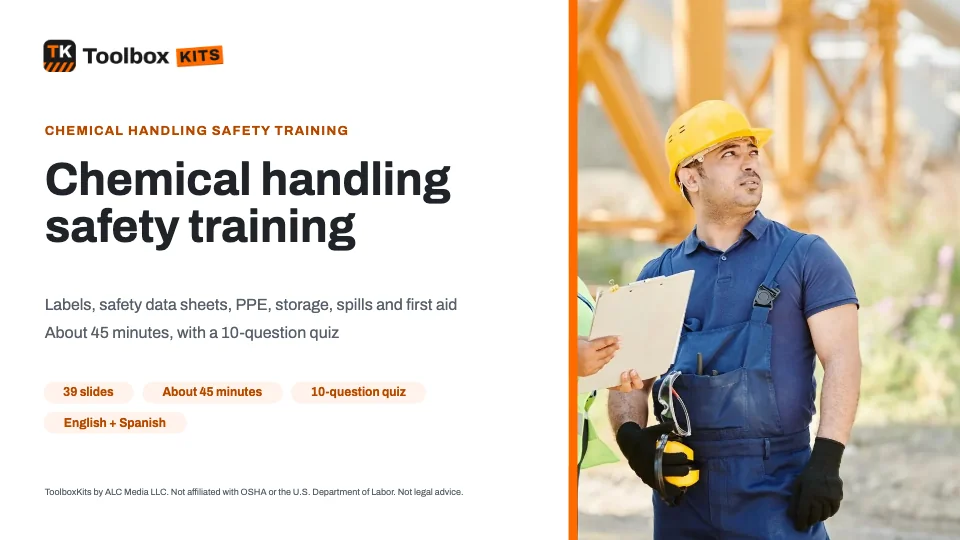 Editable PowerPoint
- Trainer guide
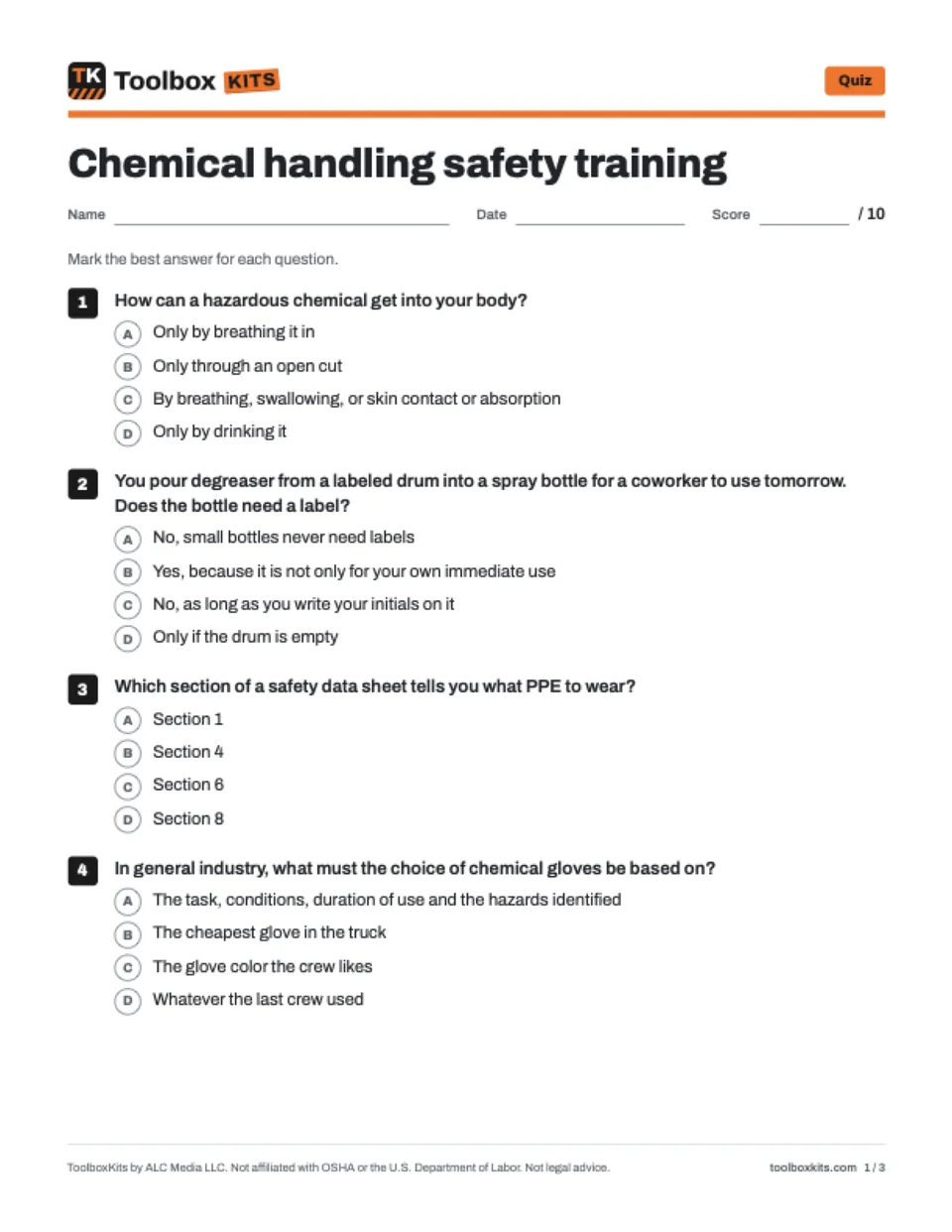 Quiz
- Answer key
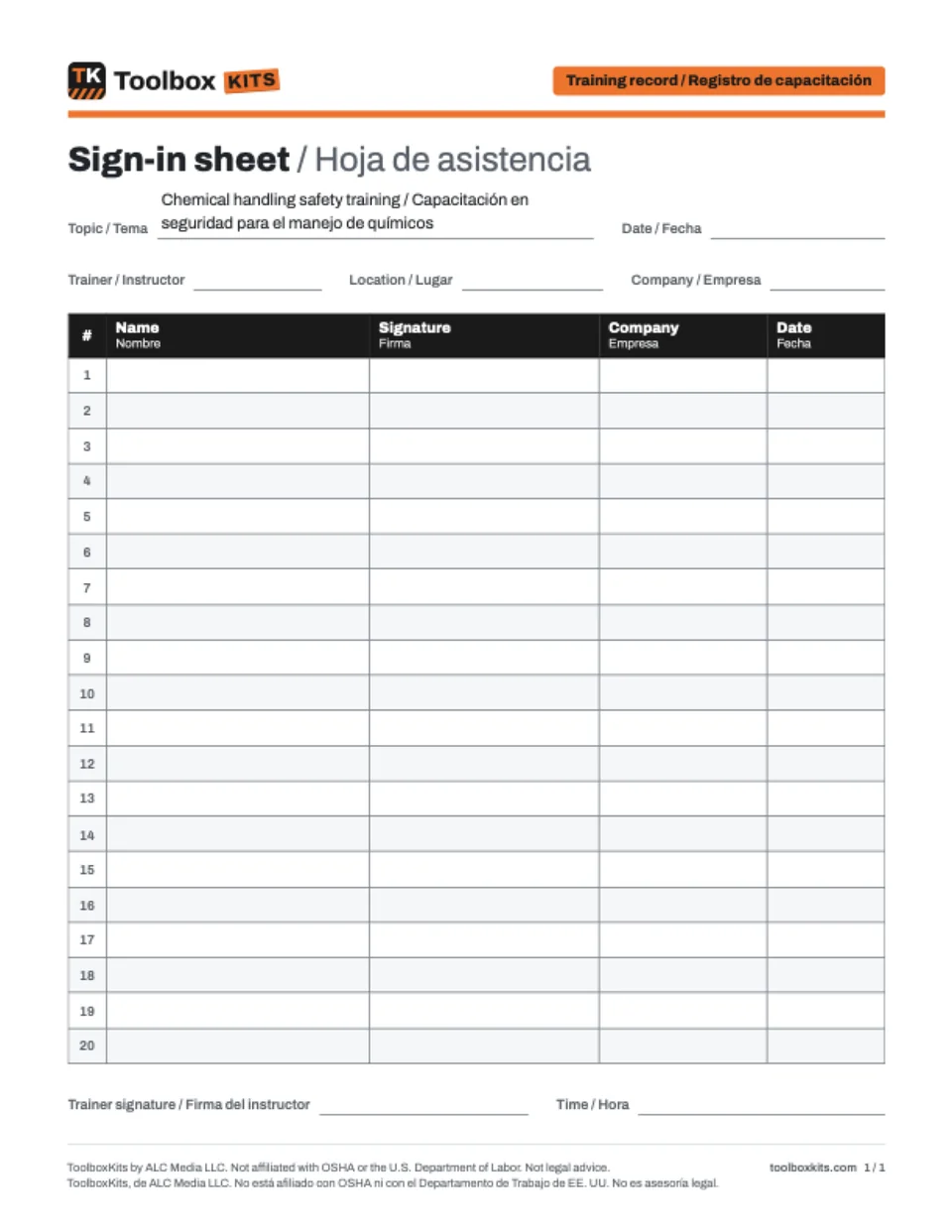 Sign-in sheet
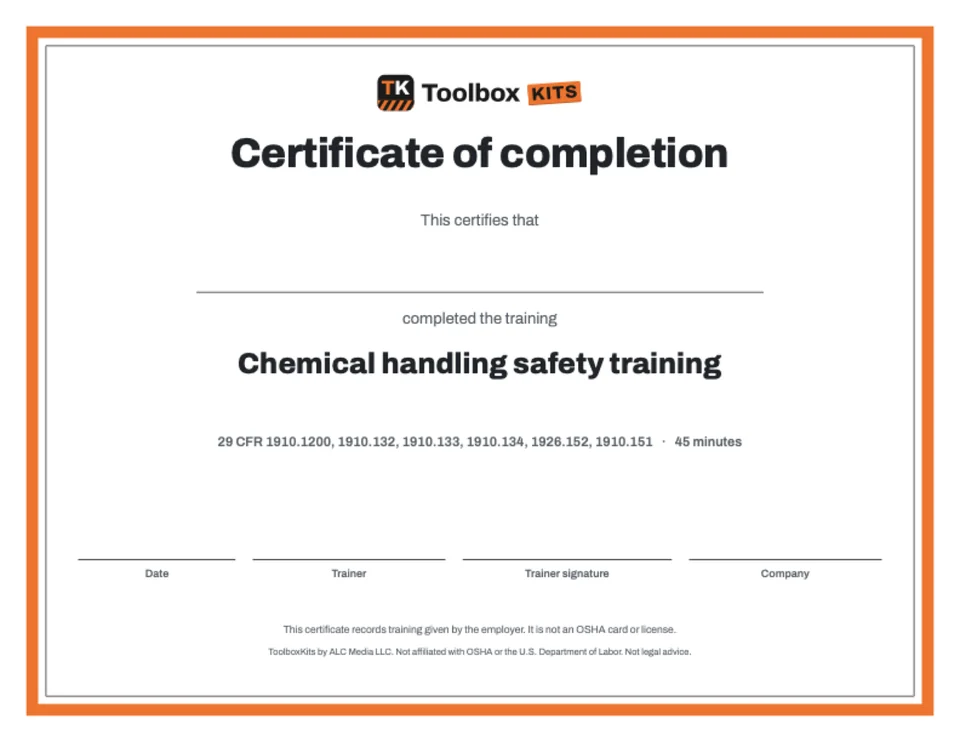 Certificate
- Crew handout
Try it
Try the quiz
Three questions from this topic. Pick an answer to see the right one and the OSHA paragraph.
Question 1 of 3
Where your eyes or body could be exposed to injurious corrosive materials, what must be in the work area?
The rule
What OSHA requires
Plain-language summary. Each line links to the exact paragraph of the regulation.
In construction, employees required to handle or use poisons, caustics and other harmful substances must be instructed in safe handling and use, and made aware of the potential hazards, personal hygiene and the personal protective measures required.
“Employees required to handle or use poisons, caustics, and other harmful substances shall be instructed regarding the safe handling and use”
Employers must give employees effective information and training on the hazardous chemicals in their work area when they are first assigned, and whenever a new chemical hazard they have not been trained on is introduced. Construction work follows the same hazard communication rule (29 CFR 1926.59).
“at the time of their initial assignment, and whenever a new chemical hazard the employees have not previously been trained about is introduced into their work area”
With limited exceptions, each container of hazardous chemicals in the workplace must be labeled, tagged or marked, either with the product identifier, signal word, hazard statements, pictograms and precautionary statements, or with the product identifier plus words, pictures or symbols that give at least general information about its hazards.
“each container of hazardous chemicals in the workplace is labeled, tagged or marked”
A portable container does not have to be labeled when a chemical is transferred into it from a labeled container and it is intended only for the immediate use of the employee who did the transfer.
“intended only for the immediate use of the employee who performs the transfer”
Employers must not remove or deface existing labels on incoming containers of hazardous chemicals unless the container is immediately marked with the required information.
“The employer shall not remove or deface existing labels on incoming containers of hazardous chemicals, unless the container is immediately marked with the required information.”
Employers must keep copies of the safety data sheet for each hazardous chemical in the workplace, readily accessible to employees in their work area during each work shift. Electronic access is allowed as long as it creates no barriers to immediate employee access.
“readily accessible during each work shift to employees when they are in their work area(s)”
Protective equipment, including PPE for the eyes, face, head and extremities, protective clothing, respirators, and protective shields and barriers, must be provided, used and maintained in a sanitary and reliable condition wherever chemical hazards, among others, could injure or impair the body through absorption, inhalation or physical contact. The construction rule is the same (29 CFR 1926.95(a)).
Employers must make sure each affected employee uses appropriate eye or face protection when exposed to eye or face hazards from liquid chemicals, acids or caustic liquids, or chemical gases or vapors. Construction has the same rule (29 CFR 1926.102(a)(1)).
“liquid chemicals, acids or caustic liquids, chemical gases or vapors”
In general industry, employers must select and require appropriate hand protection when hands are exposed to hazards such as skin absorption of harmful substances and chemical burns, and must base the choice on the tasks, the conditions, how long it is used and the hazards identified (29 CFR 1910.138(b)).
“skin absorption of harmful substances”
Where the eyes or body of any person may be exposed to injurious corrosive materials, suitable facilities for quick drenching or flushing of the eyes and body must be provided within the work area for immediate emergency use. Construction has the same rule (29 CFR 1926.50(g)).
“suitable facilities for quick drenching or flushing of the eyes and body shall be provided within the work area for immediate emergency use”
Who must be trained
Employers must provide information and training to employees on the hazardous chemicals in their work area (29 CFR 1910.1200(h)(1)). The standard covers workers who may be exposed to hazardous chemicals under normal operating conditions or in foreseeable emergencies, but not office workers or bank tellers who meet hazardous chemicals only in non-routine, isolated instances (29 CFR 1910.1200(c)). Construction follows the same rule (29 CFR 1926.59), and in construction, employees required to handle or use poisons, caustics and other harmful substances must be instructed in their safe handling and use (29 CFR 1926.21(b)(3)). Under the general industry PPE rule, each employee required to use PPE must be trained and must show they understand the training and can use the PPE properly before doing work that requires it (29 CFR 1910.132(f)(1) and (f)(2)).
When to retrain
HazCom information and training must also be provided whenever a new chemical hazard the employees have not previously been trained about is introduced into their work area (29 CFR 1910.1200(h)(1)). Under the general industry PPE rule, employees must be retrained when changes in the workplace or in the types of PPE make earlier training obsolete, or when a worker has not kept the understanding or skill needed (29 CFR 1910.132(f)(3)).

Common questions
Questions people ask
Is there a printable chemical safety toolbox talk PDF?
Yes. This chemical safety toolbox talk is free to print as a PDF in English or Spanish, with a sign-in sheet for attendance. It also works as a short chemical safety training handout, used alongside your own chemical list and safety data sheets.
Is there a chemical safety training PowerPoint or PPT?
This free talk is written to be read aloud, so you do not need slides. For a longer chemical handling session, the paid training kit for this topic is an editable PowerPoint in English and Spanish with trainer notes, a quiz and a sign-in sheet, so the slides are not a free download. The kit is built from the text of OSHA's standards and is not produced or endorsed by OSHA. If the kit is not ready to buy yet, you can request it from this page.
What should a chemical storage toolbox talk cover?
Cover keeping every container labeled and closed, storing chemicals away from heat and from products they react with, and reading section 7 of the SDS, which covers handling and storage (29 CFR 1910.1200(g)(2)). In construction, only approved containers and portable tanks may be used to store and handle flammable liquids, and flammable liquids must not be stored in exits, stairways or areas normally used for the safe passage of people (29 CFR 1926.152(a)(1) and (a)(2)). Never store chemicals in drink bottles or food containers.
What chemical safety training does OSHA require?
Under the hazard communication standard, employers must train employees on the hazardous chemicals in their work area when they are first assigned and whenever a new chemical hazard they have not been trained on is introduced (29 CFR 1910.1200(h)(1)). That training must cover at least how to detect a release, the hazards of the chemicals, how workers can protect themselves, and the details of the employer's program, including labels and safety data sheets (29 CFR 1910.1200(h)(3)). Under the general industry PPE rule, each employee required to use PPE must also be trained in when it is necessary, what is necessary, how to wear it, its limits and its care (29 CFR 1910.132(f)(1)).
What is a good chemical safety moment, at work or at home?
Pick one product your crew uses today, read its label together and find its safety data sheet. Point out the signal word, the pictograms and the PPE it calls for, then walk to the nearest eyewash. For a household chemical safety presentation, the same basics apply: keep products in their original labeled containers, store them away from children and food, and never mix bleach with ammonia or acids.
Free to share
Use this talk for free
You can print, share and adapt this talk at no cost under the Creative Commons BY-NC-SA 4.0 license. Please credit ToolboxKits with a link.