

Free 5-minute toolbox talkGeneral safetyEnglish and Spanish
Office safety moment and toolbox talk
Trips over cords and boxes, falls from chairs used as ladders, tipping file cabinets and blocked exits can all hurt people who work at a desk. What OSHA requires: In general industry, keep all places of employment, passageways, storerooms, service rooms and walking-working surfaces clean, orderly and sanitary (29 CFR 1910.22(a)(1)).
A free 5-minute office safety moment for the start of a meeting or a shift. It covers trips and spills, cords, file cabinets and shelves, workstation setup, exits and the emergency plan, with OSHA citations where a rule applies.
Updated October 29, 2026 · Based on 29 CFR 1910.22, 29 CFR 1910.37
Read it out loud
Free 5-minute toolbox talk
Read it out loud to your crew. It takes about 5 minutes.
Start with a question
Think about the path from your desk to the nearest exit. Is there anything on it someone could trip over, or that would slow us down in an emergency?
Why it matters
Offices feel safe, so hazards are easy to ignore. Trips over cords and boxes, falls from chairs used as ladders, tipping file cabinets and blocked exits can all hurt people who work at a desk. A few small habits go a long way.
Key points
Keep walkways clear and dry
In general industry, workplaces must be kept clean and orderly, and walking surfaces must be kept free of hazards such as loose boards, leaks and spills. Wipe up spills right away, push in your chair, and keep boxes, bags and cords out of walkways.
More
If a carpet edge or floor tile is loose, report it so it can be fixed or blocked off until it is.
29 CFR 1910.22(a) · 29 CFR 1910.22(d)(2)
Use cords and power strips the right way
In general industry, flexible cords, including extension cords, may not be used as a substitute for a building's fixed wiring. Do not run cords through doorways, under rugs or across walkways, and do not plug one power strip into another.
More
Check cords before you use them, and take a damaged cord out of service.
29 CFR 1910.305(g)(1)(iv)(A) · 29 CFR 1910.334(a)(2)(ii)
File cabinets, shelves and reaching high
Open one file drawer at a time and close it when you are done, so the cabinet does not tip and nobody walks into an open drawer. Keep heavy items on lower shelves, and stack boxes so they are stable and secure against sliding or collapse.
More
To reach something high, use a step stool or a ladder, never a chair, especially one with wheels.
Set up your workstation
Adjust your chair so your feet rest flat and your lower back is supported. Put the screen straight in front of you, about an arm's length away, with the top at or a little below eye level, and keep the keyboard and mouse close. Get up, stretch and rest your eyes during the day.
Keep exits clear and unlocked
In general industry, exit routes must be free and unobstructed, and no materials or equipment may be placed in them, even temporarily. Employees must be able to open an exit route door from the inside at all times without keys, tools or special knowledge.
More
Never park carts, boxes or a printer in a hallway that leads to an exit, and never stack anything in front of an electrical panel.
29 CFR 1910.37(a)(3) · 29 CFR 1910.36(d)(1)
Know the emergency plan
Where OSHA requires an emergency action plan, it must cover how to report a fire or other emergency, how to evacuate and which exit routes to use, and how everyone will be accounted for afterward.
More
The employer must review the plan with each employee covered by it, including when they are first assigned, when their duties under it change, and when the plan changes. Know the alarm, your way out, the meeting spot and who to report to.
29 CFR 1910.38(c) · 29 CFR 1910.38(f)
Scenario
Picture this: A fire alarm goes off on a busy afternoon. The quickest way out is the back hallway, but it is lined with boxes from a supply delivery and a printer that was moved there last week. A coworker hurrying past catches a foot on a power strip cord that runs across the aisle and falls. What could have prevented this, and what would you do if it happened today?
Ask the crew
- Is there anything in our walkways or exit routes right now that should not be there?
- Where are the nearest exits from this room, and where do we meet once we are outside?
- Are any cords here running across walkways or under rugs?
- Who do we tell about a loose carpet, a broken chair or a dark exit sign?
Takeaway
Keep walkways and exits clear, reach high the safe way, and know your way out before you need it.
Trainer: ______________________ Date: ____________
Credit: ToolboxKits, https://toolboxkits.com/topics/office-safety/ (CC BY-NC-SA 4.0)
The poster is also inside the paid kits.
Audit-ready records in 60 seconds
Fill in your crew and download a filled sign-in sheet for this talk. Everything is made in your browser. Names are never uploaded or stored.
Start a sign-off
Crew scan a QR code on their own phones, type their name and sign with a finger. You see the names arrive and download the signed sheet. Free, no account.
Kits
Get the kit
No subscription needed. Buy only the kit you need.
Toolbox talk kit
$4.99
- 5-minute talk, English PDF
- 5-minute talk, Spanish PDF
- Editable mini-deck (English and Spanish)
- One-page crew handout (English and Spanish)
- Bilingual sign-in sheet
- 3-question quiz with answer key (English and Spanish)
- One-page bilingual poster
- Audit-ready records in 60 seconds: fill in your crew and get a sign-in sheet and a certificate for every worker
Training kit
$9
Editable PowerPoint, 35 slides
- Editable PowerPoint with trainer notes on every slide
- Trainer guide PDF with timing and discussion tips
- 10-question quiz and answer key
- Sign-in sheet and certificate of completion with fillable fields
- One-page crew handout
- Full Spanish version of everything
- One-page bilingual poster
- Audit-ready records in 60 seconds: fill in your crew and get a sign-in sheet and a certificate for every worker
- Instant download
- Secure checkout by Stripe
- 30-day refund, no questions
Need many topics? All Access gives you every kit for $99 a year.
Inside the kit
See what is in the kit
What is in the kit
 Editable PowerPoint
- Trainer guide
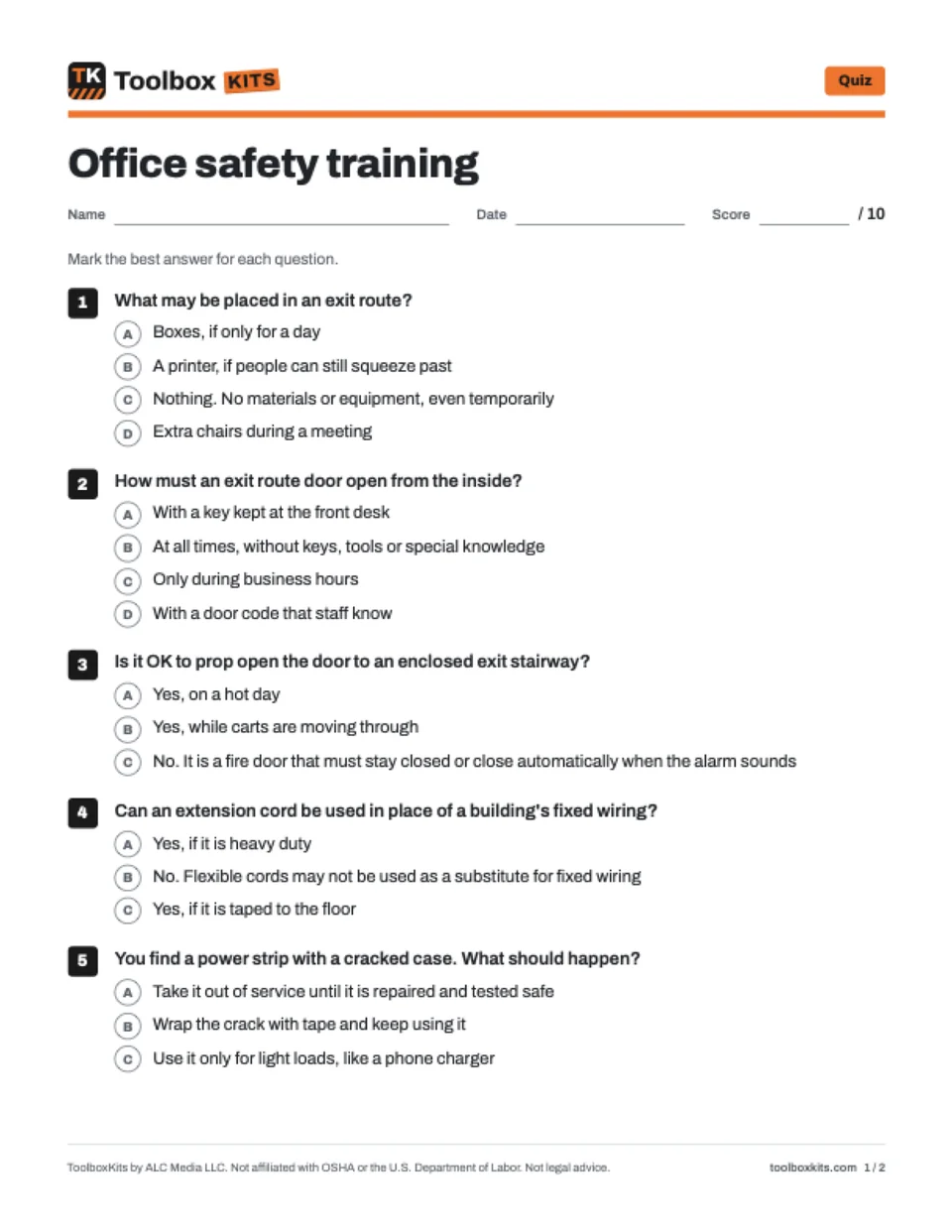 Quiz
- Answer key
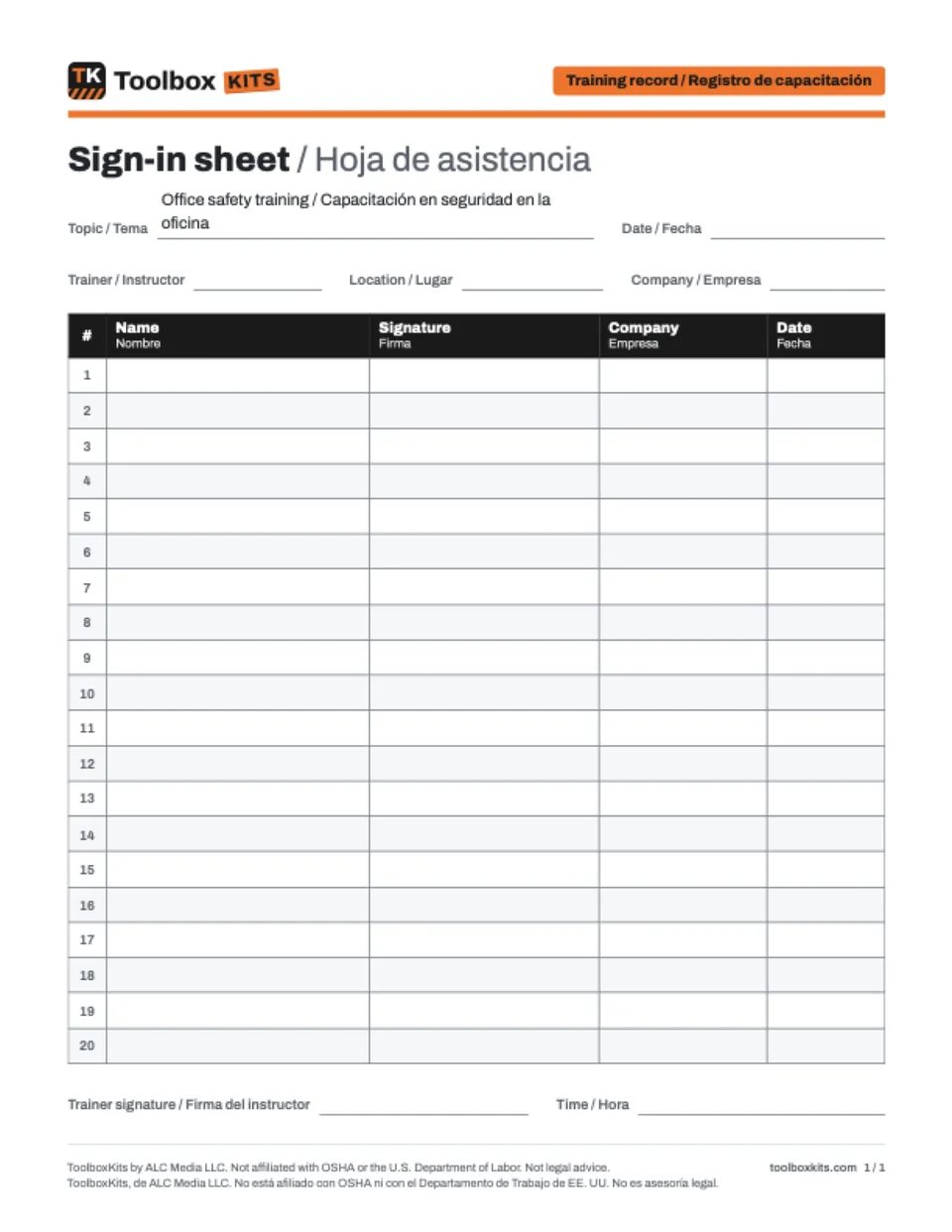 Sign-in sheet
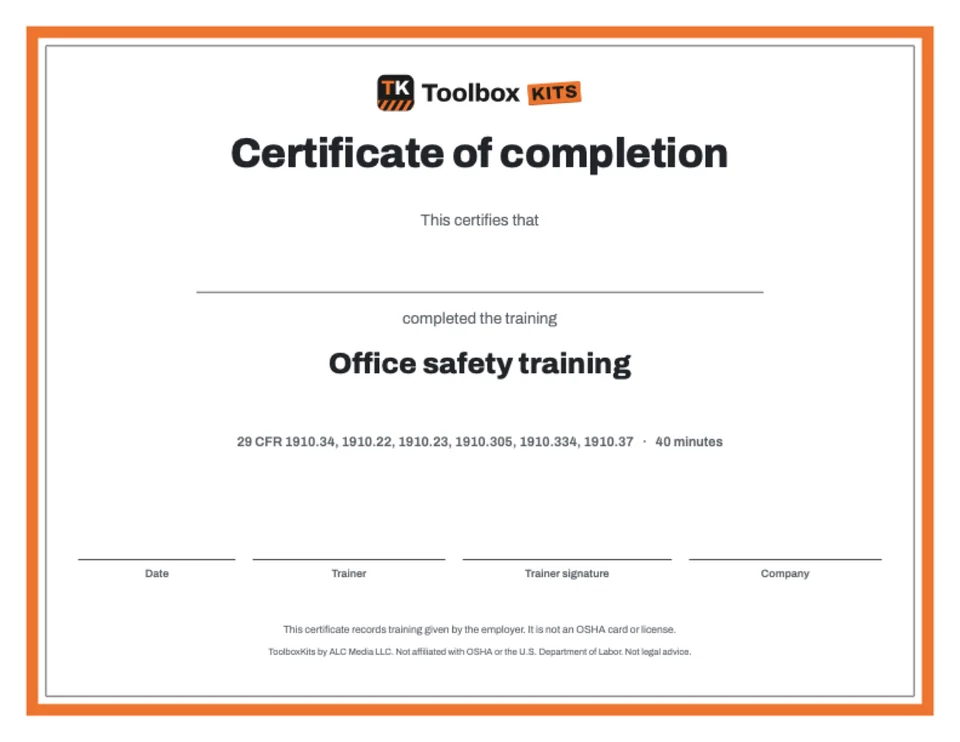 Certificate
- Crew handout
Try it
Try the quiz
Three questions from this topic. Pick an answer to see the right one and the OSHA paragraph.
Question 1 of 3
What may be placed in an office exit route?
The rule
What OSHA requires
Plain-language summary. Each line links to the exact paragraph of the regulation.
In general industry, keep all places of employment, passageways, storerooms, service rooms and walking-working surfaces clean, orderly and sanitary.
“All places of employment, passageways, storerooms, service rooms, and walking-working surfaces are kept in a clean, orderly, and sanitary condition.”
Keep walking-working surfaces free of hazards such as sharp or protruding objects, loose boards, corrosion, leaks, spills, snow and ice.
“Walking-working surfaces are maintained free of hazards such as sharp or protruding objects, loose boards, corrosion, leaks, spills, snow, and ice.”
Correct or repair hazardous conditions on walking-working surfaces before anyone uses them again. If that cannot be done right away, guard the hazard until it is fixed.
“the hazard must be guarded to prevent employees from using the walking-working surface until the hazard is corrected or repaired”
Keep exit routes free and unobstructed. No materials or equipment may be placed in an exit route, even temporarily.
“No materials or equipment may be placed, either permanently or temporarily, within the exit route.”
Employees must be able to open an exit route door from the inside at all times without keys, tools or special knowledge.
“Employees must be able to open an exit route door from the inside at all times without keys, tools, or special knowledge.”
The working space required around electrical equipment, such as the space in front of an electrical panel, may not be used for storage.
“Working space required by this standard may not be used for storage.”
Flexible cords, including extension cords, may not be used as a substitute for the fixed wiring of a building.
“As a substitute for the fixed wiring of a structure”
If a cord-and-plug connected item or an extension cord has a defect or damage that might expose an employee to injury, remove it from service until it is repaired and tested safe.
“the defective or damaged item shall be removed from service”
Where an emergency action plan is required, the employer must review it with each employee covered by it when the plan is developed or the employee is first assigned, when the employee's responsibilities under the plan change, and when the plan changes.
“An employer must review the emergency action plan with each employee covered by the plan”
Where portable fire extinguishers are provided for employee use, the employer must provide education on the general principles of extinguisher use and the hazards of fighting a fire in its beginning stage.
“an educational program to familiarize employees with the general principles of fire extinguisher use and the hazards involved with incipient stage fire fighting”
Who must be trained
OSHA has no training standard specific to office work. Where portable fire extinguishers are provided for employee use, employees must get education on extinguisher use and the hazards of fighting a fire in its beginning stage (29 CFR 1910.157(g)(1)). Where an emergency action plan is required, the employer must designate and train employees to assist in a safe and orderly evacuation of other employees (29 CFR 1910.38(e)) and review the plan with each employee covered by it (29 CFR 1910.38(f)).
When to retrain
Where portable fire extinguishers are provided for employee use, the education must be given upon initial employment and at least annually after that (29 CFR 1910.157(g)(2)). The emergency action plan must be reviewed again with an employee when their responsibilities under it change and when the plan changes (29 CFR 1910.38(f)).

Common questions
Questions people ask
What are some office safety moment examples?
Try a cord running across a walkway, a file cabinet with two drawers open, a chair being used as a ladder, boxes stacked in an exit hallway, or a paper cutter left with the blade up. Pick one, point to a real example in your office, and ask the group how to fix it. It only takes a few minutes at the start of a meeting.
How do you give a safety moment for an office meeting?
Open the meeting with one short topic, such as clear exits or cord safety. Read the scenario on this page or describe something you noticed in the office this week, ask one discussion question, and agree on one fix. Keep it to about five minutes so it happens every time.
Is there a printable office safety talk for office workers?
Yes. This office safety talk is free, and you can print it as a PDF in English or Spanish with a sign-in table. It is written for people who work at desks, front counters and reception areas.
Is there an office safety PowerPoint presentation?
The free talk on this page is made to be read aloud, so you can present it at a meeting without slides. If you want slides for a longer office safety presentation or training session, use the training kit option on this page. Walk the room as you present and point out the real exits, cords and cabinets.
What should an office safety toolbox talk cover?
Cover walkways and spills, cords and power strips, file cabinets and storage, workstation setup, exits and the emergency plan. In general industry, OSHA requires exit routes to be free and unobstructed (29 CFR 1910.37(a)(3)) and walking-working surfaces to be kept free of hazards such as spills and loose boards (29 CFR 1910.22(a)(3)).
Free to share
Use this talk for free
You can print, share and adapt this talk at no cost under the Creative Commons BY-NC-SA 4.0 license. Please credit ToolboxKits with a link.