

Free 5-minute toolbox talkGeneral safetyEnglish and Spanish
Housekeeping toolbox talk
A messy work area leads to slips, trips, cuts, falling objects and fires. What OSHA requires: During construction, alteration or repairs, keep form and scrap lumber with protruding nails, and all other debris, cleared from work areas, passageways and stairs (29 CFR 1926.25(a)).
A free 5-minute housekeeping talk for job sites, shops and warehouses. It covers debris, walkways, waste, storage and exits, with the OSHA rule behind each point.
Updated October 31, 2026 · Based on 29 CFR 1926.25, 29 CFR 1910.22
Read it out loud
Free 5-minute toolbox talk
Read it out loud to your crew. It takes about 5 minutes.
Start with a question
What is one thing in this work area right now that someone could trip over, slip on or bump into?
Why it matters
A messy work area leads to slips, trips, cuts, falling objects and fires. Clutter can also block an exit or an extinguisher right when you need it. A mess that looks minor can have serious consequences, so good housekeeping is part of the job, not a once-a-week cleanup.
Key points
Clean as you go
During construction, scrap lumber with protruding nails and all other debris must be kept cleared from work areas, passageways and stairs. Pick up as you work, not just at the end of the day. Pull or bend over nails in scrap boards before you stack them.
Keep floors and walkways clear, dry and lit
In general industry, walking-working surfaces must be kept free of hazards such as sharp or protruding objects, loose boards, corrosion, leaks, spills, snow and ice. Clean up spills right away, or block the area off until you can.
More
Run cords and hoses where people do not walk, and report burned-out lights, because people trip over what they cannot see.
Use the right waste containers
On construction sites, containers must be provided for waste, trash, oily and used rags and other refuse. Containers for garbage and oily, flammable or hazardous waste need covers, and waste must be disposed of at frequent and regular intervals.
More
Keep break areas and restrooms clean, and get food waste into the trash so it does not draw pests.
Get combustible scrap out
Wood scraps, cardboard, packaging and rags are fuel for a fire. During construction, combustible scrap and debris must be removed at regular intervals, and there must be a safe way to remove it. Use chutes, bins or dumpsters that are easy to reach so nobody has to throw debris off an edge.
Keep exits and emergency equipment clear
Exits and the routes to them must be kept free of all obstructions so they can be used right away in a fire or other emergency. Never stack materials in front of exit doors, fire extinguishers or electrical panels. If you see something blocking an exit, move it or report it right away.
Store materials so they cannot fall
Stack materials so they are stable and cannot slide, tip or roll. Keep loose materials and tools back from edges and floor openings, where they can be knocked off onto someone below.
More
During roofing work, materials and equipment may not be stored within 6 feet of a roof edge unless guardrails are erected at the edge.
Scenario
Picture this: It is Friday afternoon on a remodel job. The hallway to the back exit has scrap drywall, a coiled extension cord and a bucket of water from the tile saw. A worker carrying a box of tile cannot see his feet, and the light at the end of the hall is out. Nobody has been hurt yet. What could go wrong here, and how long would it take to fix it right now?
Ask the crew
- Which areas on our job get messy fastest, and why?
- Do we have enough trash and scrap containers, and are they where we need them?
- Is anything blocking an exit, an extinguisher or an electrical panel right now?
- What can we fix in this area together before we start work today?
Takeaway
Clean as you go, keep walkways and exits clear, and put waste where it belongs, every task and every day.
Trainer: ______________________ Date: ____________
Credit: ToolboxKits, https://toolboxkits.com/topics/housekeeping/ (CC BY-NC-SA 4.0)
The poster is also inside the paid kits.
Audit-ready records in 60 seconds
Fill in your crew and download a filled sign-in sheet for this talk. Everything is made in your browser. Names are never uploaded or stored.
Start a sign-off
Crew scan a QR code on their own phones, type their name and sign with a finger. You see the names arrive and download the signed sheet. Free, no account.
Kits
Get the kit
No subscription needed. Buy only the kit you need.
Toolbox talk kit
$4.99
- 5-minute talk, English PDF
- 5-minute talk, Spanish PDF
- Editable mini-deck (English and Spanish)
- One-page crew handout (English and Spanish)
- Bilingual sign-in sheet
- 3-question quiz with answer key (English and Spanish)
- One-page bilingual poster
- Audit-ready records in 60 seconds: fill in your crew and get a sign-in sheet and a certificate for every worker
Training kit
$9
Editable PowerPoint, 34 slides
- Editable PowerPoint with trainer notes on every slide
- Trainer guide PDF with timing and discussion tips
- 10-question quiz and answer key
- Sign-in sheet and certificate of completion with fillable fields
- One-page crew handout
- Full Spanish version of everything
- One-page bilingual poster
- Audit-ready records in 60 seconds: fill in your crew and get a sign-in sheet and a certificate for every worker
- Instant download
- Secure checkout by Stripe
- 30-day refund, no questions
Need many topics? All Access gives you every kit for $99 a year.
Inside the kit
See what is in the kit
What is in the kit
 Editable PowerPoint
- Trainer guide
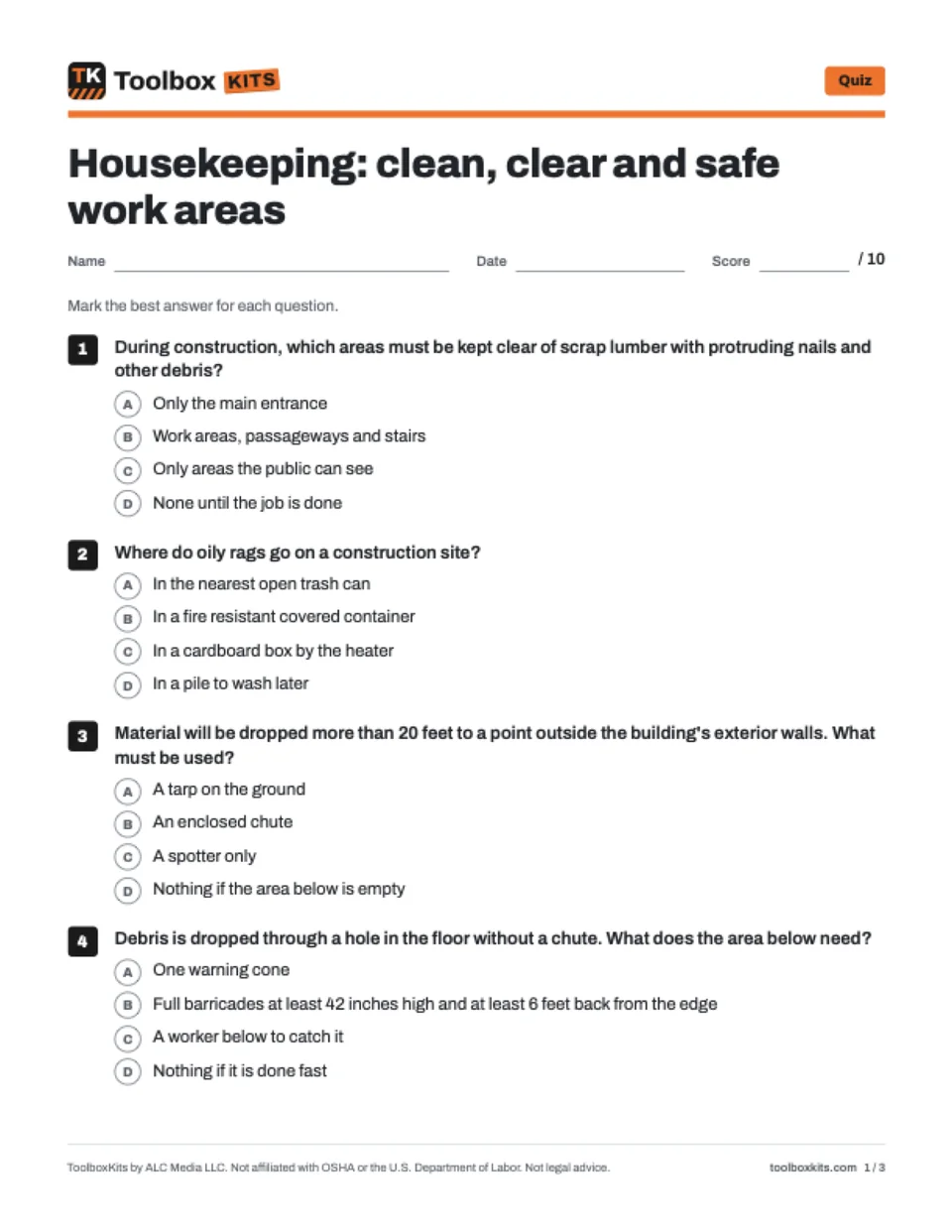 Quiz
- Answer key
 Sign-in sheet
 Certificate
- Crew handout
Try it
Try the quiz
Three questions from this topic. Pick an answer to see the right one and the OSHA paragraph.
Question 1 of 3
During construction, what must happen to scrap lumber with protruding nails?
The rule
What OSHA requires
Plain-language summary. Each line links to the exact paragraph of the regulation.
During construction, alteration or repairs, keep form and scrap lumber with protruding nails, and all other debris, cleared from work areas, passageways and stairs.
“form and scrap lumber with protruding nails, and all other debris, shall be kept cleared from work areas, passageways, and stairs, in and around buildings or other structures.”
Remove combustible scrap and debris at regular intervals during construction, and provide a safe means to remove it.
“Safe means shall be provided to facilitate such removal.”
On construction sites, provide containers for waste, trash, oily and used rags and other refuse. Containers for garbage and oily, flammable or hazardous waste must have covers, and waste must be disposed of at frequent and regular intervals.
“Garbage and other waste shall be disposed of at frequent and regular intervals.”
In general industry, keep all places of employment, passageways, storerooms, service rooms and walking-working surfaces clean, orderly and sanitary.
“All places of employment, passageways, storerooms, service rooms, and walking-working surfaces are kept in a clean, orderly, and sanitary condition.”
In general industry, keep workroom floors clean and, to the extent feasible, dry. Where wet processes are used, maintain drainage and, to the extent feasible, provide dry standing places such as false floors, platforms and mats.
In general industry, keep walking-working surfaces free of hazards such as sharp or protruding objects, loose boards, corrosion, leaks, spills, snow and ice.
“Walking-working surfaces are maintained free of hazards such as sharp or protruding objects, loose boards, corrosion, leaks, spills, snow, and ice.”
In general industry, correct or repair hazardous conditions on walking-working surfaces before anyone uses them again. If that cannot be done right away, guard the hazard until it is fixed.
In general industry, keep storage areas free of piled-up materials that create tripping, fire, explosion or pest hazards.
“Storage areas shall be kept free from accumulation of materials that constitute hazards from tripping, fire, explosion, or pest harborage.”
On construction sites, keep means of egress free of all obstructions so they can be used instantly in a fire or other emergency.
“Means of egress shall be continually maintained free of all obstructions or impediments to full instant use in the case of fire or other emergency.”
In general industry, keep exit routes free and unobstructed. No materials or equipment may be placed in an exit route, even temporarily.
“No materials or equipment may be placed, either permanently or temporarily, within the exit route.”
Common questions
Questions people ask
Is there a printable housekeeping toolbox talk PDF?
Yes. This housekeeping talk is free, and you can print it as a PDF in English or Spanish with a sign-in table. It works for construction sites, shops and warehouses.
What does OSHA require for housekeeping?
In construction, 29 CFR 1926.25 requires debris to be kept cleared from work areas, passageways and stairs, combustible scrap to be removed at regular intervals, and containers to be provided for waste, with covers for oily, flammable or hazardous waste. In general industry, 29 CFR 1910.22(a) requires workplaces and walking-working surfaces to be kept clean, orderly and sanitary, and walking-working surfaces to be kept free of hazards like spills, loose boards, snow and ice.
Why is housekeeping important on a construction site?
Scrap, cords and debris cause slips and trips, nails and sharp edges cause cuts, loose materials can fall on people below, and piles of scrap feed fires. Clutter can also block exits and extinguishers in an emergency. During construction, OSHA requires debris to be kept cleared from work areas, passageways and stairs (29 CFR 1926.25(a)).
What is good housekeeping at work?
Good housekeeping means keeping work areas clean, orderly and free of debris, with materials stored safely and waste removed on a schedule. It is a habit, not a weekly cleanup: clean as you go, put tools away and fix or report hazards right away.
What should a spring cleaning safety moment cover?
Use spring cleaning to clear out what you do not need, check that stacks and shelves are stable, empty and clean waste containers, and make sure exits and extinguishers are not blocked. Remind the crew to read the label before using any cleaning chemical and to lift with their legs, not their back.
Free to share
Use this talk for free
You can print, share and adapt this talk at no cost under the Creative Commons BY-NC-SA 4.0 license. Please credit ToolboxKits with a link.