

Free 5-minute toolbox talkEmergencies and weatherEnglish and Spanish
Fire drill toolbox talk: emergency evacuation
A drill is practice, and practice makes the real thing safer for everyone. What OSHA requires: An emergency action plan must be in writing, kept in the workplace and available to employees for review. An employer with 10 or fewer employees may communicate the plan orally (29 CFR 1910.38(b)).
A free fire drill and emergency evacuation talk for any workplace. Read it aloud in about five minutes, then walk your exit routes together.
Updated October 29, 2026 · Based on 29 CFR 1910.38, 29 CFR 1910.37
Read it out loud
Free 5-minute toolbox talk
Read it out loud to your crew. It takes about 5 minutes.
Start with a question
If the alarm sounded right now, which way would you go, and where would you meet up outside?
Why it matters
In a fire or other emergency, there is no time to think about what to do. People who already know the alarm, the exit routes and the meeting spot move faster and make fewer mistakes. A drill is practice, and practice makes the real thing safer for everyone.
Key points
Know the alarm and what it means
The employer must have and maintain an employee alarm system with a distinctive signal for each purpose. Know what a fire alarm sounds like on your site and how it differs from other signals. If you see or smell a fire before the alarm, report it right away using the way your plan says.
Know your exit routes and keep them clear
At least two exit routes must be available in a workplace to permit prompt evacuation, with exceptions where a single route is safe. Exit routes must be free and unobstructed, and no materials or equipment may be placed in them, even for a short time.
More
Know both routes from your work area, including the one that is farther from the usual door.
29 CFR 1910.37(a)(3) · 29 CFR 1910.36(b)(1)
Leave right away and calmly
Stop what you are doing, make the work safe if it only takes a moment and walk to the nearest safe exit. Do not stop for personal items, do not use elevators and do not go back inside.
More
Employees who must stay to operate critical plant operations follow the shutdown procedures in your plan before they leave.
Help others who need it
The employer must designate and train employees to assist in a safe and orderly evacuation of other employees. If you are one of them, know your job. Think about visitors, new workers and anyone who might need extra help, and make sure someone is assigned to them.
Go to the meeting point and be counted
An emergency action plan must include procedures to account for all employees after evacuation. Go straight to your assigned meeting spot, stay there and check in with your supervisor. Do not leave and do not go back in until you are told it is safe.
Know what OSHA does and does not say about drills
OSHA's emergency action plan rule does not set how often to hold a fire drill. It does require the employer to review the plan with each employee when the plan is developed or the employee is first assigned, when the employee's duties under the plan change and when the plan changes.
More
Regular drills are still a good way to practice.
Scenario
Picture this: A fire alarm sounds in a busy shop. Some workers walk to the front door, which is blocked by a stack of pallets. Another worker goes back to grab his phone. At the meeting spot, the supervisor has no way to tell who is still inside. What should have been done differently?
Ask the crew
- Where are the two ways out from your work area?
- Where is our meeting point, and who takes the headcount?
- What can block our exit routes, and how do we keep them clear?
- How would we help a visitor or someone who needs extra time?
Takeaway
Know the alarm, know two ways out, keep exits clear and get to the meeting point to be counted.
Trainer: ______________________ Date: ____________
Credit: ToolboxKits, https://toolboxkits.com/topics/fire-drills/ (CC BY-NC-SA 4.0)
The poster is also inside the paid kits.
Audit-ready records in 60 seconds
Fill in your crew and download a filled sign-in sheet for this talk. Everything is made in your browser. Names are never uploaded or stored.
Start a sign-off
Crew scan a QR code on their own phones, type their name and sign with a finger. You see the names arrive and download the signed sheet. Free, no account.
Kits
Get the kit
No subscription needed. Buy only the kit you need.
Toolbox talk kit
$4.99
- 5-minute talk, English PDF
- 5-minute talk, Spanish PDF
- Editable mini-deck (English and Spanish)
- One-page crew handout (English and Spanish)
- Bilingual sign-in sheet
- 3-question quiz with answer key (English and Spanish)
- One-page bilingual poster
- Audit-ready records in 60 seconds: fill in your crew and get a sign-in sheet and a certificate for every worker
Training kit
$9
Editable PowerPoint, 30 slides
- Editable PowerPoint with trainer notes on every slide
- Trainer guide PDF with timing and discussion tips
- 10-question quiz and answer key
- Sign-in sheet and certificate of completion with fillable fields
- One-page crew handout
- Full Spanish version of everything
- One-page bilingual poster
- Audit-ready records in 60 seconds: fill in your crew and get a sign-in sheet and a certificate for every worker
- Instant download
- Secure checkout by Stripe
- 30-day refund, no questions
Need many topics? All Access gives you every kit for $99 a year.
Inside the kit
See what is in the kit
What is in the kit
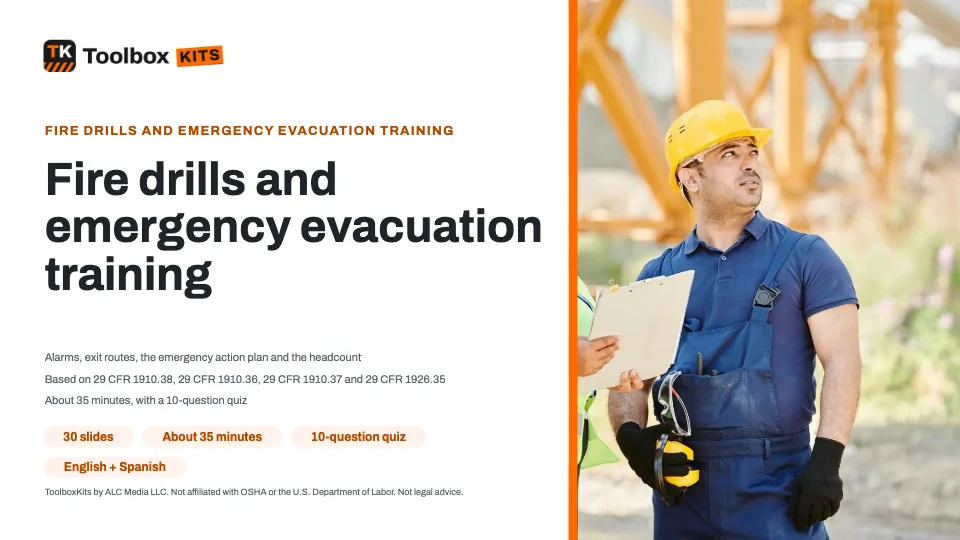 Editable PowerPoint
- Trainer guide
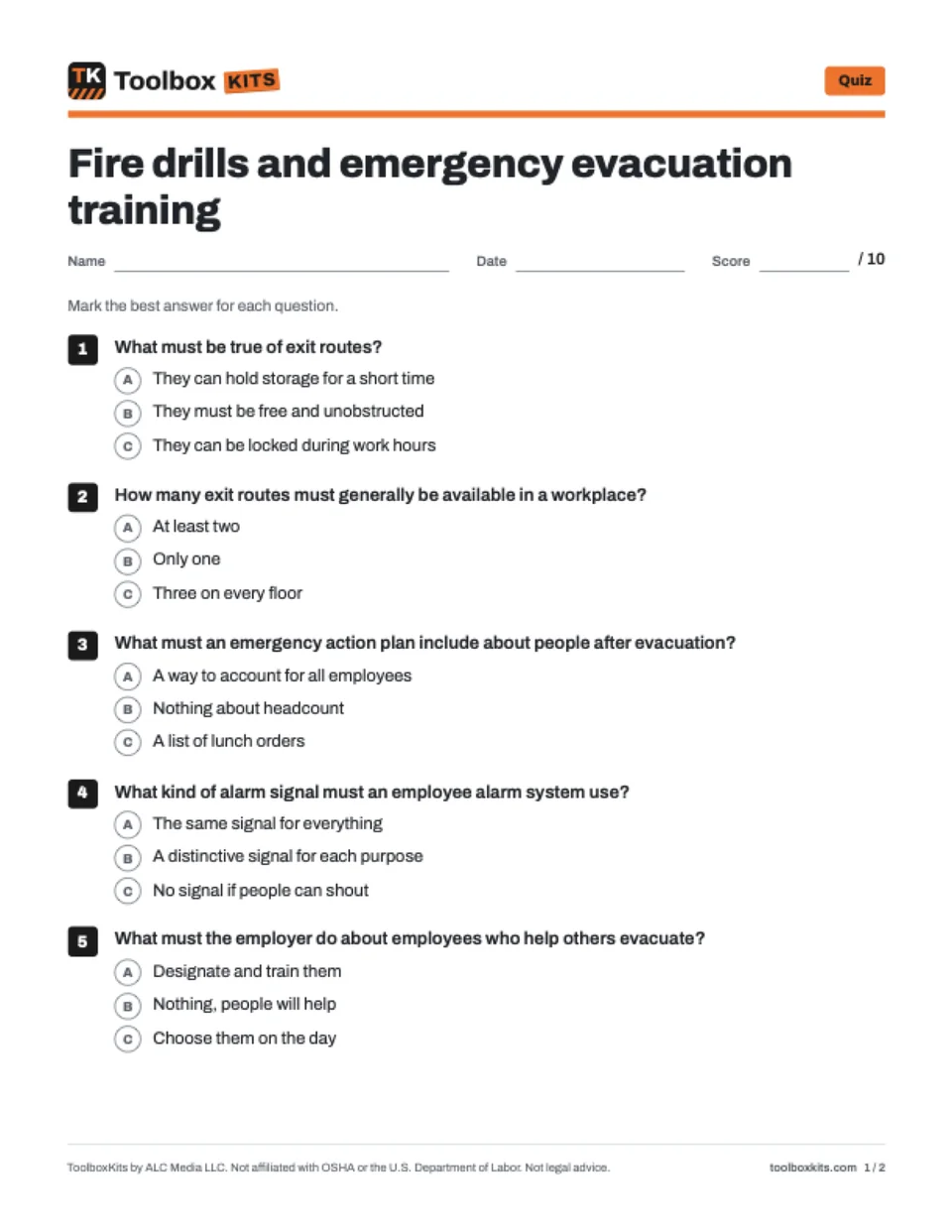 Quiz
- Answer key
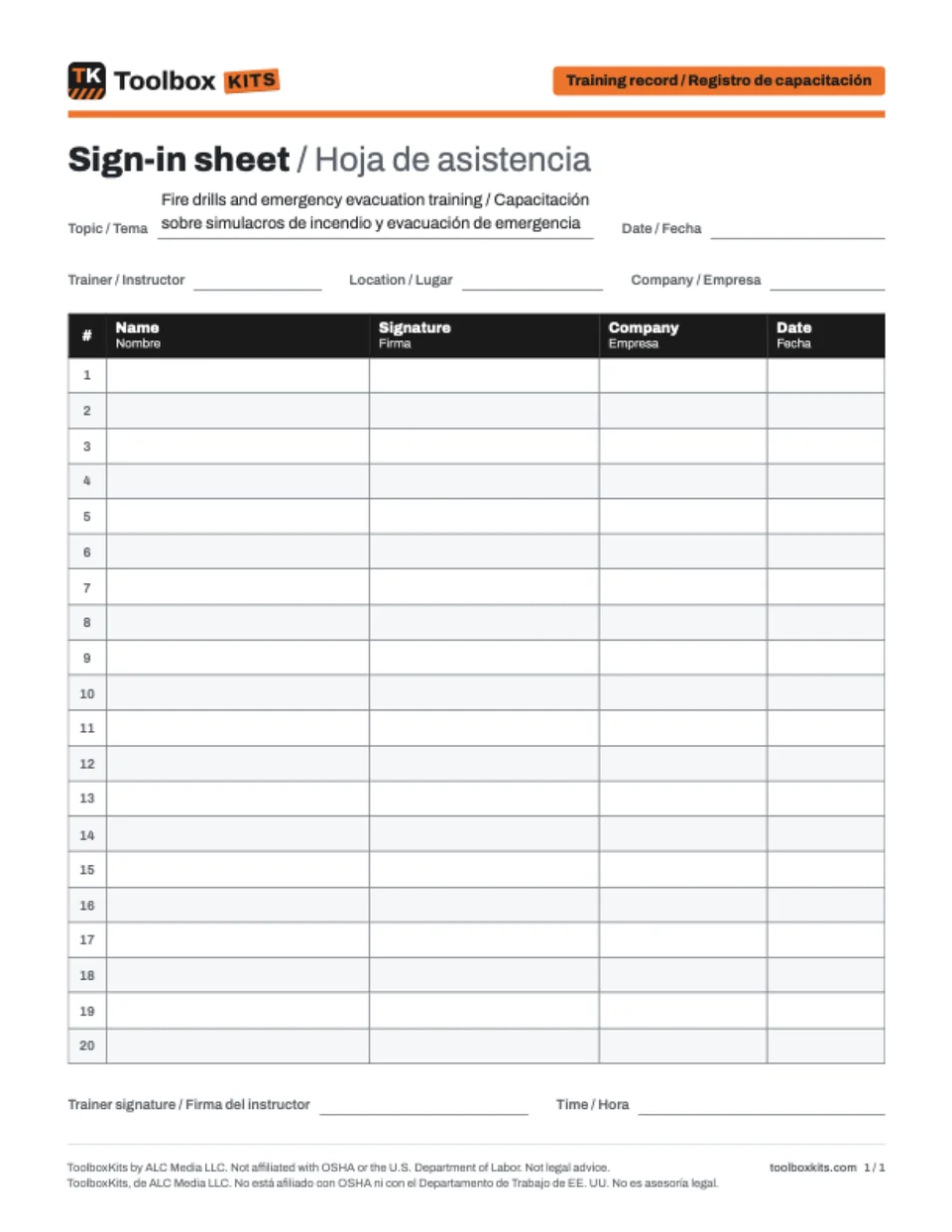 Sign-in sheet
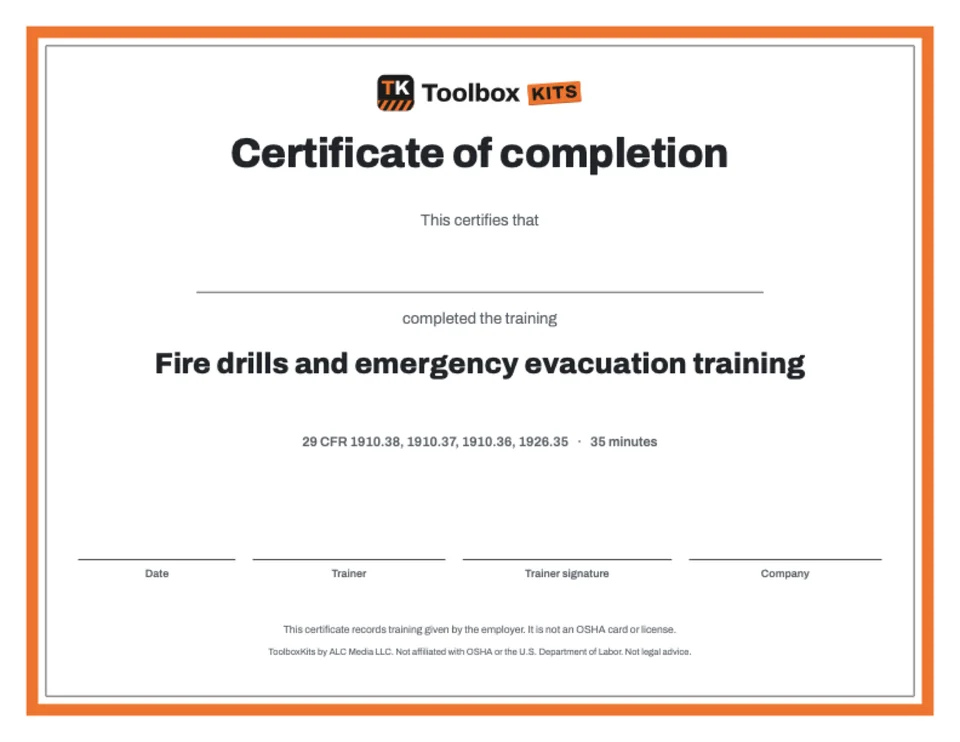 Certificate
- Crew handout
Try it
Try the quiz
Three questions from this topic. Pick an answer to see the right one and the OSHA paragraph.
Question 1 of 3
What must be true of exit routes?
The rule
What OSHA requires
Plain-language summary. Each line links to the exact paragraph of the regulation.
An emergency action plan must be in writing, kept in the workplace and available to employees for review. An employer with 10 or fewer employees may communicate the plan orally.
An emergency action plan must include procedures for emergency evacuation, including the type of evacuation and exit route assignments.
“Procedures for emergency evacuation, including type of evacuation and exit route assignments;”
An emergency action plan must include procedures to account for all employees after evacuation.
“Procedures to account for all employees after evacuation;”
The employer must have and maintain an employee alarm system that uses a distinctive signal for each purpose.
“An employer must have and maintain an employee alarm system.”
The employer must designate and train employees to assist in a safe and orderly evacuation of other employees.
“An employer must designate and train employees to assist in a safe and orderly evacuation of other employees.”
The employer must review the emergency action plan with each employee when the plan is developed or the employee is first assigned, when the employee's responsibilities under the plan change and when the plan changes.
At least two exit routes must be available in a workplace to permit prompt evacuation of employees and other occupants during an emergency, except where a single exit route is allowed.
“At least two exit routes must be available in a workplace to permit prompt evacuation of employees and other building occupants during an emergency”
Exit routes must be free and unobstructed. No materials or equipment may be placed, permanently or temporarily, within the exit route.
“Exit routes must be free and unobstructed. No materials or equipment may be placed, either permanently or temporarily, within the exit route.”
Safeguards designed to protect employees in an emergency, such as sprinkler systems, alarm systems, fire doors and exit lighting, must be in proper working order at all times.
In construction, the emergency action plan must include procedures to account for all employees after emergency evacuation has been completed.
“Procedures to account for all employees after emergency evacuation has been completed;”
Who must be trained
The employer must designate and train employees to assist in a safe and orderly evacuation of other employees (29 CFR 1910.38(e)). The employer must review the plan with each employee covered by it (29 CFR 1910.38(f)).
When to retrain
The employer must review the emergency action plan with each employee when the employee's responsibilities under the plan change and when the plan is changed (29 CFR 1910.38(f)(2) and (f)(3)).

Common questions
Questions people ask
Is there a printable emergency evacuation toolbox talk PDF?
Yes. This emergency evacuation toolbox talk is free to print as a PDF in English and Spanish, with a sign-in table for your crew. Read it aloud in about five minutes, and keep the signed sheet with your safety records.
Does OSHA require fire drills?
OSHA's emergency action plan rules (29 CFR 1910.38 and 1926.35) do not set how often to hold fire drills. They do require an emergency action plan where a standard requires one, a distinctive alarm, trained evacuation helpers and a plan review with employees. Many employers hold drills anyway to practice the plan.
What should be in evacuation procedures?
At a minimum, an emergency action plan must cover reporting emergencies, evacuation type and exit route assignments, and procedures for employees who stay to run critical operations. It must also cover a way to account for everyone, rescue and medical duties, and who to contact with questions (29 CFR 1910.38(c)).
What are the rules for emergency exits and routes?
Exit routes must be free and unobstructed, with no materials or equipment placed in them (29 CFR 1910.37(a)(3)). Each exit must be clearly visible and marked with a sign reading "Exit" (29 CFR 1910.37(b)(2)). At least two exit routes must generally be available (29 CFR 1910.36(b)(1)).
What should I do first when I hear the alarm?
Stop work, make things safe only if it takes a moment and use the nearest safe exit. Go to your assigned meeting point and check in so you are counted (29 CFR 1910.38(c)(4)). Do not use elevators and do not go back in until you are told it is safe.
Free to share
Use this talk for free
You can print, share and adapt this talk at no cost under the Creative Commons BY-NC-SA 4.0 license. Please credit ToolboxKits with a link.