

Free 5-minute toolbox talkGeneral safetyEnglish and Spanish
Construction housekeeping toolbox talk
Scrap with nails, loose cords, debris piles and shaky stacks cause trips, punctures and struck-by injuries, and piles of scrap feed fires. What OSHA requires: Combustible scrap and debris must be removed at regular intervals during construction, and a safe means must be provided to remove it (29 CFR 1926.25(b)).
A free 5-minute housekeeping talk built for construction sites. It covers scrap and nails, waste containers, debris chutes, material storage, cords and exits, with the OSHA construction rule behind each point.
Updated October 29, 2026 · Based on 29 CFR 1926.25
Read it out loud
Free 5-minute toolbox talk
Read it out loud to your crew. It takes about 5 minutes.
Start with a question
If we had to get everyone out of this building right now, what would people trip over on the way?
Why it matters
On a construction site the mess changes by the hour as trades cut, strip, unpack and move on. Scrap with nails, loose cords, debris piles and shaky stacks cause trips, punctures and struck-by injuries, and piles of scrap feed fires. Clutter also blocks stairs and exits right when people need them most.
Key points
Clean as you go
During construction, form and scrap lumber with protruding nails and all other debris must be kept cleared from work areas, passageways and stairs. Scrap lumber, waste material and rubbish must be removed from the immediate work area as the work progresses. Do not save it for a Friday cleanup.
More
Mist concrete or masonry dust before you sweep it, or use a HEPA vacuum, since dry sweeping can put silica in the air.
29 CFR 1926.252(c) · 29 CFR 1926.25(a) · 29 CFR 1926.1153(f)(1)
Pull the nails
A nail sticking up out of a board can go through a boot sole or tear open a hand. Used lumber must have all nails withdrawn before it is stacked. When you strip forms, pull or bend over the nails in scrap right away, and never leave nail-studded boards where people walk.
Use the right containers
Containers must be provided for collecting and separating waste, trash, oily and used rags and other refuse. Containers for garbage and oily, flammable or hazardous waste need covers, and garbage and other waste must be disposed of at frequent and regular intervals.
More
Solvent waste, oily rags and flammable liquids must be kept in fire resistant covered containers until they leave the site.
29 CFR 1926.25(c) · 29 CFR 1926.252(e)
Get debris down safely
Debris tossed off an upper floor can hit someone below. When materials are dropped more than 20 feet to any point outside the exterior walls of the building, an enclosed chute must be used.
More
When debris is dropped through floor holes without a chute, the landing area must be completely enclosed with barricades at least 42 inches high and at least 6 feet back from the projected edge of the opening above, with warning signs at each level. Nobody clears that lower area until debris handling stops above.
29 CFR 1926.252(a) · 29 CFR 1926.252(b)
Stack it so it stays put
Materials stored in tiers must be stacked, racked, blocked, interlocked or otherwise secured so they cannot slide, fall or collapse.
More
Inside a building under construction, do not store material within 6 feet of a hoistway or floor opening, or within 10 feet of an exterior wall that does not extend above the top of the material. Keep aisles and passageways clear and in good repair.
29 CFR 1926.250(a)(1) · 29 CFR 1926.250(b)(1) · 29 CFR 1926.250(a)(3)
Keep cords, walkways and exits clear
Working spaces, walkways and similar locations must be kept clear of cords so they do not create a hazard. Run cords and hoses overhead or along walls where you can. Exits and the routes to them must be kept free of all obstructions so they can be used instantly in a fire or other emergency.
More
Report burned-out temporary lights, because nobody can avoid a trip hazard they cannot see.
29 CFR 1926.416(b)(2) · 29 CFR 1926.34(c)
Scenario
Picture this: Carpenters are stripping forms on the second floor of a new building. Scrap boards with nails go into a pile next to the stairs, and a bundle of extension cords runs across the landing. Late in the day, a laborer carrying plywood heads down the stairs and cannot see his feet. Nobody has been hurt yet. What should the crew fix right now, and who should do it?
Ask the crew
- How can we improve the housekeeping in our work areas?
- Where does scrap pile up on this job, and are there enough containers there?
- How are we getting debris down from the upper floors, and is the area below protected?
- Is anything blocking a stairway, walkway or exit right now?
Takeaway
Clean as you go, pull the nails, stack materials so they stay put and keep every walkway, stairway and exit clear.
Trainer: ______________________ Date: ____________
Credit: ToolboxKits, https://toolboxkits.com/topics/construction-housekeeping/ (CC BY-NC-SA 4.0)
The poster is also inside the paid kits.
Audit-ready records in 60 seconds
Fill in your crew and download a filled sign-in sheet for this talk. Everything is made in your browser. Names are never uploaded or stored.
Start a sign-off
Crew scan a QR code on their own phones, type their name and sign with a finger. You see the names arrive and download the signed sheet. Free, no account.
Kits
Get the kit
No subscription needed. Buy only the kit you need.
Toolbox talk kit
$4.99
- 5-minute talk, English PDF
- 5-minute talk, Spanish PDF
- Editable mini-deck (English and Spanish)
- One-page crew handout (English and Spanish)
- Bilingual sign-in sheet
- 3-question quiz with answer key (English and Spanish)
- One-page bilingual poster
- Audit-ready records in 60 seconds: fill in your crew and get a sign-in sheet and a certificate for every worker
Training kit
$9
Editable PowerPoint, 40 slides
- Editable PowerPoint with trainer notes on every slide
- Trainer guide PDF with timing and discussion tips
- 10-question quiz and answer key
- Sign-in sheet and certificate of completion with fillable fields
- One-page crew handout
- Full Spanish version of everything
- One-page bilingual poster
- Audit-ready records in 60 seconds: fill in your crew and get a sign-in sheet and a certificate for every worker
- Instant download
- Secure checkout by Stripe
- 30-day refund, no questions
Need many topics? All Access gives you every kit for $99 a year.
Inside the kit
See what is in the kit
What is in the kit
 Editable PowerPoint
- Trainer guide
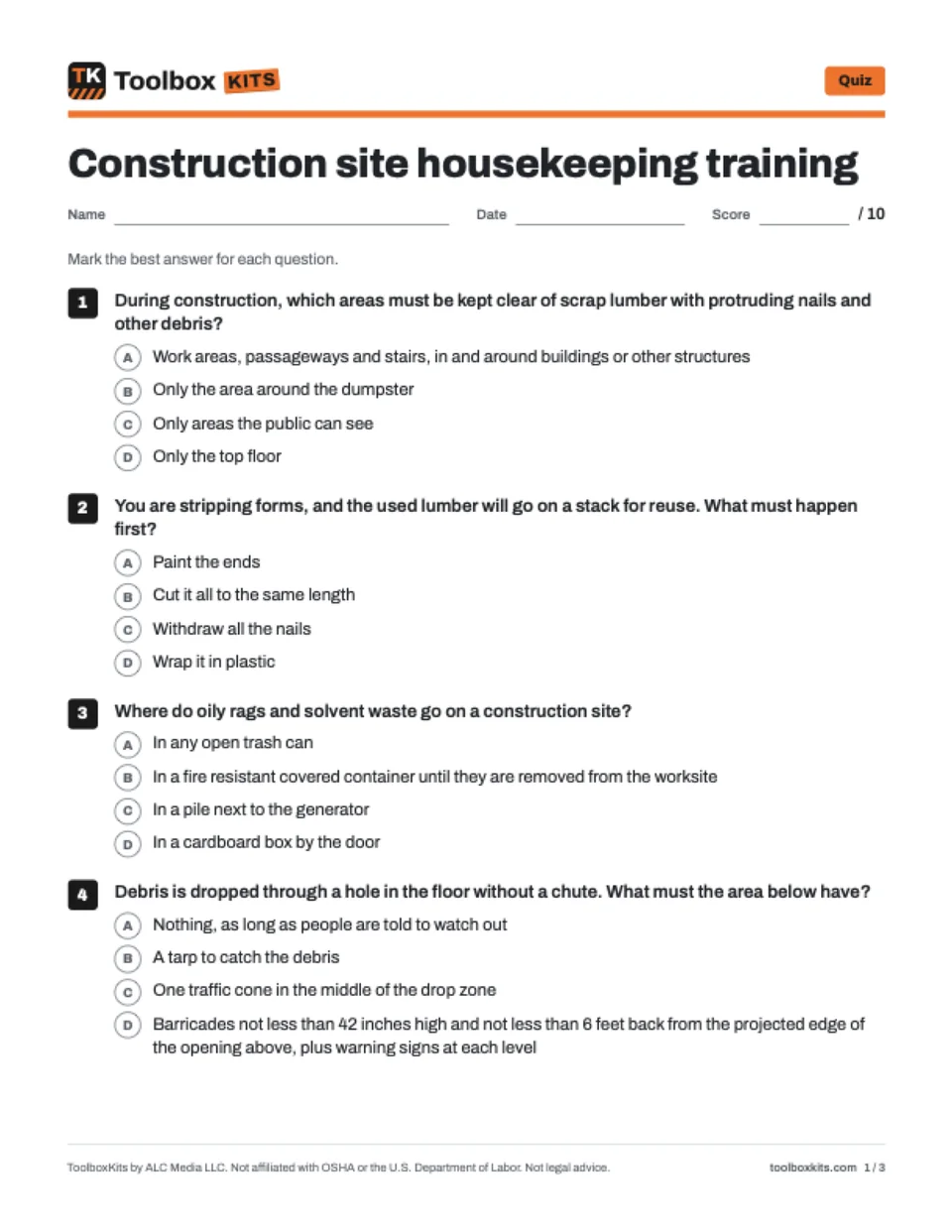 Quiz
- Answer key
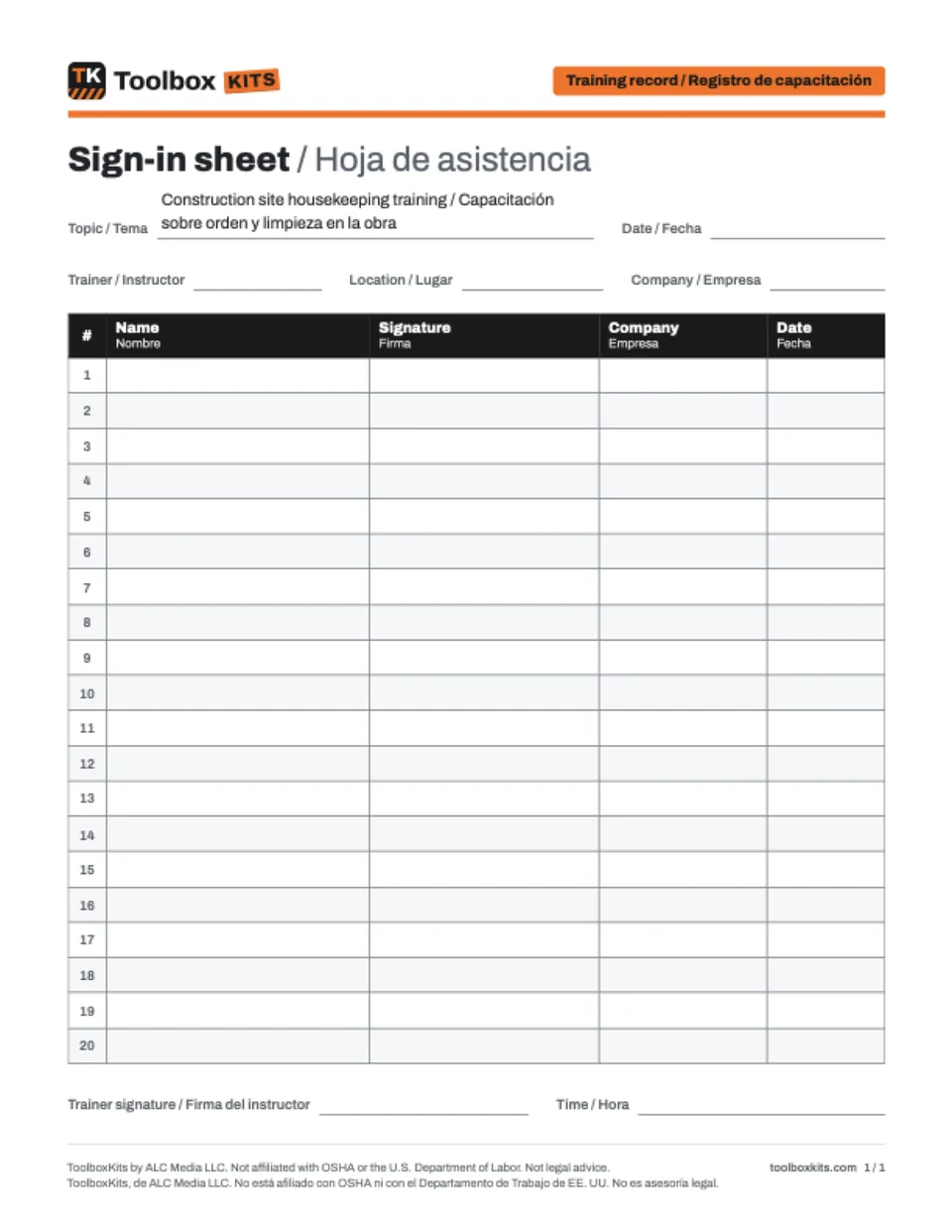 Sign-in sheet
 Certificate
- Crew handout
Try it
Try the quiz
Three questions from this topic. Pick an answer to see the right one and the OSHA paragraph.
Question 1 of 3
When must scrap lumber, waste material and rubbish be removed from the immediate work area?
The rule
What OSHA requires
Plain-language summary. Each line links to the exact paragraph of the regulation.
During construction, alteration or repairs, form and scrap lumber with protruding nails and all other debris must be kept cleared from work areas, passageways and stairs, in and around buildings or other structures. Debris must not be allowed to accumulate on scaffold platforms (29 CFR 1926.451(f)(13)).
“form and scrap lumber with protruding nails, and all other debris, shall be kept cleared from work areas, passageways, and stairs, in and around buildings or other structures.”
Combustible scrap and debris must be removed at regular intervals during construction, and a safe means must be provided to remove it.
“Combustible scrap and debris shall be removed at regular intervals during the course of construction.”
Containers must be provided for collecting and separating waste, trash, oily and used rags and other refuse. Containers for garbage and oily, flammable or hazardous wastes (such as caustics, acids and harmful dusts) must have covers, and garbage and other waste must be disposed of at frequent and regular intervals. Solvent waste, oily rags and flammable liquids must be kept in fire resistant covered containers until removed from the worksite (29 CFR 1926.252(e)).
“Containers shall be provided for the collection and separation of waste, trash, oily and used rags, and other refuse.”
When materials are dropped more than 20 feet to any point outside the exterior walls of a building, an enclosed chute of wood or equivalent material must be used. When debris is dropped through holes in the floor without chutes, the landing area must be completely enclosed with barricades at least 42 inches high and at least 6 feet back from the projected edge of the opening above, warning signs must be posted at each level, and no removal is allowed in the lower area until debris handling stops above (29 CFR 1926.252(b)).
“Whenever materials are dropped more than 20 feet to any point lying outside the exterior walls of the building, an enclosed chute of wood, or equivalent material, shall be used.”
All scrap lumber, waste material and rubbish must be removed from the immediate work area as the work progresses.
“All scrap lumber, waste material, and rubbish shall be removed from the immediate work area as the work progresses.”
Used lumber must have all nails withdrawn before it is stacked. Lumber must be stacked on level, solidly supported sills and be stable and self-supporting (29 CFR 1926.250(b)(8)(ii) and (b)(8)(iii)).
“Used lumber shall have all nails withdrawn before stacking.”
All materials stored in tiers must be stacked, racked, blocked, interlocked or otherwise secured to prevent sliding, falling or collapse. Aisles and passageways must be kept clear and in good repair (29 CFR 1926.250(a)(3)), and storage areas must be kept free of accumulated materials that create tripping, fire, explosion or pest hazards (29 CFR 1926.250(c)).
“All materials stored in tiers shall be stacked, racked, blocked, interlocked, or otherwise secured to prevent sliding, falling or collapse.”
Working spaces, walkways and similar locations must be kept clear of cords so they do not create a hazard to employees.
“Working spaces, walkways, and similar locations shall be kept clear of cords so as not to create a hazard to employees.”
Means of egress (exits and the routes to them) must be continually kept free of all obstructions so they can be used instantly in a fire or other emergency. Indoor storage must not obstruct or adversely affect means of exit (29 CFR 1926.151(d)(1)).
“Means of egress shall be continually maintained free of all obstructions or impediments to full instant use in the case of fire or other emergency.”
Dry sweeping and dry brushing must not be allowed where they could contribute to exposure to respirable crystalline silica, unless wet sweeping, HEPA-filtered vacuuming or other methods that minimize the likelihood of exposure are not feasible.
“The employer shall not allow dry sweeping or dry brushing where such activity could contribute to employee exposure to respirable crystalline silica”
Common questions
Questions people ask
Is there a printable construction housekeeping toolbox talk?
Yes. This construction housekeeping talk is free, and you can print it as a PDF in English or Spanish with a sign-in table. It takes about five minutes to read aloud at the start of a shift.
What is the OSHA standard for housekeeping in construction?
The main rule is 29 CFR 1926.25. It requires scrap lumber with protruding nails and all other debris to be kept cleared from work areas, passageways and stairs, combustible scrap to be removed at regular intervals, and containers for waste, with covers for garbage and oily, flammable or hazardous waste. Related rules cover waste disposal and debris chutes (29 CFR 1926.252) and material storage (29 CFR 1926.250).
Why is housekeeping important on a construction site?
Debris, scrap with nails and loose cords cause trips and punctures, unsecured materials can slide or fall, and piles of combustible scrap feed fires. Clutter can also block stairs and exits in an emergency. OSHA requires debris to be kept cleared from work areas, passageways and stairs during construction (29 CFR 1926.25(a)).
What should a construction site housekeeping toolbox talk cover?
Cover cleaning up as the work progresses, pulling nails, waste containers, safe ways to get debris down from upper floors, stacking materials, cords, and keeping stairs and exits clear. If your crew cuts or grinds concrete or masonry, add dust cleanup: dry sweeping is not allowed where it could add to silica exposure, unless wet sweeping, HEPA-filtered vacuuming or other methods that minimize the likelihood of exposure are not feasible (29 CFR 1926.1153(f)(1)).
Who is responsible for housekeeping on a construction site?
Everyone. Each worker and each trade should clean up as they go, and supervisors should check work areas through the day. The employer must provide waste containers (29 CFR 1926.25(c)), and its safety programs must provide for frequent and regular inspections of the job site, materials and equipment by competent persons it designates (29 CFR 1926.20(b)(2)).
Free to share
Use this talk for free
You can print, share and adapt this talk at no cost under the Creative Commons BY-NC-SA 4.0 license. Please credit ToolboxKits with a link.