

Free 5-minute toolbox talkGeneral safetyEnglish and Spanish
Environmental awareness toolbox talk for job sites
Fuel, oil, paint, concrete washout and loose trash can wash into storm drains, ditches and creeks, and some of them can also start fires or hurt people nearby. What OSHA requires: Scrap lumber, waste material and rubbish must be removed from the immediate work area as the work progresses (29 CFR 1926.252(c)).
A five-minute environmental awareness talk for construction and oil and gas crews. It covers waste and scrap, fuel and spills, storm drains and washout, and the OSHA construction rules on waste disposal and flammable liquids.
Updated October 29, 2026 · Based on 29 CFR 1926.252
Read it out loud
Free 5-minute toolbox talk
Read it out loud to your crew. It takes about 5 minutes.
Start with a question
If a hydraulic hose burst on a machine right now and oil started running toward a storm drain, what would you do first?
Why it matters
What lands on the ground at a job site does not always stay there. Fuel, oil, paint, concrete washout and loose trash can wash into storm drains, ditches and creeks, and some of them can also start fires or hurt people nearby. A spill is much easier to stop at the start than to clean up after it spreads.
Key points
Keep waste contained and covered
Containers must be provided to collect and separate waste, trash, oily and used rags and other refuse, and containers for garbage and oily, flammable or hazardous waste must have covers.
More
Solvent waste, oily rags and flammable liquids must be kept in fire resistant covered containers until they are removed from the site. Keep the lids closed so rain cannot wash waste out and wind cannot blow it away.
29 CFR 1926.25(c) · 29 CFR 1926.252(e)
Clean up as you go
Scrap lumber, waste material and rubbish must be removed from the immediate work area as the work progresses. Loose trash can blow off site, clog drains and create trip and fire hazards. Put scrap metal, cardboard and clean wood in recycling bins where the site has them.
More
Burning waste or debris must comply with local fire regulations, so never start a burn pile on your own.
29 CFR 1926.252(c) · 29 CFR 1926.252(d)
Fuel up without spills
Keep fuel and other flammable liquids in closed containers when not in use. For Category 1, 2 and 3 flammable liquids, that is an OSHA rule. In fueling areas, smoking and open flames are not allowed, and the motors of equipment being fueled must be shut off.
More
Fuel on a level spot away from drains and ditches, use a drip pan, and stay with the nozzle the whole time.
29 CFR 1926.152(f)(1) · 29 CFR 1926.152(g)(8) and (g)(10)
Stop small spills before they spread
Leaks and spills of flammable liquids must be disposed of promptly and safely. Know where the spill kit is. If it is safe, stop the source, keep the spill away from drains with absorbent socks or a drain cover, and tell your supervisor right away.
More
Section 6 of every safety data sheet covers accidental release measures, so check it for the product that spilled.
29 CFR 1926.152(f)(2) · 29 CFR 1910.1200(g)(2)(vi)
Protect storm drains and waterways
In many places, storm drains carry water straight to creeks and rivers without treatment, so only rain should go down them. Wash out concrete trucks, tools, paint and stucco only in the washout area your site sets up. Keep silt fence and drain inlet protection in place and report any damage.
More
Cover stockpiles and dumpsters before rain, and keep mud off the street.
Know your chemicals and your site plan
Construction follows the same hazard communication rule as general industry, so safety data sheets must be readily accessible in your work area during each work shift.
More
They also have sections on ecological information and disposal considerations, which OSHA does not enforce because those areas are outside its jurisdiction. Many sites also have a stormwater or spill plan, so ask your supervisor what it asks of your crew.
29 CFR 1910.1200(g)(8) · 29 CFR 1926.59 · 29 CFR 1910.1200(g)(2)(xii), (g)(2)(xiii) and (g)(2)(xvi)
Scenario
Picture this: at the end of a hot afternoon, a crew finishes a concrete pour. A laborer starts rinsing the chute and tools at the curb, right next to a storm drain. An open bucket of used form oil sits nearby, the dumpster lid is up, and dark clouds are moving in. What should the crew do differently, and what needs to happen before the rain starts?
Ask the crew
- Where is the nearest spill kit, and what is in it?
- Where do concrete washout, paint water and other liquids go on this site?
- Which storm drains or ditches near our work need protecting, and how are they protected?
- What waste could we keep separate for recycling on this job?
Takeaway
Keep waste covered and contained, keep spills out of drains, and report any spill or release right away.
Trainer: ______________________ Date: ____________
Credit: ToolboxKits, https://toolboxkits.com/topics/environmental-awareness/ (CC BY-NC-SA 4.0)
The poster is also inside the paid kits.
Audit-ready records in 60 seconds
Fill in your crew and download a filled sign-in sheet for this talk. Everything is made in your browser. Names are never uploaded or stored.
Start a sign-off
Crew scan a QR code on their own phones, type their name and sign with a finger. You see the names arrive and download the signed sheet. Free, no account.
Kits
Get the kit
No subscription needed. Buy only the kit you need.
Toolbox talk kit
$4.99
- 5-minute talk, English PDF
- 5-minute talk, Spanish PDF
- Editable mini-deck (English and Spanish)
- One-page crew handout (English and Spanish)
- Bilingual sign-in sheet
- 3-question quiz with answer key (English and Spanish)
- One-page bilingual poster
- Audit-ready records in 60 seconds: fill in your crew and get a sign-in sheet and a certificate for every worker
Training kit
$9
Editable PowerPoint, 31 slides
- Editable PowerPoint with trainer notes on every slide
- Trainer guide PDF with timing and discussion tips
- 10-question quiz and answer key
- Sign-in sheet and certificate of completion with fillable fields
- One-page crew handout
- Full Spanish version of everything
- One-page bilingual poster
- Audit-ready records in 60 seconds: fill in your crew and get a sign-in sheet and a certificate for every worker
- Instant download
- Secure checkout by Stripe
- 30-day refund, no questions
Need many topics? All Access gives you every kit for $99 a year.
Inside the kit
See what is in the kit
What is in the kit
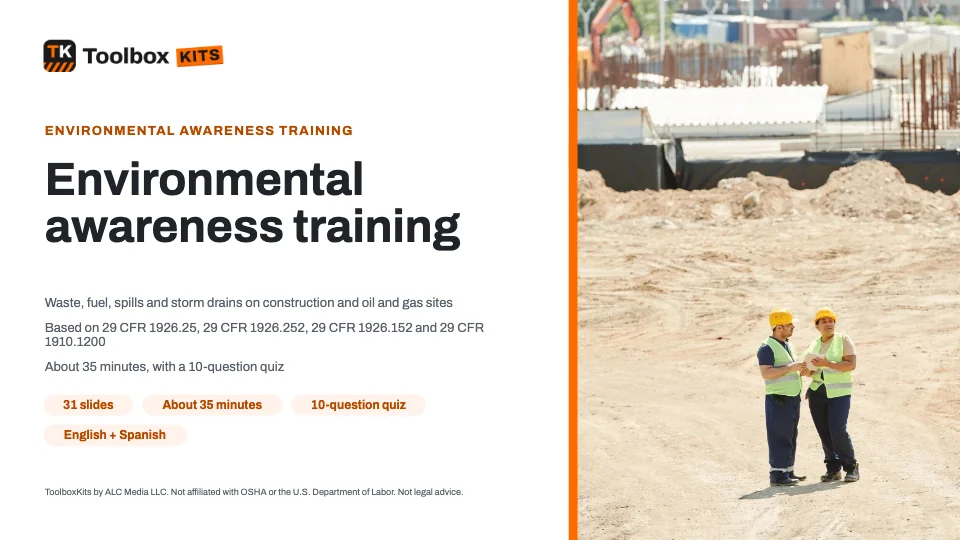 Editable PowerPoint
- Trainer guide
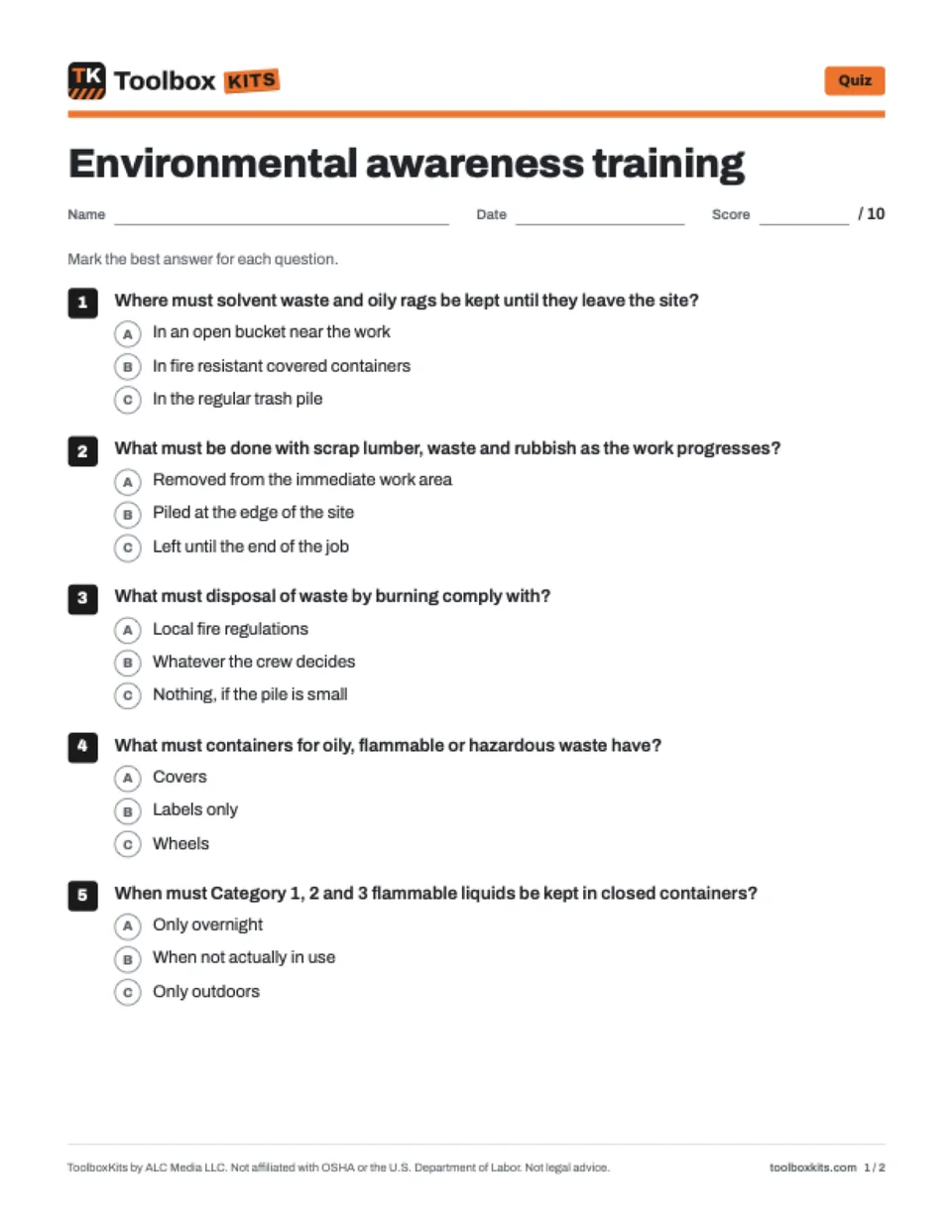 Quiz
- Answer key
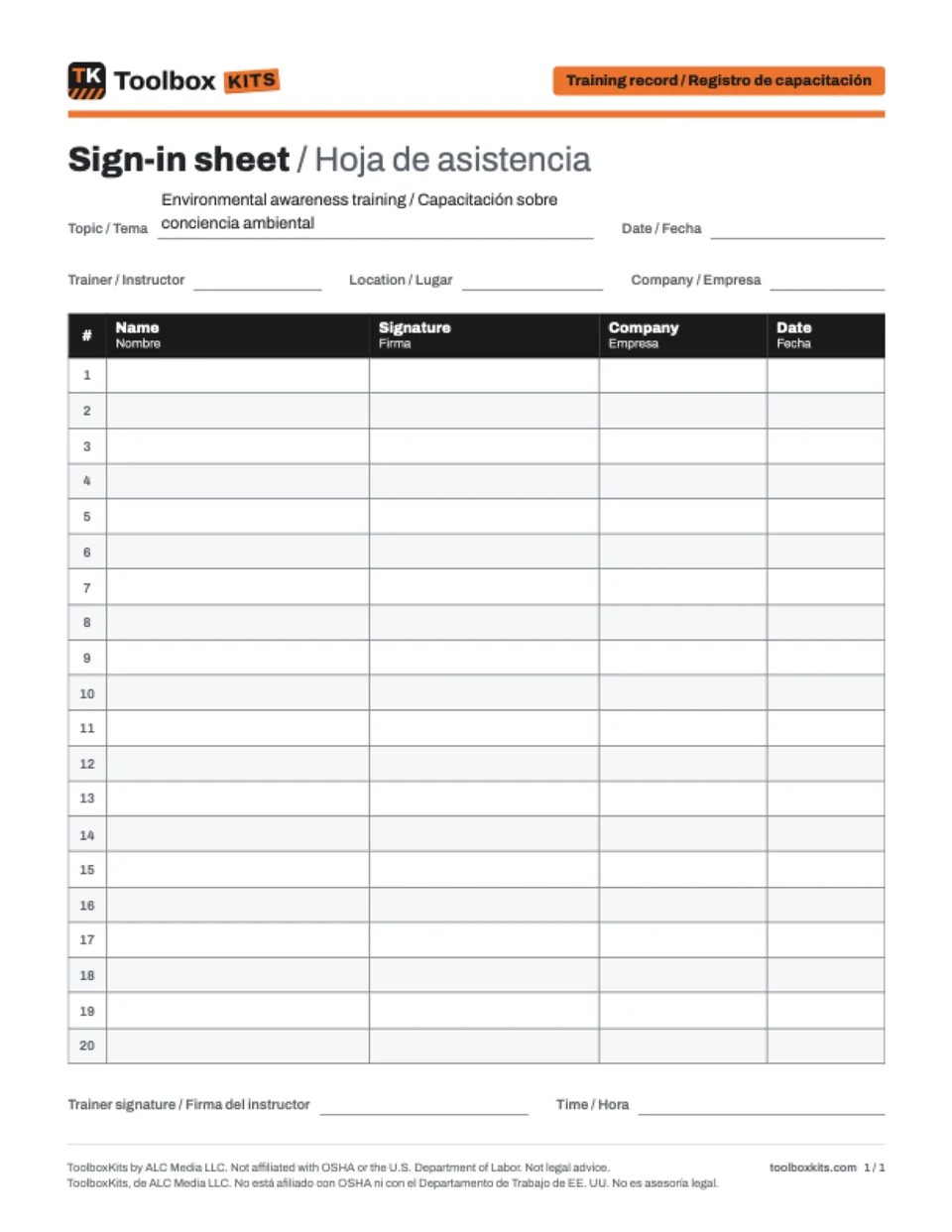 Sign-in sheet
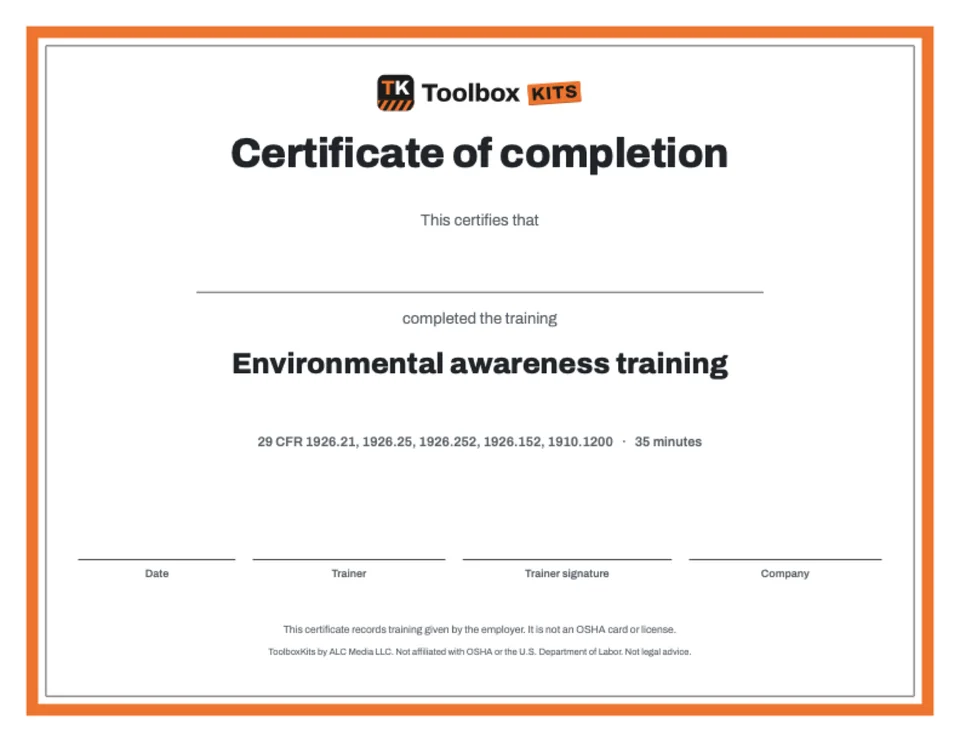 Certificate
- Crew handout
Try it
Try the quiz
Three questions from this topic. Pick an answer to see the right one and the OSHA paragraph.
Question 1 of 3
Where must solvent waste and oily rags be kept until they leave the site?
The rule
What OSHA requires
Plain-language summary. Each line links to the exact paragraph of the regulation.
Scrap lumber, waste material and rubbish must be removed from the immediate work area as the work progresses.
“All scrap lumber, waste material, and rubbish shall be removed from the immediate work area as the work progresses.”
Solvent waste, oily rags and flammable liquids must be kept in fire resistant covered containers until they are removed from the worksite.
“All solvent waste, oily rags, and flammable liquids shall be kept in fire resistant covered containers until removed from worksite.”
Disposing of waste material or debris by burning must comply with local fire regulations.
“Disposal of waste material or debris by burning shall comply with local fire regulations.”
When material is dropped more than 20 feet to any point outside the exterior walls of a building, an enclosed chute of wood or equivalent material must be used (29 CFR 1926.252(a)).
“an enclosed chute of wood, or equivalent material, shall be used”
Containers must be provided for collecting and separating waste, trash, oily and used rags and other refuse. Containers for garbage and other oily, flammable or hazardous wastes, such as caustics, acids and harmful dusts, must have covers, and garbage and other waste must be disposed of at frequent and regular intervals.
“Containers shall be provided for the collection and separation of waste, trash, oily and used rags, and other refuse.”
Category 1, 2 and 3 flammable liquids must be kept in closed containers when not actually in use.
“Category 1, 2, or 3 flammable liquids shall be kept in closed containers when not actually in use.”
Leaks and spills of flammable liquids must be disposed of promptly and safely.
“Leakage or spillage of flammable liquids shall be disposed of promptly and safely.”
In service and refueling areas, the motors of all equipment being fueled must be shut off during fueling. There may be no smoking or open flames in areas used for fueling, servicing engine fuel systems, or receiving or dispensing flammable liquids (29 CFR 1926.152(g)(8)).
“The motors of all equipment being fueled shall be shut off during the fueling operation.”
Under the hazard communication rule, which applies to construction through 29 CFR 1926.59, the employer must keep a safety data sheet for each hazardous chemical in the workplace and make sure it is readily accessible to employees in their work area during each work shift.
“readily accessible during each work shift to employees when they are in their work area(s)”
Employees who handle or use flammable liquids, gases or toxic materials must be instructed in their safe handling and use.
“Employees required to handle or use flammable liquids, gases, or toxic materials shall be instructed in the safe handling and use of these materials”
Who must be trained
In construction, the employer must instruct each employee in recognizing and avoiding unsafe conditions and the regulations that apply to their work environment (29 CFR 1926.21(b)(2)). Employees who handle or use flammable liquids, gases or toxic materials must be instructed in their safe handling and use (29 CFR 1926.21(b)(5)). Employees who handle or use poisons, caustics and other harmful substances must be instructed in safe handling and use and made aware of the potential hazards, personal hygiene and personal protective measures required (29 CFR 1926.21(b)(3)). Under hazard communication, employees must get information and training on the hazardous chemicals in their work area at the time of their initial assignment (29 CFR 1910.1200(h)(1)).
When to retrain
Employers must provide hazard communication information and training whenever a new chemical hazard that employees have not previously been trained about is introduced into their work area (29 CFR 1910.1200(h)(1)).

Common questions
Questions people ask
Is there a printable environmental toolbox talk PDF or template?
Yes. This environmental toolbox talk is free to print as a PDF in English and Spanish, with a sign-in table for your crew. Use it as a template: read it as written, then point out your own spill kit, washout area and storm drains.
What are good environmental toolbox talk topics?
Good topics include spill kits and spill response, fueling, covered waste containers, concrete washout, storm drain protection and silt fence, dust and mud on the street, chemical storage and safety data sheets, and recycling. Cover one topic per meeting and tie it to the work happening that week. The same list works for longer environmental safety meetings.
What should a pollution prevention toolbox talk cover?
Focus on stopping pollution at the source: closed containers, drip pans, covered dumpsters, a set washout area and protected drains. Some of this is also an OSHA rule. Category 1, 2 and 3 flammable liquids must be kept in closed containers when not actually in use (29 CFR 1926.152(f)(1)), and leaks or spills of flammable liquids must be disposed of promptly and safely (29 CFR 1926.152(f)(2)).
What is a good environmental or sustainability safety moment?
Pick one habit and keep it short, such as shutting off idling equipment, sorting scrap for recycling, fixing a leaking hose or keeping dumpster lids closed. Ask the crew where each kind of waste goes on today's job. Repeating one small habit every day keeps it on everyone's mind.
Do we need a written environmental program?
Written environmental plans, such as stormwater or spill plans, usually come from your company, your client or the permits for the job, so ask your supervisor which ones apply here. On the OSHA side, employers whose employees may be exposed to hazardous chemicals must have a written hazard communication program at each workplace (29 CFR 1910.1200(e)(1)), and the same rule applies to construction (29 CFR 1926.59).
Free to share
Use this talk for free
You can print, share and adapt this talk at no cost under the Creative Commons BY-NC-SA 4.0 license. Please credit ToolboxKits with a link.