

Free 5-minute toolbox talkSafety programsEnglish and Spanish
Incident reporting toolbox talk
Reporting is how small problems get fixed before they turn into serious injuries. An injury that goes unreported may not get the care it needs, and the hazard that caused it stays in place for the next person. What OSHA requires: The employer must inform each employee of how to report a work-related injury or illness (29 CFR 1904.35(a)(1)).
A free 5-minute talk on reporting injuries, illnesses, near misses and hazards at work. It explains how and when to report, your right to report without retaliation and the serious events employers must report to OSHA.
Updated October 29, 2026 · Based on 29 CFR 1904.35, 29 CFR 1904.39
Read it out loud
Free 5-minute toolbox talk
Read it out loud to your crew. It takes about 5 minutes.
Start with a question
If you cut your hand or tweaked your back today, who would you tell, and how soon?
Why it matters
Reporting is how small problems get fixed before they turn into serious injuries. An injury that goes unreported may not get the care it needs, and the hazard that caused it stays in place for the next person. Near misses are free lessons: nobody got hurt this time, but the cause is still there.
Key points
Report every injury and illness
Your employer must tell you how to report a work-related injury or illness, and must have a reasonable procedure for reporting promptly and accurately. A procedure is not reasonable if it would deter or discourage a reasonable employee from accurately reporting.
More
Report small injuries too, like cuts, strains and splinters, because they can get worse and early care helps.
29 CFR 1904.35(a)(1) · 29 CFR 1904.35(b)(1)
You have the right to report
Your employer must tell you that you have the right to report work-related injuries and illnesses. It must not fire you or discriminate against you in any way for reporting one.
More
Section 11(c) of the OSH Act also protects workers who report an injury, file a safety and health complaint or ask for access to injury records.
29 CFR 1904.35(b)(1)(iv) · 29 CFR 1904.35(b)(1)(iii) · 29 CFR 1904.36
Report near misses and hazards too
A near miss is an event where nobody got hurt this time, like a load that slips or a tool that falls past someone. Reporting it lets the crew fix the cause before someone does get hurt. Report hazards as soon as you see them, such as damaged tools, missing guardrails, blocked exits or spills.
More
If you can fix a hazard safely, fix it, then report it.
Get care first, then give the facts
Get first aid or medical care first, then report as soon as it is safe. Tell your supervisor what happened, where and when, who was involved and what you saw. Stick to facts, not blame.
More
Recording or reporting an injury does not mean that the employer or the employee was at fault, or that an OSHA rule was broken.
Serious injuries go to OSHA fast
Employers must report a work-related death to OSHA within 8 hours, and an in-patient hospitalization, amputation or loss of an eye within 24 hours. gov. Employers that do not have to keep OSHA injury records must still make these reports.
More
That is why your supervisor needs to hear about a serious injury right away.
29 CFR 1904.39(a)(2) · 29 CFR 1904.39(a)(1) · 29 CFR 1904.39(a)(3) · 29 CFR 1904.1(a)(1)
Every report should lead to a fix
A report only helps if something changes. The goal of looking into an incident is to find the cause and fix it, not to find someone to blame. If you report a hazard or near miss, ask what was done about it.
More
Share what was learned with the whole crew, so the same thing does not happen on the next shift or the next job.
Scenario
Picture this: A laborer slices her hand on a sharp sheet metal edge. It does not look bad, so she wraps it in tape and keeps working because she does not want to slow the crew down. Two days later the cut is red and swollen, and the same sharp edge catches another worker. What should have happened after the first cut, and who needed to know?
Ask the crew
- Who do you report an injury, near miss or hazard to on this job, and how?
- What is one near miss you have seen, and what could we change so it does not happen again?
- What keeps people from reporting small injuries, and how can we fix that?
- How does near miss reporting keep all of us safer?
Takeaway
Report every injury, near miss and hazard right away, stick to the facts, and expect the cause to get fixed.
Trainer: ______________________ Date: ____________
Credit: ToolboxKits, https://toolboxkits.com/topics/incident-reporting/ (CC BY-NC-SA 4.0)
The poster is also inside the paid kits.
Audit-ready records in 60 seconds
Fill in your crew and download a filled sign-in sheet for this talk. Everything is made in your browser. Names are never uploaded or stored.
Start a sign-off
Crew scan a QR code on their own phones, type their name and sign with a finger. You see the names arrive and download the signed sheet. Free, no account.
Kits
Get the kit
No subscription needed. Buy only the kit you need.
Toolbox talk kit
$4.99
- 5-minute talk, English PDF
- 5-minute talk, Spanish PDF
- Editable mini-deck (English and Spanish)
- One-page crew handout (English and Spanish)
- Bilingual sign-in sheet
- 3-question quiz with answer key (English and Spanish)
- One-page bilingual poster
- Audit-ready records in 60 seconds: fill in your crew and get a sign-in sheet and a certificate for every worker
Training kit
$9
Editable PowerPoint, 38 slides
- Editable PowerPoint with trainer notes on every slide
- Trainer guide PDF with timing and discussion tips
- 10-question quiz and answer key
- Sign-in sheet and certificate of completion with fillable fields
- One-page crew handout
- Full Spanish version of everything
- One-page bilingual poster
- Audit-ready records in 60 seconds: fill in your crew and get a sign-in sheet and a certificate for every worker
- Instant download
- Secure checkout by Stripe
- 30-day refund, no questions
Need many topics? All Access gives you every kit for $99 a year.
Inside the kit
See what is in the kit
What is in the kit
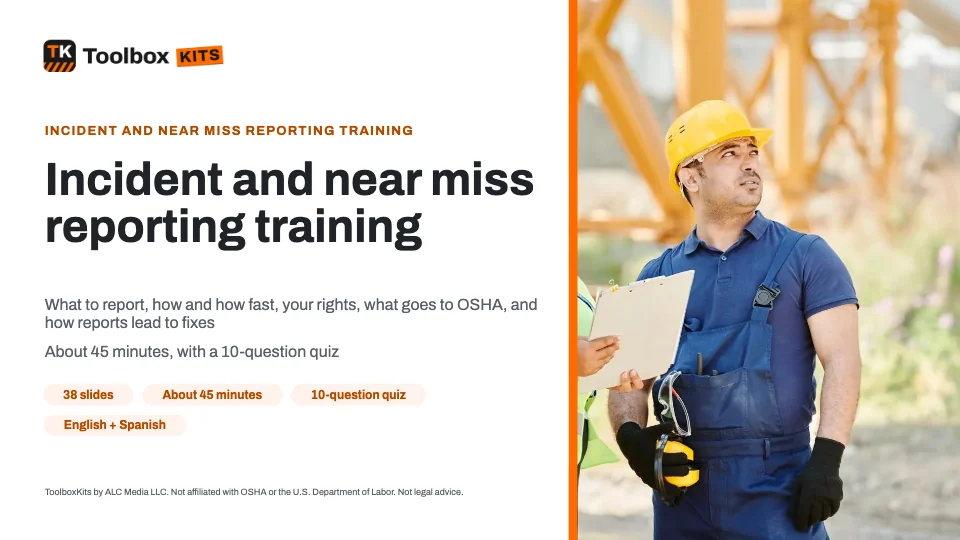 Editable PowerPoint
- Trainer guide
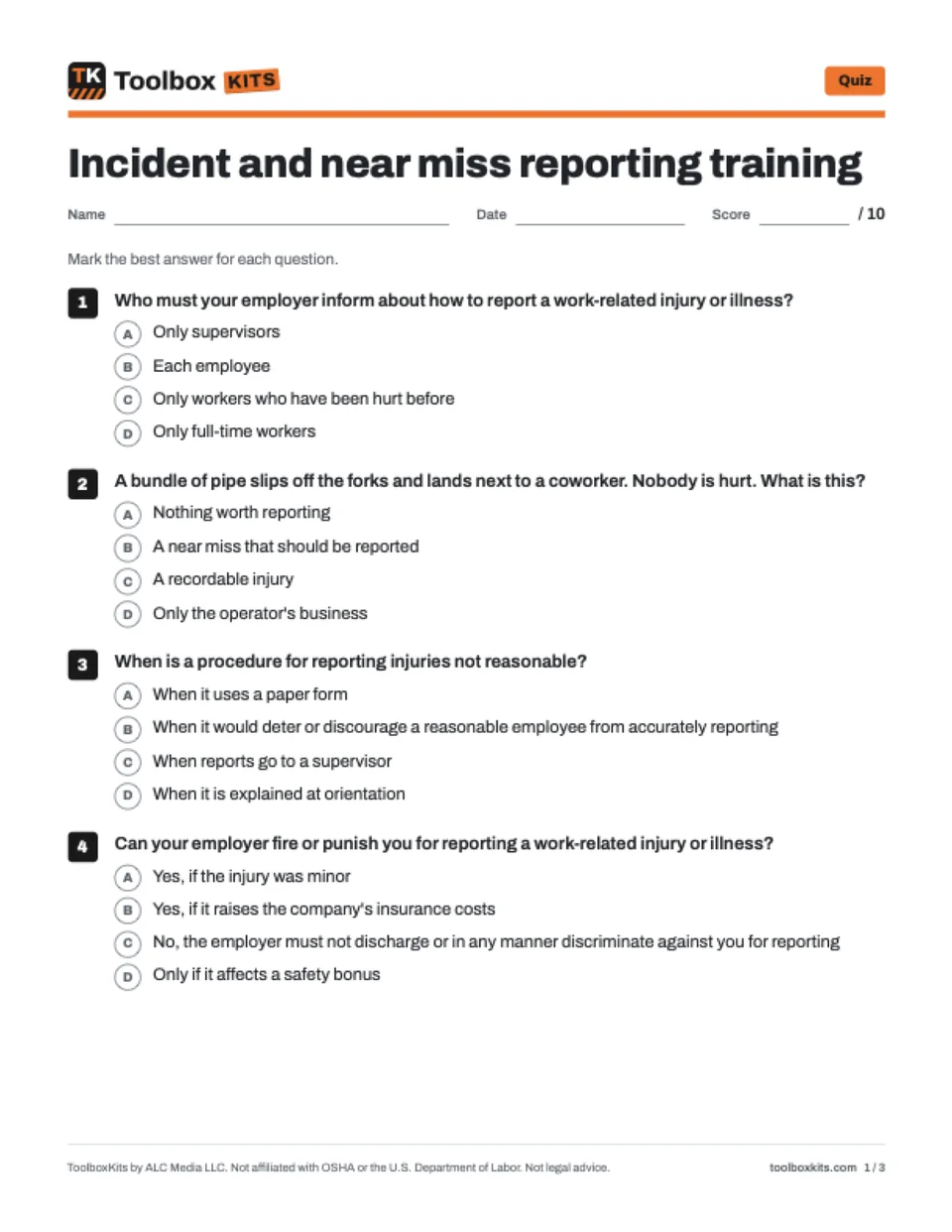 Quiz
- Answer key
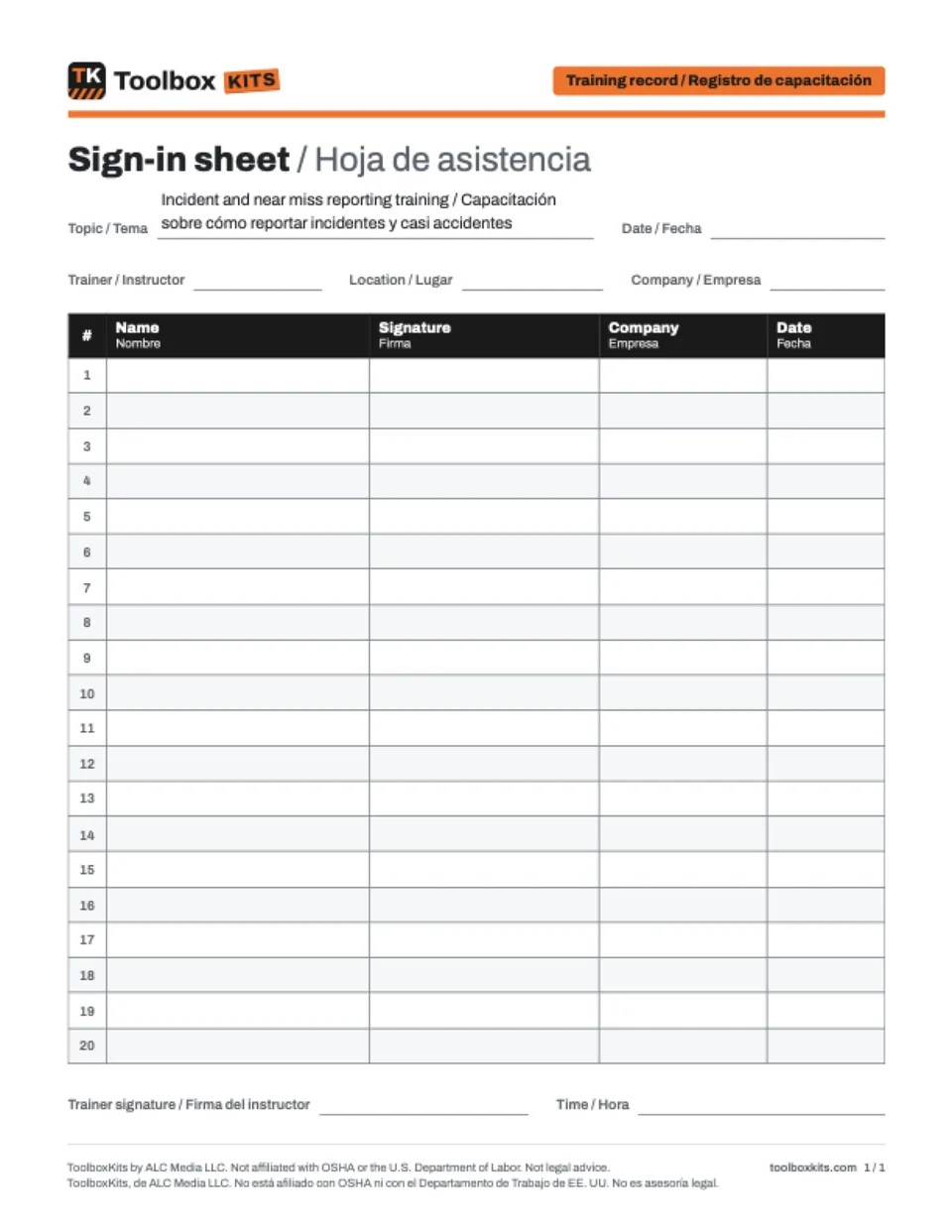 Sign-in sheet
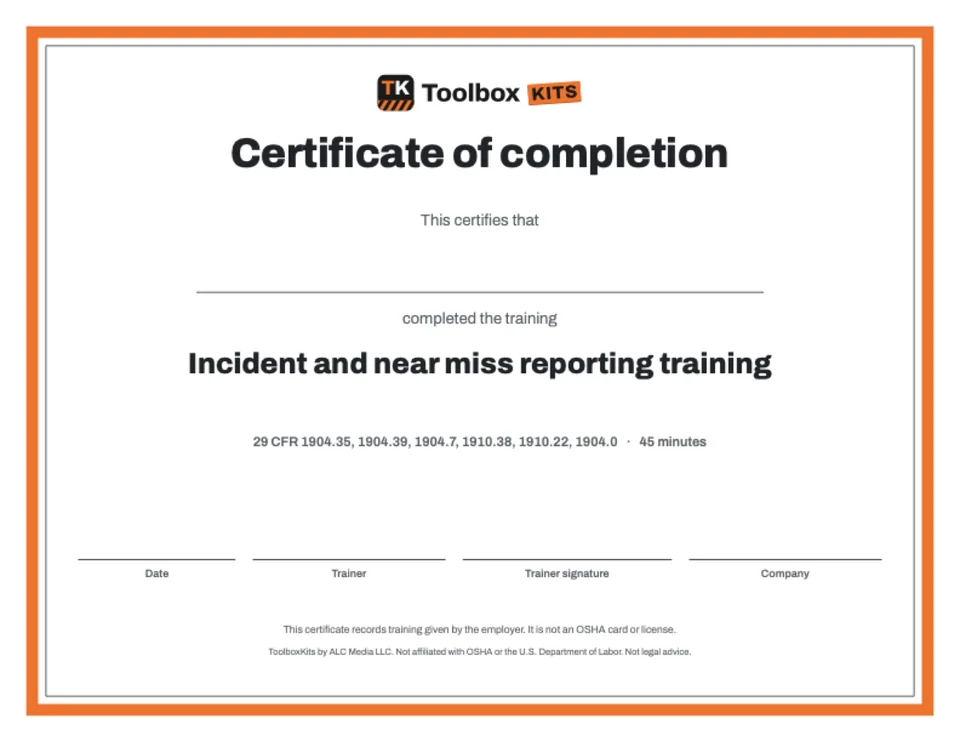 Certificate
- Crew handout
Try it
Try the quiz
Three questions from this topic. Pick an answer to see the right one and the OSHA paragraph.
Question 1 of 3
Can your employer fire or punish you for reporting a work-related injury?
The rule
What OSHA requires
Plain-language summary. Each line links to the exact paragraph of the regulation.
The employer must inform each employee of how to report a work-related injury or illness.
“You must inform each employee of how he or she is to report a work-related injury or illness to you.”
The employer must establish a reasonable procedure for employees to report work-related injuries and illnesses promptly and accurately. A procedure is not reasonable if it would deter or discourage a reasonable employee from accurately reporting.
“A procedure is not reasonable if it would deter or discourage a reasonable employee from accurately reporting a workplace injury or illness”
The employer must inform each employee of its reporting procedure (29 CFR 1904.35(b)(1)(ii)), that employees have the right to report work-related injuries and illnesses, and that employers are prohibited from discharging or in any manner discriminating against employees for reporting.
The employer must not discharge or in any manner discriminate against any employee for reporting a work-related injury or illness.
“You must not discharge or in any manner discriminate against any employee for reporting a work-related injury or illness.”
Section 11(c) of the OSH Act also prohibits employers from discriminating against an employee for reporting a work-related fatality, injury or illness. It also protects employees who file a safety and health complaint, ask for access to the part 1904 records or otherwise exercise their rights under the Act.
“section 11(c) of the OSH Act also prohibits you from discriminating against an employee for reporting a work-related fatality, injury, or illness.”
Within 8 hours after the death of any employee as a result of a work-related incident, the employer must report the fatality to OSHA.
“Within eight (8) hours after the death of any employee as a result of a work-related incident, you must report the fatality to the Occupational Safety and Health Administration (OSHA)”
Within 24 hours after the in-patient hospitalization of one or more employees, or an employee's amputation or loss of an eye, as a result of a work-related incident, the employer must report it to OSHA.
“Within twenty-four (24) hours after the in-patient hospitalization of one or more employees or an employee's amputation or an employee's loss of an eye, as a result of a work-related incident”
Reports must be made by telephone or in person to the nearest OSHA Area Office, by telephone to 1-800-321-OSHA (1-800-321-6742), or electronically through the reporting application on www.osha.gov. If the Area Office is closed, the employer must use the 800 number or the online application, not an answering machine message, fax or email (29 CFR 1904.39(b)(1)).
“You must report the fatality, in-patient hospitalization, amputation, or loss of an eye using one of the following methods”
Employers with 10 or fewer employees at all times during the last calendar year do not need to keep OSHA injury and illness records unless OSHA or the Bureau of Labor Statistics tells them in writing, but all employers covered by the OSH Act must still report fatalities, in-patient hospitalizations, amputations and losses of an eye. The same applies to partially exempt industries (29 CFR 1904.2(a)(1)).
“all employers covered by the OSH Act must report to OSHA any work-related incident that results in a fatality, the in-patient hospitalization of one or more employees, an employee amputation, or an employee loss of an eye.”
Employees, former employees and their representatives have the right to access the OSHA injury and illness records, with some limits (29 CFR 1904.35(b)(2)). When one of them asks for a copy of the OSHA 300 Log, the employer must provide it by the end of the next business day.
“you must give the requester a copy of the relevant OSHA 300 Log(s) by the end of the next business day.”
Who must be trained
The employer must inform each employee of how to report a work-related injury or illness, of its reporting procedure, of the right to report, and that employers are prohibited from discharging or discriminating against employees for reporting (29 CFR 1904.35(a)(1), (b)(1)(ii) and (b)(1)(iii)).

Common questions
Questions people ask
Is there a printable incident reporting toolbox talk PDF?
Yes. This incident reporting talk is free, and you can print it as a PDF in English or Spanish with a sign-in table. It also works as an accident reporting toolbox talk, since it covers injuries, near misses and hazards.
What is the difference between an accident, an incident and a near miss?
People usually say accident for an event that caused an injury, illness or damage. Incident is broader and includes accidents and near misses. A near miss is an event where nobody got hurt this time, but someone could have. Report all three, because each one points to a hazard that needs fixing.
When does an employer have to report an injury to OSHA?
A work-related fatality must be reported within 8 hours (29 CFR 1904.39(a)(1)), and an in-patient hospitalization, amputation or loss of an eye within 24 hours (29 CFR 1904.39(a)(2)). A fatality only has to be reported if it happens within 30 days of the incident, and a hospitalization, amputation or loss of an eye only if it happens within 24 hours of the incident (29 CFR 1904.39(b)(6)). Either way, employers required to keep OSHA injury records must still record it.
Can I get in trouble for reporting an injury at work?
Not for reporting it. Your employer must not discharge or in any manner discriminate against you for reporting a work-related injury or illness (29 CFR 1904.35(b)(1)(iv)), and section 11(c) of the OSH Act also protects you (29 CFR 1904.36). Reporting an injury also does not mean you were at fault (29 CFR 1904.0).
What should an incident reporting safety talk cover?
Cover what to report (injuries, illnesses, near misses and hazards), who to report to, how fast, and what facts to give. Remind the crew of their right to report without retaliation, and explain which serious events the employer must report to OSHA. End with how reports get followed up, so people see that reporting leads to fixes.
Free to share
Use this talk for free
You can print, share and adapt this talk at no cost under the Creative Commons BY-NC-SA 4.0 license. Please credit ToolboxKits with a link.