

Free 5-minute toolbox talkFireEnglish and Spanish
Fire and safety presentation: a fire prevention toolbox talk
A fire can start from something simple, like a pile of scrap, a leaking gas can, oily rags or a heater too close to something that burns. What OSHA requires: Construction employers must develop and maintain an effective fire protection and prevention program at the job site through all phases of the work (29 CFR 1926.24).
Use this free 5-minute fire prevention talk as a short fire safety presentation for your crew. It covers what feeds a fire, how to keep fuel and heat apart and what to do when a fire starts, with OSHA citations.
Updated October 29, 2026 · Based on 29 CFR 1910.39, 29 CFR 1926.150, 29 CFR 1926.151
Read it out loud
Free 5-minute toolbox talk
Read it out loud to your crew. It takes about 5 minutes.
Start with a question
If a fire started in this work area right now, where is the nearest extinguisher and the nearest way out?
Why it matters
A small fire can get out of control fast, and smoke can make it hard to see or breathe before you ever see flames. A fire can start from something simple, like a pile of scrap, a leaking gas can, oily rags or a heater too close to something that burns. Preventing a fire is always safer than fighting one.
Key points
Know what a fire needs
A fire needs fuel, heat and oxygen. Take away any one of them and a fire cannot start or keep burning. Fire prevention on the job mostly comes down to keeping fuel and heat apart.
Clean up what can burn
Scrap wood, cardboard, packaging and rags are all fuel. In construction, combustible scrap and debris must be removed at regular intervals, with a safe way to haul it out. Put oily and used rags in a covered container, because oily rags can heat up and catch fire on their own.
Store flammable liquids the right way
In construction, only approved containers and portable tanks may be used to store and handle flammable liquids like gasoline and many solvents. Never put fuel in a drink bottle or an open bucket. Keep fuel cans out of exits, stairways and walkways, and away from heat and sparks.
Control sparks, flames and heat
” Keep heaters, work lights and engine exhausts away from anything that can burn. Welding and cutting need extra precautions, so check the area before any hot work starts.
Keep extinguishers and exits clear
On construction sites, access to all firefighting equipment must be maintained at all times. Know where the nearest extinguisher is before you start, and make sure nothing is stacked in front of it. Never block exits or the paths to them, even for a few minutes.
Report first, then decide
If a fire starts, sound the alarm and call 911 first. Only fight it if you are trained, the fire is small, you have the right extinguisher and your exit is behind you. Remember PASS: pull the pin, aim at the base of the fire, squeeze the handle and sweep side to side. If in doubt, get out.
Scenario
Picture this: It is the end of a long day on a remodel job. A painter drops a pile of oily stain rags into an open cardboard box next to a portable heater. Someone parks a gas can by the back door, and the fire extinguisher is hidden behind a stack of drywall. Nobody has noticed any of it yet. What would you fix before the crew leaves, and who should check it every day?
Ask the crew
- Where are the nearest extinguishers and exits from where you are working today?
- What on this site could burn, and what could set it off?
- Where do oily rags, fuel cans and scrap go at the end of the shift?
- If a fire starts, how do we report it and where do we meet outside?
Takeaway
Keep fuel away from heat, keep extinguishers and exits clear, and report any fire right away.
Trainer: ______________________ Date: ____________
Credit: ToolboxKits, https://toolboxkits.com/topics/fire-prevention/ (CC BY-NC-SA 4.0)
The poster is also inside the paid kits.
Audit-ready records in 60 seconds
Fill in your crew and download a filled sign-in sheet for this talk. Everything is made in your browser. Names are never uploaded or stored.
Start a sign-off
Crew scan a QR code on their own phones, type their name and sign with a finger. You see the names arrive and download the signed sheet. Free, no account.
Kits
Get the kit
No subscription needed. Buy only the kit you need.
Toolbox talk kit
$4.99
- 5-minute talk, English PDF
- 5-minute talk, Spanish PDF
- Editable mini-deck (English and Spanish)
- One-page crew handout (English and Spanish)
- Bilingual sign-in sheet
- 3-question quiz with answer key (English and Spanish)
- One-page bilingual poster
- Audit-ready records in 60 seconds: fill in your crew and get a sign-in sheet and a certificate for every worker
Training kit
$9
Editable PowerPoint, 39 slides
- Editable PowerPoint with trainer notes on every slide
- Trainer guide PDF with timing and discussion tips
- 10-question quiz and answer key
- Sign-in sheet and certificate of completion with fillable fields
- One-page crew handout
- Full Spanish version of everything
- One-page bilingual poster
- Audit-ready records in 60 seconds: fill in your crew and get a sign-in sheet and a certificate for every worker
- Instant download
- Secure checkout by Stripe
- 30-day refund, no questions
Need many topics? All Access gives you every kit for $99 a year.
Inside the kit
See what is in the kit
What is in the kit
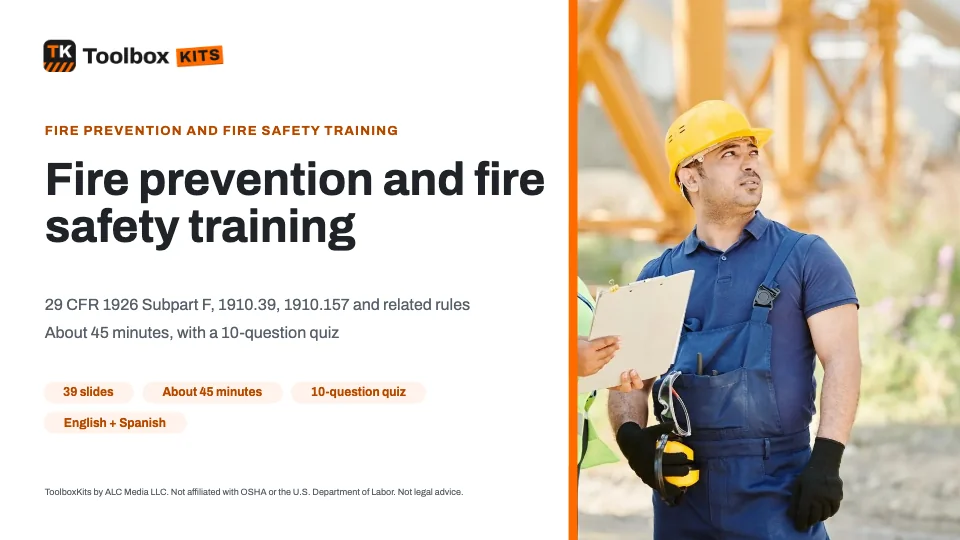 Editable PowerPoint
- Trainer guide
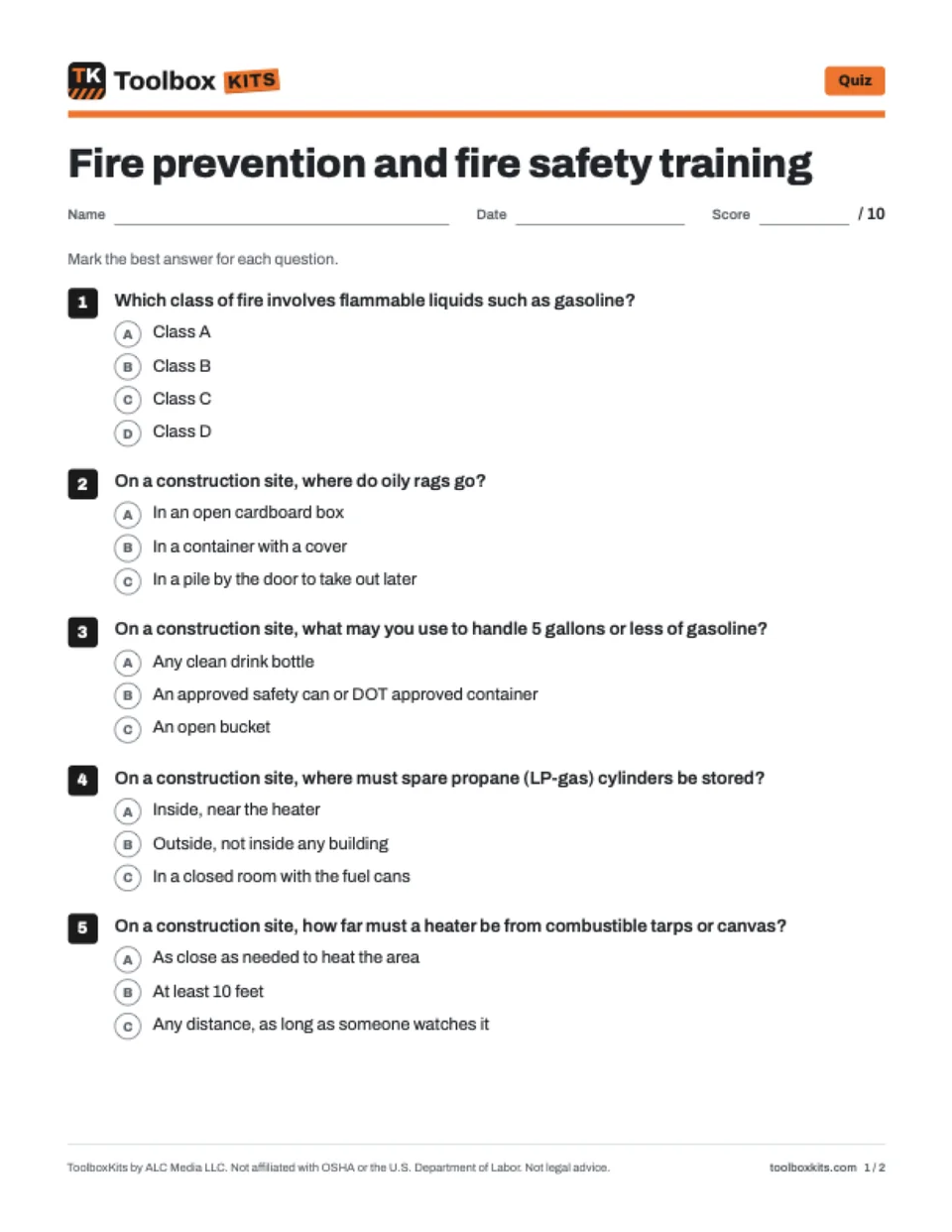 Quiz
- Answer key
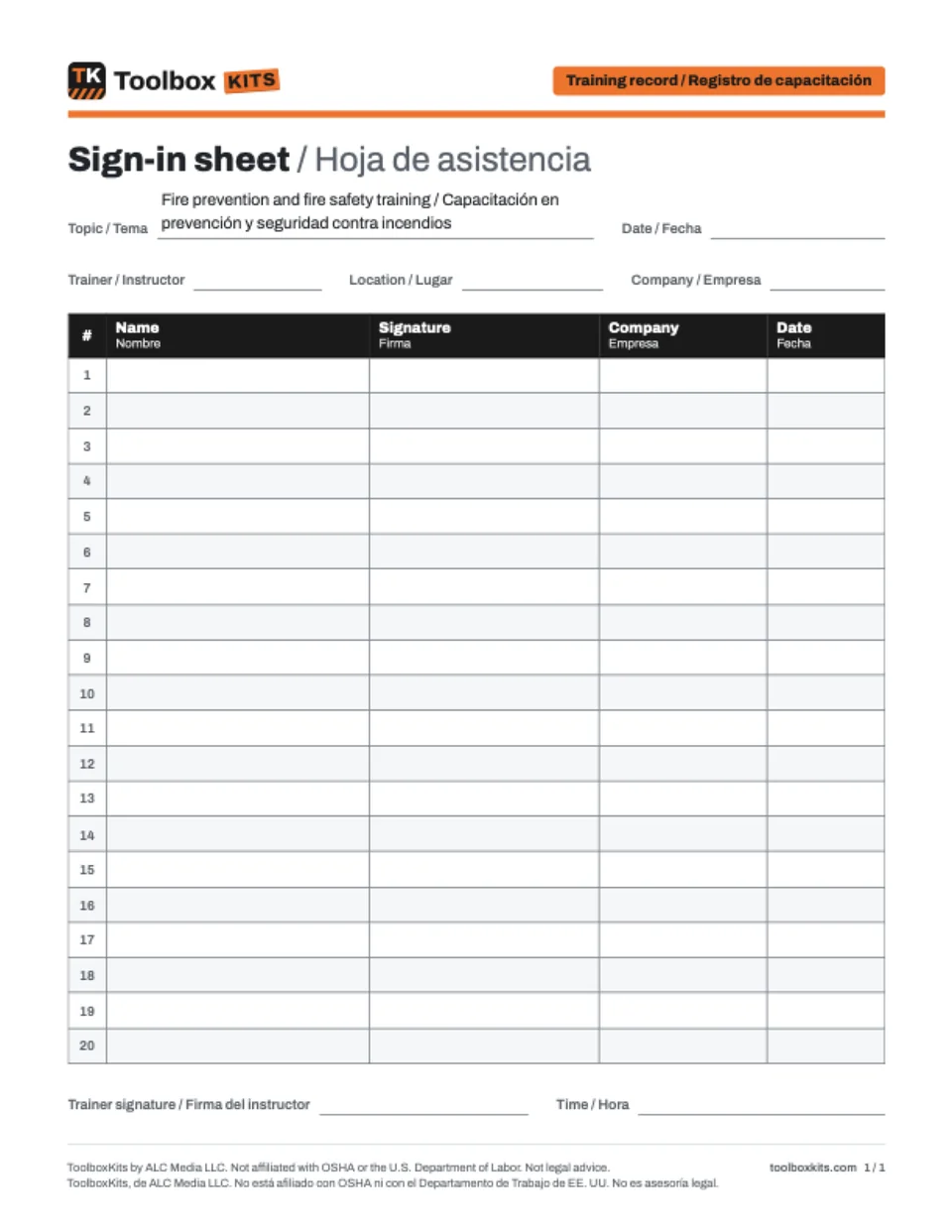 Sign-in sheet
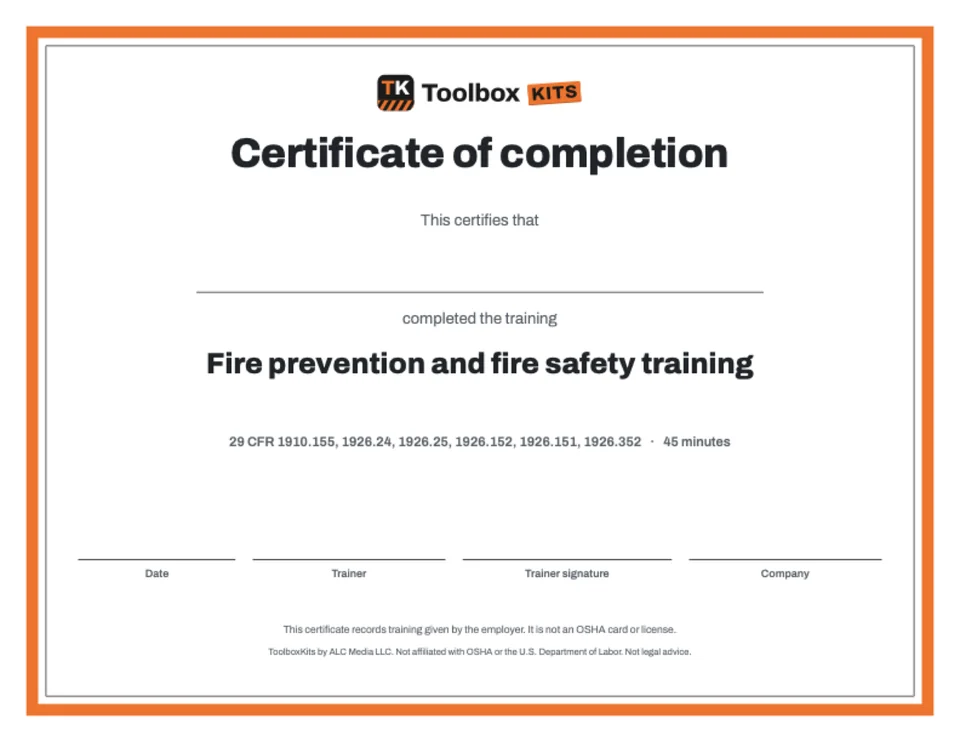 Certificate
- Crew handout
Try it
Try the quiz
Three questions from this topic. Pick an answer to see the right one and the OSHA paragraph.
Question 1 of 3
What does a fire need to start and keep burning?
The rule
What OSHA requires
Plain-language summary. Each line links to the exact paragraph of the regulation.
Construction employers must develop and maintain an effective fire protection and prevention program at the job site through all phases of the work.
“The employer shall be responsible for the development and maintenance of an effective fire protection and prevention program at the job site throughout all phases of the construction, repair, alteration, or demolition work.”
On construction sites, keep access to all available firefighting equipment open at all times.
“Access to all available firefighting equipment shall be maintained at all times.”
On construction sites, provide a fire extinguisher rated at least 2A for each 3,000 square feet of protected building area, or major fraction of it, with no more than 100 feet of travel to the nearest one.
“Travel distance from any point of the protected area to the nearest fire extinguisher shall not exceed 100 feet.”
On construction sites, provide an extinguisher rated at least 10B within 50 feet of wherever more than 5 gallons of flammable or combustible liquids or 5 pounds of flammable gas are being used.
“A fire extinguisher, rated not less than 10B, shall be provided within 50 feet of wherever more than 5 gallons of flammable or combustible liquids or 5 pounds of flammable gas are being used on the jobsite.”
On construction sites, prohibit smoking at or near operations that are a fire hazard, and post those areas “No Smoking or Open Flame.”
“Smoking shall be prohibited at or in the vicinity of operations which constitute a fire hazard, and shall be conspicuously posted: “No Smoking or Open Flame.””
On construction sites, use only approved containers and portable tanks to store and handle flammable liquids.
“Only approved containers and portable tanks shall be used for storage and handling of flammable liquids.”
Remove combustible scrap and debris at regular intervals during construction, and provide a safe means to remove it.
“Combustible scrap and debris shall be removed at regular intervals during the course of construction.”
A general industry fire prevention plan must list all major fire hazards, proper handling and storage procedures for hazardous materials, potential ignition sources and their control, and the fire protection equipment needed for each major hazard.
Where a fire prevention plan applies, tell employees about the fire hazards they are exposed to when they are first assigned to a job, and review with each employee the parts of the plan they need for self-protection.
“An employer must inform employees upon initial assignment to a job of the fire hazards to which they are exposed.”
Where portable fire extinguishers are provided for employee use, provide an educational program on the general principles of extinguisher use and the hazards of fighting a fire in its beginning stage.
“the employer shall also provide an educational program to familiarize employees with the general principles of fire extinguisher use and the hazards involved with incipient stage fire fighting.”
Who must be trained
In general industry, where portable fire extinguishers are provided for employee use, employees must get education on extinguisher use and the hazards of fighting a fire in its beginning stage (29 CFR 1910.157(g)(1)). Employees designated to use firefighting equipment as part of an emergency action plan must be trained in the use of that equipment (29 CFR 1910.157(g)(3)). In construction, employees required to handle or use flammable liquids or gases must be instructed in their safe handling and use (29 CFR 1926.21(b)(5)).
When to retrain
Extinguisher education must be provided upon initial employment and at least annually after that (29 CFR 1910.157(g)(2)). Training for employees designated to use firefighting equipment must be provided upon initial assignment and at least annually after that (29 CFR 1910.157(g)(4)).

Common questions
Questions people ask
Is there a free fire safety toolbox talk PDF?
Yes. The fire prevention talk on this page is free, and you can print it as a PDF in English or Spanish with a sign-in table. It also works as a short fire safety presentation for a crew meeting.
What should a workplace fire safety presentation cover?
Cover the fire hazards in your work area, how to control fuel and ignition sources, where the extinguishers and exits are, and how to report a fire and evacuate. Where an OSHA general industry standard requires a fire prevention plan, employers must tell employees about the fire hazards they face when first assigned to a job and review the parts of the plan they need to protect themselves.
Does OSHA require fire safety training for employees?
Yes, in several standards. In general industry, where portable fire extinguishers are provided for employee use, employees must get education on extinguisher use and the hazards of fighting a fire in its beginning stage, upon initial employment and at least annually after that (29 CFR 1910.157(g)(1) and (g)(2)). In construction, employees required to handle or use flammable liquids or gases must be instructed in their safe handling and use (29 CFR 1926.21(b)(5)).
What does OSHA require for fire prevention on a construction site?
The employer must develop and maintain an effective fire protection and prevention program for all phases of the work (29 CFR 1926.24). Access to firefighting equipment must be maintained at all times, and combustible scrap and debris must be removed at regular intervals (29 CFR 1926.150(a)(2) and 1926.25(b)). Smoking is prohibited at or near operations that are a fire hazard (29 CFR 1926.151(a)(3)).
What are good fire safety meeting topics?
Pick one topic per meeting: cleaning up scrap and rags, storing fuel and solvents, heaters and hot work, extinguisher types and the PASS method, exit routes, and how to report a fire. For a quick fire safety moment, walk the crew to the nearest extinguisher and check that it is charged, not blocked and the right type for the hazard.
Free to share
Use this talk for free
You can print, share and adapt this talk at no cost under the Creative Commons BY-NC-SA 4.0 license. Please credit ToolboxKits with a link.