

Free 5-minute toolbox talkElectricalEnglish and Spanish
Electrical safety toolbox talk
Electrical contact can cause shock, burns and electrocution, and even a small shock can make you fall from a ladder. What OSHA requires: Electrical safety training is required for employees who face a risk of electric shock that is not reduced to a safe level by the electrical installation requirements (29 CFR 1910.332(a)).
This free electrical safety toolbox talk takes about five minutes to read to your crew. It covers cords and tools, GFCIs, lockout and tagging, overhead lines and wet locations, with the OSHA rules behind each point, for construction and general industry.
Updated October 31, 2026 · Based on 29 CFR 1910.332, 29 CFR 1910.333, 29 CFR 1926.416, 29 CFR 1926.405
Read it out loud
Free 5-minute toolbox talk
Read it out loud to your crew. It takes about 5 minutes.
Start with a question
If the cord on your saw had a nick in the jacket, would you still use it to finish the cut?
Why it matters
A live wire looks exactly like a dead one, and your body can become part of the circuit. Electrical contact can cause shock, burns and electrocution, and even a small shock can make you fall from a ladder. How badly you are hurt depends on how much current flows, the path it takes through your body and how long the contact lasts.
Key points
Treat every circuit as live until it is proven dead
In general industry, live parts you may be exposed to must be deenergized before you work on or near them, unless the employer can show that deenergizing adds hazards or is not feasible because of equipment design or operational limits.
More
Never assume a circuit is off because a switch is down or a light is out. If you are not trained and qualified for electrical work, stay out of panels and boxes.
Lock it and tag it before work starts
In general industry, a lock and a tag go on each disconnecting means used to shut off the equipment, with a few exceptions in the rule. The lock keeps anyone from operating the switch, and the tag prohibits operating the switch or removing the tag without authorization.
More
Each lock and tag is removed by the person who put it on, or under that person's direct supervision. Nobody works on the equipment until a qualified person has tested it and verified it is deenergized.
29 CFR 1910.333(b)(2)(iii)(A) · 29 CFR 1910.333(b)(2)(v)(C) · 29 CFR 1910.333(b)(2)(iv)(B)
Check cords and tools every shift
OSHA's general industry rule requires a visual check of extension cords and corded tools before use on any shift, and it is a good habit on every job. Look for cuts or cracks in the jacket, missing or bent prongs, loose plugs and crushed spots.
More
If you find damage, stop, take the item out of service, tag it and tell your supervisor. Never tape over a damaged cord or cut off the ground pin to make a plug fit.
Use GFCI protection on site
On construction sites, the employer must protect workers with ground-fault circuit interrupters (GFCIs) or an assured equipment grounding conductor program. A GFCI cuts the power fast when current leaks to ground, including through a person.
More
Test GFCIs before use, and if one keeps tripping, find out why instead of bypassing it.
Look up for overhead lines
Look up before you raise a ladder, pole, scaffold section or long tool. If you are not qualified, the general industry rule says you and any conductive object you handle must stay at least 10 feet from unguarded, energized overhead lines of 50kV or below to ground.
More
Higher-voltage lines need even more room. Treat every overhead line as live.
Keep water and metal away from live parts
Do not plug in or unplug energized equipment with wet hands. Keep cords and connections out of puddles, and use cords and tools approved for wet locations when the work is wet. Take off rings, watches and metal chains when you could contact exposed live parts.
Scenario
Picture this: it rained overnight and the crew is setting up in a basement with water on the floor. The only extension cord long enough has electrical tape wrapped around a cut in the jacket. The GFCI on the temporary power keeps tripping, so someone suggests plugging into an old outlet that does not have one. Everyone wants to get started. What should happen before anyone plugs in?
Ask the crew
- Where are we using temporary power on this job, and is every outlet we use GFCI protected?
- What do you look for on a cord or tool before you plug it in?
- Where are the overhead lines near our work, and what equipment or materials could reach them?
- Who on this crew is qualified to work on electrical equipment, and who do we call when something needs repair?
Takeaway
Treat every circuit as live, check your cords and tools before you use them, and leave electrical work to qualified people.
Trainer: ______________________ Date: ____________
Credit: ToolboxKits, https://toolboxkits.com/topics/electrical-safety/ (CC BY-NC-SA 4.0)
The poster is also inside the paid kits.
Audit-ready records in 60 seconds
Fill in your crew and download a filled sign-in sheet for this talk. Everything is made in your browser. Names are never uploaded or stored.
Start a sign-off
Crew scan a QR code on their own phones, type their name and sign with a finger. You see the names arrive and download the signed sheet. Free, no account.
Kits
Get the kit
No subscription needed. Buy only the kit you need.
Toolbox talk kit
$4.99
- 5-minute talk, English PDF
- 5-minute talk, Spanish PDF
- Editable mini-deck (English and Spanish)
- One-page crew handout (English and Spanish)
- Bilingual sign-in sheet
- 3-question quiz with answer key (English and Spanish)
- One-page bilingual poster
- Audit-ready records in 60 seconds: fill in your crew and get a sign-in sheet and a certificate for every worker
Training kit
$9
Editable PowerPoint, 38 slides
- Editable PowerPoint with trainer notes on every slide
- Trainer guide PDF with timing and discussion tips
- 10-question quiz and answer key
- Sign-in sheet and certificate of completion with fillable fields
- One-page crew handout
- Full Spanish version of everything
- One-page bilingual poster
- Audit-ready records in 60 seconds: fill in your crew and get a sign-in sheet and a certificate for every worker
- Instant download
- Secure checkout by Stripe
- 30-day refund, no questions
Need many topics? All Access gives you every kit for $99 a year.
Inside the kit
See what is in the kit
What is in the kit
 Editable PowerPoint
- Trainer guide
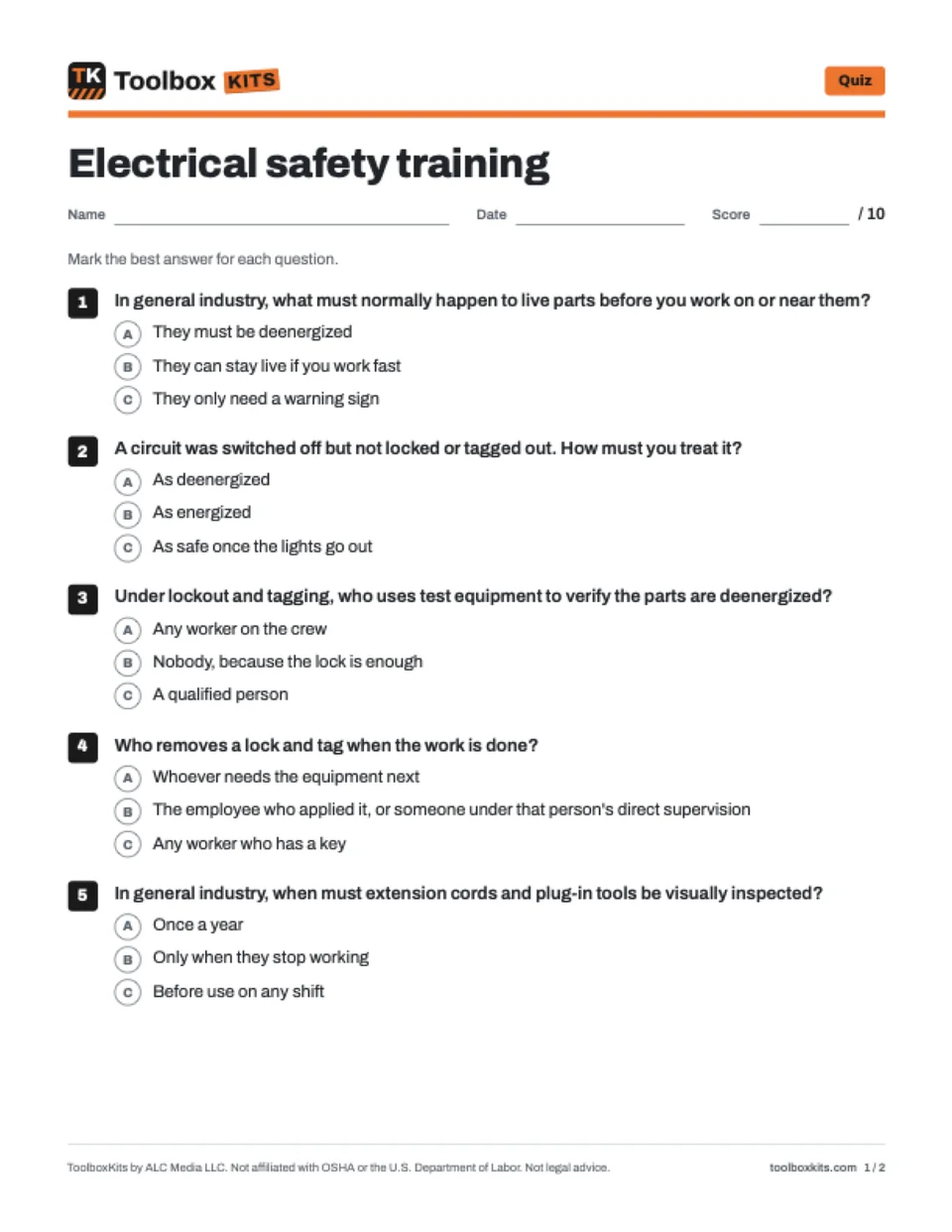 Quiz
- Answer key
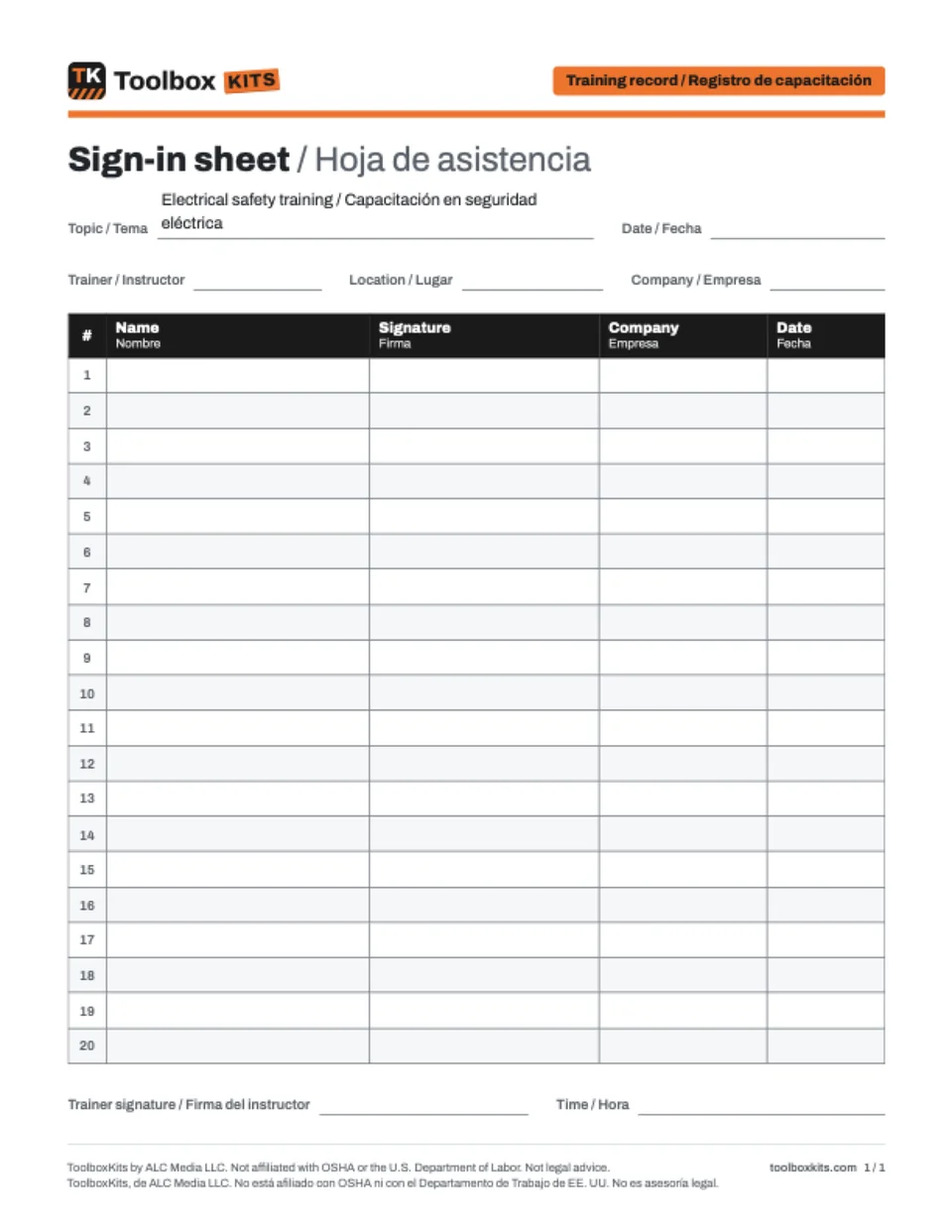 Sign-in sheet
 Certificate
- Crew handout
Try it
Try the quiz
Three questions from this topic. Pick an answer to see the right one and the OSHA paragraph.
Question 1 of 3
Which extension cords may be used with portable electric tools on a construction site?
The rule
What OSHA requires
Plain-language summary. Each line links to the exact paragraph of the regulation.
Electrical safety training is required for employees who face a risk of electric shock that is not reduced to a safe level by the electrical installation requirements. This includes the occupations in Table S-4 and other employees who may reasonably be expected to face a comparable risk.
“Other employees who also may reasonably be expected to face a comparable risk of injury due to electric shock or other electrical hazards must also be trained.”
The training must be classroom or on-the-job, and the amount of training depends on the risk to the employee.
“The training required by this section shall be of the classroom or on-the-job type. The degree of training provided shall be determined by the risk to the employee.”
Live parts an employee may be exposed to must be deenergized before work on or near them, unless the employer can show that deenergizing introduces additional or increased hazards or is infeasible.
“Live parts to which an employee may be exposed shall be deenergized before the employee works on or near them”
A lock and a tag must be placed on each disconnecting means used to deenergize the circuits and equipment being worked on, except in the limited cases the rule allows.
“A lock and a tag shall be placed on each disconnecting means used to deenergize circuits and equipment on which work is to be performed”
Only qualified persons may work on electric circuit parts or equipment that have not been deenergized under the lockout and tagging procedures.
“Only qualified persons may work on electric circuit parts or equipment that have not been deenergized under the procedures of paragraph (b) of this section.”
When an unqualified person is working in an elevated position near overhead lines, the person and the longest conductive object they may contact must stay at least 10 feet from any unguarded, energized overhead line of 50kV or below to ground.
“the person and the longest conductive object he or she may contact cannot come closer to any unguarded, energized overhead line than the following distances”
Portable cord- and plug-connected equipment and extension cords must be visually inspected before use on any shift for external defects and signs of internal damage.
“shall be visually inspected before use on any shift for external defects”
On construction sites, no employee may work so close to an electric power circuit that they could contact it, unless they are protected by deenergizing and grounding the circuit or by guarding it effectively with insulation or other means.
“unless the employee is protected against electric shock by deenergizing the circuit and grounding it or by guarding it effectively by insulation or other means”
Worn or frayed electric cords or cables must not be used.
“Worn or frayed electric cords or cables shall not be used.”
On construction sites, the employer must use either ground-fault circuit interrupters or an assured equipment grounding conductor program to protect employees.
“The employer shall use either ground fault circuit interrupters as specified in paragraph (b)(1)(ii) of this section or an assured equipment grounding conductor program”
Who must be trained
In general industry, employees who face a risk of electric shock that is not reduced to a safe level by the electrical installation requirements of 29 CFR 1910.303 through 1910.308 must be trained. This includes the occupations listed in Table S-4 and other employees who may reasonably be expected to face a comparable risk of injury from electric shock or other electrical hazards (29 CFR 1910.332(a)).

Common questions
Questions people ask
Is there a free electrical safety toolbox talk PDF?
Yes. You can download this electrical safety toolbox talk as a free printable PDF in English and Spanish. It includes a sign-in table so you can record who attended.
Is there an electrical safety PowerPoint presentation?
Yes. The electrical safety training kit includes PowerPoint slides in English and Spanish with trainer notes, a trainer guide, a quiz with an answer key, a handout and a sign-in sheet. Use it when you need a longer session than a toolbox talk.
What topics should an electrical safety meeting cover?
Start with the hazards your crew actually faces, such as damaged cords, temporary power and GFCIs, overhead lines, wet locations, and lockout and tagging. Workers covered by OSHA's general industry electrical training rule must be trained in and familiar with the safety-related work practices that pertain to their job assignments. Pick one topic per meeting and connect it to the work in front of you.
What does OSHA require for electrical safety training?
OSHA's general industry rule requires training for employees who face a risk of electric shock that is not reduced to a safe level by the electrical installation requirements (29 CFR 1910.332(a)). The training must be classroom or on-the-job, and the amount depends on the risk to the employee. This talk is based on OSHA rules and cites them, but it is not produced or endorsed by OSHA. A short toolbox talk is a good refresher, not a full training program.
Can I use this as an electrical safety moment?
Yes. For a quick electrical safety moment, ask the opening question and cover one key point, such as checking cords before use. Save the full talk, the scenario and the quiz for a full toolbox meeting.
Free to share
Use this talk for free
You can print, share and adapt this talk at no cost under the Creative Commons BY-NC-SA 4.0 license. Please credit ToolboxKits with a link.