

Free 5-minute toolbox talkSafety programsEnglish and Spanish
First day back to work safety talk: new worker orientation
Tell every new worker how to report injuries, close calls and hazards, and make sure they know it is safe to do so. What OSHA requires: OSHA has no specific standard for new worker orientation in general; the general duty to train still applies (29 CFR 1926.21(b)(2)).
A free first day back to work safety talk and new worker orientation. Use it for new hires, returning workers and visitors, in English or Spanish, in about five minutes.
Updated October 29, 2026 · Based on 29 CFR 1926.21, 29 CFR 1910.1200
Read it out loud
Free 5-minute toolbox talk
Read it out loud to your crew. It takes about 5 minutes.
Start with a question
What do you wish someone had told you on your first day on a job?
Why it matters
New workers do not know the site yet. They do not know the exits, the hazards, the habits or who to ask. Returning workers can be out of practice, and a lot may have changed while they were gone. A good first day sets the tone for safe work and makes it easier to ask questions.
Key points
Show the exits and the emergency plan
Walk the new person to the exits, the meeting spot, the first aid kit and the extinguishers. Explain who to tell and how to report a fire or other emergency. Do not just point. Walk it.
Explain the hazards of this job
Cover the real hazards of the work area, such as vehicles, heights, electrical, noise, sharp tools or hot work. Employers must instruct each employee in recognizing and avoiding unsafe conditions and the rules that apply to their work. Teach what to avoid and what to do instead.
Cover chemicals, labels and safety data sheets
Workers need information and training on hazardous chemicals in their work area at the time of their initial assignment. Show them how to read a label and where the safety data sheets are kept. Chemical-specific information must always be available through labels and safety data sheets.
Fit protective equipment and show how to use it
Hand out the protective equipment for the job and make sure it fits. Show how to put it on, take it off, check it and care for it. Where a rule requires protective equipment, workers must be trained to use it.
Introduce the people and the rules
Tell new workers who their supervisor is, who the safety lead is and who to ask when they are unsure. Make it clear that asking is expected. Give a buddy to follow for the first days, and do not hand a new person a tool, a vehicle or a task they have not been shown.
Explain how to report
Tell every new worker how to report injuries, close calls and hazards, and make sure they know it is safe to do so. Employers must inform each employee of the procedure for reporting work-related injuries and illnesses.
Scenario
Picture this: A new worker starts on Monday. The crew is busy, so someone hands him a pair of gloves and points at a pile of boxes. He does not know where the exits are or that the chemical cabinet holds something that irritates skin. He spills a cleaner and has no idea where the safety data sheets are. Nobody told him who to ask. What should his first hour have looked like?
Ask the crew
- What was missing from your first day on a job?
- Where are our exits, first aid kit and safety data sheets, and do new people know?
- Who is the go-to person for questions on this crew?
- What would you add to our first day checklist?
Takeaway
A safe first day means walking the exits, naming the hazards, fitting the equipment and making it easy to ask questions.
Trainer: ______________________ Date: ____________
Credit: ToolboxKits, https://toolboxkits.com/topics/new-worker-orientation/ (CC BY-NC-SA 4.0)
The poster is also inside the paid kits.
Audit-ready records in 60 seconds
Fill in your crew and download a filled sign-in sheet for this talk. Everything is made in your browser. Names are never uploaded or stored.
Start a sign-off
Crew scan a QR code on their own phones, type their name and sign with a finger. You see the names arrive and download the signed sheet. Free, no account.
Kits
Get the kit
No subscription needed. Buy only the kit you need.
Toolbox talk kit
$4.99
- 5-minute talk, English PDF
- 5-minute talk, Spanish PDF
- Editable mini-deck (English and Spanish)
- One-page crew handout (English and Spanish)
- Bilingual sign-in sheet
- 3-question quiz with answer key (English and Spanish)
- One-page bilingual poster
- Audit-ready records in 60 seconds: fill in your crew and get a sign-in sheet and a certificate for every worker
Training kit
$9
Editable PowerPoint, 30 slides
- Editable PowerPoint with trainer notes on every slide
- Trainer guide PDF with timing and discussion tips
- 10-question quiz and answer key
- Sign-in sheet and certificate of completion with fillable fields
- One-page crew handout
- Full Spanish version of everything
- One-page bilingual poster
- Audit-ready records in 60 seconds: fill in your crew and get a sign-in sheet and a certificate for every worker
- Instant download
- Secure checkout by Stripe
- 30-day refund, no questions
Need many topics? All Access gives you every kit for $99 a year.
Inside the kit
See what is in the kit
What is in the kit
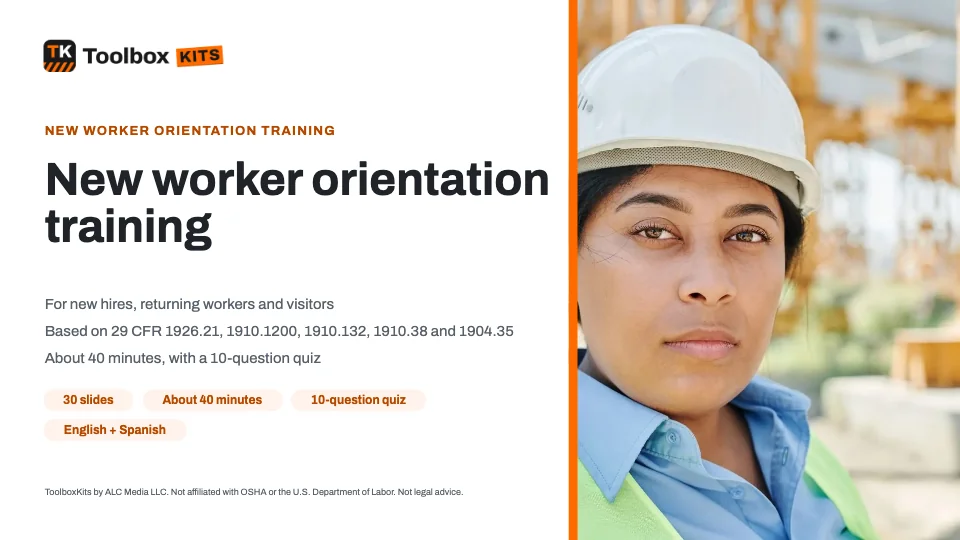 Editable PowerPoint
- Trainer guide
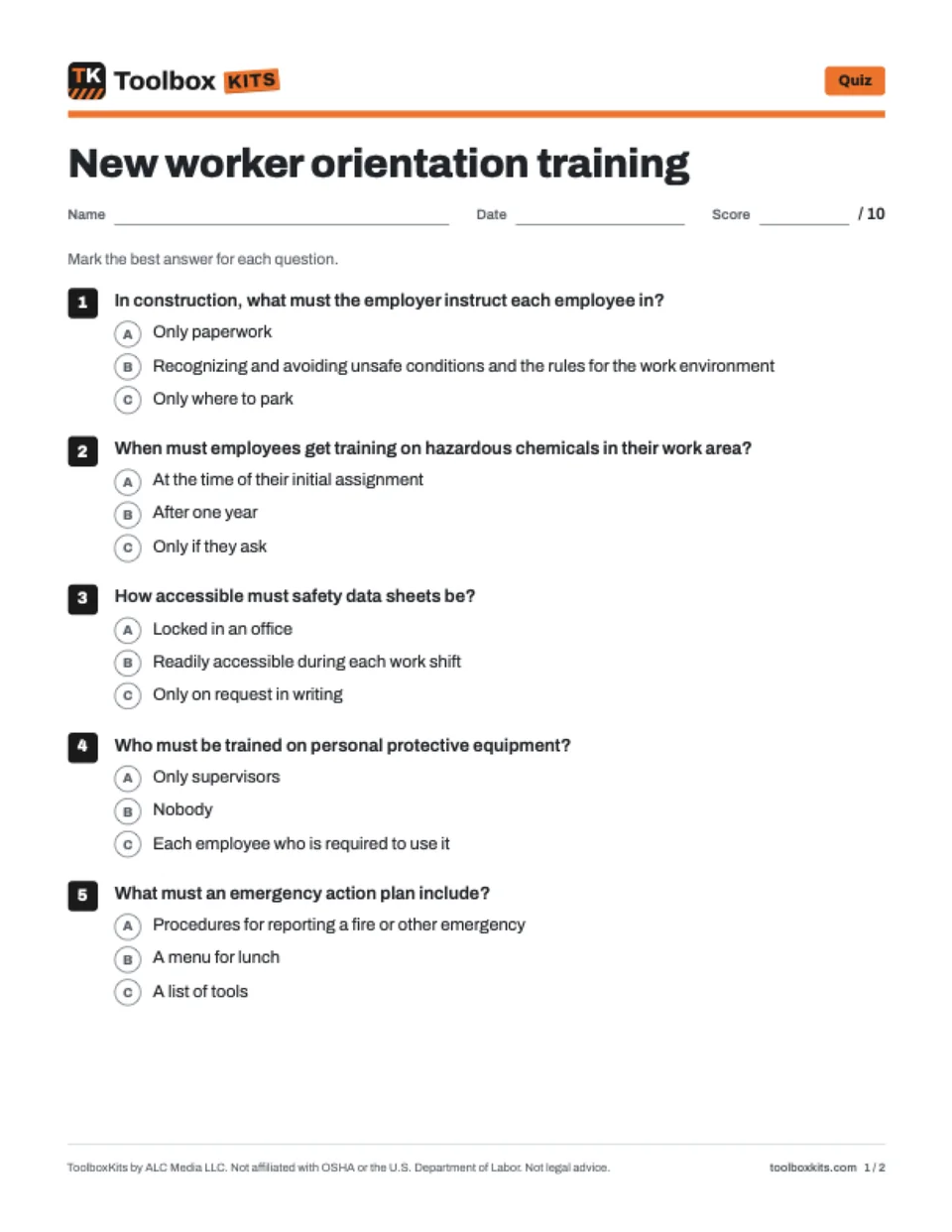 Quiz
- Answer key
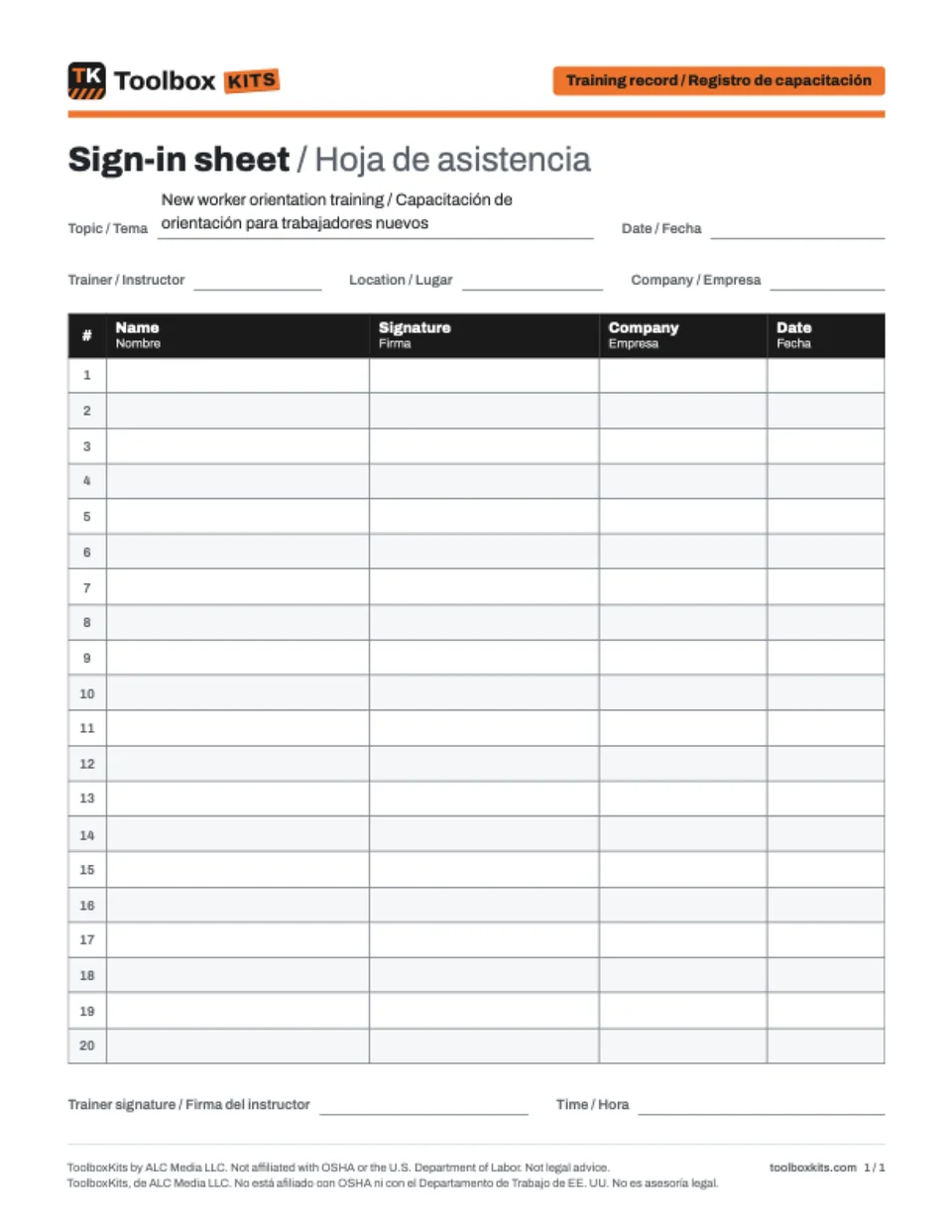 Sign-in sheet
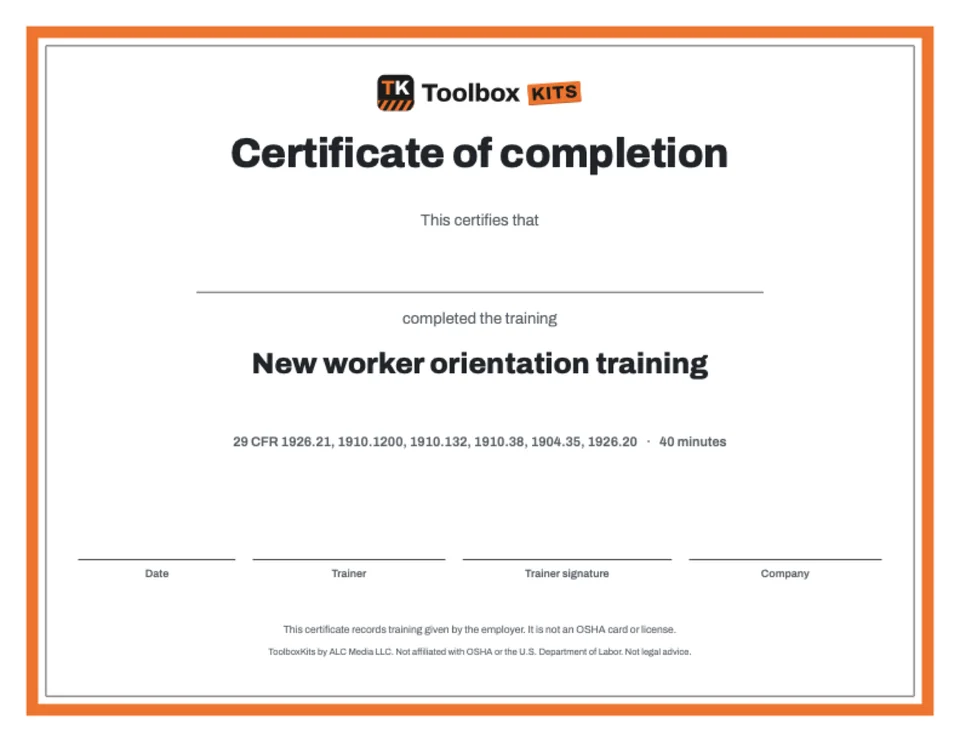 Certificate
- Crew handout
Try it
Try the quiz
Three questions from this topic. Pick an answer to see the right one and the OSHA paragraph.
Question 1 of 3
When must employees get information and training on hazardous chemicals in their work area?
The rule
What OSHA requires
Plain-language summary. Each line links to the exact paragraph of the regulation.
OSHA has no specific standard for new worker orientation in general; the general duty to train still applies. In construction, the employer must instruct each employee in recognizing and avoiding unsafe conditions and the rules that apply to their work environment.
“The employer shall instruct each employee in the recognition and avoidance of unsafe conditions and the regulations applicable to his work environment to control or eliminate any hazards or other exposure to illness or injury.”
Employers must give employees effective information and training on hazardous chemicals in their work area at the time of their initial assignment, and whenever a new chemical hazard is introduced.
“Employers shall provide employees with effective information and training on hazardous chemicals in their work area at the time of their initial assignment”
Employers must keep safety data sheets for each hazardous chemical in the workplace and make sure they are readily accessible to employees during each shift.
“The employer shall maintain in the workplace copies of the required safety data sheets for each hazardous chemical, and shall ensure that they are readily accessible during each work shift to employees when they are in their work area(s).”
Employers must provide training to each employee who is required to use personal protective equipment.
“The employer shall provide training to each employee who is required by this section to use PPE.”
Emergency action plans must include procedures for reporting a fire or other emergency. Everyone should know who to tell and how, before something happens.
“Procedures for reporting a fire or other emergency;”
Employers must tell each employee how to report work-related injuries and illnesses. Know that procedure, and use it for small injuries and close calls too.
“You must inform each employee of your procedure for reporting work-related injuries and illnesses;”
In construction, the safety program must provide for frequent and regular inspections of job sites, materials and equipment by competent persons the employer designates. Walking the site with a new worker is a good way to show what those inspections look for.
“Such programs shall provide for frequent and regular inspections of the job sites, materials, and equipment to be made by competent persons designated by the employers.”
Who must be trained
Under the hazard communication standard, employees get information and training on hazardous chemicals in their work area at the time of their initial assignment (29 CFR 1910.1200(h)(1)). Employees who must use personal protective equipment must be trained in its use (29 CFR 1910.132(f)(1)).
When to retrain
Under the hazard communication standard, employers must provide further information and training whenever a new chemical hazard the employees have not previously been trained about is introduced into their work area (29 CFR 1910.1200(h)(1)).

Common questions
Questions people ask
What should a first day back to work safety talk cover?
Cover exits and emergency plans, the hazards of the work area, chemicals and safety data sheets, protective equipment, who to ask, and how to report. For someone returning after time away, add what changed on site. Keep it short and walk the site if you can.
What should safety orientation training for new employees include?
A good safety orientation includes the emergency plan, site hazards, protective equipment, hazard communication, the rules for tools and vehicles, and how to report. Chemical training must happen at the time of initial assignment.
Is there a safety induction training PDF I can print?
Yes. This page is a free printable safety induction talk in English and Spanish with a sign-in table. For a full presentation with trainer notes and a quiz, order the training kit or request a custom one.
Is there a safety induction presentation or PowerPoint I can use?
The free talk on this page works as a short spoken orientation. The paid training kit adds slides for a longer session with notes, a quiz and a handout. Ask for a custom kit if you need your own site details.
When must new employees get training on hazardous chemicals?
Employers must give employees effective information and training on hazardous chemicals in their work area at the time of their initial assignment, and whenever a new chemical hazard is introduced.
Free to share
Use this talk for free
You can print, share and adapt this talk at no cost under the Creative Commons BY-NC-SA 4.0 license. Please credit ToolboxKits with a link.