

Free 5-minute toolbox talkEmergencies and weatherEnglish and Spanish
First aid toolbox talk
Tell your supervisor about every injury, even a small cut, splinter or strain. What OSHA requires: In general industry, if there is no infirmary, clinic or hospital in near proximity to the workplace that is used to treat all injured employees, one or more people must be adequately trained to give first aid (29 CFR 1910.151(b)).
A free first aid toolbox talk you can read to your crew in about five minutes, or use as a first aid safety moment. This first aid awareness and preparedness talk covers who is trained, where the kit is, how to get help fast and what OSHA requires.
Updated October 29, 2026 · Based on 29 CFR 1910.151, 29 CFR 1926.50
Read it out loud
Free 5-minute toolbox talk
Read it out loud to your crew. It takes about 5 minutes.
Start with a question
If someone on this crew got badly hurt right now, who would give first aid, where is the kit, and what location would you give the 911 dispatcher?
Why it matters
What the people nearby do in the first few minutes after an injury can make a big difference. On a jobsite, help can be farther away than you think, and nobody wants to be hunting for gloves or a phone signal while a coworker is bleeding. A little planning now means everyone knows their part before anything happens.
Key points
Know who is trained
Find out today who on this crew is trained in first aid. On construction sites without an infirmary, clinic, hospital or physician that is reasonably accessible in time and distance, a person with a valid first aid certificate must be available at the worksite.
More
In general industry, if no infirmary, clinic or hospital in near proximity is used to treat all injured employees, someone must be adequately trained to give first aid.
29 CFR 1926.50(c) · 29 CFR 1910.151(b)
Know where the kit is and keep it stocked
Everyone should know where the first aid kit is, whether it is in the trailer, the truck or the shop. On construction jobs, the kit must be in a weatherproof container and checked before it goes out to each job and at least weekly, so used items get replaced.
More
If you use the last of something, tell your foreman.
Know how to get help fast
Before a construction project starts, provisions must be made for prompt medical attention in case of serious injury. Know how to call 911 from this site and how an ambulance gets in.
More
On a construction site, if the phone system does not automatically give the 911 dispatcher your latitude and longitude, the site's latitude and longitude or other clear location information must be posted where everyone can see it.
29 CFR 1926.50(f)(2)(ii)(A) · 29 CFR 1926.50(b)
Protect yourself first
Make sure the scene is safe before you step in, so you do not become the second person hurt. Put on gloves from the kit before you touch blood, and treat all blood as if it could carry disease. Do not move a seriously hurt person unless they are in danger where they are.
Flush chemicals right away
Where a worker's eyes or body may be exposed to corrosive materials, there must be facilities for quick drenching or flushing of the eyes and body right in the work area. Know where the eyewash or shower is and keep the path to it clear.
More
If a chemical gets in someone's eyes, start flushing right away and keep going while someone else calls for help.
Report every injury
Tell your supervisor about every injury, even a small cut, splinter or strain. Small wounds can get infected, and some injuries feel worse hours later. Reporting also gets the hazard fixed before it hurts someone else.
Scenario
Picture this: A laborer slices his forearm on a sharp metal edge at the far end of a large site. The crew grabs the kit from the truck, but someone used up the gauze and gloves last week and nobody restocked it. No one is sure who has first aid training, and the worker calling 911 cannot tell the dispatcher which gate the ambulance should use. What should this crew have sorted out before the shift started?
Ask the crew
- Who on this crew is trained in first aid, and how do we reach them fast?
- Where are the first aid kits and eyewash stations on this site, and who keeps them stocked?
- What is this site's address or location, and where would an ambulance come in?
- What would you do in the first minute if a coworker was badly hurt?
Takeaway
Know who is trained, where the kit is and how to call for help before anyone gets hurt.
Trainer: ______________________ Date: ____________
Credit: ToolboxKits, https://toolboxkits.com/topics/first-aid/ (CC BY-NC-SA 4.0)
The poster is also inside the paid kits.
Audit-ready records in 60 seconds
Fill in your crew and download a filled sign-in sheet for this talk. Everything is made in your browser. Names are never uploaded or stored.
Start a sign-off
Crew scan a QR code on their own phones, type their name and sign with a finger. You see the names arrive and download the signed sheet. Free, no account.
Kits
Get the kit
No subscription needed. Buy only the kit you need.
Toolbox talk kit
$4.99
- 5-minute talk, English PDF
- 5-minute talk, Spanish PDF
- Editable mini-deck (English and Spanish)
- One-page crew handout (English and Spanish)
- Bilingual sign-in sheet
- 3-question quiz with answer key (English and Spanish)
- One-page bilingual poster
- Audit-ready records in 60 seconds: fill in your crew and get a sign-in sheet and a certificate for every worker
Training kit
$9
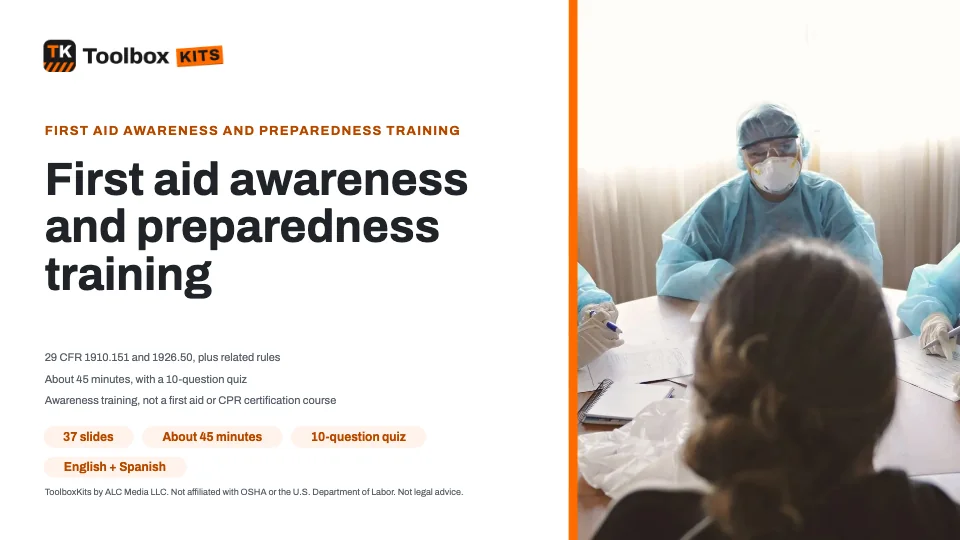
Editable PowerPoint, 37 slides
- Editable PowerPoint with trainer notes on every slide
- Trainer guide PDF with timing and discussion tips
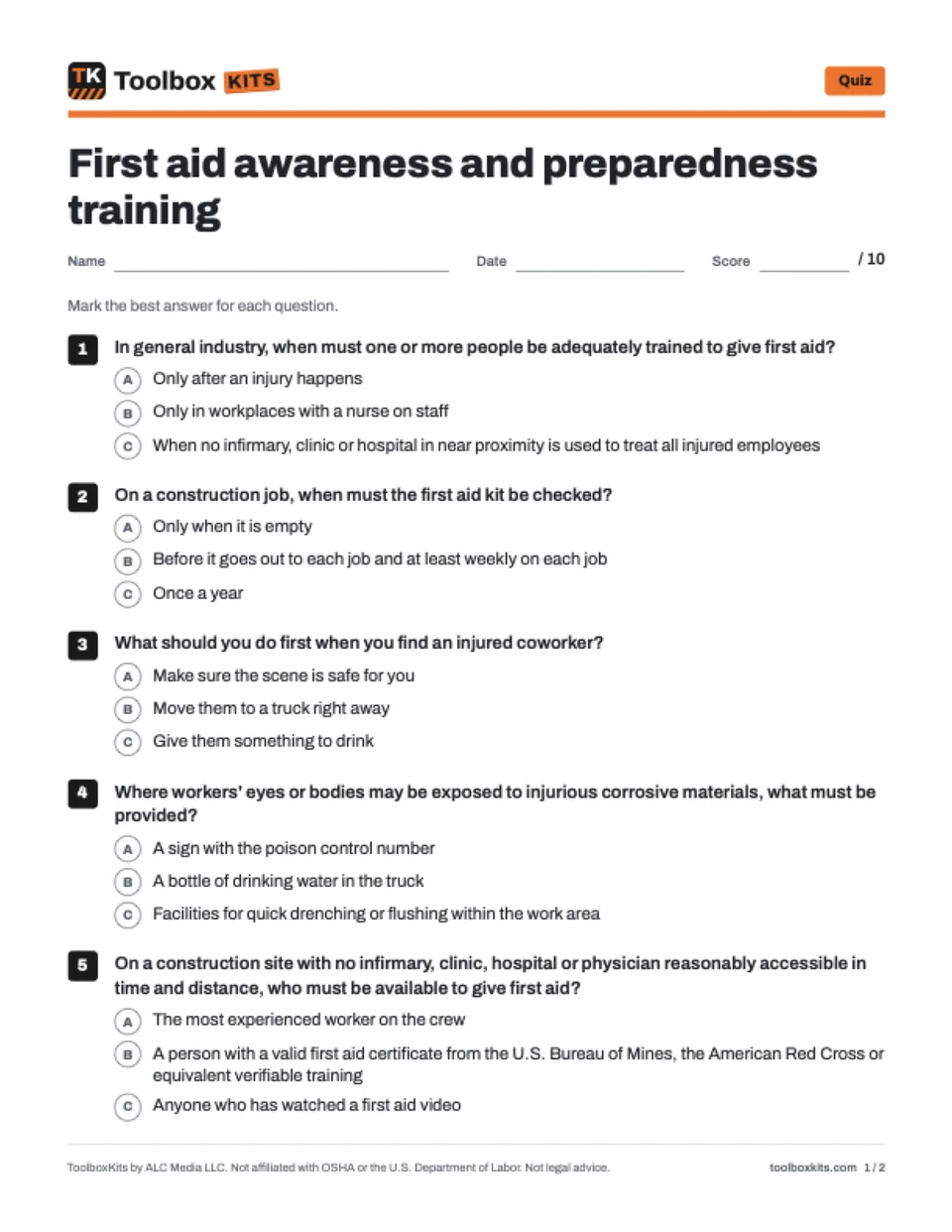
- 10-question quiz and answer key
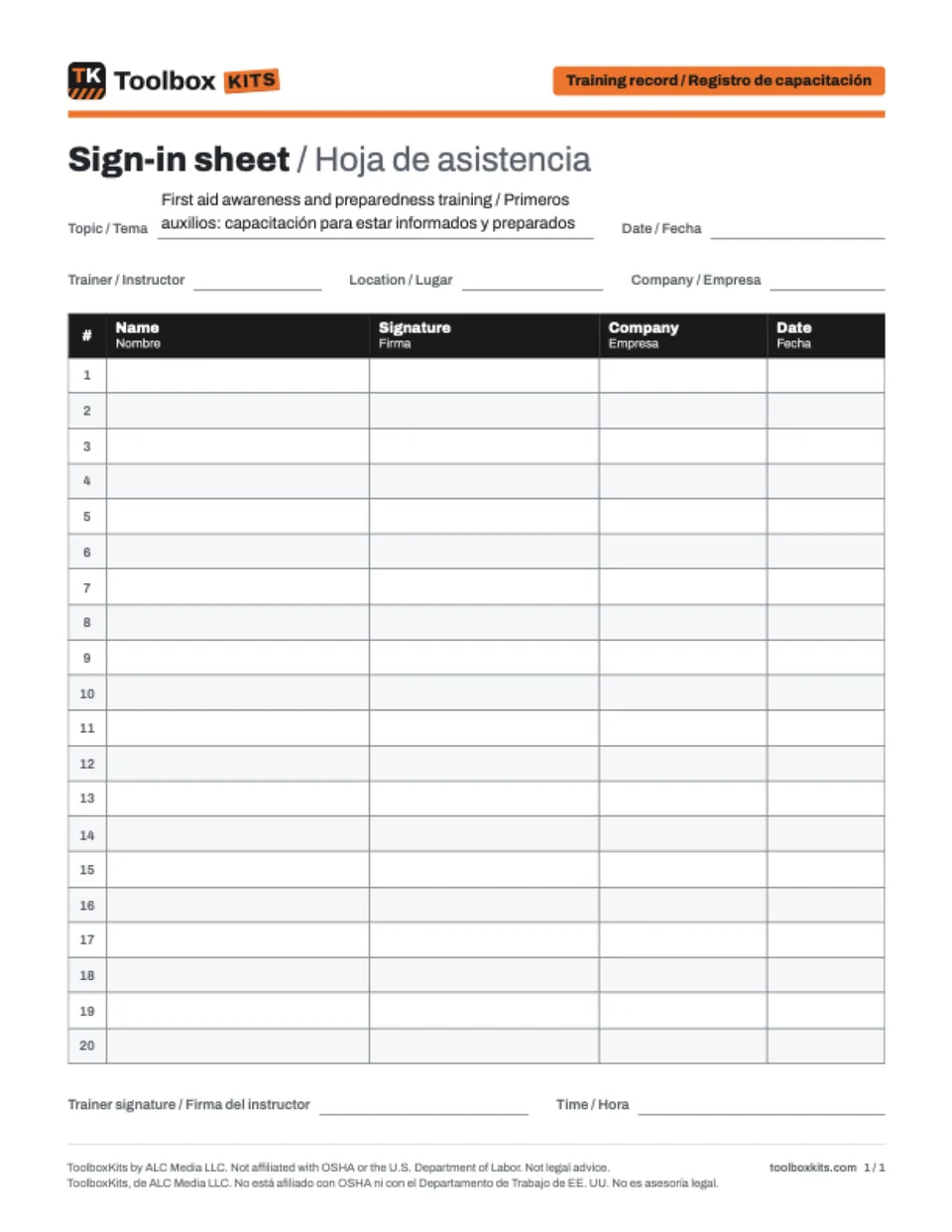
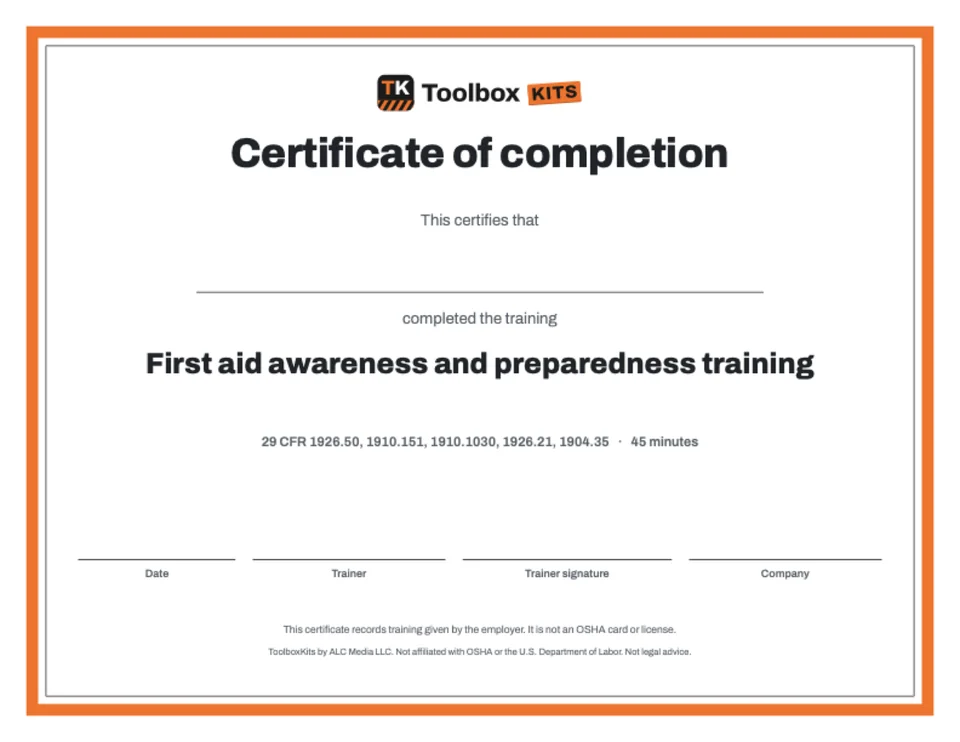
- Sign-in sheet and certificate of completion with fillable fields
- One-page crew handout
- Full Spanish version of everything
- One-page bilingual poster
- Audit-ready records in 60 seconds: fill in your crew and get a sign-in sheet and a certificate for every worker
- Instant download
- Secure checkout by Stripe
- 30-day refund, no questions
Need many topics? All Access gives you every kit for $99 a year.
Inside the kit
See what is in the kit
What is in the kit
 Editable PowerPoint
- Trainer guide
 Quiz
- Answer key
 Sign-in sheet
 Certificate
- Crew handout
Try it
Try the quiz
Three questions from this topic. Pick an answer to see the right one and the OSHA paragraph.
Question 1 of 3
On a construction job, when must the first aid kit be checked so used items get replaced?
The rule
What OSHA requires
Plain-language summary. Each line links to the exact paragraph of the regulation.
In general industry, if there is no infirmary, clinic or hospital in near proximity to the workplace that is used to treat all injured employees, one or more people must be adequately trained to give first aid. Adequate first aid supplies must be readily available.
“a person or persons shall be adequately trained to render first aid. Adequate first aid supplies shall be readily available.”
In construction, provisions for prompt medical attention in case of serious injury must be made before the project starts.
“Provisions shall be made prior to commencement of the project for prompt medical attention in case of serious injury.”
In construction, if no infirmary, clinic, hospital or physician is reasonably accessible in time and distance, a person with a valid first aid certificate from the U.S. Bureau of Mines, the American Red Cross or equivalent training that can be verified by documentary evidence must be available at the worksite to give first aid.
“a person who has a valid certificate in first-aid training from the U.S. Bureau of Mines, the American Red Cross, or equivalent training that can be verified by documentary evidence”
On construction sites, first aid supplies must be easy to reach when needed.
“First aid supplies shall be easily accessible when required.”
In construction, the contents of the first aid kit must be in a weatherproof container with individual sealed packages for each type of item. The employer must check it before it is sent out on each job and at least weekly on each job, so used items are replaced.
“shall be checked by the employer before being sent out on each job and at least weekly on each job to ensure that the expended items are replaced.”
In construction, there must be proper equipment to promptly transport an injured person to a physician or hospital, or a communication system to contact ambulance service.
“Proper equipment for prompt transportation of the injured person to a physician or hospital, or a communication system for contacting necessary ambulance service, shall be provided.”
On construction sites in areas where 911 emergency dispatch is not available, the phone numbers of physicians, hospitals or ambulances must be posted where they are easy to see.
“the telephone numbers of the physicians, hospitals, or ambulances shall be conspicuously posted.”
In construction, when the communication system used at the site does not automatically give the 911 dispatcher the caller's latitude and longitude, the employer must post the worksite's latitude and longitude, or other location information that clearly tells employees where the worksite is, in a conspicuous location at the worksite. This does not apply where readily available landlines have 911 service that automatically identifies the caller's location (29 CFR 1926.50(f)(2)(ii)(B)).
Where the eyes or body of any person may be exposed to injurious corrosive materials, suitable facilities for quick drenching or flushing of the eyes and body must be provided within the work area for immediate emergency use. The construction rule says the same (29 CFR 1926.50(g)).
“suitable facilities for quick drenching or flushing of the eyes and body shall be provided within the work area for immediate emergency use.”
On construction sites where harmful plants or animals are present, employees who may be exposed must be instructed about the hazards, how to avoid injury and the first aid procedures to use if they are injured.
“employees who may be exposed shall be instructed regarding the potential hazards, and how to avoid injury, and the first aid procedures to be used in the event of injury.”
Who must be trained
In general industry, if there is no infirmary, clinic or hospital in near proximity to the workplace that is used for the treatment of all injured employees, a person or persons must be adequately trained to render first aid (29 CFR 1910.151(b)). In construction, if no infirmary, clinic, hospital or physician is reasonably accessible in time and distance, a person with a valid certificate in first aid training from the U.S. Bureau of Mines, the American Red Cross, or equivalent training that can be verified by documentary evidence must be available at the worksite (29 CFR 1926.50(c)). On construction sites where harmful plants or animals are present, employees who may be exposed must be instructed in the first aid procedures to use in the event of injury (29 CFR 1926.21(b)(4)).

Common questions
Questions people ask
Is there a printable first aid toolbox talk PDF?
Yes. This first aid toolbox talk is a free printable PDF in English and Spanish, with a sign-in table for your crew. Print it, read it aloud in about five minutes, and keep the signed sheet with your safety records.
Does OSHA require first aid training at work?
Under the general first aid rules, it depends on how close medical help is. In general industry, if there is no infirmary, clinic or hospital in near proximity that is used to treat all injured employees, one or more people must be adequately trained to give first aid (29 CFR 1910.151(b)). In construction, if no infirmary, clinic, hospital or physician is reasonably accessible in time and distance, a person with a valid first aid certificate must be available at the worksite (29 CFR 1926.50(c)).
Does a first aid toolbox talk count as first aid or CPR training?
No. A toolbox talk builds first aid awareness, but it does not teach hands-on skills or give anyone a certificate. Where the construction rule requires a first aid provider at the worksite, that person needs a valid certificate from the U.S. Bureau of Mines, the American Red Cross or equivalent training that can be verified by documentary evidence (29 CFR 1926.50(c)). CPR is best learned in a hands-on class with practice.
What first aid topics work for a safety meeting or safety moment?
Pick one per meeting: who is trained, where the kits and eyewash stations are, how to call 911 and give the site location, how to control bleeding with firm pressure, and why every injury gets reported. For a quick first aid safety moment, open the kit together and check what is missing.
Is there a safety and first aid PowerPoint presentation?
This free talk is written to be read aloud, so you do not need slides to run it. For a longer safety and first aid presentation, the training kit for this topic adds an editable PowerPoint in English and Spanish with trainer notes, a quiz and a sign-in sheet. If the kit is not ready to buy yet, you can request it from this page. Neither the talk nor the kit is a first aid certification course.
Free to share
Use this talk for free
You can print, share and adapt this talk at no cost under the Creative Commons BY-NC-SA 4.0 license. Please credit ToolboxKits with a link.