

Free 5-minute toolbox talkEmergencies and weatherEnglish and Spanish
Severe weather safety toolbox talk
People get hurt when nobody knows who calls the stop or where to go. What OSHA requires: OSHA has no specific standard for severe weather; the general duty to train still applies. On construction sites, the employer must instruct each employee in recognizing and avoiding unsafe conditions and the regulations that apply to their work environment (29 CFR 1926.21(b)(2)).
A 5-minute talk for crews who work through storms, wind and rain. It covers lightning, high wind, working in the rain, shelter and headcounts, and the OSHA rules that apply when the weather turns.
Updated October 29, 2026 · Based on 29 CFR 1910.38
Read it out loud
Free 5-minute toolbox talk
Read it out loud to your crew. It takes about 5 minutes.
Start with a question
If a storm rolled in during the next hour, do you know where you would go and who would tell you to stop?
Why it matters
Storms can build fast, and inclement weather changes every job on site. Lightning can strike before the rain arrives, wind can turn a sheet of plywood into a sail, and rain makes ladders, steel and mud slick. People get hurt when nobody knows who calls the stop or where to go. A plan everyone knows ahead of time takes the guessing out of a bad moment.
Key points
Know the plan before the storm hits
Find out now how a weather warning will reach you, where the crew shelters, and who gives the all-clear. Where an emergency action plan is required, it must be reviewed with you when the plan is developed or you are first assigned.
More
It must be reviewed again when your duties under it change and when the plan changes. Check the forecast before the shift, and have one person keep an eye on weather alerts during the day.
Lightning: get inside and stay there
If you can hear thunder, treat it as a warning that lightning is close enough to strike. Get off roofs, steel, scaffolds, equipment and open ground, and go into a fully enclosed building or a hard-topped vehicle with the windows up. Stay away from tall objects, metal and water while you move.
More
Stay sheltered until the storm has clearly passed and the all-clear is given.
High wind changes the job at height
Treat wind as high when it can push you off balance or make you lose control of what you are carrying. Work on or from scaffolds is prohibited during storms or high winds.
More
The only exception is when a competent person has determined it is safe and the workers are protected by a personal fall arrest system or wind screens. Tie down or bring in loose sheets, panels and tarps before the wind picks up.
Cranes need a weather call
Wind, ice and snow change how stable a crane is and how much it can safely lift. On crane work, the competent person must adjust the equipment, the operation or both to address the effect of wind, ice and snow on stability and rated capacity.
More
If you are rigging or signaling and the wind is making the load hard to control, stop and tell the operator.
Rain means slick, muddy and hard to see
Rain makes ladders, planks, steel and stairs slippery and makes it harder for drivers and operators to see. Slow down, wear boots with good tread, and keep cords and tools out of standing water.
More
Excavations must be inspected by a competent person after every rainstorm when workers can reasonably be expected to be exposed, because water can weaken trench walls.
Get to shelter and do a headcount
When the warning comes, stop work and go straight to the assigned shelter. An emergency action plan must include procedures to account for all employees after an evacuation, so check in with your foreman every time.
More
If someone is missing, tell the person in charge right away instead of going back out to look on your own.
Scenario
Picture this: A crew is setting roof trusses on a hot afternoon. Dark clouds are building to the west, and someone hears thunder, but the foreman wants to finish the last few trusses before the rain. The wind picks up and a truss starts to swing on the crane line. Nobody is sure who should call a stop or where everyone is supposed to go. What should have happened, and when?
Ask the crew
- How do we get weather warnings on this job, and who is watching for them today?
- Where is our shelter, and how would you get there from where you are working?
- Which jobs on this site do we stop first when the wind picks up?
- After a storm, what has to be checked before we go back to work?
Takeaway
Know the plan before the storm, stop and get to shelter at the first thunder or dangerous wind, and do not restart until the site has been checked.
Trainer: ______________________ Date: ____________
Credit: ToolboxKits, https://toolboxkits.com/topics/severe-weather/ (CC BY-NC-SA 4.0)
The poster is also inside the paid kits.
Audit-ready records in 60 seconds
Fill in your crew and download a filled sign-in sheet for this talk. Everything is made in your browser. Names are never uploaded or stored.
Start a sign-off
Crew scan a QR code on their own phones, type their name and sign with a finger. You see the names arrive and download the signed sheet. Free, no account.
Kits
Get the kit
No subscription needed. Buy only the kit you need.
Toolbox talk kit
$4.99
- 5-minute talk, English PDF
- 5-minute talk, Spanish PDF
- Editable mini-deck (English and Spanish)
- One-page crew handout (English and Spanish)
- Bilingual sign-in sheet
- 3-question quiz with answer key (English and Spanish)
- One-page bilingual poster
- Audit-ready records in 60 seconds: fill in your crew and get a sign-in sheet and a certificate for every worker
Training kit
$9
Editable PowerPoint, 35 slides
- Editable PowerPoint with trainer notes on every slide
- Trainer guide PDF with timing and discussion tips
- 10-question quiz and answer key
- Sign-in sheet and certificate of completion with fillable fields
- One-page crew handout
- Full Spanish version of everything
- One-page bilingual poster
- Audit-ready records in 60 seconds: fill in your crew and get a sign-in sheet and a certificate for every worker
- Instant download
- Secure checkout by Stripe
- 30-day refund, no questions
Need many topics? All Access gives you every kit for $99 a year.
Inside the kit
See what is in the kit
What is in the kit
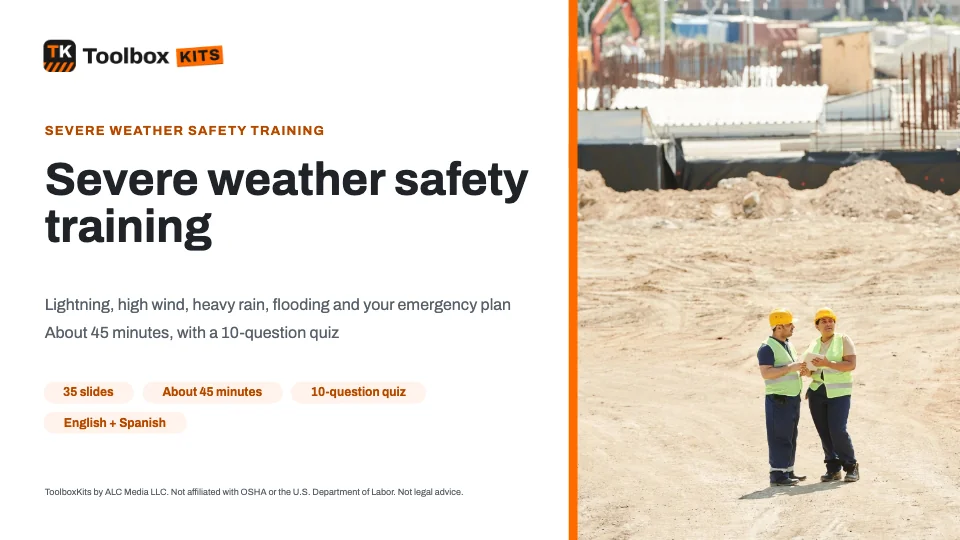 Editable PowerPoint
- Trainer guide
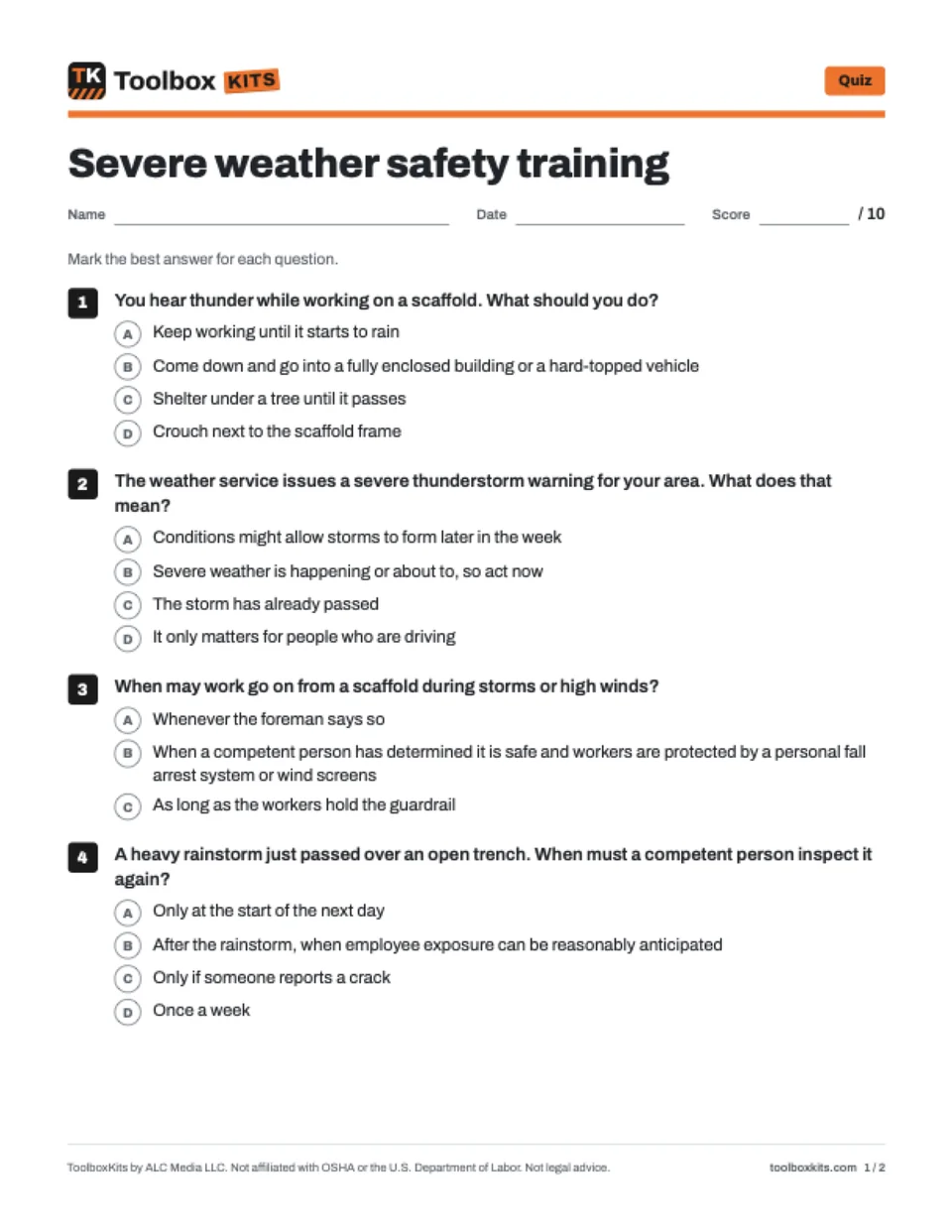 Quiz
- Answer key
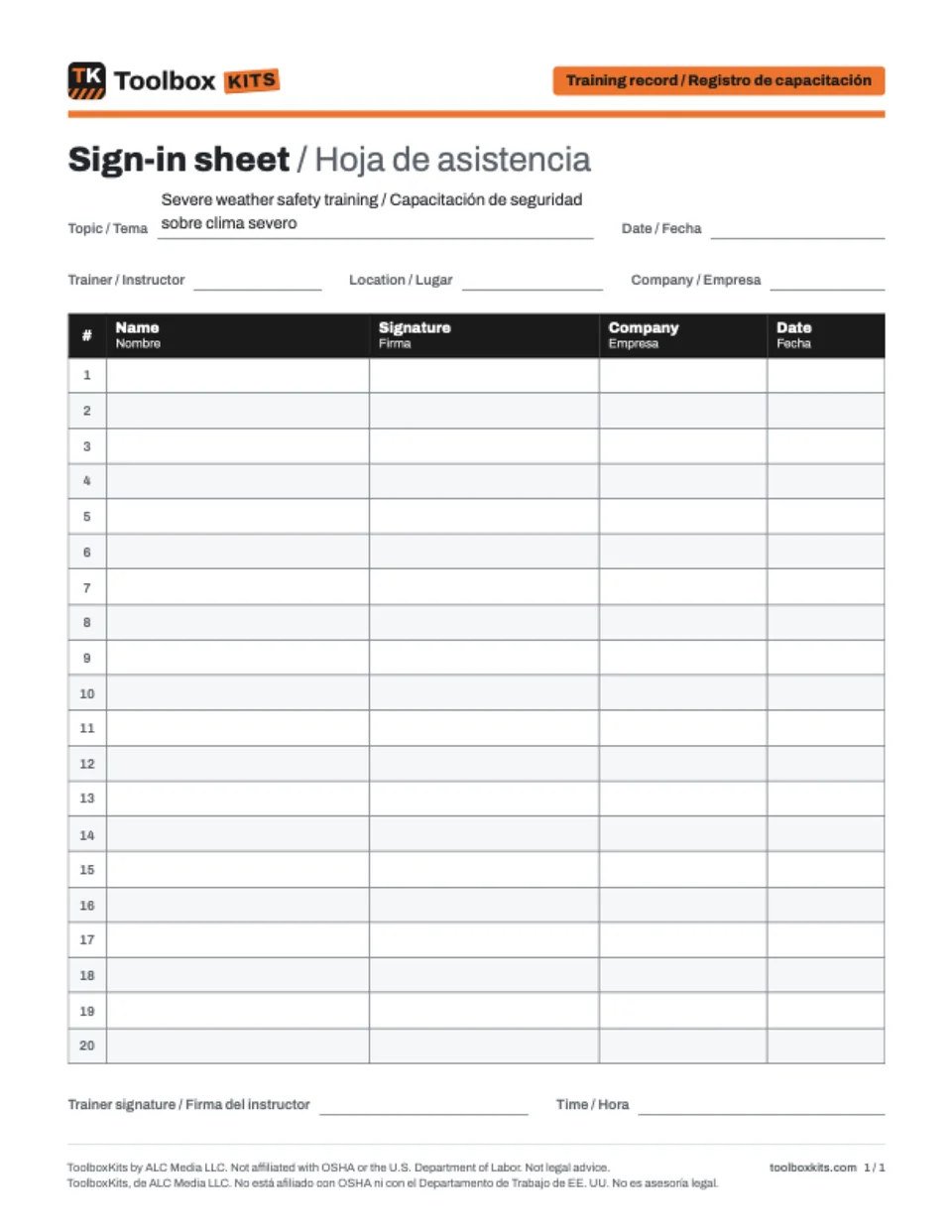 Sign-in sheet
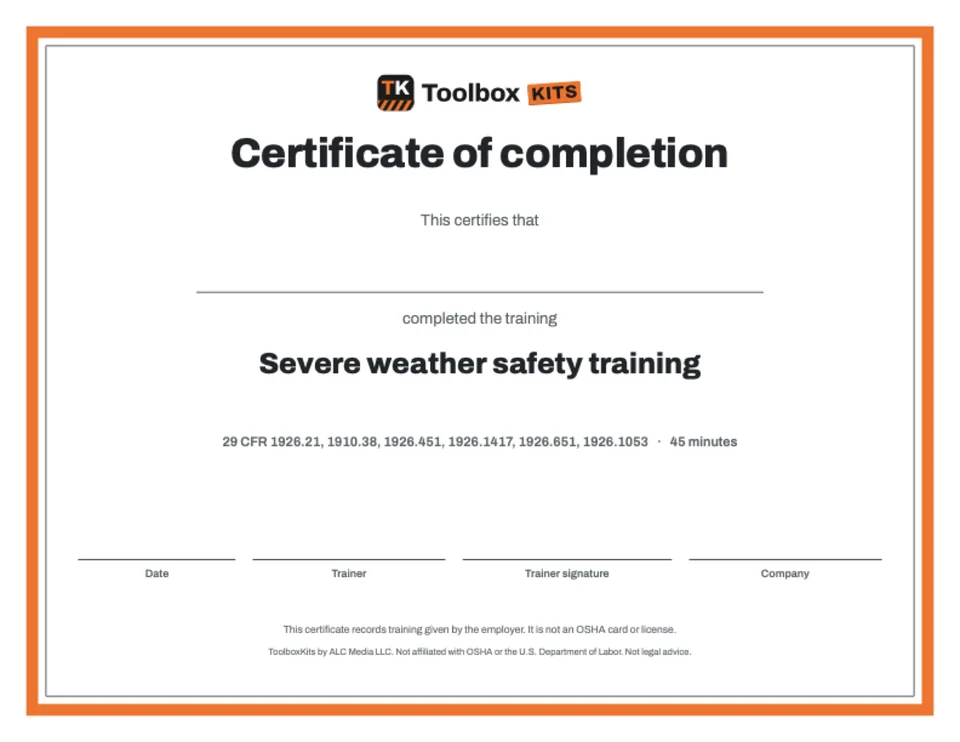 Certificate
- Crew handout
Try it
Try the quiz
Three questions from this topic. Pick an answer to see the right one and the OSHA paragraph.
Question 1 of 3
You hear thunder while working on a roof. What should you do?
The rule
What OSHA requires
Plain-language summary. Each line links to the exact paragraph of the regulation.
OSHA has no specific standard for severe weather; the general duty to train still applies. On construction sites, the employer must instruct each employee in recognizing and avoiding unsafe conditions and the regulations that apply to their work environment.
“The employer shall instruct each employee in the recognition and avoidance of unsafe conditions and the regulations applicable to his work environment”
An employer must have an emergency action plan whenever an OSHA general industry standard requires one, and 1910.38 sets the rules for that plan.
“An employer must have an emergency action plan whenever an OSHA standard in this part requires one.”
An emergency action plan must be in writing, kept in the workplace and available to employees for review. An employer with 10 or fewer employees may communicate the plan orally.
“an employer with 10 or fewer employees may communicate the plan orally to employees.”
The plan must include procedures to account for all employees after an evacuation.
“Procedures to account for all employees after evacuation”
The employer must have and maintain an employee alarm system that uses a distinctive signal for each purpose.
“The employee alarm system must use a distinctive signal for each purpose”
The employer must designate and train employees to help with a safe and orderly evacuation of other employees.
“An employer must designate and train employees to assist in a safe and orderly evacuation of other employees.”
The plan must be reviewed with each employee it covers when the plan is developed or the employee is first assigned to a job, when the employee's responsibilities under the plan change, and when the plan is changed.
Work on or from scaffolds is prohibited during storms or high winds unless a competent person has determined that it is safe and the workers are protected by a personal fall arrest system or wind screens.
“Work on or from scaffolds is prohibited during storms or high winds unless a competent person has determined that it is safe for employees to be on the scaffold”
For cranes and derricks, when a local storm warning has been issued, the competent person must decide whether the manufacturer's recommendations for securing the equipment need to be put in place.
“When a local storm warning has been issued, the competent person must determine whether it is necessary to implement manufacturer recommendations for securing the equipment.”
A competent person must inspect excavations, the areas next to them and protective systems daily, before work starts and as needed during the shift, and again after every rainstorm or other hazard-increasing event. These inspections are only required when employee exposure can be reasonably anticipated.
“Inspections shall also be made after every rainstorm or other hazard increasing occurrence.”
Who must be trained
Where an emergency action plan is required, the employer must designate and train employees to assist in a safe and orderly evacuation of other employees (29 CFR 1910.38(e)). In construction, before putting the plan in place, the employer must designate and train a sufficient number of persons to assist in the safe and orderly emergency evacuation of employees (29 CFR 1926.35(e)(1)). Every construction employee must also be instructed in recognizing and avoiding unsafe conditions (29 CFR 1926.21(b)(2)).
When to retrain
The emergency action plan must be reviewed with each employee it covers when the plan is developed or the employee is first assigned to a job, when the employee's responsibilities under the plan change, and when the plan is changed (29 CFR 1910.38(f)). In construction, the plan must be reviewed with each covered employee when it is developed, when the employee's responsibilities or designated actions under it change, and when the plan is changed (29 CFR 1926.35(e)(2)). The parts of the plan an employee must know to protect themselves in an emergency must be reviewed with them on initial assignment (29 CFR 1926.35(e)(3)).

Common questions
Questions people ask
What should a thunderstorm toolbox talk cover?
Cover how the crew will know a storm is coming, who calls the stop, where to shelter and when it is safe to go back to work. Treat thunder as a sign that lightning is close enough to strike, and get off roofs, scaffolds, equipment and open ground. Some work has its own rule: blasting operations must be suspended and people removed from the blasting area during the approach and progress of an electric storm (29 CFR 1926.900(k)(2)).
What does OSHA say about working in high winds?
OSHA has no single wind speed limit for all work, but several rules deal with wind. Work on or from scaffolds is prohibited during storms or high winds unless a competent person has determined it is safe and workers are protected by a personal fall arrest system or wind screens (29 CFR 1926.451(f)(12)). When a crane is used to lift people and the wind speed (sustained or gusts) exceeds 20 mph at the personnel platform, a qualified person must decide whether it is safe to lift (29 CFR 1926.1431(k)(8)(i)).
What should a working in the rain safety talk cover?
Cover slippery ladders, planks and steel, mud and footing, visibility for drivers and operators, and keeping cords and tools out of water. Ladders may not be used on slippery surfaces unless they are secured or have slip-resistant feet (29 CFR 1926.1053(b)(7)). Excavations must also be inspected by a competent person after every rainstorm when workers can reasonably be expected to be exposed (29 CFR 1926.651(k)(1)).
Should a severe weather talk cover wind chill?
Yes, in cold months. Wind pulls heat away from the body faster, so a cold, windy day can bring on cold stress sooner than the temperature alone suggests. Dress in layers, keep a dry change of clothes, and take warm-up breaks. OSHA has no specific standard for cold stress; the general duty to train still applies (29 CFR 1926.21(b)(2)).
What is a good severe weather safety moment for the rainy season?
Pick one question and answer it as a crew: where do we go if we hear thunder, and who tells us when it is safe to come back out? Walk the route to the shelter once, and make sure new workers know it too. You can print this talk free in English and Spanish as a quick rain or severe weather safety moment, with a sign-in sheet.
Free to share
Use this talk for free
You can print, share and adapt this talk at no cost under the Creative Commons BY-NC-SA 4.0 license. Please credit ToolboxKits with a link.