

Free 5-minute toolbox talkEmergencies and weatherEnglish and Spanish
Lightning toolbox talk: lightning safety on the job
Lightning can strike far from the rain. What OSHA requires: OSHA has no general lightning safety standard for outdoor work. The general training duty applies: in construction, the employer must instruct each employee in recognizing and avoiding unsafe conditions and the rules that apply to the work (29 CFR 1926.21(b)(2)).
A free lightning safety talk for crews who work outdoors. Use it as a five minute safety moment before the storm season or before a day with thunder in the forecast.
Updated October 29, 2026 · Based on 29 CFR 1910.38
Read it out loud
Free 5-minute toolbox talk
Read it out loud to your crew. It takes about 5 minutes.
Start with a question
If you heard thunder right now, where would you go and who would make the call to stop work?
Why it matters
Lightning can strike far from the rain. Open ground, high places, tall equipment and metal put outdoor workers at the most risk. The safest choice is to stop work and get inside before the storm is close. OSHA has no general lightning safety standard for outdoor work, so protection depends on your site's emergency plan and on everyone knowing it.
Key points
Know who calls it and what the signal is
Before the storm, your crew needs to know who stops work, how the alarm sounds and where to go. If your workplace has an emergency action plan, it must include procedures for reporting emergencies and for evacuation, including exit route assignments. The alarm must use a distinctive signal.
29 CFR 1910.38(c)(2) · 29 CFR 1910.38(c)(1) and (c)(2) · 29 CFR 1910.38(d)
Go to a safe shelter early
A fully enclosed building or a hard-topped vehicle with the windows up is the safest choice. Do not shelter under a tree, a pop-up tent, a porch roof or an open shed. Do not wait for rain. If you can hear thunder, you are close enough to be struck.
Get down from high places and away from tall equipment
Come down from roofs, ladders, scaffolds, lifts and towers right away. Stay away from cranes, poles and other tall objects. Work on or from scaffolds is prohibited during storms or high winds unless a competent person has determined it is safe and the employees are protected.
Stay away from metal and water
Put down metal tools, ladders and pipe. Stay off metal fences, rebar and open water. Do not use plug-in tools or corded equipment during a storm. Do not stand in puddles or next to wet, bare ground.
Account for everyone
Once people are in shelter, take a headcount. An emergency action plan must have procedures to account for all employees after evacuation. Tell the supervisor who is missing. Do not send people out to look until it is safe.
29 CFR 1910.38(c)(4)
Do not rush back out
The danger does not end when the rain stops. Follow your plan for how long to wait after the last thunder before work restarts. The emergency action plan must be reviewed with employees when it is developed, when it changes and when their responsibilities change.
29 CFR 1910.38(f)(1) · 29 CFR 1910.38(f)
Scenario
Picture this: A roofing crew is finishing the last section on a hot afternoon. A dark cloud builds to the west and the foreman hears distant thunder. The crew wants to finish in fifteen minutes. One worker is on a metal ladder, another is holding a pipe and a third is walking toward a tree for shade. What should the foreman do right now?
Ask the crew
- Where do we shelter on this site, and could everyone fit?
- Who has the authority to stop work for weather?
- How would we find out about approaching storms during the day?
- How do we make sure we account for everyone after we take shelter?
Takeaway
When you hear thunder, stop work, get to a safe shelter and count heads before anyone goes back out.
Trainer: ______________________ Date: ____________
Credit: ToolboxKits, https://toolboxkits.com/topics/lightning/ (CC BY-NC-SA 4.0)
The poster is also inside the paid kits.
Audit-ready records in 60 seconds
Fill in your crew and download a filled sign-in sheet for this talk. Everything is made in your browser. Names are never uploaded or stored.
Start a sign-off
Crew scan a QR code on their own phones, type their name and sign with a finger. You see the names arrive and download the signed sheet. Free, no account.
Kits
Get the kit
No subscription needed. Buy only the kit you need.
Toolbox talk kit
$4.99
- 5-minute talk, English PDF
- 5-minute talk, Spanish PDF
- Editable mini-deck (English and Spanish)
- One-page crew handout (English and Spanish)
- Bilingual sign-in sheet
- 3-question quiz with answer key (English and Spanish)
- One-page bilingual poster
- Audit-ready records in 60 seconds: fill in your crew and get a sign-in sheet and a certificate for every worker
Training kit
$9
Editable PowerPoint, 30 slides
- Editable PowerPoint with trainer notes on every slide
- Trainer guide PDF with timing and discussion tips
- 10-question quiz and answer key
- Sign-in sheet and certificate of completion with fillable fields
- One-page crew handout
- Full Spanish version of everything
- One-page bilingual poster
- Audit-ready records in 60 seconds: fill in your crew and get a sign-in sheet and a certificate for every worker
- Instant download
- Secure checkout by Stripe
- 30-day refund, no questions
Need many topics? All Access gives you every kit for $99 a year.
Inside the kit
See what is in the kit
What is in the kit
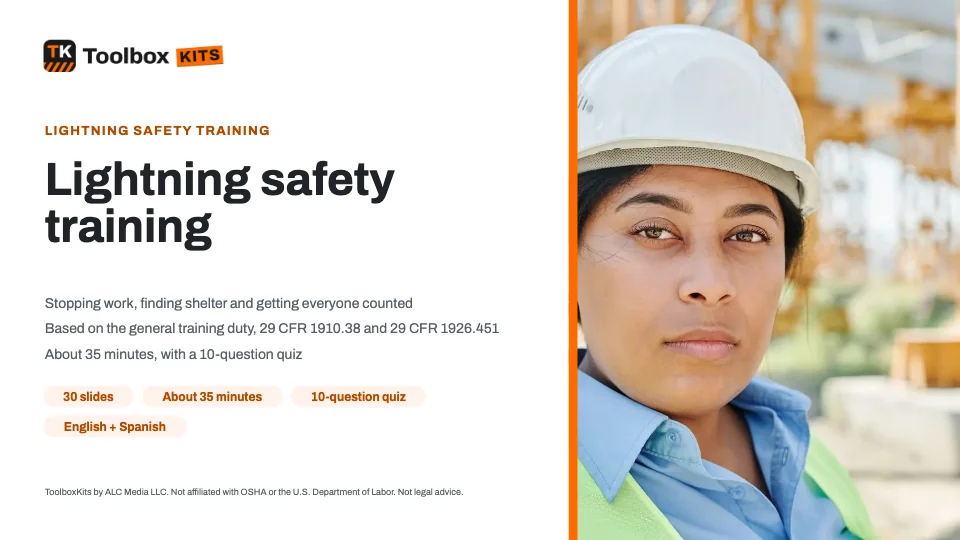 Editable PowerPoint
- Trainer guide
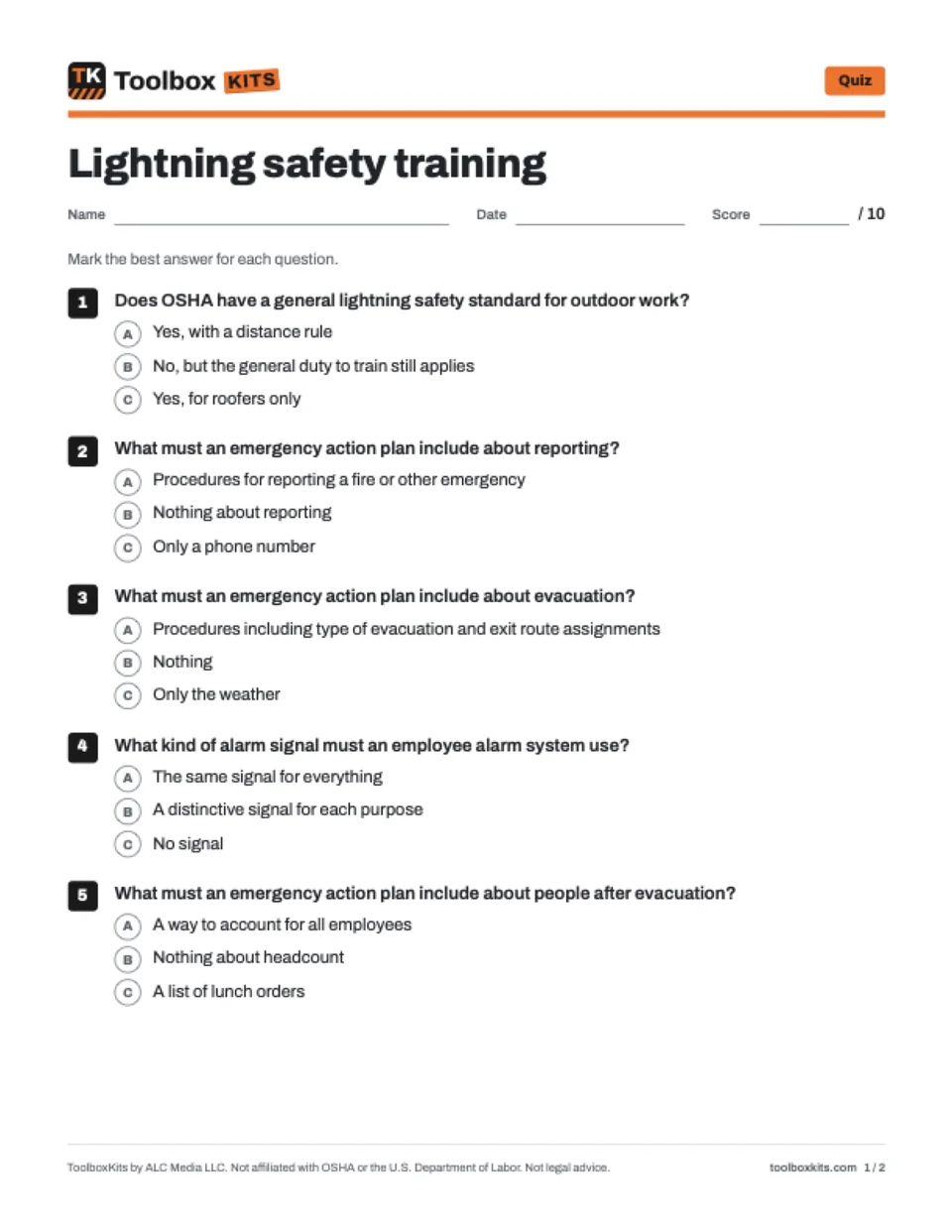 Quiz
- Answer key
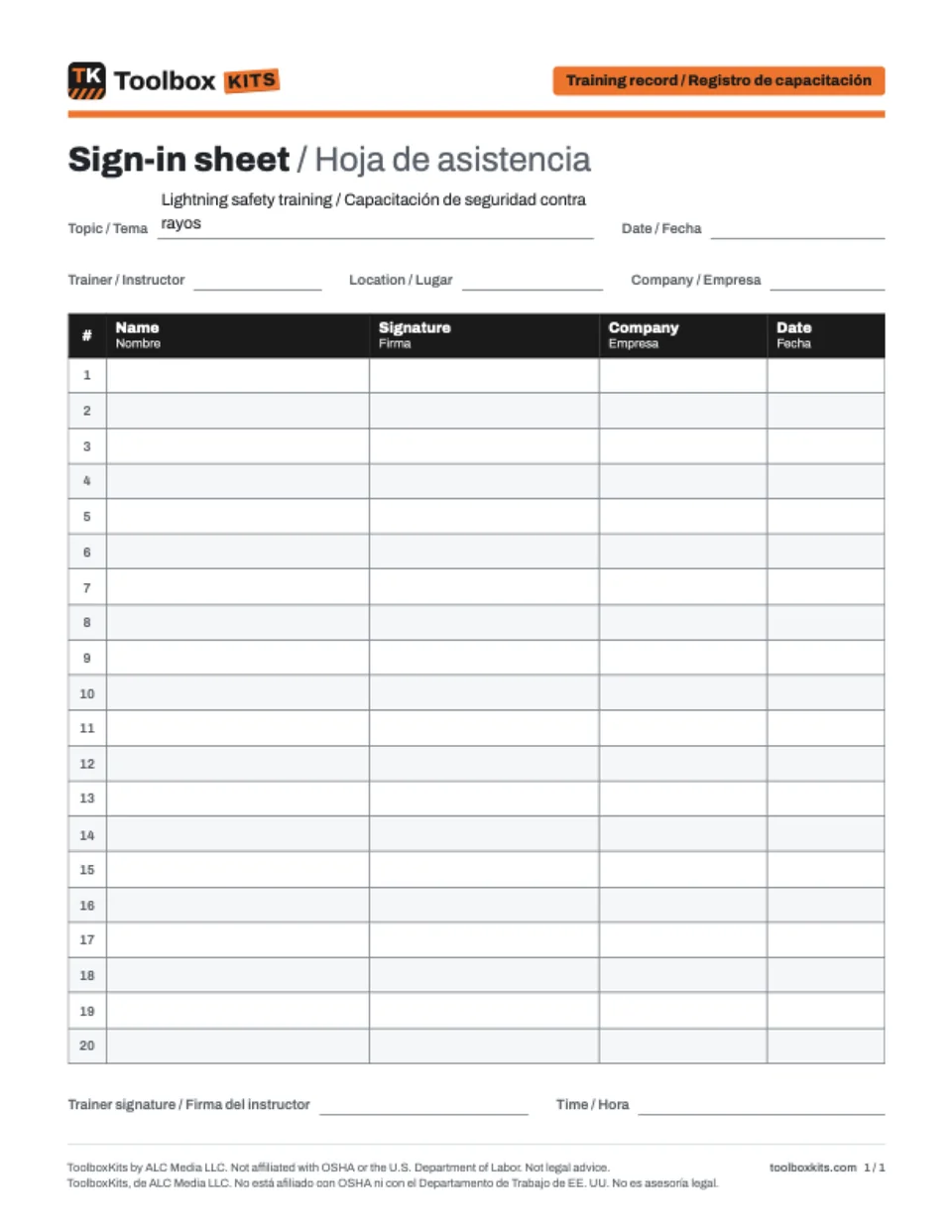 Sign-in sheet
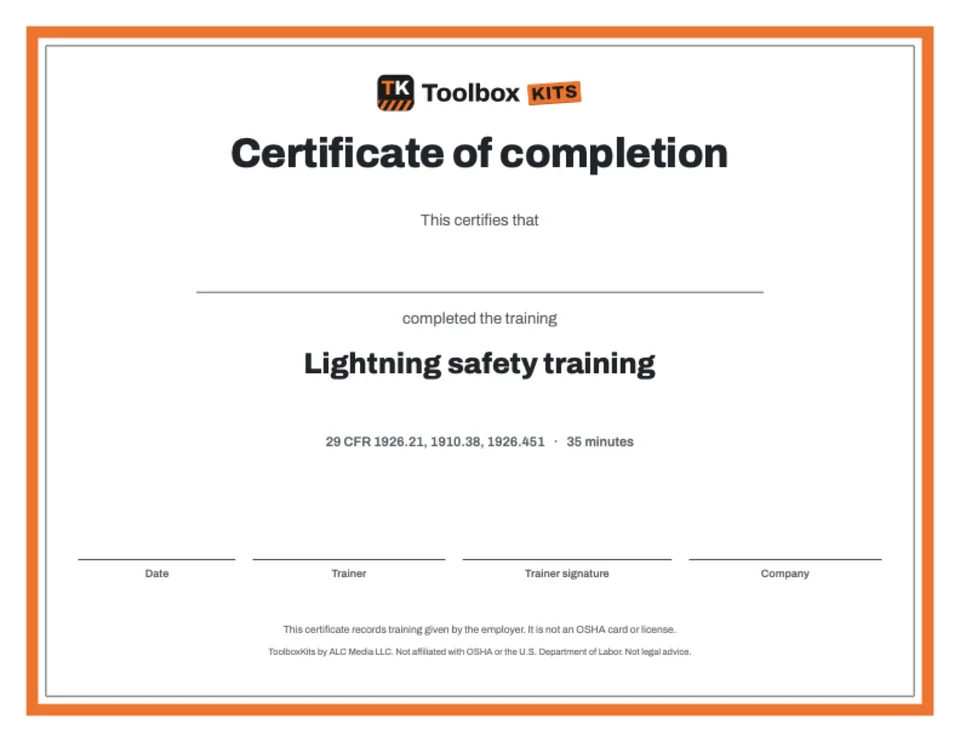 Certificate
- Crew handout
Try it
Try the quiz
Three questions from this topic. Pick an answer to see the right one and the OSHA paragraph.
Question 1 of 3
You hear thunder while working outside. What should you do?
The rule
What OSHA requires
Plain-language summary. Each line links to the exact paragraph of the regulation.
OSHA has no general lightning safety standard for outdoor work. The general training duty applies: in construction, the employer must instruct each employee in recognizing and avoiding unsafe conditions and the rules that apply to the work.
“The employer shall instruct each employee in the recognition and avoidance of unsafe conditions and the regulations applicable to his work environment to control or eliminate any hazards or other exposure to illness or injury.”
An employer must have an emergency action plan whenever an OSHA standard in the general industry part requires one.
“An employer must have an emergency action plan whenever an OSHA standard in this part requires one.”
An emergency action plan must include procedures for emergency evacuation, including the type of evacuation and exit route assignments.
“Procedures for emergency evacuation, including type of evacuation and exit route assignments;”
An emergency action plan must include procedures to account for all employees after evacuation.
“Procedures to account for all employees after evacuation;”
The employer must have and maintain an employee alarm system that uses a distinctive signal for each purpose.
“An employer must have and maintain an employee alarm system.”
The employer must designate and train employees to assist in a safe and orderly evacuation of other employees.
“An employer must designate and train employees to assist in a safe and orderly evacuation of other employees.”
The employer must review the plan with each employee when it is developed or the employee is first assigned, when the employee's responsibilities change and when the plan changes.
In construction, work on or from scaffolds is prohibited during storms or high winds unless a competent person has determined it is safe for employees to be on the scaffold and those employees are protected by a personal fall arrest system or wind screens.
Who must be trained
OSHA has no lightning training rule. If your workplace must have an emergency action plan, the employer must designate and train employees to assist in a safe and orderly evacuation (29 CFR 1910.38(e)), and in construction must instruct each employee in recognizing and avoiding unsafe conditions (29 CFR 1926.21(b)(2)).

Common questions
Questions people ask
Is there a printable lightning toolbox talk?
Yes. This lightning toolbox talk is free to print as a PDF in English and Spanish, with a sign-in table for your crew. Read it aloud in about five minutes and keep the signed sheet with your safety records.
Does OSHA have a lightning safety standard?
OSHA has no general lightning safety standard for outdoor work. The general duty to train still applies: in construction, the employer must instruct each employee in recognizing and avoiding unsafe conditions (29 CFR 1926.21(b)(2)). Emergency action plan rules (29 CFR 1910.38) and the scaffold storm rule (29 CFR 1926.451(f)(12)) also help.
What is a lightning safety moment?
A safety moment is a short talk given before work starts. A lightning safety moment covers who stops work, where the crew shelters and how you take a headcount. This page gives you a full five minute talk you can shorten.
What should a lightning plan include?
It should say who has authority to stop work, how the crew is warned, where to shelter, how to account for everyone and when work can restart. If your workplace is required to have an emergency action plan, it must include reporting and evacuation procedures and a way to account for all employees (29 CFR 1910.38(c)).
Is there a lightning safety presentation or PowerPoint?
This free talk is written to be read aloud, so you do not need slides. For a longer lightning and severe weather session, the paid training kit for this topic is an editable PowerPoint in English and Spanish with trainer notes, a quiz and a sign-in sheet. If the kit is not ready to buy yet, you can request it from this page.
Free to share
Use this talk for free
You can print, share and adapt this talk at no cost under the Creative Commons BY-NC-SA 4.0 license. Please credit ToolboxKits with a link.