

Free 5-minute toolbox talkElectricalEnglish and Spanish
Extension cord safety toolbox talk
A damaged cord can shock you or start a fire, and a cord across a walkway can trip someone. What OSHA requires: In construction, extension cord sets used with portable electric tools and appliances must be three-wire type and designed for hard or extra-hard usage (29 CFR 1926.405(a)(2)(ii)(J)).
A free 5-minute talk on using extension cords safely on the job. It covers picking the right cord, inspecting it, grounding and GFCI protection, cable management and damaged cords, with citations to the OSHA rules.
Updated October 29, 2026 · Based on 29 CFR 1926.405, 29 CFR 1910.305, 29 CFR 1926.416
Read it out loud
Free 5-minute toolbox talk
Read it out loud to your crew. It takes about 5 minutes.
Start with a question
Who here has seen a cord run over, pinched in a door or patched with tape on this job?
Why it matters
Extension cords take a beating on the job. They get run over, dragged across sharp edges, pinched in doors and left lying in water. A damaged cord can shock you or start a fire, and a cord across a walkway can trip someone. Many of these problems can be spotted with a quick look before you plug in.
Key points
Use the right cord for the job
In construction, extension cords used with portable electric tools and appliances must be three-wire type and designed for hard or extra-hard usage. Look for the cord type printed on the jacket, such as SJO or STO.
More
Make sure the cord is rated for the tool you plug into it, and for outdoor use if you work outside.
Inspect every cord before you use it
Check the whole length for cuts, crushed spots and exposed wires, and make sure the plug is tight and no prong is bent or missing. On construction sites, worn or frayed cords must not be used.
More
In general industry, cords must be visually inspected before use on any shift, and a damaged cord that might expose an employee to injury must be removed from service until it is repaired and tested.
29 CFR 1926.416(e)(1) · 29 CFR 1910.334(a)(2)(i) and (ii)
Keep the ground path whole
Never cut off or bend back the grounding prong, and never use an adapter that breaks the ground path.
More
In general industry, plugs and receptacles may not be connected or altered in a way that breaks the continuity of the equipment grounding conductor, and adapters that interrupt the grounding connection may not be used. If a plug does not fit the outlet, find the right outlet or cord instead of forcing it.
29 CFR 1910.334(a)(3)(ii) · 29 CFR 1910.334(a)(3)(ii) and (iii)
Plug into GFCI protection and keep connections dry
On construction sites, the employer must protect workers with either ground-fault circuit interrupters (GFCIs) or an assured equipment grounding conductor program. Plug into GFCI protection, and if a GFCI keeps tripping, stop and report it instead of moving to another outlet.
More
In general industry, your hands may not be wet when you plug or unplug cords if energized equipment is involved. Keep connections out of water, mud and snow.
29 CFR 1926.404(b)(1)(i) · 29 CFR 1910.334(a)(5)(i)
Keep cords out of walkways and away from damage
On construction sites, walkways and work spaces must be kept clear of cords, cords that pass through doorways or other pinch points must be protected from damage, and extension cords must not be fastened with staples, hung from nails or suspended by wire.
More
Route cords along the edges of the work area, and use cord covers or ramps where a cord must cross a path.
29 CFR 1926.416(e)(2) · 29 CFR 1926.416(b)(2) · 29 CFR 1926.405(a)(2)(ii)(I)
Do not splice, overload or misuse a cord
On construction sites, flexible cords may be used only in continuous lengths without a splice or tap, and hard service cords No. 12 or larger may be repaired only with a splice that keeps the cord's insulation, outer sheath properties and usage characteristics.
More
Wrapping tape around a cut does not restore the outer sheath, so tag the cord and take it out of service. Do not lift or lower a tool by its cord, and unplug any cord that feels hot.
Scenario
Picture this: A carpenter needs power at the far end of a building. He plugs two light-duty cords together; one has tape over a cut and the other is missing its grounding prong. He runs them through a doorway where a forklift travels, and the connection ends up in a puddle. What went wrong, and what should he have done instead?
Ask the crew
- Where do cords cross walkways or doorways on our job, and how do we protect them?
- What do you check on a cord before you plug it in?
- Where are our GFCIs, and what do we do if one keeps tripping?
- Where do damaged cords go so nobody picks one up by mistake?
Takeaway
Check every cord before you plug it in, use GFCI protection, keep cords out of harm's way and take damaged cords out of service.
Trainer: ______________________ Date: ____________
Credit: ToolboxKits, https://toolboxkits.com/topics/extension-cords/ (CC BY-NC-SA 4.0)
The poster is also inside the paid kits.
Audit-ready records in 60 seconds
Fill in your crew and download a filled sign-in sheet for this talk. Everything is made in your browser. Names are never uploaded or stored.
Start a sign-off
Crew scan a QR code on their own phones, type their name and sign with a finger. You see the names arrive and download the signed sheet. Free, no account.
Kits
Get the kit
No subscription needed. Buy only the kit you need.
Toolbox talk kit
$4.99
- 5-minute talk, English PDF
- 5-minute talk, Spanish PDF
- Editable mini-deck (English and Spanish)
- One-page crew handout (English and Spanish)
- Bilingual sign-in sheet
- 3-question quiz with answer key (English and Spanish)
- One-page bilingual poster
- Audit-ready records in 60 seconds: fill in your crew and get a sign-in sheet and a certificate for every worker
Training kit
$9
Editable PowerPoint, 30 slides
- Editable PowerPoint with trainer notes on every slide
- Trainer guide PDF with timing and discussion tips
- 10-question quiz and answer key
- Sign-in sheet and certificate of completion with fillable fields
- One-page crew handout
- Full Spanish version of everything
- One-page bilingual poster
- Audit-ready records in 60 seconds: fill in your crew and get a sign-in sheet and a certificate for every worker
- Instant download
- Secure checkout by Stripe
- 30-day refund, no questions
Need many topics? All Access gives you every kit for $99 a year.
Inside the kit
See what is in the kit
What is in the kit
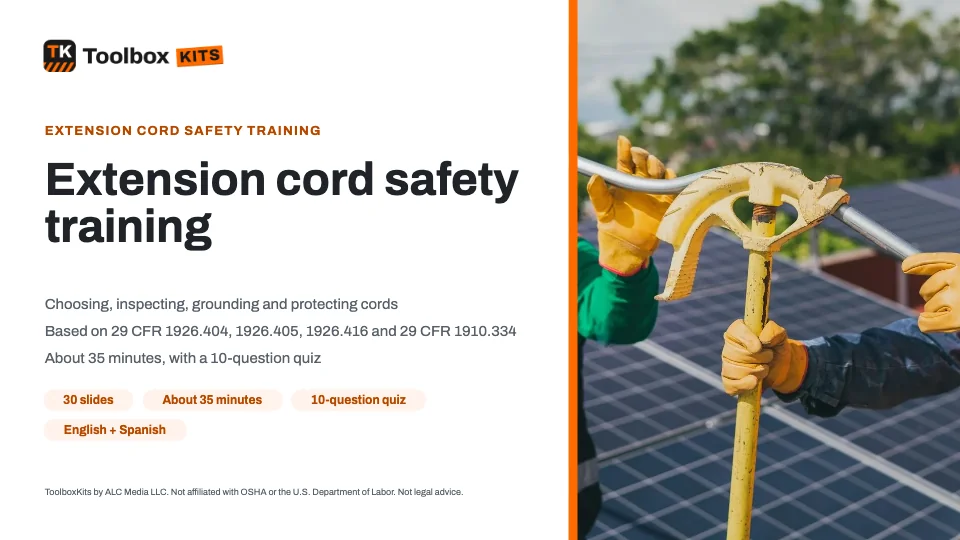 Editable PowerPoint
- Trainer guide
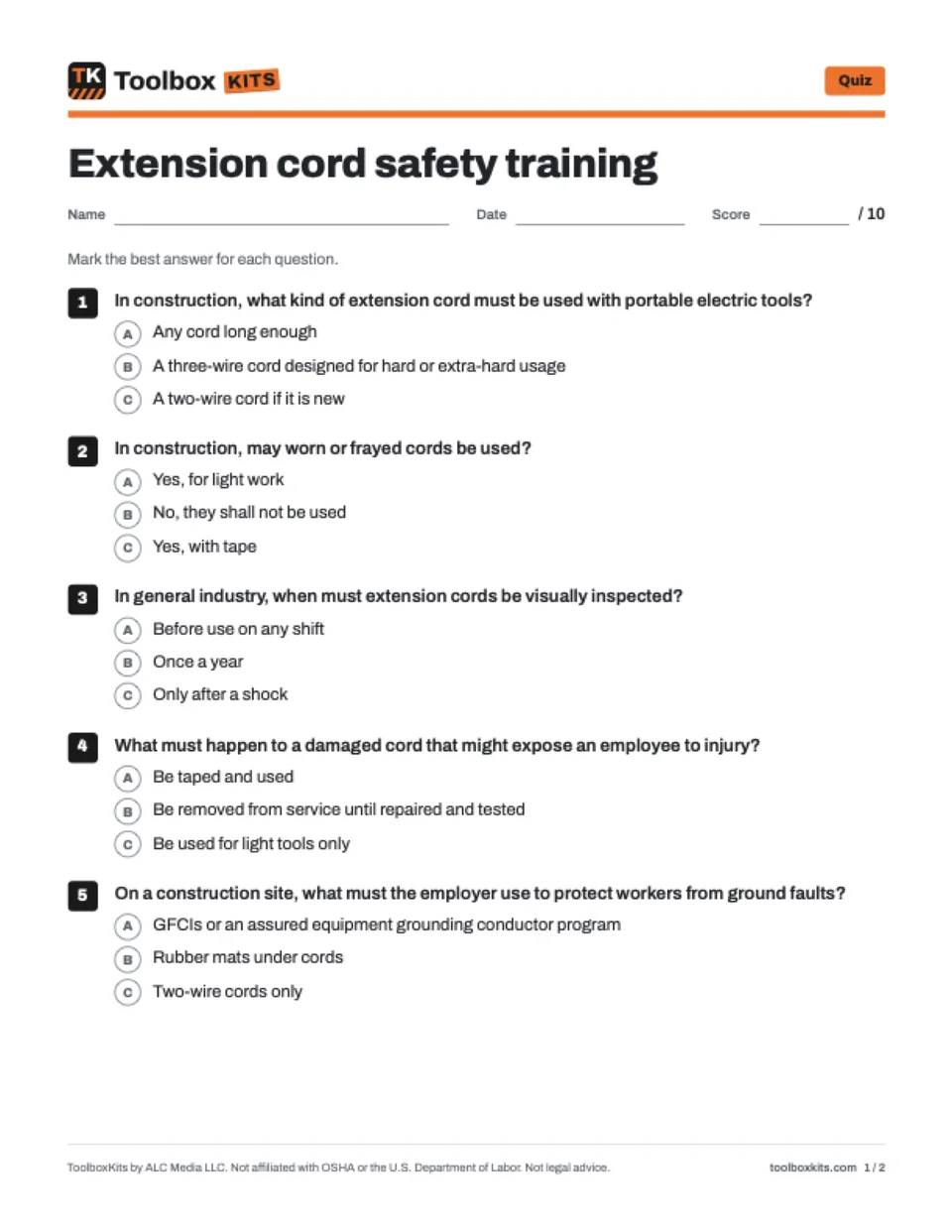 Quiz
- Answer key
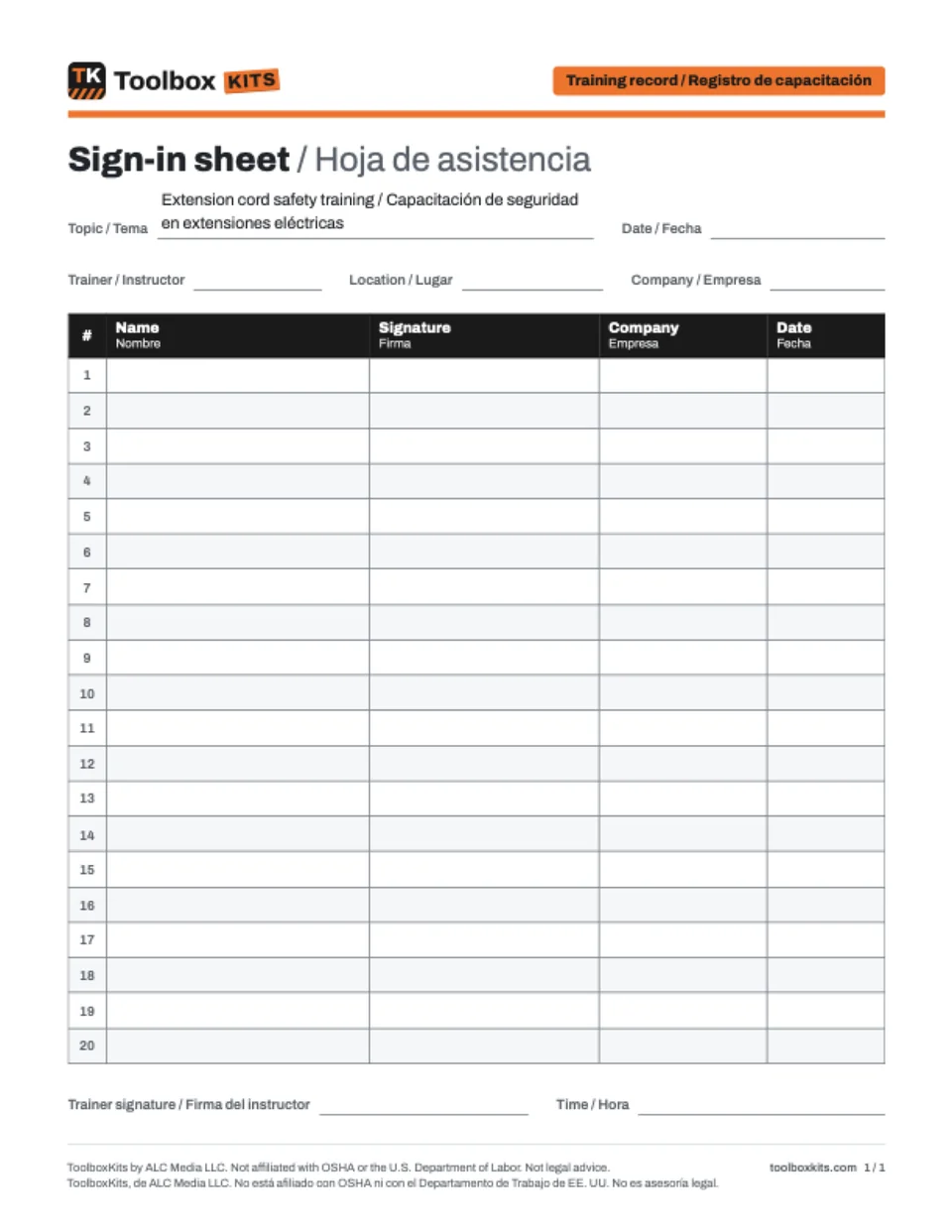 Sign-in sheet
 Certificate
- Crew handout
Try it
Try the quiz
Three questions from this topic. Pick an answer to see the right one and the OSHA paragraph.
Question 1 of 3
In construction, what kind of extension cord must be used with portable electric tools?
The rule
What OSHA requires
Plain-language summary. Each line links to the exact paragraph of the regulation.
In construction, extension cord sets used with portable electric tools and appliances must be three-wire type and designed for hard or extra-hard usage. Hard service cord (types S, ST, SO, STO) and junior hard service cord (types SJ, SJO, SJT, SJTO) are examples of cords designed for hard or extra-hard usage. These cord types may not be used unless they are durably marked on the surface with the type designation, size and number of conductors (29 CFR 1926.405(g)(2)(ii)).
“Extension cord sets used with portable electric tools and appliances shall be of three-wire type and shall be designed for hard or extra-hard usage.”
In construction, worn or frayed electric cords or cables must not be used.
“Worn or frayed electric cords or cables shall not be used.”
In general industry, extension cords and portable equipment with a cord and plug must be visually inspected before use on any shift for external defects, such as loose parts, deformed and missing pins, or damage to the outer jacket or insulation, and for signs of possible internal damage, such as a pinched or crushed outer jacket. Cords that stay connected once they are put in place and are not exposed to damage need not be inspected until they are relocated. If a defect or damage might expose an employee to injury, the item must be removed from service, and no employee may use it until repairs and tests make it safe (29 CFR 1910.334(a)(2)(ii)).
“flexible cord sets (extension cords) shall be visually inspected before use on any shift for external defects”
On construction sites, the employer must protect employees with either ground-fault circuit interrupters (GFCIs) or an assured equipment grounding conductor program. Where GFCIs are used, all 120-volt, single-phase, 15-ampere and 20-ampere receptacle outlets that are not part of the permanent wiring of the building or structure and are in use by employees must have approved GFCIs for personnel protection, with a limited exception for certain small portable or vehicle-mounted generators (29 CFR 1926.404(b)(1)(ii)).
“The employer shall use either ground fault circuit interrupters as specified in paragraph (b)(1)(ii) of this section or an assured equipment grounding conductor program”
Under an assured equipment grounding conductor program on a construction site, each cord set, attachment cap, plug and receptacle of cord sets, and any equipment connected by cord and plug must be visually inspected before each day's use for external defects and signs of internal damage, except cord sets and receptacles that are fixed and not exposed to damage. Damaged or defective equipment must not be used until repaired. The required tests must be done before first use, before equipment returns to service after repairs, before use after any incident that can reasonably be suspected of causing damage (for example, a cord set being run over), and at intervals not exceeding 3 months, or 6 months for cord sets and receptacles that are fixed and not exposed to damage (29 CFR 1926.404(b)(1)(iii)(E)(1) through (E)(4)).
“shall be visually inspected before each day's use for external defects, such as deformed or missing pins or insulation damage, and for indications of possible internal damage”
In general industry, for temporary wiring used during construction-like activities, including certain maintenance, remodeling or repair work, all 125-volt, single-phase, 15-ampere, 20-ampere and 30-ampere receptacle outlets that are not part of the permanent wiring of the building or structure and are in use by personnel must have GFCI protection. A cord connector on an extension cord set counts as a receptacle outlet when the cord set is used for temporary electric power, and cord sets and devices with the required GFCI built in that are connected to the receptacle closest to the source of power are acceptable protection.
“A cord connector on an extension cord set is considered to be a receptacle outlet if the cord set is used for temporary electric power.”
In construction, extension cords must not be fastened with staples, hung from nails or suspended by wire. In general industry, flexible cords may not be fastened with staples or hung in a way that could damage the outer jacket or insulation, and cords connected to equipment may not be used to raise or lower it (29 CFR 1910.334(a)(1)).
“Extension cords shall not be fastened with staples, hung from nails, or suspended by wire.”
In construction, flexible cords and cables must be protected from damage, and sharp corners and projections must be avoided. They may pass through doorways or other pinch points if protection is provided to avoid damage. Working spaces, walkways and similar locations must be kept clear of cords so they do not create a hazard to employees (29 CFR 1926.416(b)(2)). In general industry, cords and cables in temporary wiring must be protected from accidental damage, such as from sharp corners, projections, doorways or other pinch points (29 CFR 1910.305(a)(2)(x)).
“Flexible cords and cables shall be protected from damage. Sharp corners and projections shall be avoided.”
In construction, flexible cords may be used only in continuous lengths without splice or tap. Hard service flexible cords No. 12 or larger may be repaired if the splice keeps the insulation, outer sheath properties and usage characteristics of the cord. Unless needed for a use the rule permits, flexible cords must not be used as a substitute for the fixed wiring of a structure or run through holes in walls, ceilings or floors (29 CFR 1926.405(g)(1)(iii)(A) and (B)). General industry has the same continuous-length rule and allows the same kind of splice repair on hard-service and junior hard-service cord No. 14 and larger (29 CFR 1910.305(g)(2)(ii)).
“Flexible cords shall be used only in continuous lengths without splice or tap.”
In general industry, a flexible cord used with grounding-type equipment must contain an equipment grounding conductor (29 CFR 1910.334(a)(3)(i)). Plugs and receptacles may not be connected or altered in a way that would prevent proper continuity of the equipment grounding conductor, and adapters that interrupt the grounding connection may not be used (29 CFR 1910.334(a)(3)(ii) and (iii)). Employees' hands may not be wet when plugging and unplugging cords if energized equipment is involved (29 CFR 1910.334(a)(5)(i)).
“Attachment plugs and receptacles may not be connected or altered in a manner which would prevent proper continuity of the equipment grounding conductor”
Who must be trained
In general industry, employees who face a risk of electric shock that is not reduced to a safe level by the electrical installation requirements must be trained (29 CFR 1910.332(a)), and the training covers the safety-related work practices in 29 CFR 1910.331 through 1910.335 that pertain to their jobs, including the cord rules in 29 CFR 1910.334 (29 CFR 1910.332(b)(1)). In construction, the employer must instruct each employee in recognizing and avoiding unsafe conditions and the regulations that apply to their work environment (29 CFR 1926.21(b)(2)).

Common questions
Questions people ask
Is there a printable extension cord toolbox talk PDF?
Yes. This extension cord safety talk is free, and you can print it as a PDF in English or Spanish with a sign-in table. Read it aloud in about five minutes before work with portable power tools, temporary lights or temporary power.
What should an electrical cord safety toolbox talk cover?
Cover picking the right cord, inspecting it before use, keeping the grounding prong, GFCI protection, routing cords out of walkways and what to do with a damaged cord. In construction, extension cords used with portable tools must be three-wire type and designed for hard or extra-hard usage (29 CFR 1926.405(a)(2)(ii)(J)), and worn or frayed cords must not be used (29 CFR 1926.416(e)(1)).
What should a cable management toolbox talk cover?
Cover where cords run, how they are protected and how they are hung. On construction sites, walkways and work spaces must be kept clear of cords (29 CFR 1926.416(b)(2)), cords must be protected from damage and sharp corners (29 CFR 1926.405(a)(2)(ii)(I)), and extension cords must not be fastened with staples, hung from nails or suspended by wire (29 CFR 1926.416(e)(2)). Walk the site and agree on how the crew will protect cords at doorways and traffic crossings.
What does OSHA require for extension cords?
In construction, the employer must use GFCIs or an assured equipment grounding conductor program (29 CFR 1926.404(b)(1)(i)), extension cords for portable tools must be three-wire, hard or extra-hard usage cords (29 CFR 1926.405(a)(2)(ii)(J)), and worn or frayed cords must not be used (29 CFR 1926.416(e)(1)). In general industry, cords must be visually inspected before use on any shift, and a damaged cord that might expose an employee to injury must be removed from service until it is repaired and tested (29 CFR 1910.334(a)(2)(i) and (ii)). Both sets of rules limit splices in flexible cords (29 CFR 1926.405(g)(2)(iii) and 29 CFR 1910.305(g)(2)(ii)).
How often should extension cords be inspected?
Look over every cord before you use it. In general industry, cords must be visually inspected before use on any shift (29 CFR 1910.334(a)(2)(i)). On construction sites that use an assured equipment grounding conductor program, cord sets must be visually inspected before each day's use, unless they are fixed and not exposed to damage, and tested at intervals not exceeding 3 months, or 6 months for those that are fixed and not exposed to damage (29 CFR 1926.404(b)(1)(iii)(C) and (E)(4)).
Free to share
Use this talk for free
You can print, share and adapt this talk at no cost under the Creative Commons BY-NC-SA 4.0 license. Please credit ToolboxKits with a link.