

Free 5-minute toolbox talkFalls and heightsEnglish and Spanish
Working at height toolbox talk
Falls do not only happen on big jobs. What OSHA requires: Construction: a worker on a walking/working surface with an unprotected side or edge 6 feet or more above a lower level must be protected by guardrails, safety nets or personal fall arrest systems (29 CFR 1926.501(b)(1)).
A five-minute talk on working at height for your crew. It covers when fall protection is required, surfaces, holes, harnesses, falling objects and rescue, with OSHA citations.
Updated October 29, 2026 · Based on 29 CFR 1926.501, 29 CFR 1910.28
Read it out loud
Free 5-minute toolbox talk
Read it out loud to your crew. It takes about 5 minutes.
Start with a question
Where on this job could someone fall to a lower level today, and what is stopping them?
Why it matters
Falls do not only happen on big jobs. A quick task on a roof, a deck or a platform edge can be just as dangerous. Open edges, uncovered holes, weak surfaces and harnesses that are not checked are hazards we can control before anyone goes up, because there is no time to fix them during a fall.
Key points
Know when fall protection kicks in
In construction, a worker on a surface with an unprotected side or edge 6 feet or more above a lower level must be protected by a guardrail, a safety net or a personal fall arrest system. In general industry, the trigger is 4 feet.
More
Ladders, scaffolds and lifts have their own rules, so check before you go up.
29 CFR 1926.501(b)(1) · 29 CFR 1910.28(b)(1)(i)
Check the surface before you trust it
Before anyone works on a roof, deck or platform, the employer must determine that it has the strength and structural integrity to support workers safely. Rotted decking, fragile roof panels and skylights can give way without warning. If you are not sure a surface will hold you, stay off it and ask.
Cover and protect every hole
Holes, including skylights, are easy to miss. In construction, workers must be protected from tripping or stepping into or through holes by covers. A good cover is secured so it cannot slide and marked so nobody pulls it up for scrap. Never stand or sit on a skylight.
Inspect your harness every time
In construction, a personal fall arrest system must be inspected before each use for wear, damage and other deterioration, and defective parts must come out of service. In general industry, the check is required before first use on each shift.
More
Check the webbing, stitching, buckles, D-rings, snaps and lanyard. Tie off only to an anchorage meant for fall arrest, never to a guardrail.
29 CFR 1926.502(d)(21) · 29 CFR 1910.140(c)(18)
Watch what falls, not just who falls
When workers are exposed to falling objects, each one must wear a hard hat. The employer must also use toeboards, screens or guardrails, a canopy, or a barricaded area below. Keep tools tethered and materials back from the edge.
Plan the rescue before the fall
A worker caught by a harness still needs to be reached quickly. In construction, the employer must provide for prompt rescue after a fall, or make sure workers can rescue themselves. In general industry, the employer must provide for prompt rescue of each worker who falls.
More
Know the plan before you clip in, not after.
29 CFR 1926.502(d)(20) · 29 CFR 1910.140(c)(21)
Scenario
Picture this: a small crew is finishing a roof on a commercial building. The guardrail along one edge was taken down to land a load of materials and never put back. One worker steps back to look over the layout, close to the open edge, while another is untangling a harness that nobody checked this morning. What should happen before anyone goes back to work up there?
Ask the crew
- Where are the open edges, holes and skylights on this job right now?
- Who checked their harness and lanyard this morning, and what did they look for?
- If someone falls and is hanging in a harness, how do we get them down quickly?
- What near misses have we had with edges or holes, and did we fix the cause?
Takeaway
Before you go up, know what protects you from a fall, check your gear, and make sure every edge and hole is protected.
Trainer: ______________________ Date: ____________
Credit: ToolboxKits, https://toolboxkits.com/topics/working-at-heights/ (CC BY-NC-SA 4.0)
The poster is also inside the paid kits.
Audit-ready records in 60 seconds
Fill in your crew and download a filled sign-in sheet for this talk. Everything is made in your browser. Names are never uploaded or stored.
Start a sign-off
Crew scan a QR code on their own phones, type their name and sign with a finger. You see the names arrive and download the signed sheet. Free, no account.
Kits
Get the kit
No subscription needed. Buy only the kit you need.
Toolbox talk kit
$4.99
- 5-minute talk, English PDF
- 5-minute talk, Spanish PDF
- Editable mini-deck (English and Spanish)
- One-page crew handout (English and Spanish)
- Bilingual sign-in sheet
- 3-question quiz with answer key (English and Spanish)
- One-page bilingual poster
- Audit-ready records in 60 seconds: fill in your crew and get a sign-in sheet and a certificate for every worker
Training kit
$9
Editable PowerPoint, 34 slides
- Editable PowerPoint with trainer notes on every slide
- Trainer guide PDF with timing and discussion tips
- 10-question quiz and answer key
- Sign-in sheet and certificate of completion with fillable fields
- One-page crew handout
- Full Spanish version of everything
- One-page bilingual poster
- Audit-ready records in 60 seconds: fill in your crew and get a sign-in sheet and a certificate for every worker
- Instant download
- Secure checkout by Stripe
- 30-day refund, no questions
Need many topics? All Access gives you every kit for $99 a year.
Inside the kit
See what is in the kit
What is in the kit
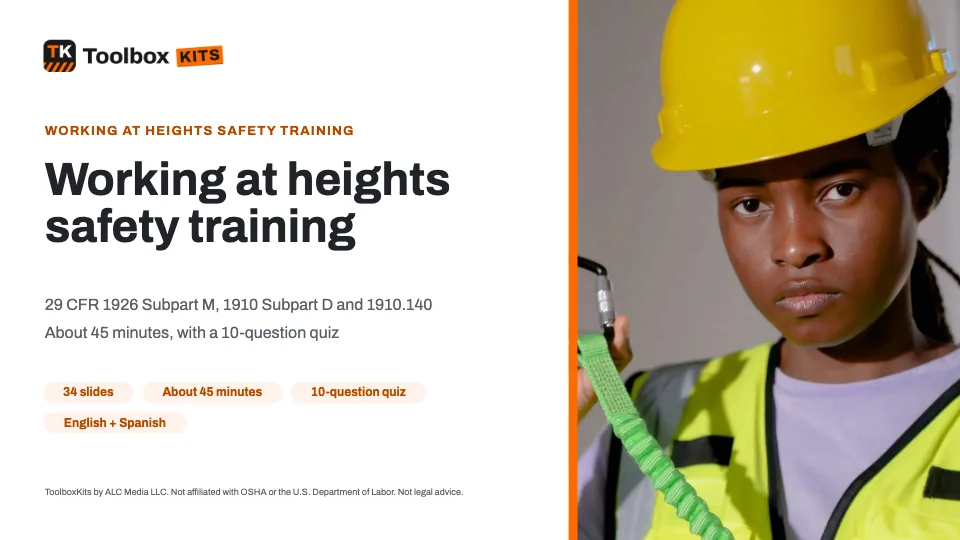 Editable PowerPoint
- Trainer guide
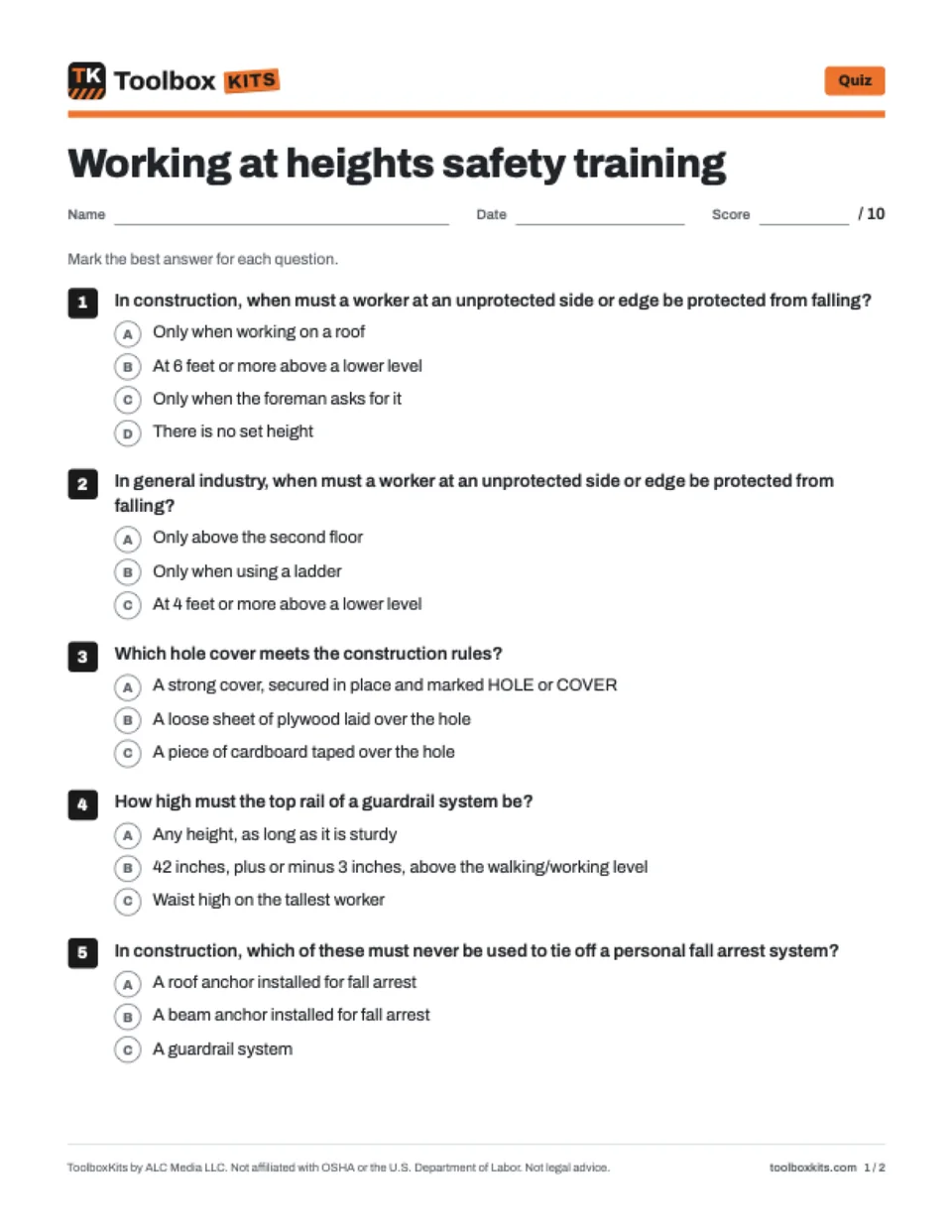 Quiz
- Answer key
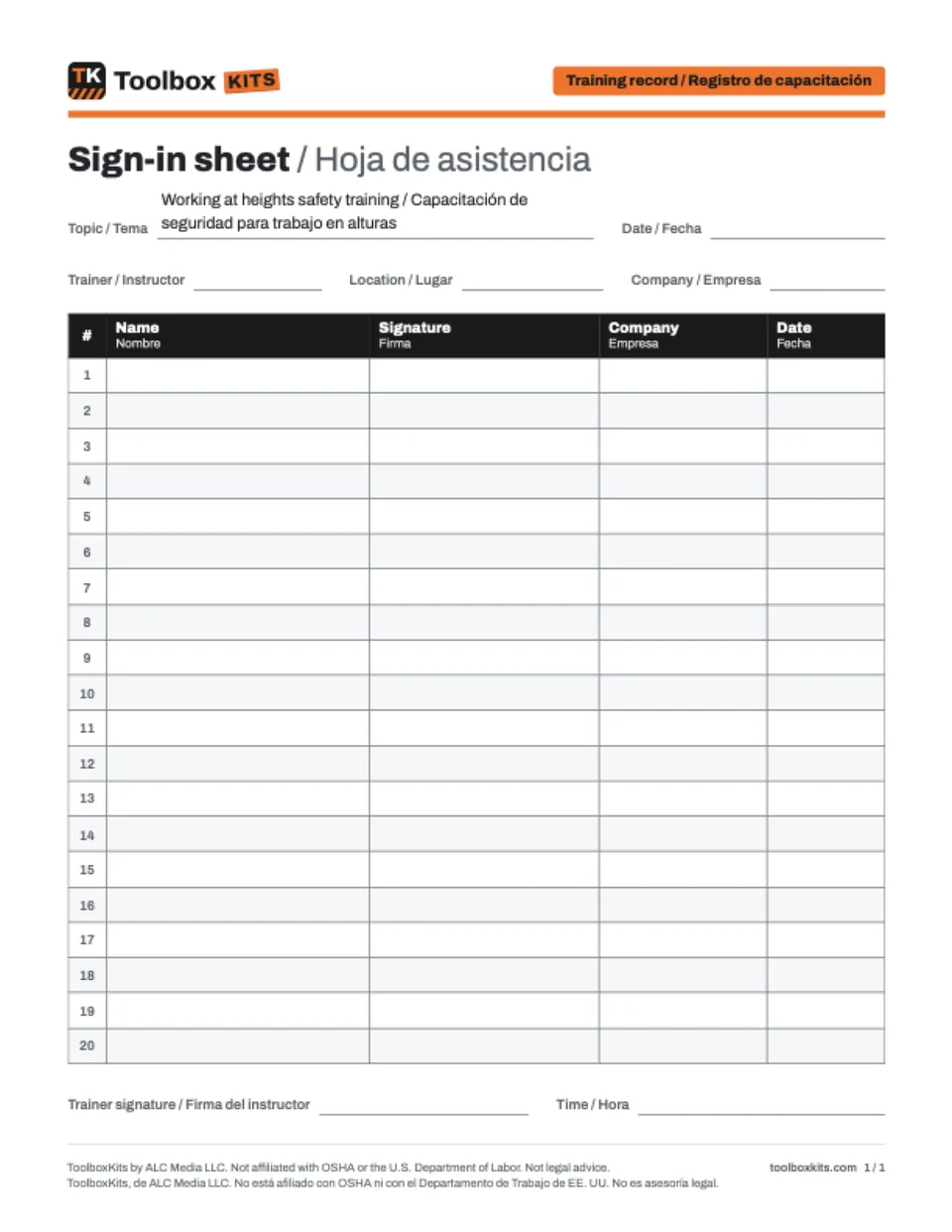 Sign-in sheet
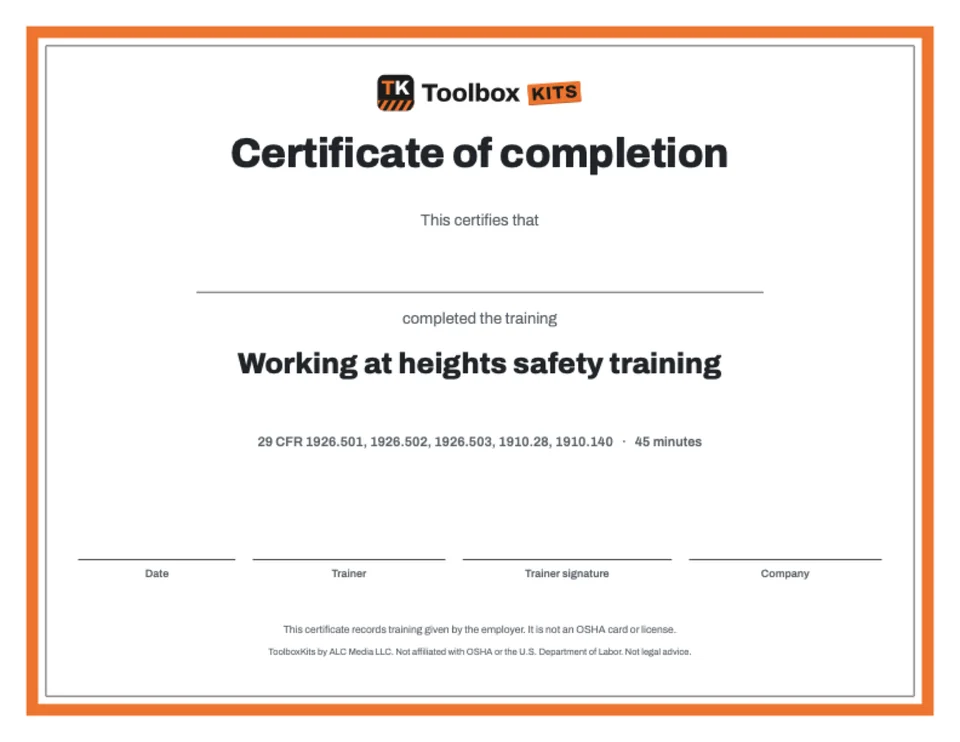 Certificate
- Crew handout
Try it
Try the quiz
Three questions from this topic. Pick an answer to see the right one and the OSHA paragraph.
Question 1 of 3
In construction, when must a worker at an unprotected side or edge be protected from falling?
The rule
What OSHA requires
Plain-language summary. Each line links to the exact paragraph of the regulation.
Construction: a worker on a walking/working surface with an unprotected side or edge 6 feet or more above a lower level must be protected by guardrails, safety nets or personal fall arrest systems.
“with an unprotected side or edge which is 6 feet (1.8 m) or more above a lower level shall be protected from falling by the use of guardrail systems, safety net systems, or personal fall arrest systems”
General industry: a worker on a walking-working surface with an unprotected side or edge 4 feet or more above a lower level must be protected from falling by guardrails, safety nets or personal fall protection systems.
“each employee on a walking-working surface with an unprotected side or edge that is 4 feet (1.2 m) or more above a lower level is protected from falling”
The employer must determine that walking and working surfaces are strong enough to support workers safely before anyone works on them.
“Employees shall be allowed to work on those surfaces only when the surfaces have the requisite strength and structural integrity.”
Construction: workers must be protected from falling through holes, including skylights, more than 6 feet above lower levels by personal fall arrest systems, covers or guardrails around the holes.
“Each employee on walking/working surfaces shall be protected from falling through holes (including skylights) more than 6 feet (1.8 m) above lower levels”
When workers are exposed to falling objects, each must wear a hard hat, and the employer must also use toeboards, screens or guardrails, a canopy, or a barricaded area below.
“When an employee is exposed to falling objects, the employer shall have each employee wear a hard hat”
Construction: personal fall arrest systems must be inspected before each use, and defective parts removed from service.
“Personal fall arrest systems shall be inspected prior to each use for wear, damage and other deterioration, and defective components shall be removed from service.”
Construction: the employer must provide for prompt rescue after a fall, or make sure workers can rescue themselves.
“The employer shall provide for prompt rescue of employees in the event of a fall or shall assure that employees are able to rescue themselves.”
Construction: every worker who might be exposed to fall hazards must be trained to recognize them and to follow the procedures that minimize them.
“The employer shall provide a training program for each employee who might be exposed to fall hazards.”
General industry: workers who use personal fall protection systems, or who must be trained under other rules in the subpart, must be trained before they are exposed to a fall hazard.
“Before any employee is exposed to a fall hazard, the employer must provide training for each employee who uses personal fall protection systems or who is required to be trained as specified elsewhere in this subpart.”
General industry: fall protection training must be given in a manner each worker understands.
“The employer must provide information and training to each employee in a manner that the employee understands.”
Who must be trained
Construction: each employee who might be exposed to fall hazards, trained by a competent person (29 CFR 1926.503(a)(1) and (a)(2)). General industry: each employee who uses personal fall protection systems or who is required to be trained elsewhere in subpart D, before they are exposed to a fall hazard, trained by a qualified person (29 CFR 1910.30(a)(1) and (a)(2)).
When to retrain
Retrain a worker when there is reason to believe they no longer have the understanding and skill needed, for example when changes in the workplace or in the fall protection systems or equipment make earlier training obsolete, or when gaps show up in the worker's knowledge or use of the equipment (29 CFR 1926.503(c); 29 CFR 1910.30(c)).
Common questions
Questions people ask
Is there a working at height toolbox talk presentation?
This free talk is written to be read aloud, so you can run it without slides. If you want a slide presentation, the training kit for this topic includes an editable PowerPoint with trainer notes, a quiz and a sign-in sheet, in English and Spanish.
Is there a printable work at height toolbox talk PDF?
Yes. This talk is available as a free printable PDF in English and Spanish, with a sign-in table for your crew. Print it, read it aloud in about five minutes, and keep the signed sheet with your safety records.
What points should a working at height toolbox talk cover?
Cover when fall protection is required for your type of work, checking surfaces before you trust them, covering holes, harness inspection and tie-off, falling objects and rescue. In construction, the starting point is protection for anyone 6 feet or more above a lower level at an unprotected side or edge. Pick the points that match the work your crew is doing this week.
Who needs working at height safety training?
In construction, the employer must provide a training program for each employee who might be exposed to fall hazards. The program must teach them to recognize the hazards of falling and the procedures to follow to minimize them. A toolbox talk is a good refresher, but it does not replace that training.
Can I use this as a working at height safety moment?
Yes. For a short safety moment, read the scenario and ask one discussion question before the crew goes up. It works well at the start of roof, deck or steel work, or any shift with open edges.
Free to share
Use this talk for free
You can print, share and adapt this talk at no cost under the Creative Commons BY-NC-SA 4.0 license. Please credit ToolboxKits with a link.