

Free 5-minute toolbox talkFalls and heightsEnglish and Spanish
Scaffolding safety toolbox talk
One missing plank, a soft base or a rail left off can turn a normal shift into a fall. What OSHA requires: Each worker who works on a scaffold must be trained by a qualified person to recognize the hazards of that type of scaffold and to understand how to control them (29 CFR 1926.454(a)).
A 5-minute scaffold safety talk to read aloud before work. It covers inspections, getting on and off, fall protection, footing, load limits and the people working below, with the OSHA rule behind each point.
Updated October 29, 2026 · Based on 29 CFR 1926.451, 29 CFR 1926.452, 29 CFR 1926.454
Read it out loud
Free 5-minute toolbox talk
Read it out loud to your crew. It takes about 5 minutes.
Start with a question
Who checked the scaffold you are about to climb today, and what did they look at?
Why it matters
A scaffold changes every day as it is built, moved, loaded and taken down. One missing plank, a soft base or a rail left off can turn a normal shift into a fall. People working below are at risk too, from tools and material that drop off the platform. A minute of looking before you climb is how we catch these problems.
Key points
A competent person checks it every shift
A competent person must inspect the scaffold for visible defects before each work shift and after anything that could affect its structure. That check does not replace your own eyes. Before you climb, look for missing planks, loose pins, missing rails and soft ground under the base.
More
If something looks wrong, stay off and tell your foreman.
Get on and off the right way
When the platform is more than 2 feet above or below the point of access, use a ladder, stair tower, ramp, walkway or other proper access. Crossbraces are never a means of access, so do not climb them. Keep your hands free when you climb, and raise tools and material with a hand line or hoist.
Guardrails or fall arrest above 10 feet
Each worker on a scaffold more than 10 feet above a lower level must be protected from falling to that lower level. Depending on the type of scaffold, that usually means guardrails, a personal fall arrest system, or both. Never pull a rail to pass material and leave it off.
More
If a rail is missing, stop and get it fixed before you work there.
Solid footing under every leg
Scaffold poles, legs, posts, frames and uprights must bear on base plates and mud sills or another adequate firm foundation. Loose bricks, concrete blocks, boxes and buckets are not a foundation. Check that the ground has not gone soft from rain or digging, and that the scaffold stands plumb.
Know the load limit
A scaffold must not be loaded past its maximum intended load or rated capacity, whichever is less. That limit counts people, tools and material together. Do not stockpile block or brick in one bay, and keep platforms clear of debris.
More
If you are not sure what the scaffold can hold, ask the competent person.
Protect the people below
Workers on a scaffold wear hard hats and must also be protected from falling tools and debris with toeboards, screens, guardrail systems, debris nets, catch platforms or canopies. Barricade the area below when something could fall on people.
More
Use tool lanyards where you can, and never toss material off the platform.
Scenario
Picture this: Late yesterday, another crew pulled two planks and a section of guardrail to land some material, and nobody put them back or told anyone. This morning the ladder is blocked by a pallet, so the first worker up climbs the crossbraces instead. At the top, the worker steps toward the open end of the platform, where the planks used to be. What should have happened here, and who should have caught it?
Ask the crew
- Who is the competent person for our scaffolds, and how do we reach them?
- What would make you stay off a scaffold today?
- Are there power lines, high winds or icy planks we need to plan for on this job?
- How do we keep people below safe while we work overhead?
Takeaway
Look before you climb, use proper access, keep rails and planks in place, and stay off any scaffold that does not look right.
Trainer: ______________________ Date: ____________
Credit: ToolboxKits, https://toolboxkits.com/topics/scaffold-safety/ (CC BY-NC-SA 4.0)
The poster is also inside the paid kits.
Audit-ready records in 60 seconds
Fill in your crew and download a filled sign-in sheet for this talk. Everything is made in your browser. Names are never uploaded or stored.
Start a sign-off
Crew scan a QR code on their own phones, type their name and sign with a finger. You see the names arrive and download the signed sheet. Free, no account.
Kits
Get the kit
No subscription needed. Buy only the kit you need.
Toolbox talk kit
$4.99
- 5-minute talk, English PDF
- 5-minute talk, Spanish PDF
- Editable mini-deck (English and Spanish)
- One-page crew handout (English and Spanish)
- Bilingual sign-in sheet
- 3-question quiz with answer key (English and Spanish)
- One-page bilingual poster
- Audit-ready records in 60 seconds: fill in your crew and get a sign-in sheet and a certificate for every worker
Training kit
$9
Editable PowerPoint, 35 slides
- Editable PowerPoint with trainer notes on every slide
- Trainer guide PDF with timing and discussion tips
- 10-question quiz and answer key
- Sign-in sheet and certificate of completion with fillable fields
- One-page crew handout
- Full Spanish version of everything
- One-page bilingual poster
- Audit-ready records in 60 seconds: fill in your crew and get a sign-in sheet and a certificate for every worker
- Instant download
- Secure checkout by Stripe
- 30-day refund, no questions
Need many topics? All Access gives you every kit for $99 a year.
Inside the kit
See what is in the kit
What is in the kit
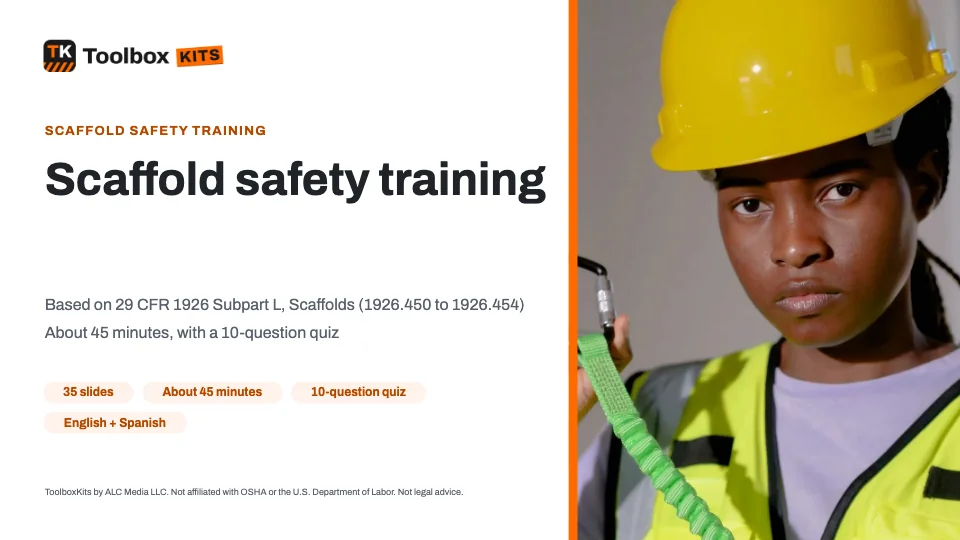 Editable PowerPoint
- Trainer guide
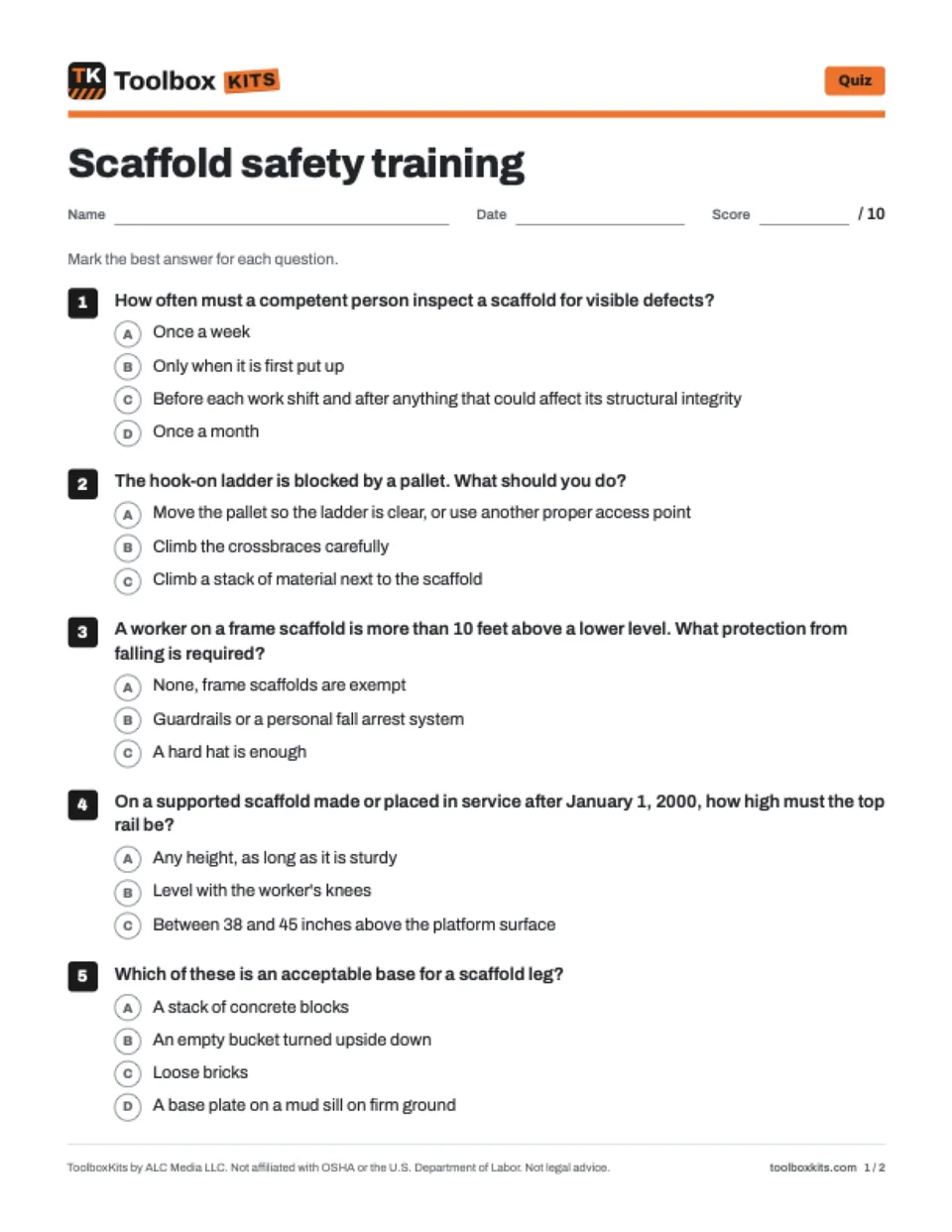 Quiz
- Answer key
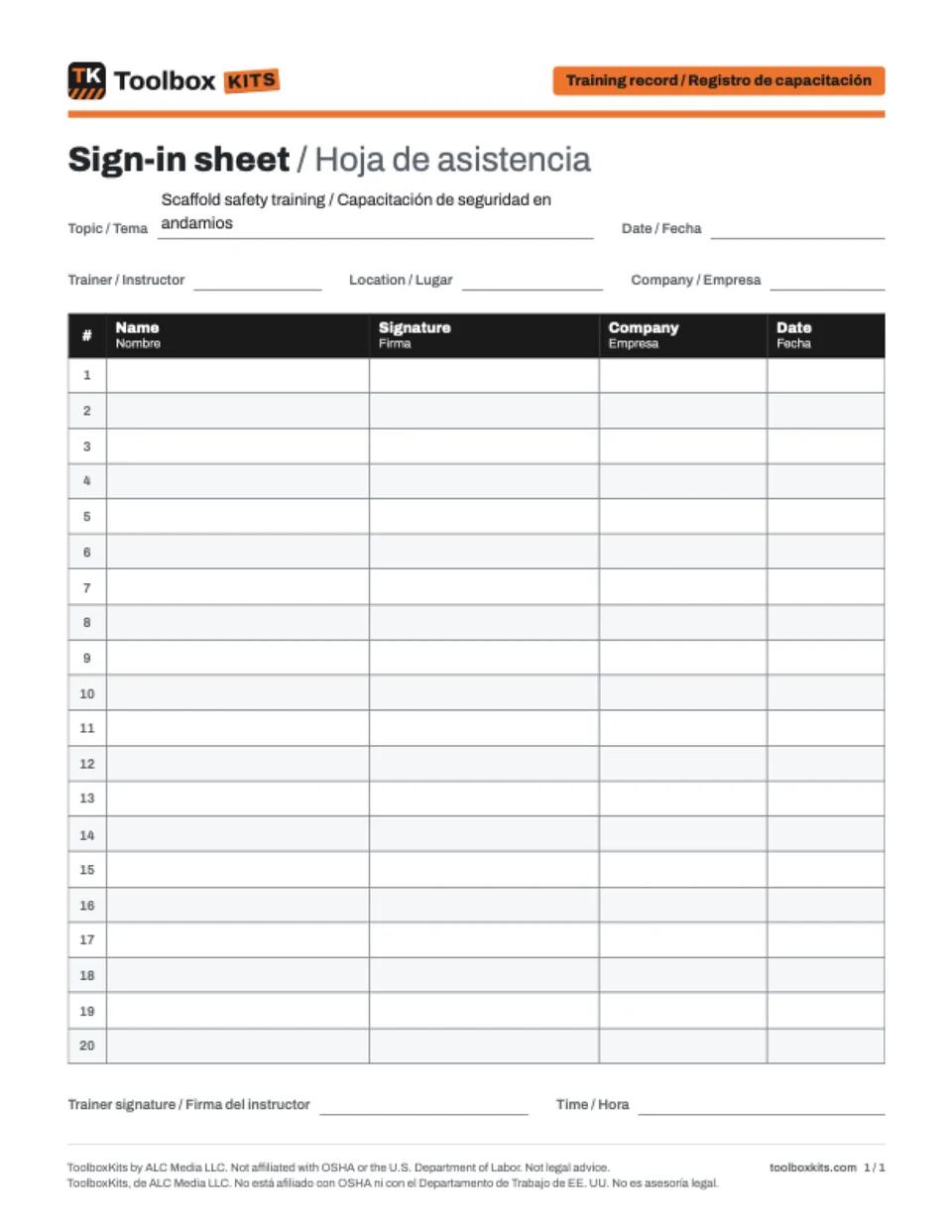 Sign-in sheet
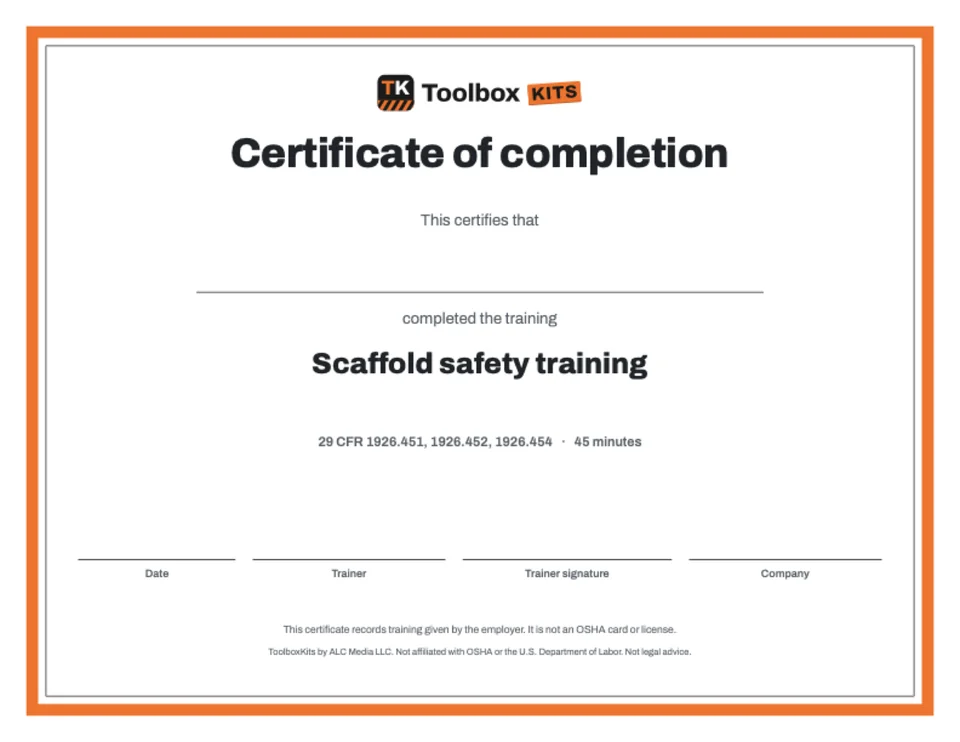 Certificate
- Crew handout
Try it
Try the quiz
Three questions from this topic. Pick an answer to see the right one and the OSHA paragraph.
Question 1 of 3
How often must a competent person inspect a scaffold for visible defects?
The rule
What OSHA requires
Plain-language summary. Each line links to the exact paragraph of the regulation.
Each worker who works on a scaffold must be trained by a qualified person to recognize the hazards of that type of scaffold and to understand how to control them.
“trained by a person qualified in the subject matter to recognize the hazards associated with the type of scaffold being used”
Workers who erect, take down, move, operate, repair, maintain or inspect a scaffold must be trained by a competent person.
“trained by a competent person to recognize any hazards associated with the work in question”
A competent person must inspect scaffolds for visible defects before each work shift and after anything that could affect their structural integrity.
“inspected for visible defects by a competent person before each work shift”
Each worker on a scaffold more than 10 feet above a lower level must be protected from falling to that lower level.
“Each employee on a scaffold more than 10 feet (3.1 m) above a lower level shall be protected from falling to that lower level.”
When a platform is more than 2 feet above or below the point of access, proper access such as ladders, stair towers, ramps or walkways must be used. Crossbraces may not be used for access.
“Crossbraces shall not be used as a means of access.”
Scaffolds and their components may not be loaded beyond their maximum intended load or rated capacity, whichever is less.
“shall not be loaded in excess of their maximum intended loads or rated capacities, whichever is less”
Each platform on all working levels must be fully planked or decked between the front uprights and the guardrail supports.
“Each platform on all working levels of scaffolds shall be fully planked or decked”
Scaffold poles, legs, posts, frames and uprights must bear on base plates and mud sills or another adequate firm foundation.
“shall bear on base plates and mud sills or other adequate firm foundation”
Besides hard hats, workers on scaffolds must be protected from falling tools and debris by toeboards, screens, guardrail systems, debris nets, catch platforms or canopy structures.
“In addition to wearing hardhats each employee on a scaffold shall be provided with additional protection from falling hand tools, debris, and other small objects”
Scaffolds may only be erected, moved, taken down or altered under the supervision and direction of a competent person, by experienced and trained workers that person selects.
“only under the supervision and direction of a competent person qualified in scaffold erection, moving, dismantling or alteration”
Who must be trained
Each employee who performs work while on a scaffold, trained by a person qualified in the subject matter (29 CFR 1926.454(a)). Each employee who erects, disassembles, moves, operates, repairs, maintains or inspects a scaffold, trained by a competent person (29 CFR 1926.454(b)).
When to retrain
Required when the employer has reason to believe a worker lacks the skill or understanding for safe scaffold work. At a minimum, retrain when changes at the worksite, or changes in the types of scaffolds, fall protection, falling object protection or other equipment, present a hazard the worker has not been trained on, or when the worker's scaffold work shows they have not kept the needed proficiency (29 CFR 1926.454(c)).

Common questions
Questions people ask
Is there a printable scaffolding toolbox talk PDF?
Yes. This scaffolding safety talk is a free printable PDF in English and Spanish, with a sign-in sheet to record who attended. Print it, read it aloud before the shift, and keep the signed sheet with your training records.
Does a scaffolding safety talk count as OSHA scaffold training?
Not on its own. Each worker who works on a scaffold must be trained by a person qualified in the subject to recognize the hazards of that type of scaffold and the procedures to control them. A toolbox talk is a good refresher between those training sessions.
What scaffold safety meeting topics should we cover?
Rotate through inspections, access, guardrails and fall arrest, footing, load limits, falling objects, power lines and weather. Give a fresh talk any time a new type of scaffold or new fall protection shows up on the job. Retraining is required when changes in scaffold types, fall protection, falling object protection or other equipment bring a hazard a worker has not been trained on.
What should we check before working on scaffolding?
First, confirm that a competent person has inspected the scaffold for visible defects before this shift. Then do your own quick look at the base, planks, guardrails and access. Stay off if planks, rails or braces are missing, or if the platform is covered in snow, ice or other slippery material.
Is there a scaffold safety training PowerPoint?
The free talk on this page is made to be read aloud from a printout, so you do not need a projector. If you want slides for a longer scaffold safety presentation, use the training kit option on this page. Slides work best when the trainer stops to point at the real scaffolds on your job.
Free to share
Use this talk for free
You can print, share and adapt this talk at no cost under the Creative Commons BY-NC-SA 4.0 license. Please credit ToolboxKits with a link.