

Free 5-minute toolbox talkFalls and heightsEnglish and Spanish
Harness toolbox talk: safety harness inspection
Your harness is the one piece of gear that has to work the first time you fall. What OSHA requires: In construction, personal fall arrest systems must be inspected before each use for wear, damage and other deterioration, and defective components must be removed from service (29 CFR 1926.502(d)(21)).
A free safety harness toolbox talk for crews who wear a full body harness. Read it aloud in about five minutes before anyone clips in.
Updated October 29, 2026 · Based on 29 CFR 1926.502, 29 CFR 1910.140
Read it out loud
Free 5-minute toolbox talk
Read it out loud to your crew. It takes about 5 minutes.
Start with a question
When you last put on your harness, did you look at the webbing, the stitching and the hardware first?
Why it matters
Your harness is the one piece of gear that has to work the first time you fall. A cut strap, a bent buckle or a cracked D-ring will not show up until it is too late. A quick check before each use is how you find the problem on the ground instead of in the air.
Key points
Inspect it before every use
Personal fall arrest systems must be inspected before each use for wear, damage and other deterioration, and defective components must be removed from service. In general industry, the check is before initial use during each workshift for mildew, wear, damage and other deterioration.
More
Do it every time, even when the harness is new.
29 CFR 1926.502(d)(21) · 29 CFR 1910.140(c)(18)
What to look at on the harness
Run the straps through your hands. Look for cuts, frays, burns, melted or glazed spots, chemical stains, stiff or hard areas and mildew. Check the stitching for pulled or broken threads. Check the buckles and the D-ring for cracks, bends, rust and sharp edges.
More
Read the label and make sure it is still readable. Check any energy absorber for signs it has been used.
Check the lanyard and connectors
Look over the lanyard, lifeline, anchorage connector and snaphooks the same way. In general industry, snaphooks and carabiners must be the automatic locking type that need at least two separate, consecutive movements to open.
More
Make sure each connector closes and locks, and that it is the right size for what it connects to.
Wear it right
Snug the leg and chest straps and keep the webbing flat. In construction, the attachment point of a body harness must be in the center of your back near shoulder level, or above your head. Harnesses and components are for employee protection only, not for hoisting materials.
29 CFR 1926.502(d)(17) · 29 CFR 1926.502(d)(18)
After a fall, pull it from service
A personal fall arrest system or component that has been loaded by a fall must be removed from service right away. It cannot be used again until a competent person inspects it and decides it is undamaged and suitable for reuse. If a harness is damaged, tag it out and tell your supervisor.
More
Do not fix it yourself.
Have a rescue plan
The employer must provide for prompt rescue of employees in the event of a fall, or make sure they can rescue themselves. Hanging in a harness can be dangerous, so know who will call for help and how the person will be brought down before anyone goes up.
Scenario
Picture this: A worker grabs a harness from the back of a truck on a hot, dusty morning. The shoulder strap is stiff and shiny in one spot, and the leg strap buckle feels loose. The crew is behind schedule and the roof is waiting, so he figures it looks fine and clips in. A coworker notices him adjusting the buckle. What should have happened before he climbed?
Ask the crew
- Where do we store harnesses, and how do we protect them from sun, chemicals and sharp edges?
- Who removes a damaged harness from service on this job?
- What is our plan to rescue someone hanging in a harness?
- What would make you stop and swap your harness before climbing?
Takeaway
Check your harness every time you wear it, and if you have any doubt, pull it from service.
Trainer: ______________________ Date: ____________
Credit: ToolboxKits, https://toolboxkits.com/topics/harness-inspection/ (CC BY-NC-SA 4.0)
The poster is also inside the paid kits.
Audit-ready records in 60 seconds
Fill in your crew and download a filled sign-in sheet for this talk. Everything is made in your browser. Names are never uploaded or stored.
Start a sign-off
Crew scan a QR code on their own phones, type their name and sign with a finger. You see the names arrive and download the signed sheet. Free, no account.
Kits
Get the kit
No subscription needed. Buy only the kit you need.
Toolbox talk kit
$4.99
- 5-minute talk, English PDF
- 5-minute talk, Spanish PDF
- Editable mini-deck (English and Spanish)
- One-page crew handout (English and Spanish)
- Bilingual sign-in sheet
- 3-question quiz with answer key (English and Spanish)
- One-page bilingual poster
- Audit-ready records in 60 seconds: fill in your crew and get a sign-in sheet and a certificate for every worker
Training kit
$9
Editable PowerPoint, 31 slides
- Editable PowerPoint with trainer notes on every slide
- Trainer guide PDF with timing and discussion tips
- 10-question quiz and answer key
- Sign-in sheet and certificate of completion with fillable fields
- One-page crew handout
- Full Spanish version of everything
- One-page bilingual poster
- Audit-ready records in 60 seconds: fill in your crew and get a sign-in sheet and a certificate for every worker
- Instant download
- Secure checkout by Stripe
- 30-day refund, no questions
Need many topics? All Access gives you every kit for $99 a year.
Inside the kit
See what is in the kit
What is in the kit
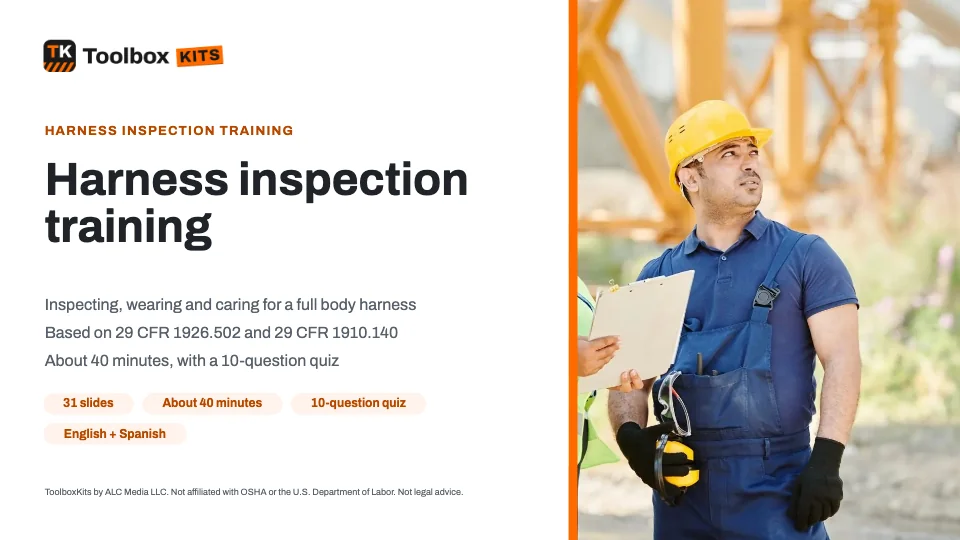 Editable PowerPoint
- Trainer guide
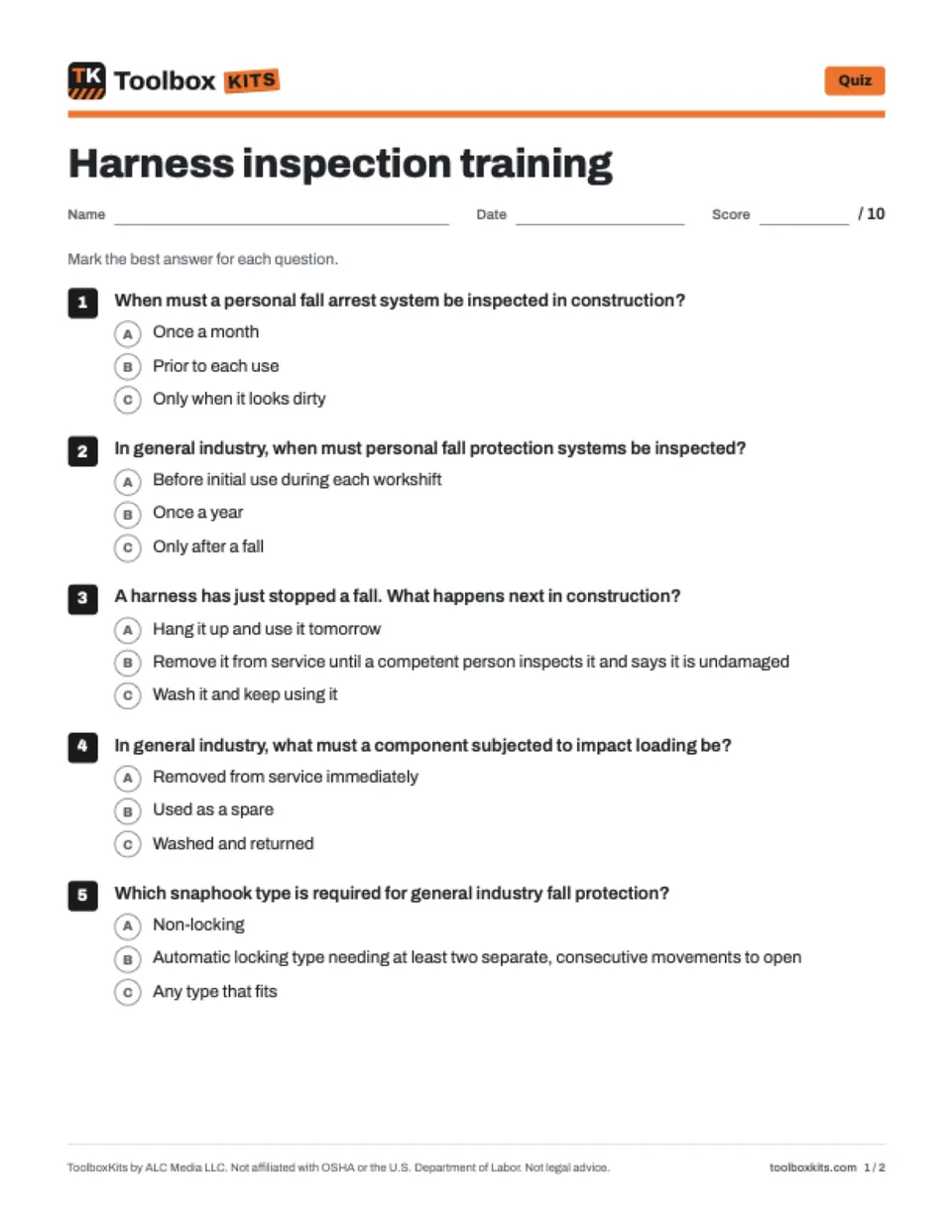 Quiz
- Answer key
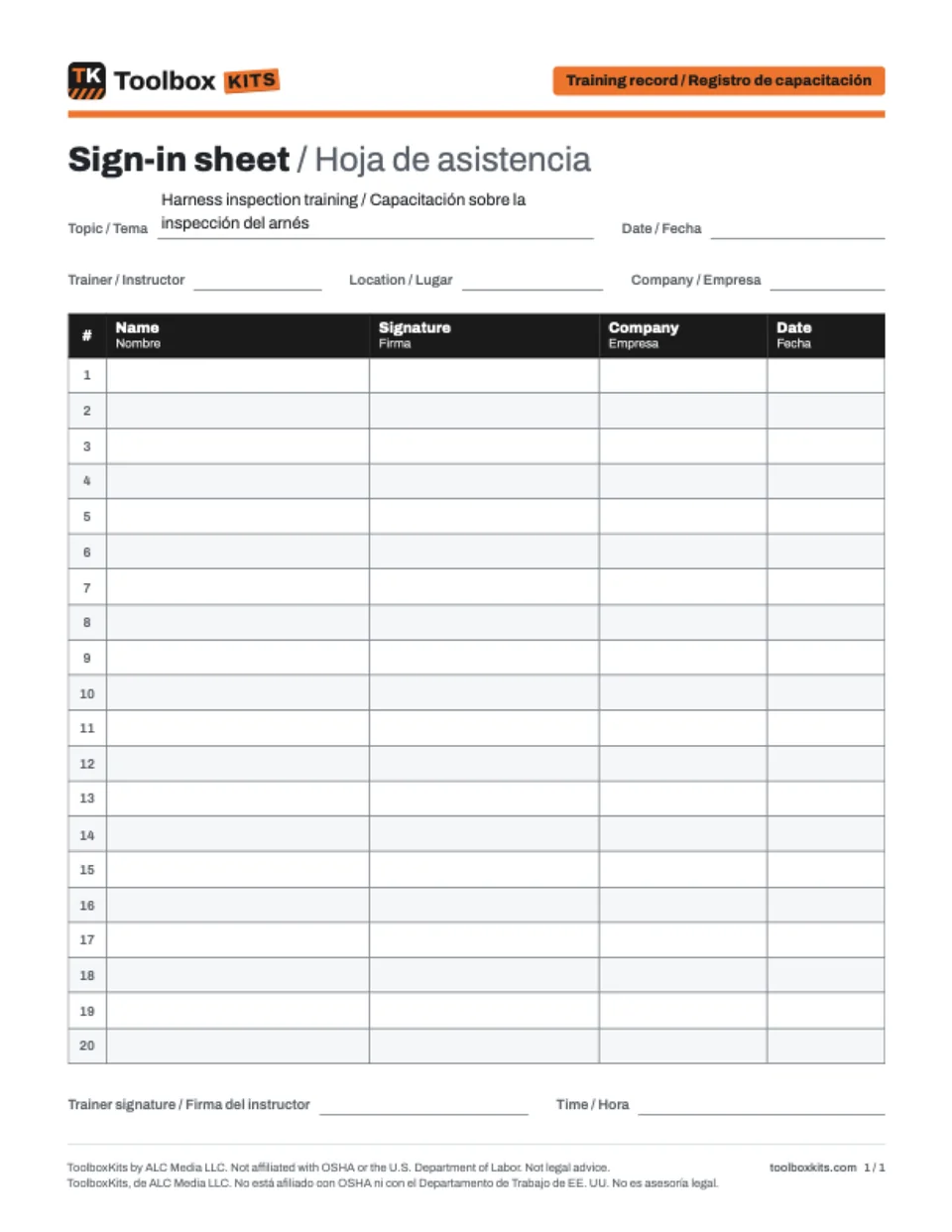 Sign-in sheet
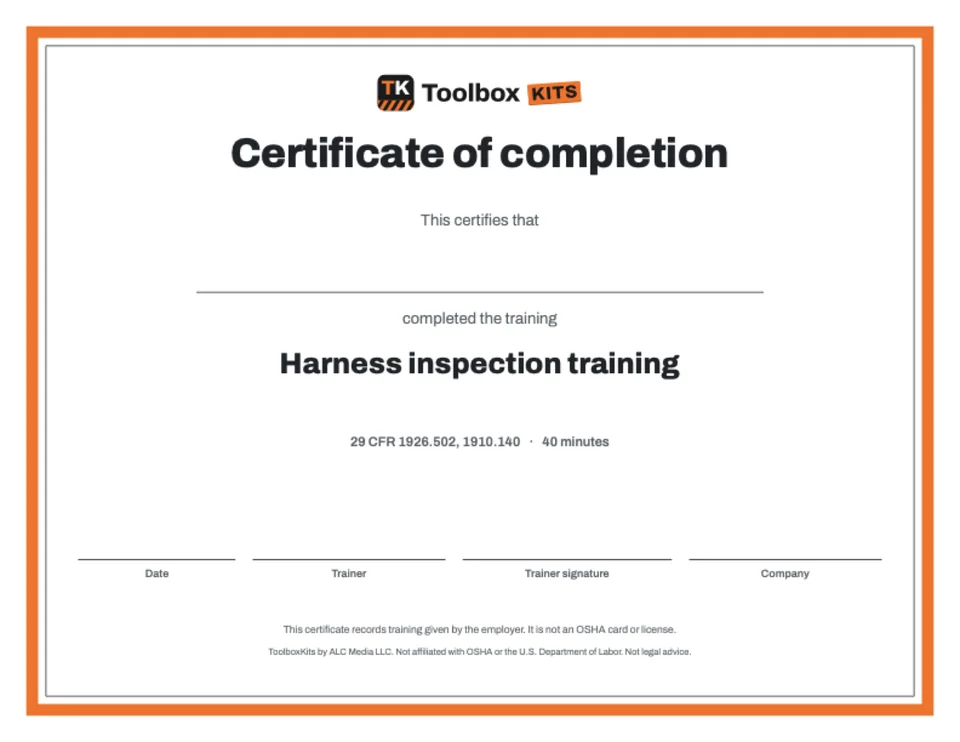 Certificate
- Crew handout
Try it
Try the quiz
Three questions from this topic. Pick an answer to see the right one and the OSHA paragraph.
Question 1 of 3
When must a safety harness be inspected in construction?
The rule
What OSHA requires
Plain-language summary. Each line links to the exact paragraph of the regulation.
In construction, personal fall arrest systems must be inspected before each use for wear, damage and other deterioration, and defective components must be removed from service.
“Personal fall arrest systems shall be inspected prior to each use for wear, damage and other deterioration, and defective components shall be removed from service.”
In general industry, personal fall protection systems must be inspected before initial use during each workshift for mildew, wear, damage and other deterioration, and defective components must be removed from service.
“Personal fall protection systems must be inspected before initial use during each workshift for mildew, wear, damage, and other deterioration, and defective components must be removed from service.”
In construction, a system or component that has been loaded by a fall must be removed from service right away and not used again until a competent person determines it is undamaged and suitable for reuse.
In general industry, a personal fall protection system or component subjected to impact loading must be removed from service immediately and not used again until a competent person inspects it and determines it is not damaged and safe for use.
In general industry, snaphooks and carabiners must be the automatic locking type that require at least two separate, consecutive movements to open.
“Snaphooks and carabiners must be the automatic locking type that require at least two separate, consecutive movements to open.”
Body belts are prohibited as part of a personal fall arrest system in general industry. In construction, body belts are not acceptable as part of a personal fall arrest system.
“Body belts are prohibited as part of a personal fall arrest system.”
In construction, the attachment point of a body harness must be in the center of the wearer's back near shoulder level, or above the wearer's head.
Harnesses and components must be used only for employee protection, not to hoist materials.
The employer must provide for prompt rescue of employees in the event of a fall, or make sure employees can rescue themselves.
“The employer shall provide for prompt rescue of employees in the event of a fall or shall assure that employees are able to rescue themselves.”
Common questions
Questions people ask
Is there a printable harness toolbox talk PDF?
Yes. This harness toolbox talk is free to print as a PDF in English and Spanish, with a sign-in table for your crew. Read it aloud in about five minutes before anyone puts on a harness, and keep the signed sheet with your safety records.
How often must a safety harness be inspected?
A harness must be inspected before each use in construction (29 CFR 1926.502(d)(21)), and before initial use during each workshift in general industry (29 CFR 1910.140(c)(18)). Defective components must be removed from service. A competent person must also inspect gear that has been loaded by a fall before it is used again.
What is the difference between a full body harness and a body belt?
A full body harness spreads the force of a fall across the body. A body belt is not acceptable as part of a personal fall arrest system in construction (29 CFR 1926.502(d)) and is prohibited as part of one in general industry (29 CFR 1910.140(d)(3)). A body belt may still be used in a positioning system.
How long does a safety harness last?
The OSHA rules cited here do not set a retirement date for a harness. They require inspection before each use and removal of defective components, and removal after a fall. Follow the manufacturer's instructions for service life, storage and care.
Is there a safety harness training PowerPoint or PDF?
This free talk is written to be read aloud, so you do not need slides. For a longer harness safety session, the paid training kit for this topic is an editable PowerPoint in English and Spanish with trainer notes, a quiz and a sign-in sheet. If the kit is not ready to buy yet, you can request it from this page. Slides do not replace hands-on fit and inspection practice.
Free to share
Use this talk for free
You can print, share and adapt this talk at no cost under the Creative Commons BY-NC-SA 4.0 license. Please credit ToolboxKits with a link.