

Free 5-minute toolbox talkChemicals and exposuresEnglish and Spanish
Safety data sheets toolbox talk: how to read and use an SDS
Cleaners, paints, solvents, fuels and adhesives can burn, poison or catch fire. What OSHA requires: The hazard communication standard requires all employers to give employees information about the hazardous chemicals they are exposed to, through a hazard communication program, labels and other warnings, safety data sheets and training (29 CFR 1910.1200(b)(1)).
A free SDS toolbox talk for crews who use or work near chemicals. Read it aloud in about five minutes so everyone knows where the safety data sheets are and how to read them.
Updated October 29, 2026 · Based on 29 CFR 1910.1200
Read it out loud
Free 5-minute toolbox talk
Read it out loud to your crew. It takes about 5 minutes.
Start with a question
If a coworker got a chemical splash in the eye right now, could you find the safety data sheet right away?
Why it matters
Cleaners, paints, solvents, fuels and adhesives can burn, poison or catch fire. A safety data sheet (SDS) tells you the hazards of a chemical and how to protect yourself. It also tells you what to do if something goes wrong. It only helps if you know where it is and how to read it.
Key points
Every hazardous chemical has an SDS
Employers must have a safety data sheet in the workplace for each hazardous chemical they use. SDS is the current name for what many people still call an MSDS. If you bring a new product to the job, make sure the SDS comes with it, and tell your supervisor.
You must be able to get to it
The employer must keep copies of the safety data sheets in the workplace and make sure they are readily accessible during each work shift to employees in their work areas. Electronic access is allowed as long as there are no barriers to immediate access.
More
Know where the binder or the tablet is, and how to use it.
Know the 16 sections
An SDS uses a set format with 16 numbered sections. Learn the ones you need most: Section 1 identification, Section 2 hazards, Section 4 first aid, Section 5 fire fighting, Section 6 spills, Section 7 handling and storage, and Section 8 exposure controls and personal protective equipment.
Labels tell you the quick story
Each container of hazardous chemicals in the workplace must be labeled, tagged or marked. Look at the product name, the signal word, the hazard statements and the pictograms.
More
Labels on incoming containers must not be removed or defaced unless the container is immediately marked with the required information. If a label is missing, do not use the product. Ask first.
29 CFR 1910.1200(f)(6) · 29 CFR 1910.1200(f)(9)
Training is part of the deal
Employers must give employees effective information and training on hazardous chemicals in their work area at the time of their initial assignment and whenever a new chemical hazard is introduced.
More
Training must include how to read an SDS, including the order of information and how employees can obtain and use the hazard information.
29 CFR 1910.1200(h)(1) · 29 CFR 1910.1200(h)(3)(iv)
Use it before you start and in an emergency
Read the SDS before you use a new product. Check the personal protective equipment, the ventilation and what not to mix it with. In an emergency, go to Section 4 for first aid and Section 6 for spills, and tell responders the product name.
More
If you work at more than one site, the SDS may be kept at the main workplace, but you must be able to get the information immediately in an emergency.
29 CFR 1910.1200(g)(9)
Scenario
Picture this: A maintenance worker is told to clean a floor drain. He grabs an unlabeled spray bottle from a shelf and sprays it. Soon his eyes burn and he starts coughing. His coworker runs to find the safety data sheet, but nobody knows which product it was or where the binder is kept. What should have been in place to avoid this?
Ask the crew
- Where are the safety data sheets kept on this site, and how do we get to them?
- What chemicals do we use, and which ones have you read the SDS for?
- What would you do if a container had no label?
- Which SDS section would you check first if someone was splashed?
Takeaway
Know where the SDS is, read it before you use a new chemical and never use an unlabeled container.
Trainer: ______________________ Date: ____________
Credit: ToolboxKits, https://toolboxkits.com/topics/safety-data-sheets/ (CC BY-NC-SA 4.0)
The poster is also inside the paid kits.
Audit-ready records in 60 seconds
Fill in your crew and download a filled sign-in sheet for this talk. Everything is made in your browser. Names are never uploaded or stored.
Start a sign-off
Crew scan a QR code on their own phones, type their name and sign with a finger. You see the names arrive and download the signed sheet. Free, no account.
Kits
Get the kit
No subscription needed. Buy only the kit you need.
Toolbox talk kit
$4.99
- 5-minute talk, English PDF
- 5-minute talk, Spanish PDF
- Editable mini-deck (English and Spanish)
- One-page crew handout (English and Spanish)
- Bilingual sign-in sheet
- 3-question quiz with answer key (English and Spanish)
- One-page bilingual poster
- Audit-ready records in 60 seconds: fill in your crew and get a sign-in sheet and a certificate for every worker
Training kit
$9
Editable PowerPoint, 30 slides
- Editable PowerPoint with trainer notes on every slide
- Trainer guide PDF with timing and discussion tips
- 10-question quiz and answer key
- Sign-in sheet and certificate of completion with fillable fields
- One-page crew handout
- Full Spanish version of everything
- One-page bilingual poster
- Audit-ready records in 60 seconds: fill in your crew and get a sign-in sheet and a certificate for every worker
- Instant download
- Secure checkout by Stripe
- 30-day refund, no questions
Need many topics? All Access gives you every kit for $99 a year.
Inside the kit
See what is in the kit
What is in the kit
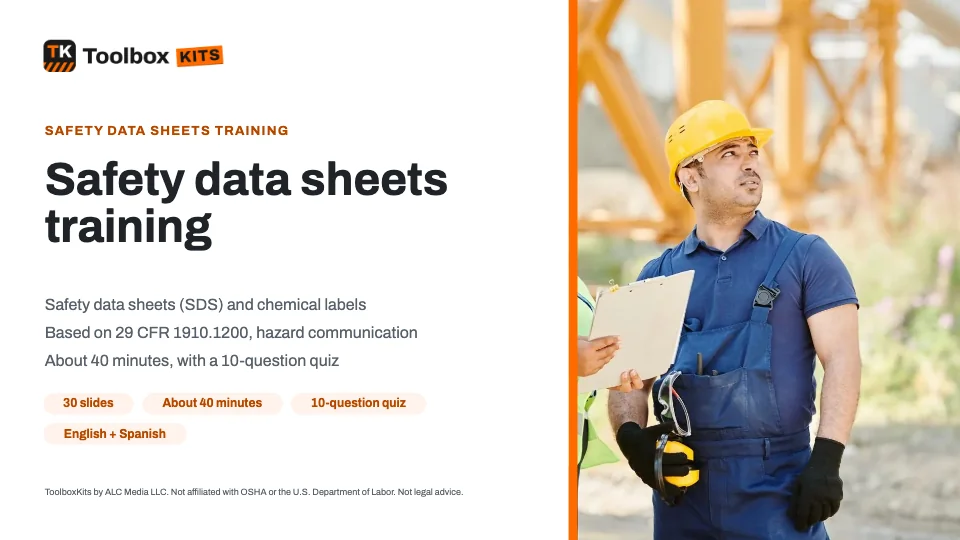 Editable PowerPoint
- Trainer guide
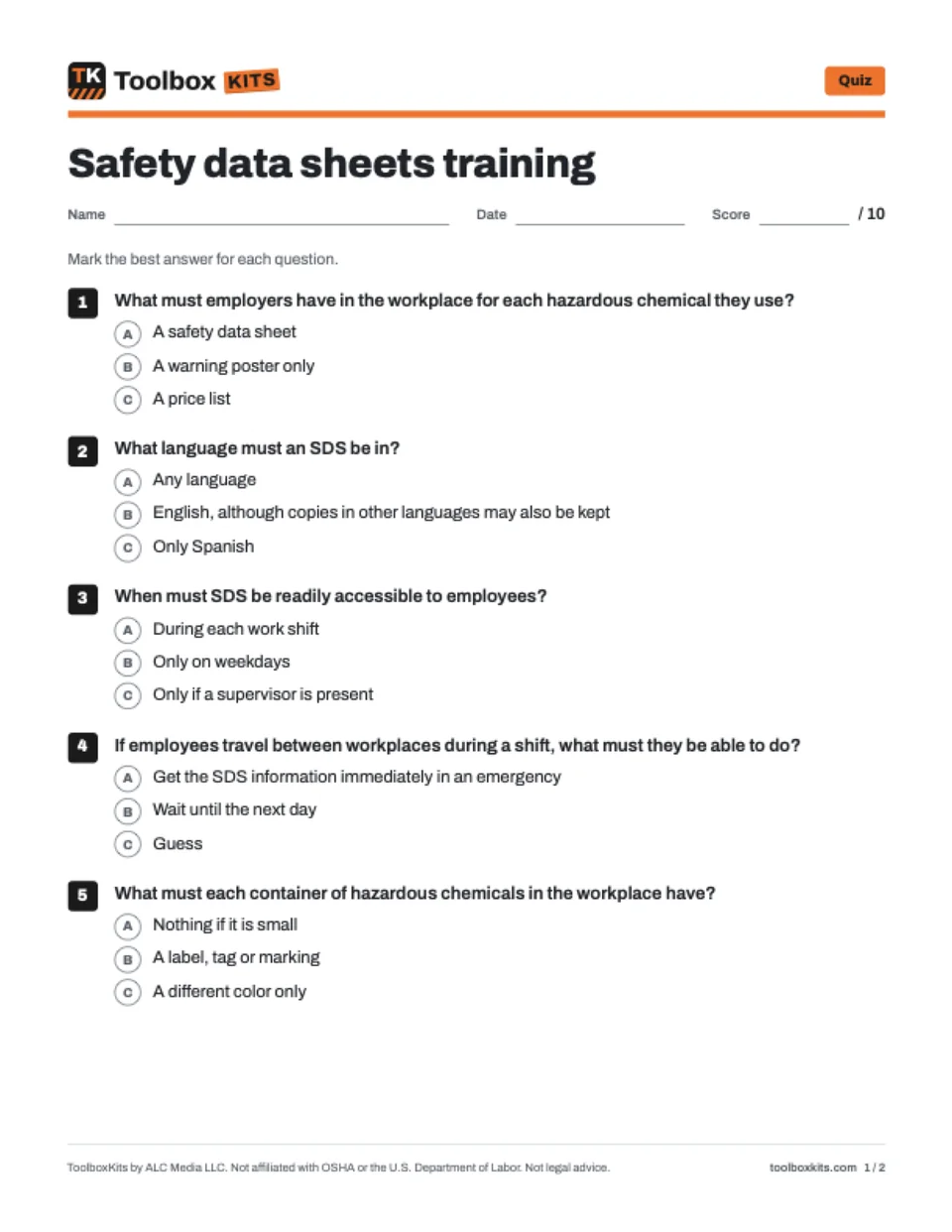 Quiz
- Answer key
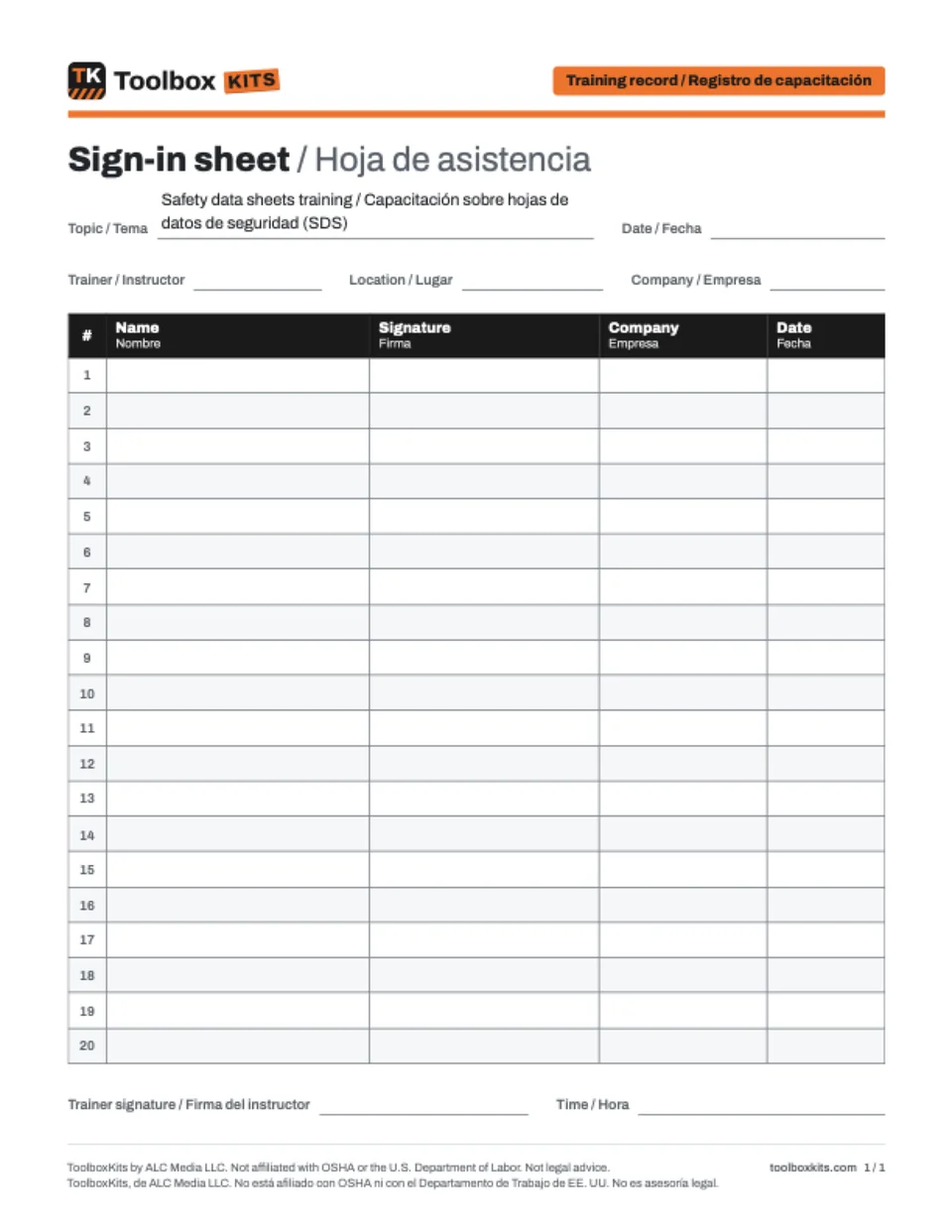 Sign-in sheet
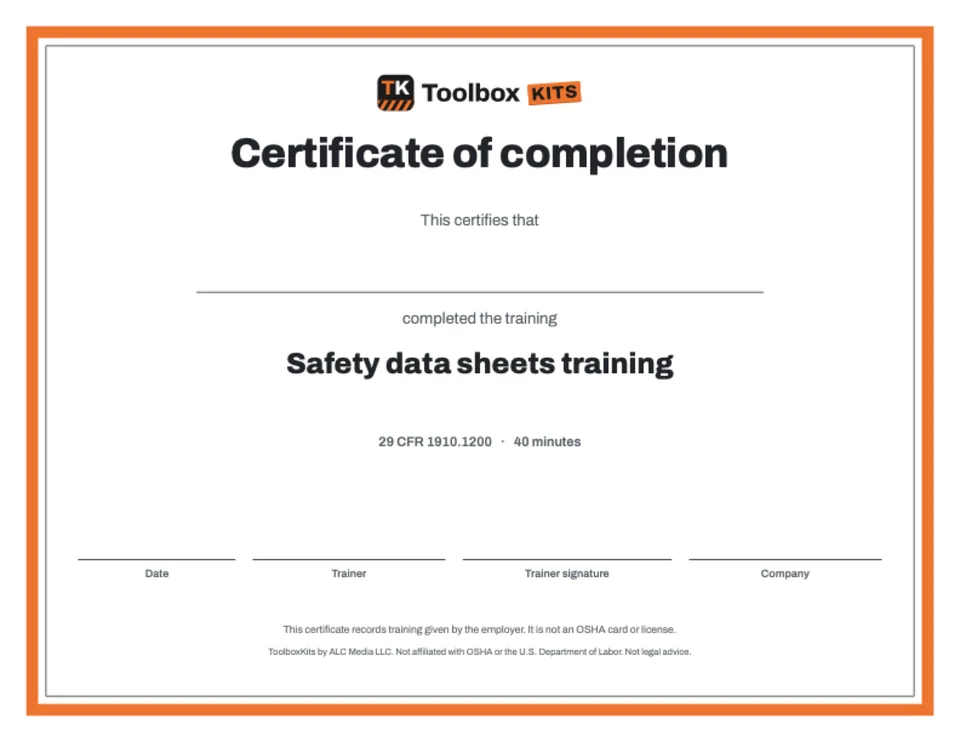 Certificate
- Crew handout
Try it
Try the quiz
Three questions from this topic. Pick an answer to see the right one and the OSHA paragraph.
Question 1 of 3
How many numbered sections does a safety data sheet have?
The rule
What OSHA requires
Plain-language summary. Each line links to the exact paragraph of the regulation.
The hazard communication standard requires all employers to give employees information about the hazardous chemicals they are exposed to, through a hazard communication program, labels and other warnings, safety data sheets and training.
Employers must develop, implement and maintain at each workplace a written hazard communication program that includes a list of the hazardous chemicals present.
“Employers shall develop, implement, and maintain at each workplace, a written hazard communication program”
Employers must have a safety data sheet in the workplace for each hazardous chemical they use.
“Employers shall have a safety data sheet in the workplace for each hazardous chemical which they use.”
An SDS must be in English, although the employer may keep copies in other languages as well. It must include the 16 headings listed in the standard, in order, from Section 1 Identification to Section 16 Other information.
“the safety data sheet is in English (although the employer may maintain copies in other languages as well)”
Employers must keep safety data sheets in the workplace and make sure they are readily accessible to employees in their work areas during each work shift. Electronic access is permitted if there are no barriers to immediate access.
Where employees travel between workplaces during a shift, the SDS may be kept at the primary workplace, but employees must be able to get the information immediately in an emergency.
Each container of hazardous chemicals in the workplace must be labeled, tagged or marked with the shipped container label information, or with the product identifier and words, pictures or symbols that give at least general hazard information.
“the employer shall ensure that each container of hazardous chemicals in the workplace is labeled, tagged or marked with either:”
Employers must not remove or deface existing labels on incoming containers of hazardous chemicals unless the container is immediately marked with the required information.
“The employer shall not remove or deface existing labels on incoming containers of hazardous chemicals, unless the container is immediately marked with the required information.”
Employers must give employees effective information and training on hazardous chemicals in their work area at the time of their initial assignment, and whenever a new chemical hazard they have not been trained about is introduced.
“Employers shall provide employees with effective information and training on hazardous chemicals in their work area at the time of their initial assignment”
Training must include an explanation of the labels and the workplace labeling system, and the safety data sheet, including the order of information and how employees can obtain and use the hazard information.
“the safety data sheet, including the order of information and how employees can obtain and use the appropriate hazard information.”
Who must be trained
Employers must give employees effective information and training on hazardous chemicals in their work area (29 CFR 1910.1200(h)(1)). The training must cover the hazard communication program, the labels and the safety data sheets (29 CFR 1910.1200(h)(3)(iv)).
When to retrain
Employers must provide training whenever a new chemical hazard that the employees have not previously been trained about is introduced into their work area (29 CFR 1910.1200(h)(1)).

Common questions
Questions people ask
Is there a printable safety data sheets toolbox talk?
Yes. This safety data sheet toolbox talk is free to print as a PDF in English and Spanish, with a sign-in table for your crew. Read it aloud in about five minutes and keep the signed sheet with your safety records.
What is the difference between an MSDS and an SDS?
MSDS is the older name. OSHA's hazard communication standard now uses the term safety data sheet, or SDS, with a set 16 section format (29 CFR 1910.1200(g)(2)). If you find an old MSDS on the job, ask your supervisor to get the current SDS from the manufacturer or supplier.
Does an SDS have to be on paper?
No. Copies must be kept in the workplace and be readily accessible to employees during each work shift, and electronic access is permitted as long as it creates no barriers to immediate access (29 CFR 1910.1200(g)(8)). Everyone in the work area needs to know how to open it.
What are the 16 sections of a safety data sheet?
They run from Section 1, Identification, through Section 16, Other information. The list includes hazards, composition, first aid, fire fighting, accidental release, handling and storage, exposure controls and personal protection, and stability and reactivity (29 CFR 1910.1200(g)(2)). OSHA does not enforce the information in sections 12 through 15 (29 CFR 1910.1200(g)(2)(xvi)).
Is there a safety data sheet training PowerPoint?
This free talk is written to be read aloud, so you do not need slides. For a longer SDS and hazard communication session, the paid training kit for this topic is an editable PowerPoint in English and Spanish with trainer notes, a quiz and a sign-in sheet. If the kit is not ready to buy yet, you can request it from this page. Slides do not replace training on the chemicals in your own work area.
Free to share
Use this talk for free
You can print, share and adapt this talk at no cost under the Creative Commons BY-NC-SA 4.0 license. Please credit ToolboxKits with a link.