

Free 5-minute toolbox talkChemicals and exposuresEnglish and Spanish
Hazard communication toolbox talk (HazCom)
Without it, people get hurt by chemicals they did not know were dangerous. What OSHA requires: All employers must give their employees information about the hazardous chemicals they are exposed to, through a hazard communication program, labels and other forms of warning, safety data sheets, and information and training (29 CFR 1910.1200(b)(1)).
A free 5-minute HazCom talk on chemical labels, pictograms and safety data sheets, and the training OSHA's hazard communication standard requires. The same rule covers general industry and construction.
Updated October 29, 2026 · Based on 29 CFR 1910.1200, 29 CFR 1926.59
Read it out loud
Free 5-minute toolbox talk
Read it out loud to your crew. It takes about 5 minutes.
Start with a question
If you found a container on this job with no label, how would you find out what is in it?
Why it matters
Hazardous chemicals are part of everyday work: fuel, solvents, paint, cleaners, cement and more. Hazard communication, or HazCom, is the system that tells you what those hazards are and how to protect yourself, through labels, safety data sheets and training. Without it, people get hurt by chemicals they did not know were dangerous.
Key points
Your employer's written HazCom program
Your employer must develop, implement and maintain a written hazard communication program at each workplace. It lists the hazardous chemicals present and explains how labels, safety data sheets and training are handled, and how workers learn about the hazards of non-routine tasks.
More
You must be told where the program, the chemical list and the safety data sheets are kept.
29 CFR 1910.1200(e)(1) · 29 CFR 1910.1200(h)(2)(iii)
Read the whole label
Shipped containers of hazardous chemicals must be labeled with the product identifier, a signal word, hazard statements, pictograms, precautionary statements and contact details for the manufacturer, importer or other responsible party.
More
“Danger” is used for the more severe hazards and “Warning” for the less severe, and hazard statements describe the nature of the hazard. Precautionary statements describe how to prevent harm from exposure or from improper storage or handling, so read them before you open the container.
29 CFR 1910.1200(f)(1) · 29 CFR 1910.1200(c)
Learn the pictograms
OSHA's standard designates eight pictograms. On shipped containers, each one is a black symbol on a white background with a red diamond border.
More
A flame means the product can catch fire, the corrosion symbol means it can burn skin and eyes or eat through metal, and the skull and crossbones means a single exposure can be toxic or deadly. One product can carry several, so read them all.
Use the safety data sheet
There must be a safety data sheet (SDS) for each hazardous chemical, readily accessible in your work area during each work shift.
More
Every SDS has 16 sections in the same order: section 2 lists the hazards, section 4 first aid, section 7 handling and storage, and section 8 exposure controls and personal protection. If you cannot find the SDS, ask before you use the product.
29 CFR 1910.1200(g)(2) · 29 CFR 1910.1200(g)(8)
Label the containers you fill
Workplace containers of hazardous chemicals, including jugs and spray bottles filled on site, must be labeled, tagged or marked, with a few exceptions. One is a portable container filled from a labeled container for the immediate use of the person who filled it.
More
Workplace labels must be legible, in English, and prominently displayed on the container or readily available in the work area. Employers may add another language, such as Spanish, if the information is also in English.
29 CFR 1910.1200(f)(10) · 29 CFR 1910.1200(f)(6) and (f)(8)
Training and the 2026 deadline
Your employer must give you effective information and training on the hazardous chemicals in your work area when first assigned and whenever a new chemical hazard you have not been trained on is introduced.
More
Training covers at least how to detect a release, the hazards, how to protect yourself, and the details of your employer's program, including labels and safety data sheets. Under the updated standard, employers must, as necessary, give additional training on newly identified hazards of substances no later than November 20, 2026.
29 CFR 1910.1200(h)(3) · 29 CFR 1910.1200(h)(1) · 29 CFR 1910.1200(j)(2)(ii)
Scenario
Picture this: A painting crew starts work in a building where another contractor stores its supplies. One painter finds an unlabeled bucket with a strong smell and uses it to thin paint, thinking it is solvent. Soon the crew feels dizzy, and one worker's arms break out in a rash. Nobody knows what was in it or where the other contractor's safety data sheets are. What should have happened first?
Ask the crew
- Where are our written program, chemical list and safety data sheets kept?
- Which pictograms are on the products we use here, and what do they mean?
- What do you do if you find a container with no label?
- Who do you tell when a new chemical shows up on site?
Takeaway
No label, no use: read the label and the SDS, know the pictograms, and ask before you use any chemical you do not know.
Trainer: ______________________ Date: ____________
Credit: ToolboxKits, https://toolboxkits.com/topics/hazard-communication/ (CC BY-NC-SA 4.0)
The poster is also inside the paid kits.
Audit-ready records in 60 seconds
Fill in your crew and download a filled sign-in sheet for this talk. Everything is made in your browser. Names are never uploaded or stored.
Start a sign-off
Crew scan a QR code on their own phones, type their name and sign with a finger. You see the names arrive and download the signed sheet. Free, no account.
Kits
Get the kit
No subscription needed. Buy only the kit you need.
Toolbox talk kit
$4.99
- 5-minute talk, English PDF
- 5-minute talk, Spanish PDF
- Editable mini-deck (English and Spanish)
- One-page crew handout (English and Spanish)
- Bilingual sign-in sheet
- 3-question quiz with answer key (English and Spanish)
- One-page bilingual poster
- Audit-ready records in 60 seconds: fill in your crew and get a sign-in sheet and a certificate for every worker
Training kit
$9
Editable PowerPoint, 39 slides
- Editable PowerPoint with trainer notes on every slide
- Trainer guide PDF with timing and discussion tips
- 10-question quiz and answer key
- Sign-in sheet and certificate of completion with fillable fields
- One-page crew handout
- Full Spanish version of everything
- One-page bilingual poster
- Audit-ready records in 60 seconds: fill in your crew and get a sign-in sheet and a certificate for every worker
- Instant download
- Secure checkout by Stripe
- 30-day refund, no questions
Need many topics? All Access gives you every kit for $99 a year.
Inside the kit
See what is in the kit
What is in the kit
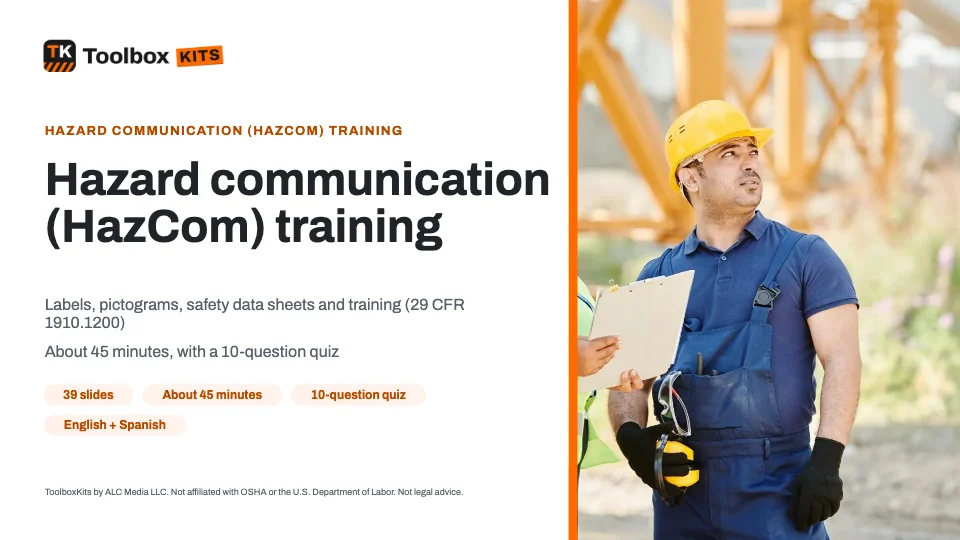 Editable PowerPoint
- Trainer guide
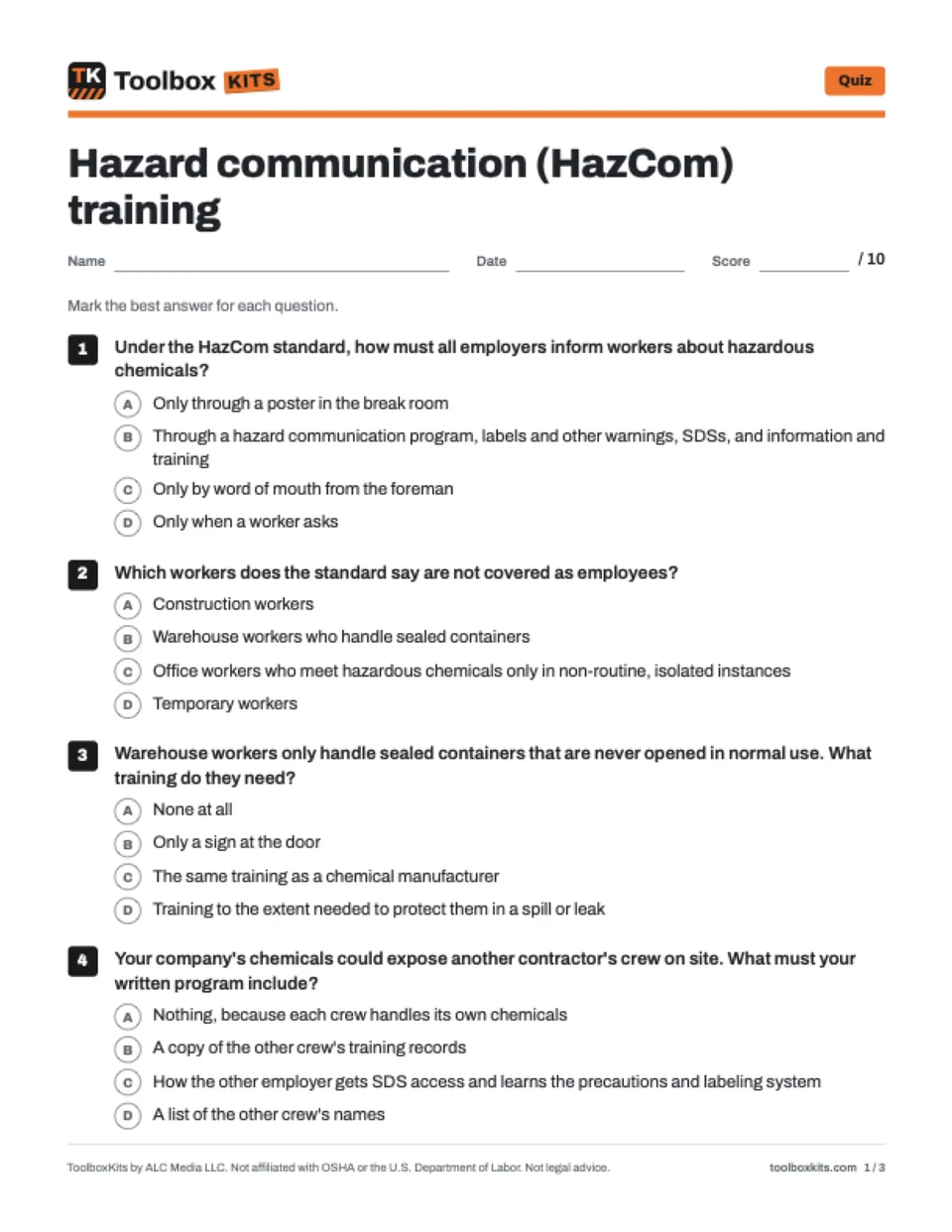 Quiz
- Answer key
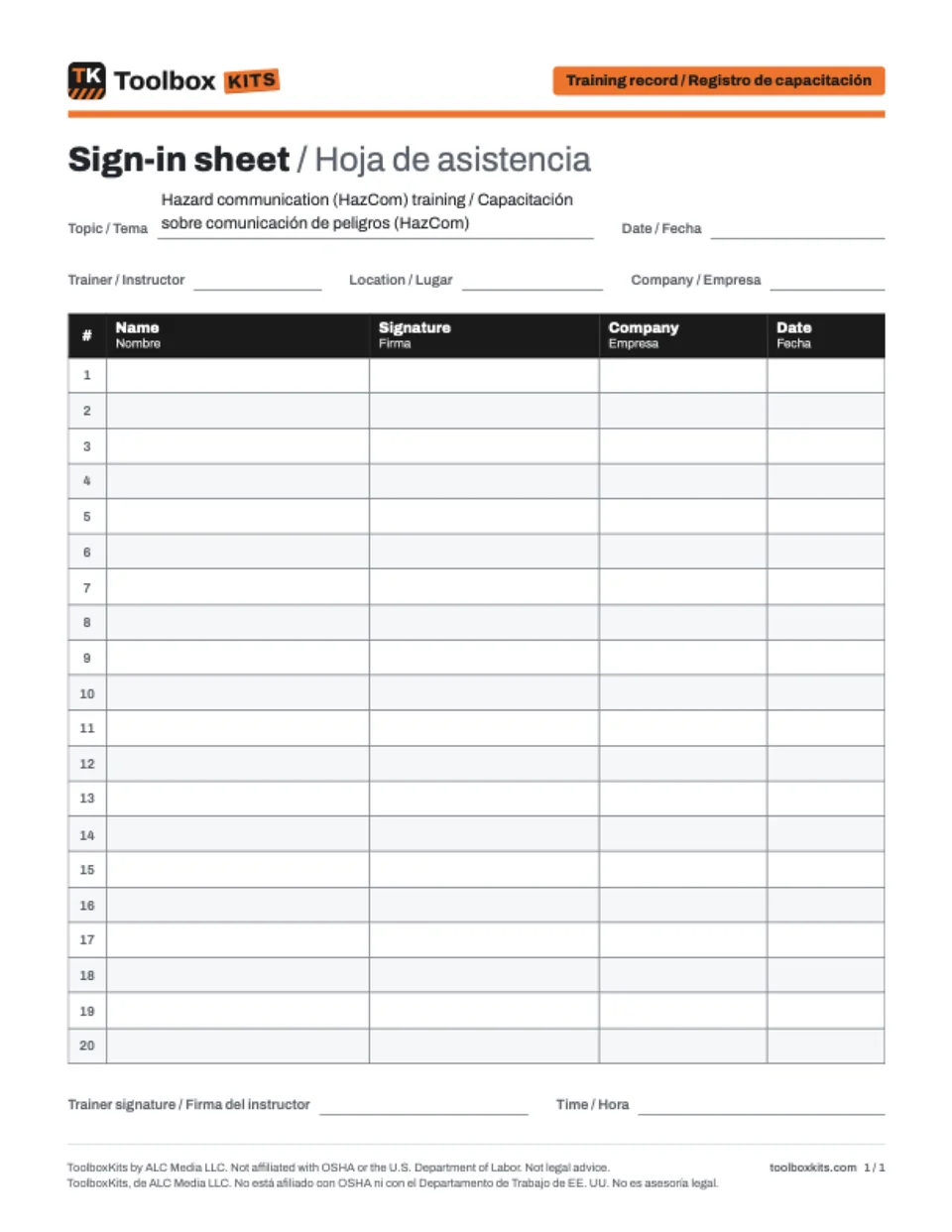 Sign-in sheet
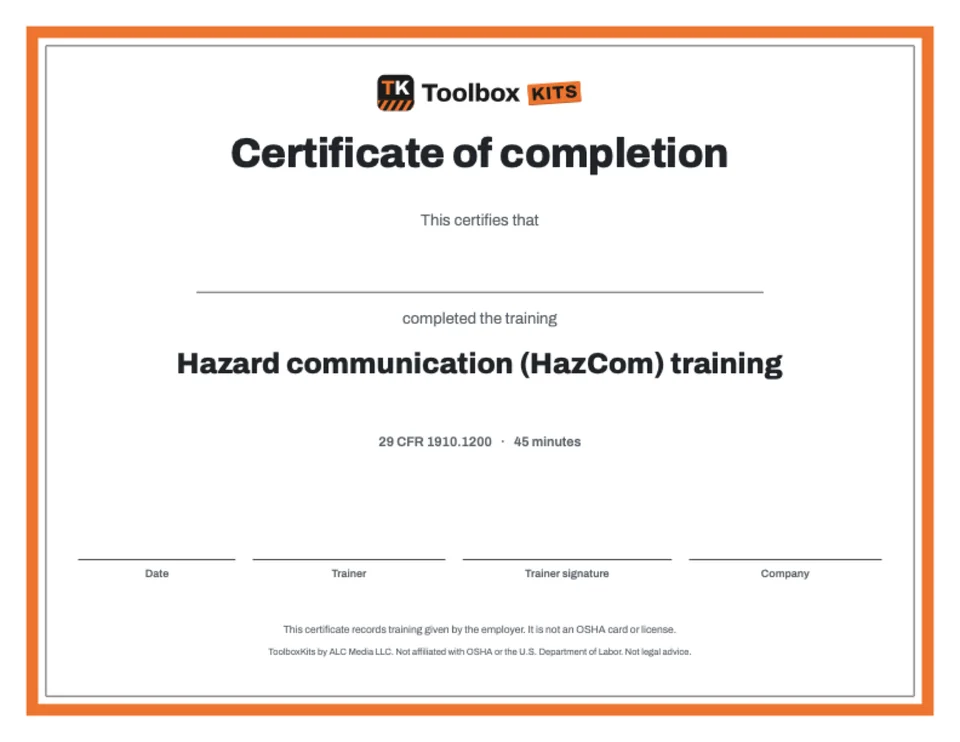 Certificate
- Crew handout
Try it
Try the quiz
Three questions from this topic. Pick an answer to see the right one and the OSHA paragraph.
Question 1 of 3
When must employers give HazCom information and training?
The rule
What OSHA requires
Plain-language summary. Each line links to the exact paragraph of the regulation.
All employers must give their employees information about the hazardous chemicals they are exposed to, through a hazard communication program, labels and other forms of warning, safety data sheets, and information and training.
“all employers to provide information to their employees about the hazardous chemicals to which they are exposed”
The hazard communication requirements for construction work are identical to the general industry standard.
“The requirements applicable to construction work under this section are identical to those set forth at § 1910.1200 of this chapter.”
Employers must develop, implement and maintain at each workplace a written hazard communication program that describes how labels, safety data sheets and training will be handled, lists the hazardous chemicals known to be present, and explains how employees will be told about the hazards of non-routine tasks and of chemicals in unlabeled pipes in their work areas.
Employers who produce, use or store hazardous chemicals where employees of other employers may be exposed, such as a construction contractor working on site, must include in their program how those employers get access to safety data sheets and learn about needed precautions and the labeling system used.
“for example, employees of a construction contractor working on-site”
Labels on shipped containers must include the product identifier, signal word, hazard statements, pictograms, precautionary statements, and the name, U.S. address and U.S. telephone number of the chemical manufacturer, importer or other responsible party.
Except where the standard allows otherwise, each container of hazardous chemicals in the workplace must be labeled, tagged or marked, either with the product identifier, signal word, hazard statements, pictograms and precautionary statements, or with the product identifier plus words, pictures or symbols that give at least general information about the hazards.
“each container of hazardous chemicals in the workplace is labeled, tagged or marked”
Workplace labels must be legible, in English and prominently displayed on the container, or readily available in the work area throughout each work shift. Employers with employees who speak other languages may add the information in their language, as long as it is also presented in English.
“Employers having employees who speak other languages may add the information in their language to the material presented, as long as the information is presented in English as well.”
The employer must keep the required safety data sheets in the workplace and make sure they are readily accessible to employees in their work area during each work shift. Electronic access is allowed if it creates no barriers to immediate access.
“readily accessible during each work shift to employees when they are in their work area(s)”
Employers must provide employees with effective information and training on hazardous chemicals in their work area at initial assignment and whenever a new chemical hazard they have not been trained on is introduced. Training may cover categories of hazards, such as flammability, or specific chemicals, but chemical-specific information must always be available through labels and safety data sheets.
“Chemical-specific information must always be available through labels and safety data sheets.”
For substances, employers must, as necessary, update any alternative workplace labeling and the hazard communication program and provide any additional training for newly identified hazards no later than November 20, 2026. For mixtures, the deadline is May 19, 2028 (29 CFR 1910.1200(j)(3)(ii)).
“no later than November 20, 2026”
Who must be trained
Employers must provide employees with effective information and training on hazardous chemicals in their work area (29 CFR 1910.1200(h)(1)). The standard defines an employee as a worker who may be exposed to hazardous chemicals under normal operating conditions or in foreseeable emergencies; office workers or bank tellers who meet hazardous chemicals only in non-routine, isolated instances are not covered (29 CFR 1910.1200(c)). Where employees only handle sealed containers that are not opened under normal use, as in warehousing or retail sales, training is required to the extent needed to protect them in a spill or leak (29 CFR 1910.1200(b)(4)(iii)). Construction work follows the same rule (29 CFR 1926.59).
When to retrain
Information and training must be provided at initial assignment and again whenever a new chemical hazard the employees have not previously been trained about is introduced into their work area (29 CFR 1910.1200(h)(1)). For newly identified hazards under the updated standard, any additional training is due no later than November 20, 2026 for substances and May 19, 2028 for mixtures (29 CFR 1910.1200(j)(2)(ii) and (j)(3)(ii)).

Common questions
Questions people ask
Is there a printable hazard communication toolbox talk PDF?
Yes. This hazard communication toolbox talk is free to print as a PDF in English or Spanish, with a sign-in sheet for attendance. Read it with your crew, then show them where your written program, chemical list and safety data sheets are kept.
Is there an OSHA HazCom training PowerPoint?
The free talk on this page is written to be read aloud, so you do not need slides. For a longer hazard communication training session, the paid training kit for this topic is an editable PowerPoint in English and Spanish with trainer notes, a quiz and a sign-in sheet. It is built from the text of 29 CFR 1910.1200 and is not produced or endorsed by OSHA. If the kit is not ready to buy yet, you can request it from this page.
What should a HazCom safety talk cover?
OSHA's hazard communication training must cover at least how to detect the presence or release of a hazardous chemical, the hazards of the chemicals in the work area, the measures workers can take to protect themselves, and the details of the employer's program, including labels and safety data sheets. A short safety talk can take one piece at a time: the label, the pictograms, the SDS or what to do in a spill.
Does a HazCom toolbox talk count as hazard communication training?
It can be part of it, but a general talk will not cover everything on its own. Training must include the hazards of the chemicals in the work area and the details of your employer's own program, such as your labeling system and how to get your safety data sheets. Use this talk alongside your chemical list, real labels and the SDSs for the products your crew uses.
When do workers need a hazard communication safety talk or training?
Employers must provide HazCom information and training when a worker is first assigned and whenever a new chemical hazard the worker has not been trained on is introduced into the work area. The standard ties training to those events rather than to a fixed refresher schedule. Under the updated standard, any additional training on newly identified hazards is due no later than November 20, 2026 for substances and May 19, 2028 for mixtures (29 CFR 1910.1200(j)(2)(ii) and (j)(3)(ii)).
Free to share
Use this talk for free
You can print, share and adapt this talk at no cost under the Creative Commons BY-NC-SA 4.0 license. Please credit ToolboxKits with a link.