

Free 5-minute toolbox talkOil and gasEnglish and Spanish
Oil and gas safety moment for well site crews
Fuel, crude oil, treating chemicals and drilling fluid additives can all be hazardous. Your employer must keep a safety data sheet for each hazardous chemical in the workplace, readily accessible during each work shift (29 CFR 1910.1200(g)(8)). What OSHA requires: Employers must develop, implement and maintain a written hazard communication program at each workplace (29 CFR 1910.1200(e)(1)).
A free oil and gas safety moment for crews on drilling, completion and production locations. Read it aloud in about five minutes to cover chemical hazards, gas detection, escape routes and working safely with other crews on site.
Updated October 29, 2026 · Based on 29 CFR 1910.119, 29 CFR 1910.1200
Read it out loud
Free 5-minute toolbox talk
Read it out loud to your crew. It takes about 5 minutes.
Start with a question
If a gas alarm went off on this location right now, would everyone here know which way to go and where to meet?
Why it matters
Well sites put flammable gas and liquids, possible toxic gas like hydrogen sulfide, high pressure, heavy equipment and several crews in one small area. Conditions can change fast, and one missed step can lead to a fire, an explosion or a toxic release. Knowing the hazards and looking out for each other is how everyone gets home.
Key points
Know the chemicals on location
Fuel, crude oil, treating chemicals and drilling fluid additives can all be hazardous. Your employer must keep a safety data sheet for each hazardous chemical in the workplace, readily accessible during each work shift.
More
If your crew travels between well sites during a shift, the sheets may be kept at the primary workplace facility, but your employer must make sure you can get the information immediately in an emergency.
29 CFR 1910.1200(g)(9) · 29 CFR 1910.1200(g)(8)
Read the label before you open it
With limited exceptions, each container of hazardous chemicals on location must be labeled, tagged or marked with at least the product identifier and general information about its hazards.
More
Labels on incoming containers must not be removed or defaced unless the container is immediately marked with the required information. If you find an unlabeled drum, tote or bottle, do not guess what is inside. Stop and ask.
29 CFR 1910.1200(f)(6) · 29 CFR 1910.1200(f)(9)
Trust your monitor, not your nose
Your hazard communication training must include the methods and observations used to detect a chemical release, such as employer monitoring, continuous monitoring devices and the look or odor of a chemical being released.
More
Wear your personal gas monitor where required, check it the way you were trained and know what each alarm means. Some gases, like hydrogen sulfide, can dull your sense of smell, so never use your nose to decide an area is safe.
Know your way out
Before work starts, find the wind sock, the muster point and more than one way off location. If an alarm sounds or you see or smell a release, stop work, move upwind or crosswind away from the source and go to the muster point for a head count.
More
Never go back in after someone unless you are trained and equipped for rescue, or you may become the next victim.
Many crews, one location
A well site can have the operator, a drilling or service contractor and truck drivers all working at once.
More
When an employer's hazardous chemicals could expose another employer's workers, its written hazard communication program must include how it will give the other employers access to safety data sheets and tell them about needed precautions and the labeling system used. Go to the site orientation and ask what the other crews near you are doing.
Control ignition and stop when things change
Flammable gas and vapors can travel and find an ignition source, so follow the site rules for phones, lighters, vehicles and hot work permits. If something changes, like a new chemical, a pressure reading that looks wrong or a strange smell, stop and ask before you keep going.
More
Your employer must give you information and training whenever a new chemical hazard you have not been trained about is introduced into your work area.
Scenario
Picture this: A service crew arrives on a production location to work on a tank battery. The pumper mentions that one tank hatch has been leaking, and a worker climbs up to check it without a gas monitor. Another crew is welding on a line nearby, and nobody has talked about what each crew is doing. What should happen before anyone climbs a tank, opens a hatch or strikes an arc?
Ask the crew
- Where are the wind sock and muster point on today's location?
- Which chemicals are on this location, and where are their safety data sheets?
- What does each alarm on your gas monitor mean, and what do you do when it goes off?
- How do we find out what other crews on location are doing near us?
Takeaway
Know your chemicals, trust your monitor, know your way out and talk to every crew on location.
Trainer: ______________________ Date: ____________
Credit: ToolboxKits, https://toolboxkits.com/topics/oil-and-gas-safety/ (CC BY-NC-SA 4.0)
The poster is also inside the paid kits.
Audit-ready records in 60 seconds
Fill in your crew and download a filled sign-in sheet for this talk. Everything is made in your browser. Names are never uploaded or stored.
Start a sign-off
Crew scan a QR code on their own phones, type their name and sign with a finger. You see the names arrive and download the signed sheet. Free, no account.
Kits
Get the kit
No subscription needed. Buy only the kit you need.
Toolbox talk kit
$4.99
- 5-minute talk, English PDF
- 5-minute talk, Spanish PDF
- Editable mini-deck (English and Spanish)
- One-page crew handout (English and Spanish)
- Bilingual sign-in sheet
- 3-question quiz with answer key (English and Spanish)
- One-page bilingual poster
- Audit-ready records in 60 seconds: fill in your crew and get a sign-in sheet and a certificate for every worker
Training kit
$9
Editable PowerPoint, 39 slides
- Editable PowerPoint with trainer notes on every slide
- Trainer guide PDF with timing and discussion tips
- 10-question quiz and answer key
- Sign-in sheet and certificate of completion with fillable fields
- One-page crew handout
- Full Spanish version of everything
- One-page bilingual poster
- Audit-ready records in 60 seconds: fill in your crew and get a sign-in sheet and a certificate for every worker
- Instant download
- Secure checkout by Stripe
- 30-day refund, no questions
Need many topics? All Access gives you every kit for $99 a year.
Inside the kit
See what is in the kit
What is in the kit
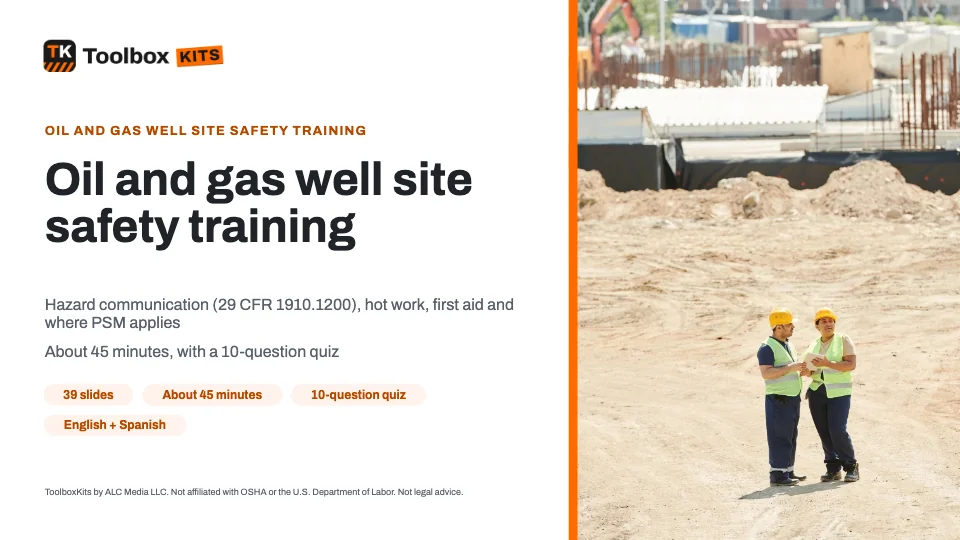 Editable PowerPoint
- Trainer guide
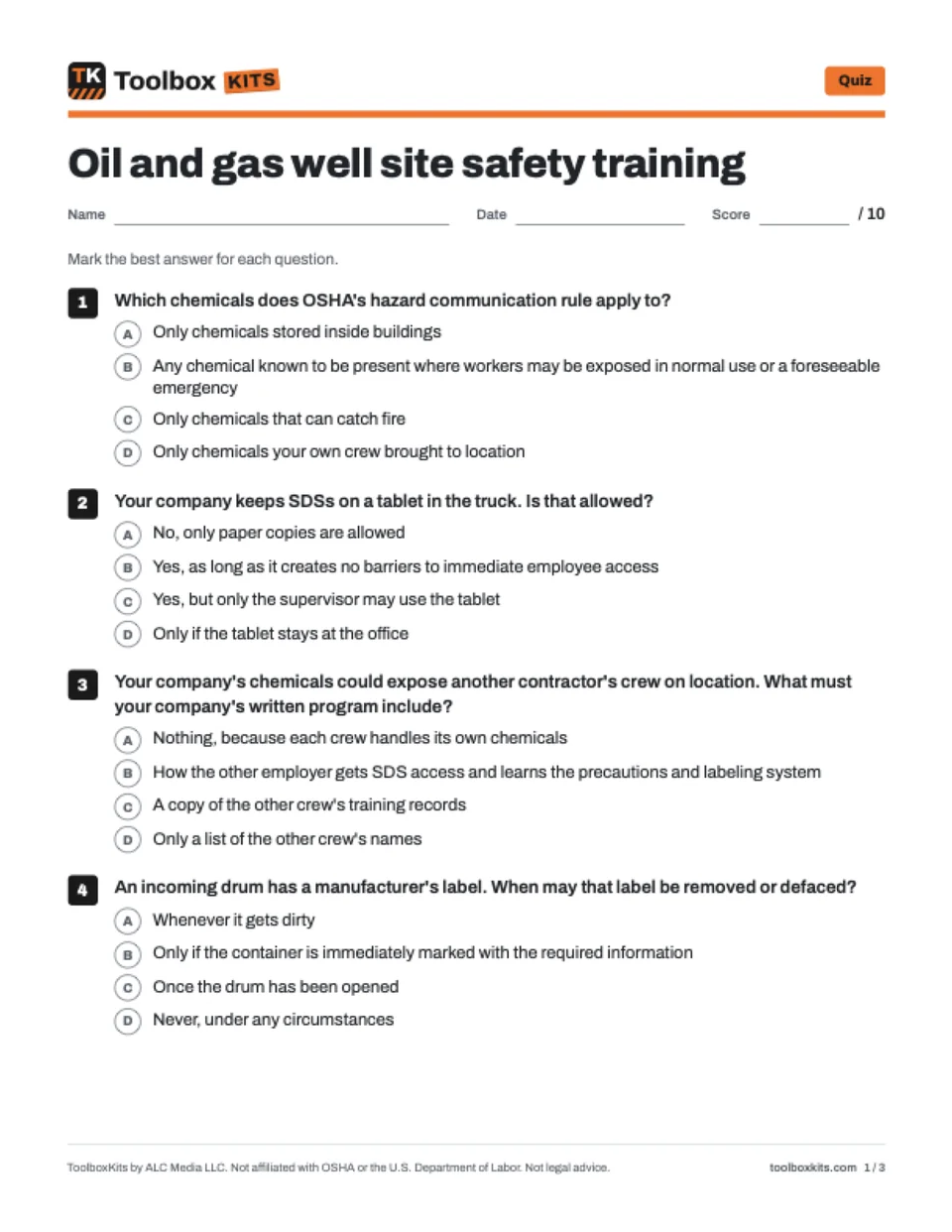 Quiz
- Answer key
 Sign-in sheet
 Certificate
- Crew handout
Try it
Try the quiz
Three questions from this topic. Pick an answer to see the right one and the OSHA paragraph.
Question 1 of 3
Your crew travels between well sites during a shift. What must be true about safety data sheets?
The rule
What OSHA requires
Plain-language summary. Each line links to the exact paragraph of the regulation.
OSHA's hazard communication standard applies to any chemical known to be present in the workplace in a way that employees may be exposed under normal conditions of use or in a foreseeable emergency.
“This section applies to any chemical which is known to be present in the workplace in such a manner that employees may be exposed under normal conditions of use or in a foreseeable emergency.”
Employers must develop, implement and maintain a written hazard communication program at each workplace. It must include a list of the hazardous chemicals known to be present and the methods used to tell employees about the hazards of non-routine tasks and of chemicals in unlabeled pipes in their work areas.
“Employers shall develop, implement, and maintain at each workplace, a written hazard communication program”
Where an employer's hazardous chemicals could expose another employer's employees, such as contractors on site, the written program must also include how the other employers will get access to safety data sheets and be told about precautionary measures and the labeling system used.
“Employers who produce, use, or store hazardous chemicals at a workplace in such a way that the employees of other employer(s) may be exposed”
With limited exceptions, each container of hazardous chemicals in the workplace must be labeled, tagged or marked with either the product identifier, signal word, hazard statements, pictograms and precautionary statements required on shipped container labels, or the product identifier plus words, pictures or symbols that give at least general information about the chemical's hazards.
“the employer shall ensure that each container of hazardous chemicals in the workplace is labeled, tagged or marked with either”
The employer must keep copies of the safety data sheet for each hazardous chemical in the workplace and make sure they are readily accessible to employees in their work areas during each work shift. Electronic access is allowed if it creates no barriers to immediate employee access.
“readily accessible during each work shift to employees when they are in their work area(s)”
Where employees travel between workplaces during a work shift, the safety data sheets may be kept at the primary workplace facility, but the employer must make sure employees can immediately obtain the required information in an emergency.
“the employer shall ensure that employees can immediately obtain the required information in an emergency.”
Employers must provide effective information and training on hazardous chemicals in the work area at the time of initial assignment, and whenever a new chemical hazard the employees have not been trained about is introduced.
“Employers shall provide employees with effective information and training on hazardous chemicals in their work area at the time of their initial assignment”
Training must include the methods and observations that can be used to detect the presence or release of a hazardous chemical in the work area, such as employer monitoring, continuous monitoring devices, and the look or odor of a chemical being released.
“Methods and observations that may be used to detect the presence or release of a hazardous chemical in the work area”
OSHA's process safety management (PSM) standard does not apply to oil or gas well drilling or servicing operations. It also does not apply to retail facilities or to normally unoccupied remote facilities (29 CFR 1910.119(a)(2)).
“Oil or gas well drilling or servicing operations”
Where PSM does cover a process, each employee operating it, and each employee before operating a newly assigned process, must be trained in an overview of the process and its operating procedures. The training must emphasize the specific safety and health hazards, emergency operations including shutdown, and safe work practices for the employee's job tasks.
“The training shall include emphasis on the specific safety and health hazards, emergency operations including shutdown, and safe work practices applicable to the employee's job tasks.”
Who must be trained
Employees must get effective information and training on the hazardous chemicals in their work area at the time of their initial assignment (29 CFR 1910.1200(h)(1)). Where OSHA's process safety management standard covers a process, each employee operating it, and each employee before operating a newly assigned process, must be trained in an overview of the process and its operating procedures (29 CFR 1910.119(g)(1)(i)). That standard does not apply to oil or gas well drilling or servicing operations (29 CFR 1910.119(a)(2)(ii)).
When to retrain
Employers must provide hazard communication information and training again whenever a new chemical hazard the employees have not previously been trained about is introduced into their work area (29 CFR 1910.1200(h)(1)). Under the current version of the rule, which took effect July 19, 2024, employers must also, as necessary, provide any additional training for newly identified hazards no later than November 20, 2026 for substances and May 19, 2028 for mixtures (29 CFR 1910.1200(j)(1), (j)(2)(ii) and (j)(3)(ii)). Where PSM covers a process, refresher training must be provided at least every three years, and more often if necessary (29 CFR 1910.119(g)(2)).

Common questions
Questions people ask
What is a good oil and gas safety moment?
A good oil and gas safety moment is short, covers one hazard and ties it to the work on location that day. Strong choices are gas monitor alarms, muster points, chemical labels and safety data sheets, or checking in with the other crews on site. If chemicals are involved, remember that employees must get training on the hazardous chemicals in their work area when first assigned and whenever a new chemical hazard they have not been trained about is introduced into their work area (29 CFR 1910.1200(h)(1)).
What are some oil and gas safety moment examples?
Examples include what to do when your hydrogen sulfide monitor alarms, finding the wind sock and muster point, reading a chemical label before opening a container, staying out of the line of fire around pressurized lines and following the hot work permit. Driving between locations, fatigue on long shifts and dropped objects on the rig floor also make good safety moments. Rotate them so the message stays fresh.
What are good drilling rig and oil field safety meeting topics?
Good topics include hazard communication and safety data sheets, gas detection, hot work and ignition sources, pinch points and the line of fire on the rig floor, working at height and lockout before maintenance. Driving between locations, fatigue and heat or cold stress are worth covering too. Pick one topic per meeting and connect it to that day's tasks.
Is there an oil and gas safety presentation in PowerPoint?
This free safety moment is written to be read aloud, so you can run it without slides. If you want an oil and gas safety presentation with slides for a longer session, use the training kit option on this page. You can also print this talk as a PDF in English and Spanish with a sign-in table.
What should a pipeline or offshore safety moment cover?
For pipeline work, cover getting lines located before any digging, the signs of a leak such as a hissing sound, an odor or dead vegetation, and keeping ignition sources away. Offshore, good topics are muster drills, dropped objects, permits to work and stopping the job when something is not right. In both settings, follow your site's own procedures and talk through the plan before the job starts.
Free to share
Use this talk for free
You can print, share and adapt this talk at no cost under the Creative Commons BY-NC-SA 4.0 license. Please credit ToolboxKits with a link.