

Free 5-minute toolbox talkFireEnglish and Spanish
Fire extinguisher toolbox talk
Fires grow fast, and smoke can fill a room before you know it. What OSHA requires: In general industry, the employer must provide portable fire extinguishers and mount, locate and identify them so they are readily accessible to employees without exposing them to possible injury (29 CFR 1910.157(c)(1)).
A free fire extinguisher toolbox talk you can read to your crew in about five minutes, or use as a quick fire extinguisher safety moment. It covers where extinguishers go, which type fights which fire, when to fight and when to leave, the PASS method and the OSHA rules that apply.
Updated October 29, 2026 · Based on 29 CFR 1910.157, 29 CFR 1926.150
Read it out loud
Free 5-minute toolbox talk
Read it out loud to your crew. It takes about 5 minutes.
Start with a question
If a fire started next to you right now, could you reach the nearest extinguisher without looking for it, and would you know how to use it?
Why it matters
A fire extinguisher can stop a small fire before it spreads, but only if it is close by, charged and the right type for the fire. Fires grow fast, and smoke can fill a room before you know it. Knowing when to fight a fire and when to get out matters as much as knowing how to pull the pin.
Key points
Know where the nearest one is
Before you start work, find the closest extinguisher and the closest way out. On construction sites, access to all firefighting equipment must be kept open at all times. Never stack material, park a cart or hang gear in front of an extinguisher, even for a few minutes.
Match the extinguisher to the fire
In general industry, extinguishers must be chosen for the kinds of fires the workplace can expect. The label tells you the class: A for wood, paper and cloth, B for flammable liquids, gases and grease, C for live electrical equipment and D for burning metals.
More
An extinguisher marked ABC works on the first three, and water should never go on a fuel, grease or electrical fire.
Fight only a small, new fire
An extinguisher is for a fire in its beginning stage, the kind you can put out with a portable extinguisher without protective clothing or breathing gear.
More
Before you fight it, make sure others have been alerted and someone has called the fire department, the fire is small and not spreading, smoke is not filling the area and your way out is behind you. If any of these is not true, or you are not sure you can handle it, get out and close the door behind you.
Use the PASS method
Remember PASS: pull the pin, aim the nozzle at the base of the fire, squeeze the handle and sweep from side to side. Start a few steps back and move in as the fire gets smaller. Once it is out, back away while you keep watching it, because it can flare up again.
Check it before you count on it
In general industry, portable extinguishers must be visually inspected monthly. When you walk past one, check that it is in its spot and not blocked, the pin and seal are in place, the gauge needle is in the green if it has a gauge, and the hose and body are not damaged.
More
If anything looks wrong, report it right away so it can be replaced.
Training is part of the rule
In general industry, where your employer provides extinguishers for employees to use, it must give you education on the general principles of using them and the hazards of fighting a fire in its beginning stage.
More
Workers named in an emergency action plan to use firefighting equipment must also be trained on that equipment. Ask for a hands-on demonstration with the extinguishers on this site.
29 CFR 1910.157(g)(1) · 29 CFR 1910.157(g)(3)
Scenario
Picture this: Late in the shift, a spark from a grinder lands near a gas can that has been leaking, and flames start to spread across the floor. The extinguisher by the door is behind a stack of drywall, and when someone finally drags it out, the gauge reads empty. A coworker runs over with a bucket of water while smoke builds up near the only exit. What should each person have done, and what should have been checked before today?
Ask the crew
- Where are the two closest extinguishers to where you are working today, and what classes are they rated for?
- What kinds of fires could start in our work area, and do our extinguishers match them?
- Who checks our extinguishers, and what do you do if you find one that is empty, damaged or blocked?
- What would make you decide not to fight a fire and just get out?
Takeaway
Know where the nearest extinguisher is, keep it clear and charged, and only fight a small fire with your way out behind you.
Trainer: ______________________ Date: ____________
Credit: ToolboxKits, https://toolboxkits.com/topics/fire-extinguishers/ (CC BY-NC-SA 4.0)
The poster is also inside the paid kits.
Audit-ready records in 60 seconds
Fill in your crew and download a filled sign-in sheet for this talk. Everything is made in your browser. Names are never uploaded or stored.
Start a sign-off
Crew scan a QR code on their own phones, type their name and sign with a finger. You see the names arrive and download the signed sheet. Free, no account.
Kits
Get the kit
No subscription needed. Buy only the kit you need.
Toolbox talk kit
$4.99
- 5-minute talk, English PDF
- 5-minute talk, Spanish PDF
- Editable mini-deck (English and Spanish)
- One-page crew handout (English and Spanish)
- Bilingual sign-in sheet
- 3-question quiz with answer key (English and Spanish)
- One-page bilingual poster
- Audit-ready records in 60 seconds: fill in your crew and get a sign-in sheet and a certificate for every worker
Training kit
$9
Editable PowerPoint, 36 slides
- Editable PowerPoint with trainer notes on every slide
- Trainer guide PDF with timing and discussion tips
- 10-question quiz and answer key
- Sign-in sheet and certificate of completion with fillable fields
- One-page crew handout
- Full Spanish version of everything
- One-page bilingual poster
- Audit-ready records in 60 seconds: fill in your crew and get a sign-in sheet and a certificate for every worker
- Instant download
- Secure checkout by Stripe
- 30-day refund, no questions
Need many topics? All Access gives you every kit for $99 a year.
Inside the kit
See what is in the kit
What is in the kit
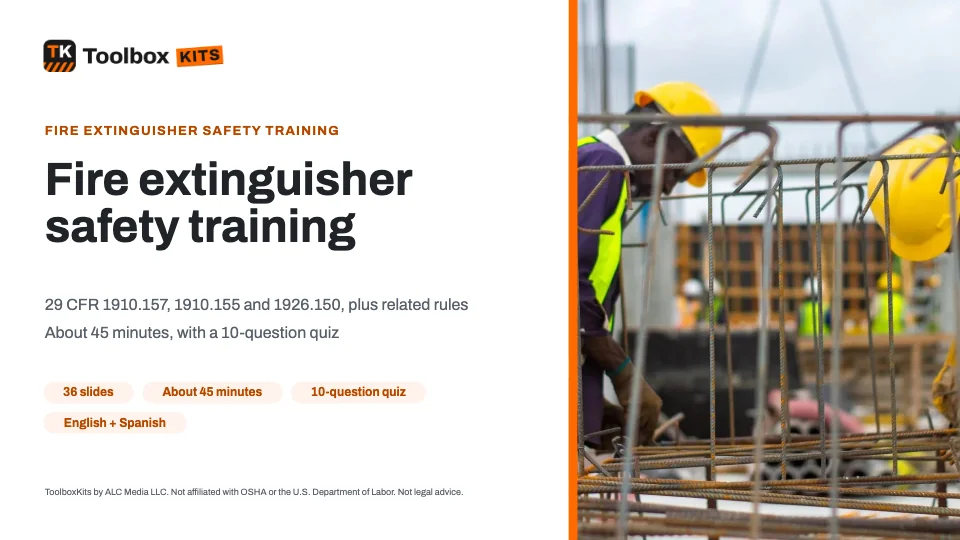 Editable PowerPoint
- Trainer guide
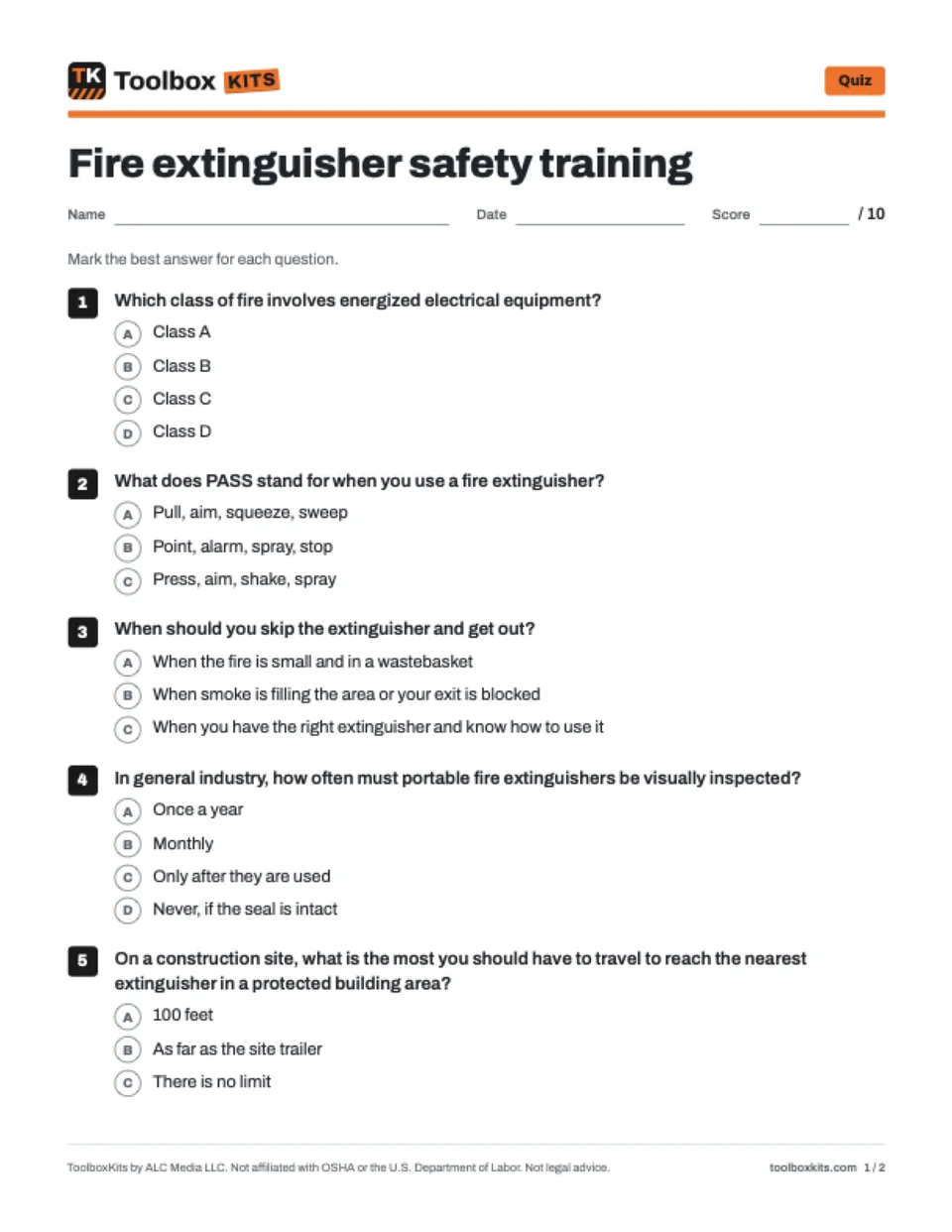 Quiz
- Answer key
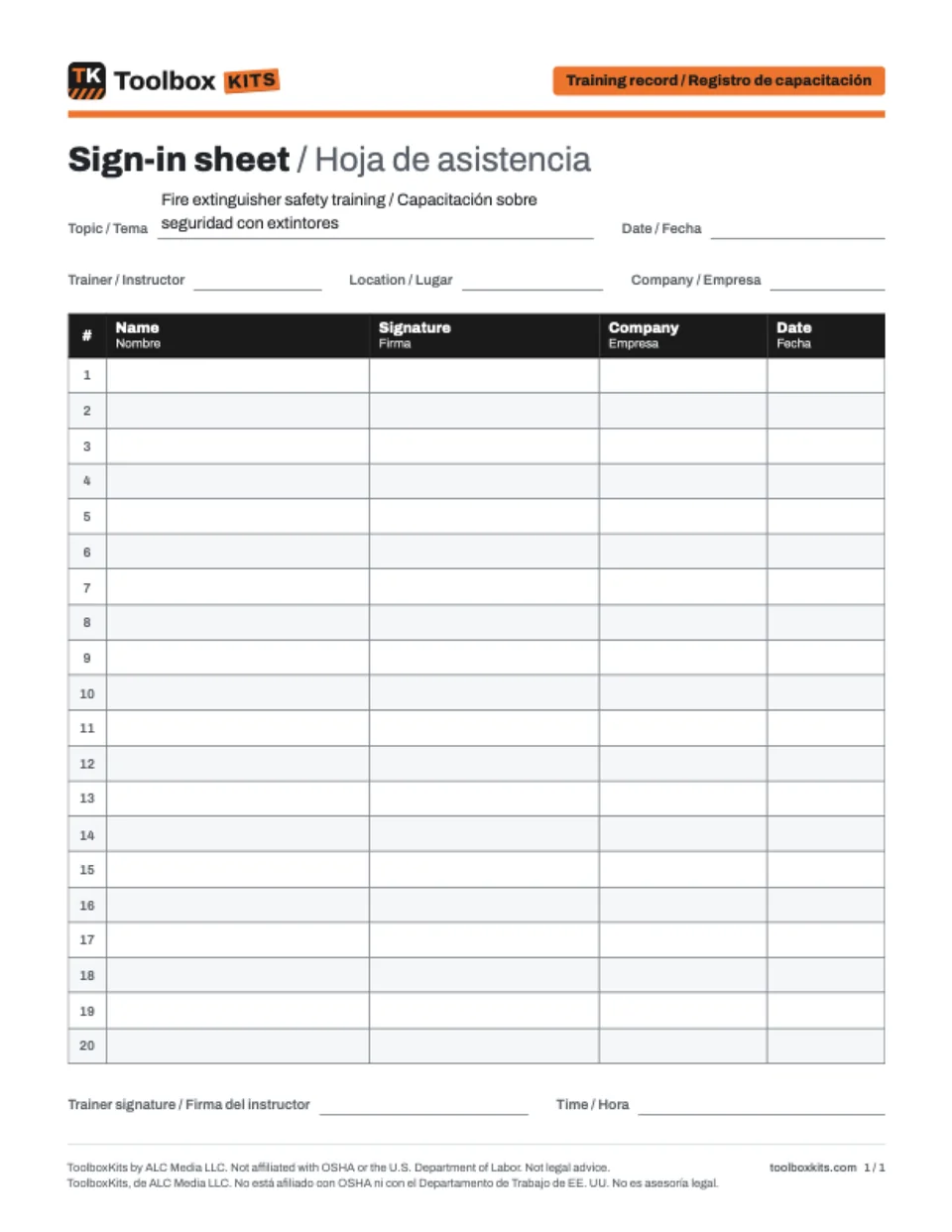 Sign-in sheet
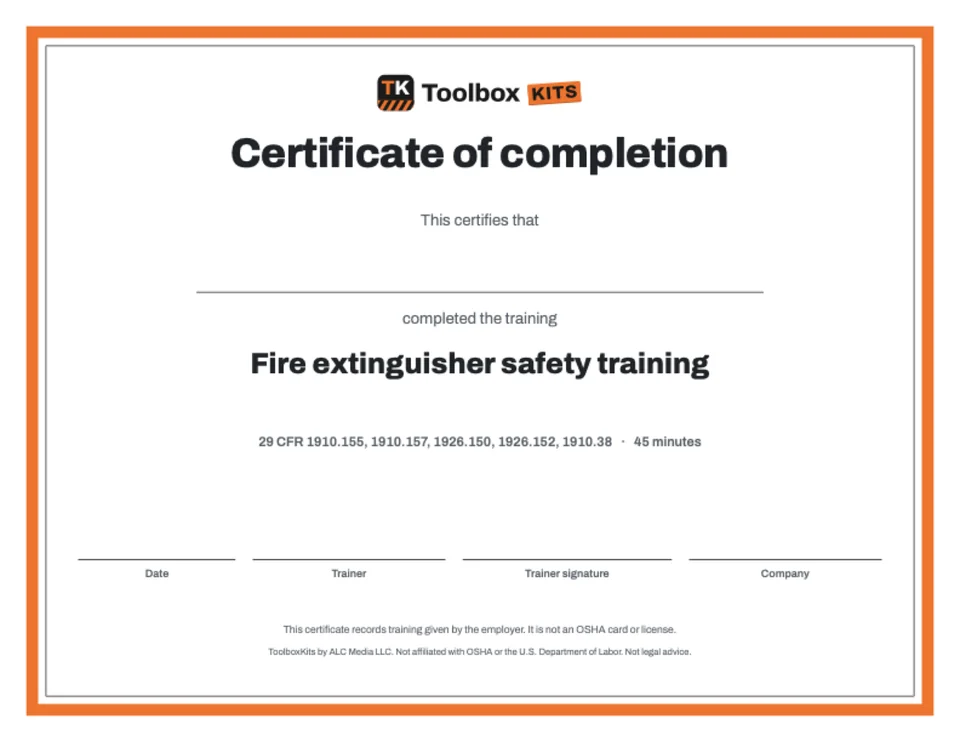 Certificate
- Crew handout
Try it
Try the quiz
Three questions from this topic. Pick an answer to see the right one and the OSHA paragraph.
Question 1 of 3
What does PASS stand for when you use a fire extinguisher?
The rule
What OSHA requires
Plain-language summary. Each line links to the exact paragraph of the regulation.
In general industry, the employer must provide portable fire extinguishers and mount, locate and identify them so they are readily accessible to employees without exposing them to possible injury.
“The employer shall provide portable fire extinguishers and shall mount, locate and identify them so that they are readily accessible to employees without subjecting the employees to possible injury.”
In general industry, extinguishers for Class A fires must be placed so the travel distance for employees to any extinguisher is 75 feet or less.
“The employer shall distribute portable fire extinguishers for use by employees on Class A fires so that the travel distance for employees to any extinguisher is 75 feet (22.9 m) or less.”
In general industry, extinguishers for Class B fires must be placed so the travel distance from the Class B hazard area to any extinguisher is 50 feet or less.
“the travel distance from the Class B hazard area to any extinguisher is 50 feet (15.2 m) or less”
In general industry, extinguishers must be kept fully charged, in operable condition and in their designated places at all times except during use.
“maintained in a fully charged and operable condition and kept in their designated places at all times except during use”
In general industry, portable extinguishers must be visually inspected monthly.
“Portable extinguishers or hose used in lieu thereof under paragraph (d)(3) of this section shall be visually inspected monthly.”
In general industry, extinguishers must also get an annual maintenance check. The employer must record the date of that check and keep the record for one year after the last entry or the life of the shell, whichever is less.
“The employer shall assure that portable fire extinguishers are subjected to an annual maintenance check.”
In general industry, where extinguishers are provided for employee use, the employer must provide an educational program on the general principles of extinguisher use and the hazards of fighting a fire in its beginning (incipient) stage.
“the employer shall also provide an educational program to familiarize employees with the general principles of fire extinguisher use and the hazards involved with incipient stage fire fighting.”
On construction sites, all firefighting equipment must be inspected periodically and kept in operating condition, and defective equipment must be replaced immediately.
“All firefighting equipment shall be periodically inspected and maintained in operating condition. Defective equipment shall be immediately replaced.”
On construction sites, provide a fire extinguisher rated at least 2A for each 3,000 square feet of protected building area, or major fraction of it, and keep the travel distance to the nearest one at 100 feet or less.
“Travel distance from any point of the protected area to the nearest fire extinguisher shall not exceed 100 feet.”
On construction sites, provide an extinguisher rated at least 10B within 50 feet of wherever more than 5 gallons of flammable or combustible liquids or 5 pounds of flammable gas are being used. This does not apply to the fuel tanks built into motor vehicles.
“A fire extinguisher, rated not less than 10B, shall be provided within 50 feet of wherever more than 5 gallons of flammable or combustible liquids or 5 pounds of flammable gas are being used on the jobsite.”
Who must be trained
In general industry, where portable fire extinguishers are provided for employee use, employees must get education on the general principles of extinguisher use and the hazards of fighting a fire in its beginning (incipient) stage (29 CFR 1910.157(g)(1)). Employees designated to use firefighting equipment as part of an emergency action plan must be trained in the use of that equipment (29 CFR 1910.157(g)(3)). Where standpipe systems or hose stations are used instead of Class A extinguishers, employees must be trained at least annually in their use (29 CFR 1910.157(d)(3)).
When to retrain
In general industry, the extinguisher education must be given upon initial employment and at least annually after that (29 CFR 1910.157(g)(2)). Training for employees designated to use firefighting equipment must be given upon initial assignment to the designated group and at least annually after that (29 CFR 1910.157(g)(4)).

Common questions
Questions people ask
Is there a printable fire extinguisher toolbox talk PDF?
Yes. This fire extinguisher toolbox talk is a free printable PDF in English and Spanish, with a sign-in table for your crew. Print it, read it aloud in about five minutes, and keep the signed sheet with your safety records.
What should a fire extinguisher inspection toolbox talk cover?
Show the crew what to look for: the extinguisher is in its place and not blocked, the pin and tamper seal are intact, the gauge is in the green if it has one, and there is no damage or corrosion. In general industry, portable extinguishers must be visually inspected monthly and get an annual maintenance check (29 CFR 1910.157(e)(2) and (e)(3)). On construction sites, firefighting equipment must be inspected periodically, and defective equipment must be replaced immediately (29 CFR 1926.150(a)(4)).
Does OSHA require fire extinguisher training?
Yes, in general industry. Where portable extinguishers are provided for employee use, the employer must provide education on the general principles of extinguisher use and the hazards of fighting a fire in its beginning stage, upon initial employment and at least annually after that (29 CFR 1910.157(g)(1) and (g)(2)). Employees designated to use firefighting equipment under an emergency action plan must be trained on that equipment (29 CFR 1910.157(g)(3)). In construction, the general duty to instruct each employee in recognizing and avoiding unsafe conditions applies (29 CFR 1926.21(b)(2)).
Is there a fire extinguisher training PowerPoint?
This free talk is written to be read aloud, so you do not need slides to run it. For a longer fire safety awareness and fire extinguisher training session, the training kit for this topic adds an editable PowerPoint in English and Spanish with trainer notes, a quiz and a sign-in sheet. If the kit is not ready to buy yet, you can request it from this page. The kit is not produced or endorsed by OSHA.
Can I use this as a fire extinguisher safety moment?
Yes. For a quick safety moment, walk the crew to the nearest extinguisher, check its gauge, pin and label together, and review the PASS method. Save the full talk, the scenario and the quiz for a longer toolbox meeting.
Free to share
Use this talk for free
You can print, share and adapt this talk at no cost under the Creative Commons BY-NC-SA 4.0 license. Please credit ToolboxKits with a link.