

Free 5-minute toolbox talkFireEnglish and Spanish
Hot work toolbox talk: permits and fire watch
Sparks and hot slag travel farther than you think and fall through cracks into places you cannot see. What OSHA requires: In general industry, when the object cannot readily be moved, movable fire hazards nearby must be taken to a safe place (29 CFR 1910.252(a)(1)(iii)).
A free 5-minute hot work safety talk for welding, cutting, brazing and torch work. It covers who authorizes the work, clearing combustibles, fire watch, extinguishers and gas cylinders, with OSHA citations for general industry and construction.
Updated October 29, 2026 · Based on 29 CFR 1910.252, 29 CFR 1926.352
Read it out loud
Free 5-minute toolbox talk
Read it out loud to your crew. It takes about 5 minutes.
Start with a question
Before anyone strikes an arc or lights a torch today, who checks the area for anything a spark could reach?
Why it matters
Hot work is any job that makes sparks, flame or heat that could start a fire, like welding, torch cutting, brazing and grinding. Sparks and hot slag travel farther than you think and fall through cracks into places you cannot see. A spark can smolder in dust or trash and turn into a fire after the crew goes home.
Key points
Get the area checked and authorized
In general industry, before welding or cutting is permitted, the person responsible for authorizing it must inspect the area and designate the precautions, with authorization preferably given as a written permit.
More
Know who signs permits on this job, and do not start until the precautions are in place.
Move the work or move the combustibles
First ask if the job can be done without hot work, like bolting instead of welding. In construction, move the work to a designated safe location when practical, or, if it cannot readily be moved, take all movable fire hazards nearby to a safe place or otherwise protect them.
More
In general industry, combustibles must be moved at least 35 feet away where practicable, or covered with flameproofed covers or otherwise shielded. If fire hazards cannot be moved or guarded, welding and cutting must not be done.
29 CFR 1910.252(a)(2)(vii) · 29 CFR 1926.352(a) · 29 CFR 1910.252(a)(1)(iii)
Check below, behind and next door
In general industry, where floor cracks or openings cannot be closed, protect combustibles below from falling sparks, and do the same for cracks or holes in walls, open doorways and open or broken windows.
More
In construction, when welding, cutting or heating on a wall, floor or ceiling, take the same precautions on the opposite side. Heat travels through metal too, so check behind pipes, beams and metal walls.
29 CFR 1926.352(f) · 29 CFR 1910.252(a)(2)(i)
Post a fire watch when needed
In general industry, a fire watch is required where more than a minor fire might develop, or where appreciable combustibles are closer than 35 feet to the work, among other conditions.
More
The fire watcher keeps extinguishing equipment ready, is trained to use it, knows how to sound the alarm, and stays at least a half hour after the work ends. In construction, when normal precautions are not enough, extra people must guard against fire during the work and long enough afterward to make sure no fire can start.
29 CFR 1910.252(a)(2)(iii)(A) · 29 CFR 1910.252(a)(2)(iii)(B) · 29 CFR 1926.352(e)
Keep firefighting equipment ready
Suitable fire extinguishing equipment must be ready for instant use, and on construction jobs it must be immediately available in the work area. Check that it is charged and not blocked.
More
In construction, do not weld, cut or heat where applying flammable paint, the presence of other flammable compounds or heavy dust concentrations create a hazard.
29 CFR 1926.352(d) · 29 CFR 1926.352(c)
Treat containers and cylinders with care
In construction, a drum, container or hollow structure that held toxic or flammable substances must be filled with water, or thoroughly cleaned, ventilated and tested, before welding, cutting or heating. Before heat is applied, it also needs a vent or opening to release built-up pressure.
More
Keep gas cylinders where sparks, hot slag or flame will not reach them, or use fire resistant shields when that is impractical.
29 CFR 1926.352(i) · 29 CFR 1926.352(j) · 29 CFR 1926.350(b)(1)
Scenario
Picture this: A welder is asked to cut out an old steel bracket on a mezzanine. Cardboard and wood pallets sit on the floor below, and there are gaps where the deck meets the wall. Nobody checks underneath or posts a fire watch, and the crew leaves right after the last cut. What could happen next, and what should have been done first?
Ask the crew
- Who authorizes hot work on this site, and where are permits kept?
- What could sparks reach here today, including below us and behind walls?
- When do we need a fire watch, and how long does that person stay?
- Where is the nearest extinguisher, and is it the right type?
Takeaway
No hot work until the area is checked and authorized, combustibles are moved or protected, an extinguisher is ready and a fire watch is posted when needed.
Trainer: ______________________ Date: ____________
Credit: ToolboxKits, https://toolboxkits.com/topics/hot-work/ (CC BY-NC-SA 4.0)
The poster is also inside the paid kits.
Audit-ready records in 60 seconds
Fill in your crew and download a filled sign-in sheet for this talk. Everything is made in your browser. Names are never uploaded or stored.
Start a sign-off
Crew scan a QR code on their own phones, type their name and sign with a finger. You see the names arrive and download the signed sheet. Free, no account.
Kits
Get the kit
No subscription needed. Buy only the kit you need.
Toolbox talk kit
$4.99
- 5-minute talk, English PDF
- 5-minute talk, Spanish PDF
- Editable mini-deck (English and Spanish)
- One-page crew handout (English and Spanish)
- Bilingual sign-in sheet
- 3-question quiz with answer key (English and Spanish)
- One-page bilingual poster
- Audit-ready records in 60 seconds: fill in your crew and get a sign-in sheet and a certificate for every worker
Training kit
$9
Editable PowerPoint, 41 slides
- Editable PowerPoint with trainer notes on every slide
- Trainer guide PDF with timing and discussion tips
- 10-question quiz and answer key
- Sign-in sheet and certificate of completion with fillable fields
- One-page crew handout
- Full Spanish version of everything
- One-page bilingual poster
- Audit-ready records in 60 seconds: fill in your crew and get a sign-in sheet and a certificate for every worker
- Instant download
- Secure checkout by Stripe
- 30-day refund, no questions
Need many topics? All Access gives you every kit for $99 a year.
Inside the kit
See what is in the kit
What is in the kit
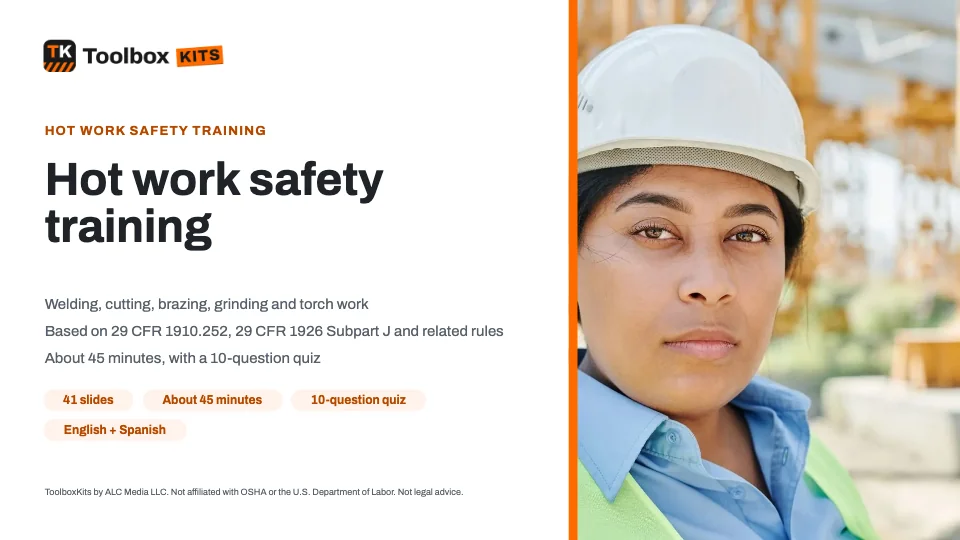 Editable PowerPoint
- Trainer guide
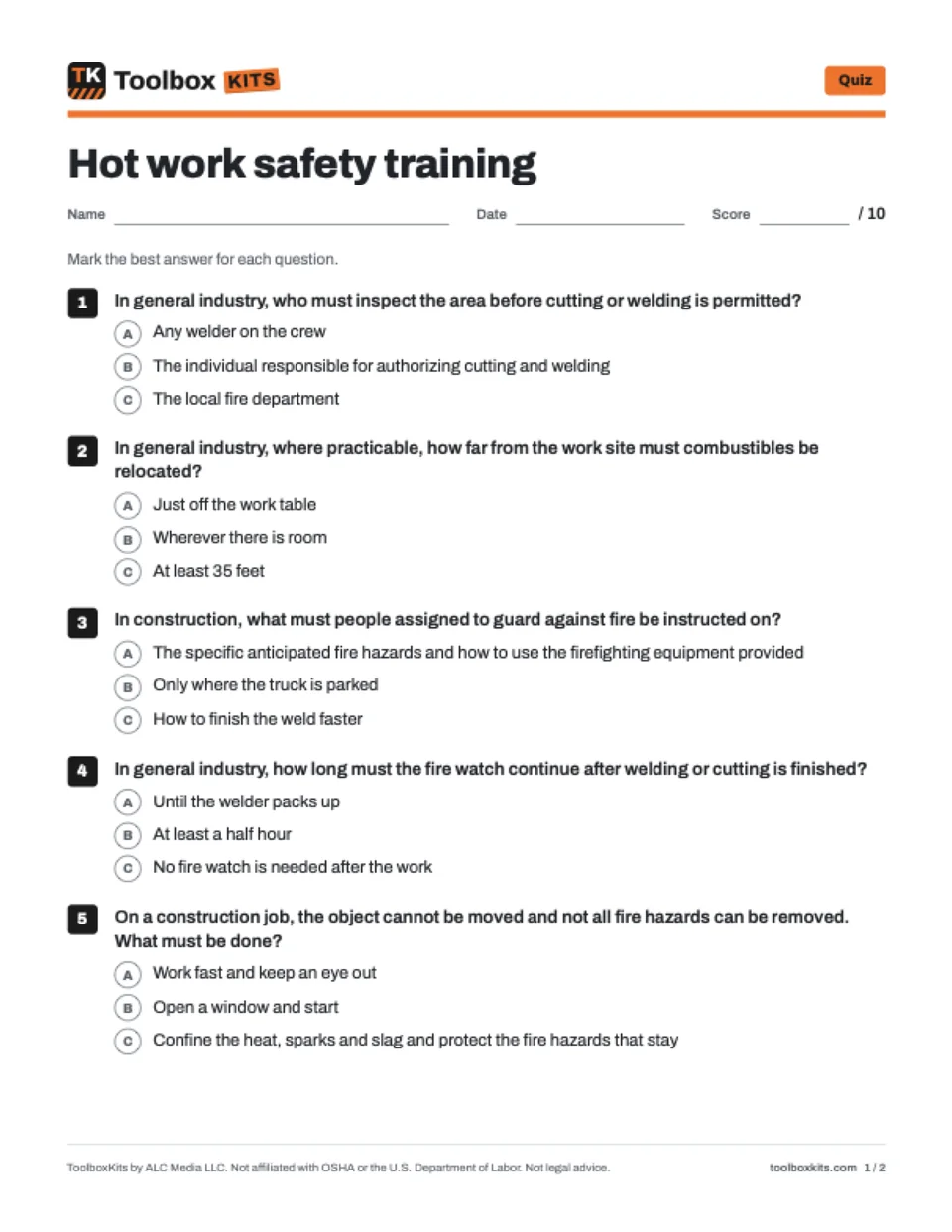 Quiz
- Answer key
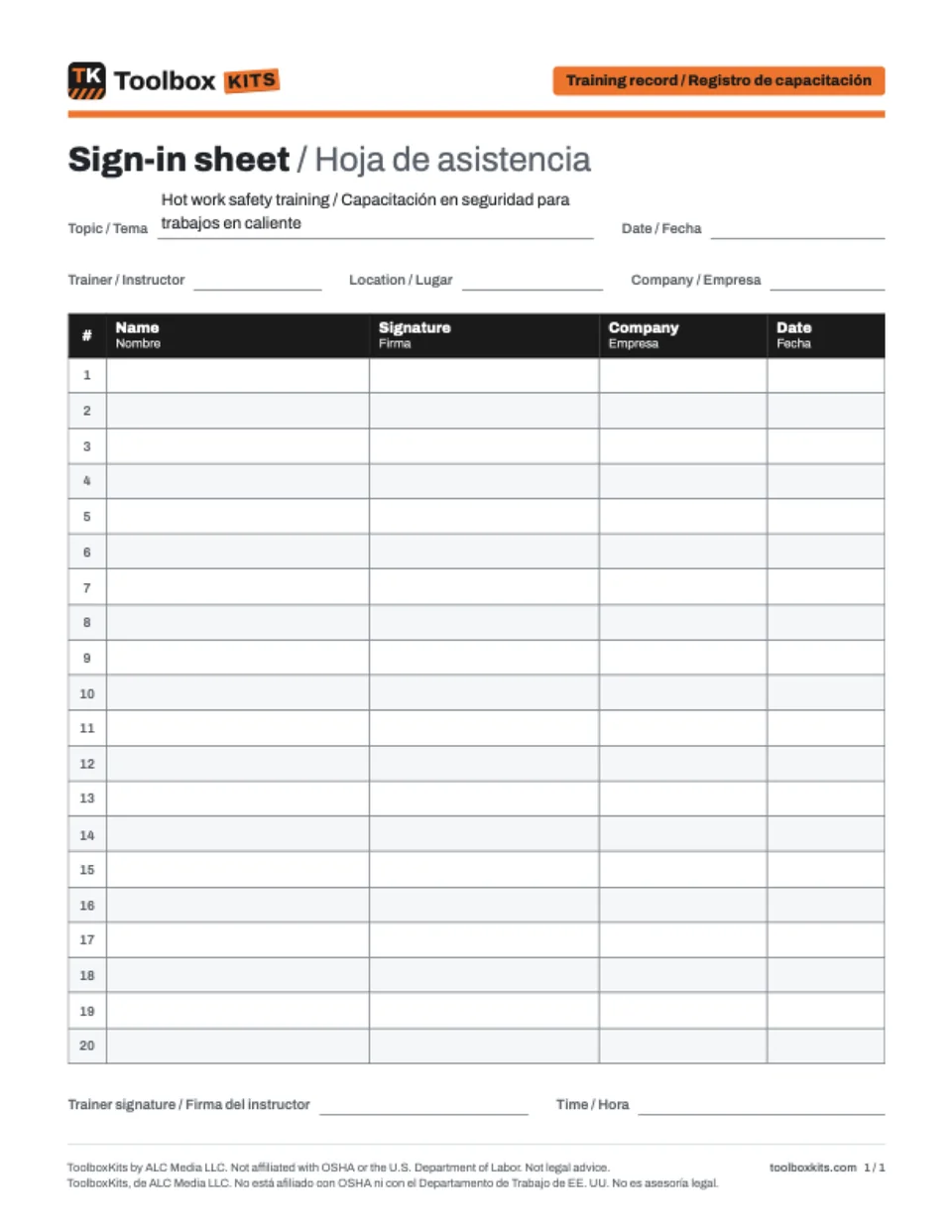 Sign-in sheet
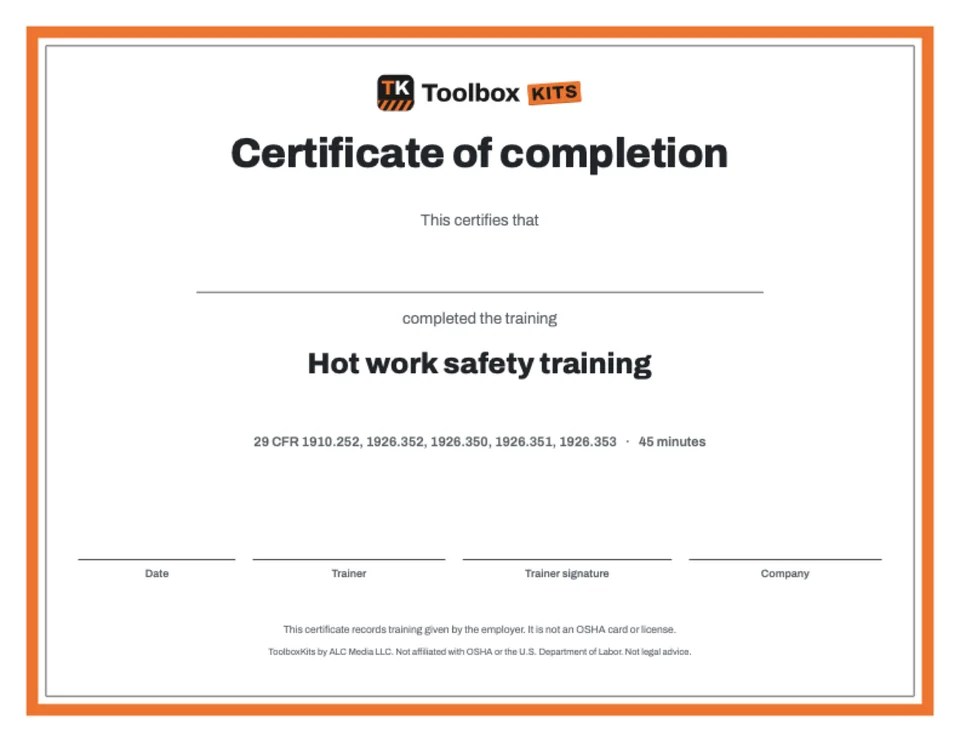 Certificate
- Crew handout
Try it
Try the quiz
Three questions from this topic. Pick an answer to see the right one and the OSHA paragraph.
Question 1 of 3
In general industry, how long must a fire watch be kept after welding or cutting is finished?
The rule
What OSHA requires
Plain-language summary. Each line links to the exact paragraph of the regulation.
In general industry, before cutting or welding is permitted, the area must be inspected by the person responsible for authorizing cutting and welding, who designates the precautions to follow, preferably in a written permit.
“He shall designate precautions to be followed in granting authorization to proceed preferably in the form of a written permit.”
In general industry, when the object cannot readily be moved, movable fire hazards nearby must be taken to a safe place. If the object cannot be moved and not all fire hazards can be removed, guards must be used to confine heat, sparks and slag and protect the fire hazards that remain (29 CFR 1910.252(a)(1)(i) and (a)(1)(ii)). If these precautions cannot be followed, welding and cutting must not be done.
“cannot be followed then welding and cutting shall not be performed”
In general industry, combustibles must be relocated at least 35 feet from the work site where practicable. Where that is impracticable, they must be protected with flameproofed covers or otherwise shielded.
“Where practicable, all combustibles shall be relocated at least 35 feet (10.7 m) from the work site.”
Fire watchers must have fire extinguishing equipment readily available and be trained in its use, be familiar with how to sound an alarm, and keep the fire watch for at least a half hour after welding or cutting is finished.
“A fire watch shall be maintained for at least a half hour after completion of welding or cutting operations to detect and extinguish possible smoldering fires.”
In general industry, cutting or welding is not permitted in areas not authorized by management, in sprinklered buildings while the sprinkler protection is impaired, in the presence of explosive atmospheres, or near large quantities of exposed, readily ignitible materials such as bulk sulfur, baled paper or cotton.
Management must insist that cutters or welders and their supervisors are suitably trained in the safe operation of their equipment and the safe use of the process.
“suitably trained in the safe operation of their equipment and the safe use of the process”
In construction, objects to be welded, cut or heated must be moved to a designated safe location when practical. If they cannot readily be moved, all movable fire hazards nearby must be taken to a safe place or otherwise protected.
“all movable fire hazards in the vicinity shall be taken to a safe place, or otherwise protected”
In construction, suitable fire extinguishing equipment must be immediately available in the work area and maintained ready for instant use.
“Suitable fire extinguishing equipment shall be immediately available in the work area and shall be maintained in a state of readiness for instant use.”
In construction, when normal fire prevention precautions are not sufficient, additional personnel must guard against fire during the work and for a sufficient time afterward, and must be instructed on the specific anticipated fire hazards and how to use the firefighting equipment provided.
“Such personnel shall be instructed as to the specific anticipated fire hazards and how the firefighting equipment provided is to be used.”
In construction, drums, containers or hollow structures that have contained toxic or flammable substances must be filled with water, or thoroughly cleaned of those substances and ventilated and tested, before welding, cutting or heating is done on them.
“either be filled with water or thoroughly cleaned of such substances and ventilated and tested”
Who must be trained
In general industry, management must insist that cutters or welders and their supervisors are suitably trained in the safe operation of their equipment and the safe use of the process (29 CFR 1910.252(a)(2)(xiii)(C)), and fire watchers must be trained in the use of the fire extinguishing equipment they have (29 CFR 1910.252(a)(2)(iii)(B)). In construction, people assigned to guard against fire must be instructed on the specific anticipated fire hazards and how to use the firefighting equipment provided (29 CFR 1926.352(e)), and employers must instruct employees in the safe use of fuel gas (29 CFR 1926.350(d)) and in the safe means of arc welding and cutting (29 CFR 1926.351(d)).
Common questions
Questions people ask
Is there a printable welding, cutting and hot work toolbox talk PDF?
Yes. This hot work safety toolbox talk is free to print as a PDF in English or Spanish, with a sign-in sheet for attendance. It covers welding, cutting, brazing and torch work, and it works as a short hot work safety training handout next to your own permit form.
Does OSHA require a hot work permit?
In general industry, before cutting or welding is permitted, the area must be inspected by the person responsible for authorizing the work, who designates the precautions to follow, preferably in the form of a written permit. That rule states a preference for a written permit rather than requiring one in every case, but some OSHA standards do require a hot work permit, such as for hot work on or near a process covered by the process safety management standard (29 CFR 1910.119(k)(1)) or, with some exceptions, at grain handling facilities (29 CFR 1910.272(f)(1)). Many employers and building owners require a written permit for all hot work, so check your site rules and cover them in your hot work permit safety talk.
Do we need a hot work written program?
OSHA's general industry welding rule does not use that name, but it does require management to set up areas and procedures for cutting and welding based on fire potential, designate who authorizes cutting and welding in other areas, make sure welders and their supervisors are suitably trained, and tell contractors about flammable materials or hazards they may not know about. A written hot work program with a permit form is a practical way to cover those duties.
Is there a hot work safety training PowerPoint?
This free talk is written to be read aloud, so you do not need slides or a projector. For a longer hot work safety presentation, the paid training kit for this topic is an editable PowerPoint in English and Spanish with trainer notes, a quiz and a sign-in sheet, so the slides are not a free download. It is built from the text of OSHA's welding and cutting standards and is not produced or endorsed by OSHA. If the kit is not ready to buy yet, you can request it from this page.
What should a hot work safety presentation cover?
Cover who authorizes the work, moving or protecting combustibles, checking below and behind walls, extinguishers, the fire watch, gas cylinders and containers, plus eye protection and ventilation for fumes. In general industry, a fire watch must be kept for at least a half hour after welding or cutting is finished to detect and put out smoldering fires. End by walking the actual work area and filling out the permit together.
Free to share
Use this talk for free
You can print, share and adapt this talk at no cost under the Creative Commons BY-NC-SA 4.0 license. Please credit ToolboxKits with a link.