

Free 5-minute toolbox talkFireEnglish and Spanish
Welding safety presentation and toolbox talk
A spark can smolder out of sight after the crew leaves, fumes can harm your lungs, the arc can burn your eyes and skin, and the welding circuit can shock you. What OSHA requires: In construction, when practical, objects to be welded, cut or heated must be moved to a designated safe location (29 CFR 1926.352(a)).
A five-minute welding safety talk you can present at a safety meeting or before hot work starts. It covers fire prevention and fire watch, fumes, arc rays, electric shock and gas cylinders, with the OSHA rule behind each point.
Updated October 29, 2026 · Based on 29 CFR 1910.252, 29 CFR 1926.351, 29 CFR 1926.353
Read it out loud
Free 5-minute toolbox talk
Read it out loud to your crew. It takes about 5 minutes.
Start with a question
Before you strike an arc or light a torch today, what nearby could a spark or hot slag reach?
Why it matters
Welding and cutting put heat, sparks, hot slag, fumes, intense light and electricity in one spot. A spark can smolder out of sight after the crew leaves, fumes can harm your lungs, the arc can burn your eyes and skin, and the welding circuit can shock you.
Key points
Clear the area before hot work
When practical, move the work to a designated safe location, and if it cannot be readily moved, take all movable fire hazards nearby to a safe place or protect them. If it cannot be moved and the fire hazards cannot all be removed, confine the heat, sparks and slag and protect what cannot be moved.
More
When welding on walls, floors or ceilings, take the same precautions on the opposite side. Keep suitable fire extinguishing equipment in the work area, ready for instant use.
29 CFR 1926.352(a) · 29 CFR 1926.352(b) · 29 CFR 1926.352(f) · 29 CFR 1926.352(d)
Post a fire watch when it is needed
In construction, when normal fire prevention precautions are not enough, extra people must be assigned to guard against fire during the work and for a sufficient period afterward.
More
In general industry, fire watchers must have extinguishing equipment readily available, be trained in its use, know how to sound the alarm and keep watching for at least a half hour after welding or cutting is finished.
29 CFR 1910.252(a)(2)(iii)(B) · 29 CFR 1926.352(e)
Keep fumes out of your breathing zone
Fumes come from the base metal, coatings, filler metal and flux, so keep your head out of the plume and put the exhaust hood close to the work.
More
Your employer must cover the hazardous materials in fluxes, coatings, coverings and filler metals in the hazard communication program, give you access to their labels and safety data sheets, and train you. Coated metal, like painted or galvanized steel, can give off more hazardous fumes.
Protect your eyes and skin from the arc
The arc's ultraviolet rays and intense light can burn your eyes and skin. In general industry, helmets or hand shields must be used for all arc welding and arc cutting except submerged arc welding, and helpers and attendants must get proper eye protection.
More
On construction sites, anyone welding, cutting or heating must have suitable eye protection, and where practicable, noncombustible or flameproof screens must shield people nearby from the rays. Use a filter shade right for the job and cover your skin.
29 CFR 1910.252(b)(2)(i)(A) · 29 CFR 1926.353(e)(2) · 29 CFR 1926.351(e)
Stay clear of electric shock
Before leaving an electrode holder unattended, remove the electrode and place the holder so it cannot contact people or conducting objects. Never dip a hot holder in water, and open the power supply switch when you leave or stop work for any appreciable length of time or move the machine.
More
Report faulty equipment to your supervisor, and do not use cables that need repair.
29 CFR 1926.351(d) · 29 CFR 1926.351(b)(4)
Handle gas cylinders with care
Keep compressed gas cylinders secured upright, except briefly while actually being hoisted or carried, and far enough from the work that sparks, hot slag or flame cannot reach them. Close the valve when work is finished, when the cylinder is empty and whenever it is moved.
More
Keep oxygen cylinders and fittings away from oil and grease, and inspect hoses and torches at the start of each shift.
29 CFR 1926.350(a)(9) · 29 CFR 1926.350(b)(1) · 29 CFR 1926.350(a)(8) · 29 CFR 1926.350(i), (f)(3) and (g)(2)
Scenario
Picture this: a crew is torch cutting old brackets on an upper floor during a renovation. The floor has cracks, and the room below is full of cardboard and scrap wood. The fire watch gets called away to unload a truck, and the crew finishes and leaves for lunch. What went wrong, and what should have happened?
Ask the crew
- What could catch a spark near this week's hot work, including behind walls and below floors?
- Who is the fire watch, and do they know where the extinguisher and the alarm are?
- What do you check on cables, hoses, torches and cylinders before you start?
Takeaway
Clear the area, keep a fire watch, control fumes, shield your eyes and skin, and check your gear every time.
Trainer: ______________________ Date: ____________
Credit: ToolboxKits, https://toolboxkits.com/topics/welding-safety/ (CC BY-NC-SA 4.0)
The poster is also inside the paid kits.
Audit-ready records in 60 seconds
Fill in your crew and download a filled sign-in sheet for this talk. Everything is made in your browser. Names are never uploaded or stored.
Start a sign-off
Crew scan a QR code on their own phones, type their name and sign with a finger. You see the names arrive and download the signed sheet. Free, no account.
Kits
Get the kit
No subscription needed. Buy only the kit you need.
Toolbox talk kit
$4.99
- 5-minute talk, English PDF
- 5-minute talk, Spanish PDF
- Editable mini-deck (English and Spanish)
- One-page crew handout (English and Spanish)
- Bilingual sign-in sheet
- 3-question quiz with answer key (English and Spanish)
- One-page bilingual poster
- Audit-ready records in 60 seconds: fill in your crew and get a sign-in sheet and a certificate for every worker
Training kit
$9
Editable PowerPoint, 31 slides
- Editable PowerPoint with trainer notes on every slide
- Trainer guide PDF with timing and discussion tips
- 10-question quiz and answer key
- Sign-in sheet and certificate of completion with fillable fields
- One-page crew handout
- Full Spanish version of everything
- One-page bilingual poster
- Audit-ready records in 60 seconds: fill in your crew and get a sign-in sheet and a certificate for every worker
- Instant download
- Secure checkout by Stripe
- 30-day refund, no questions
Need many topics? All Access gives you every kit for $99 a year.
Inside the kit
See what is in the kit
What is in the kit
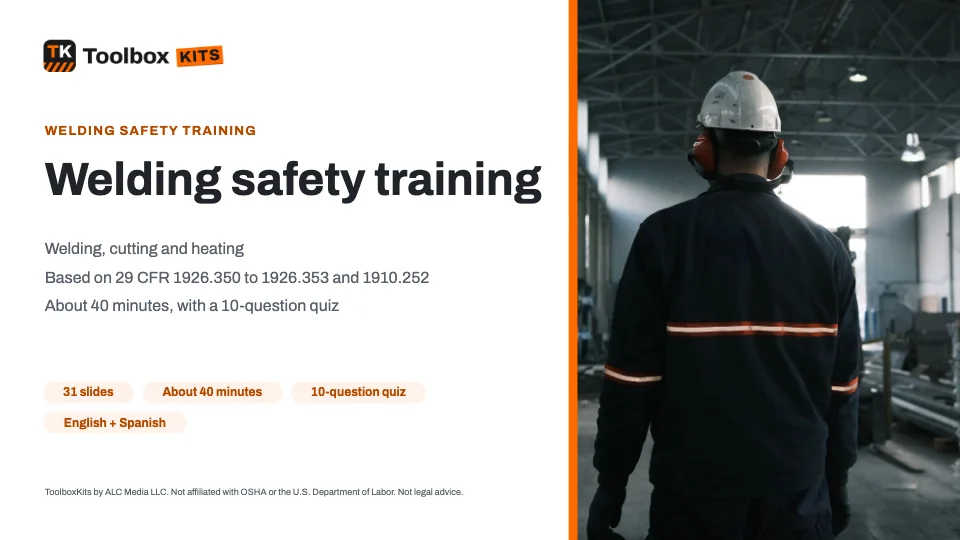 Editable PowerPoint
- Trainer guide
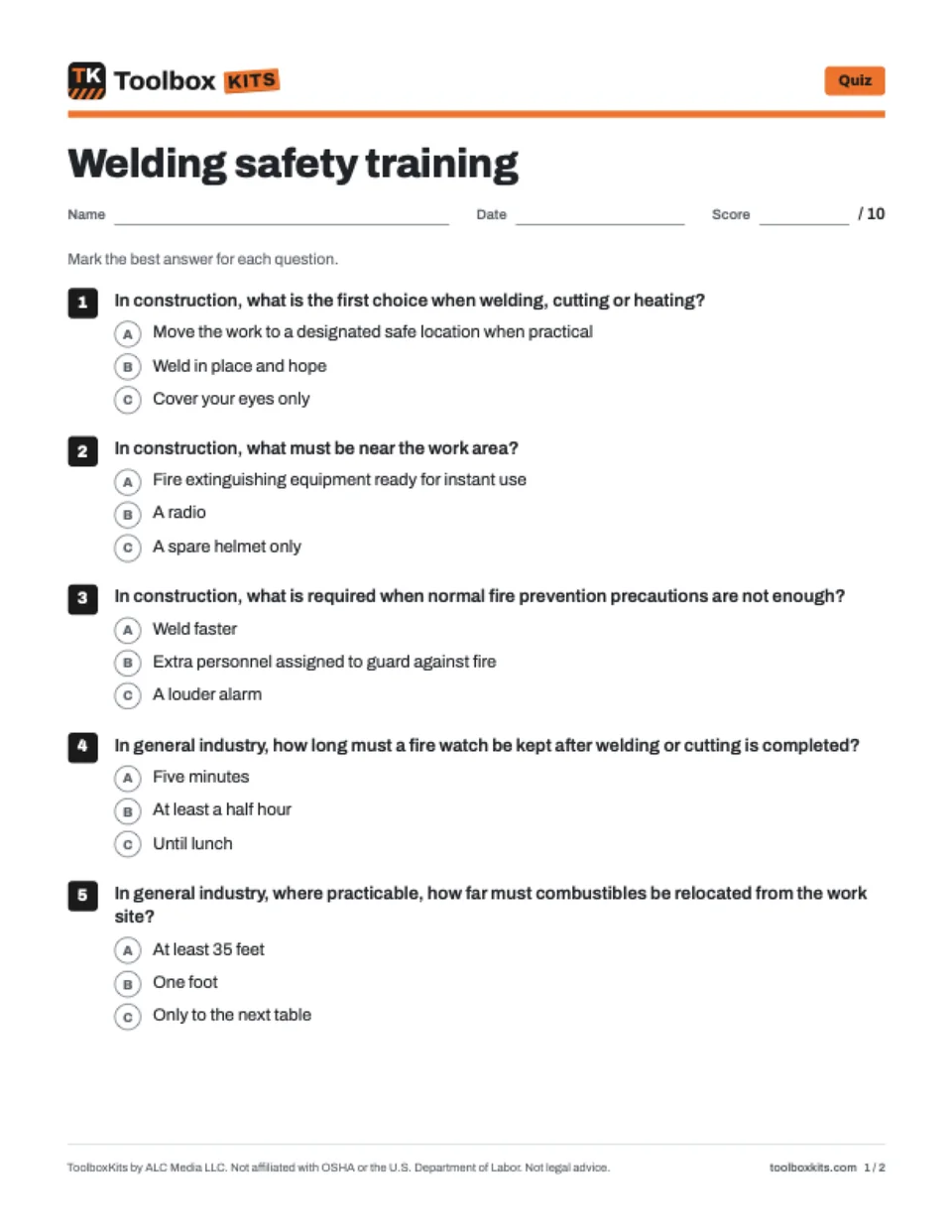 Quiz
- Answer key
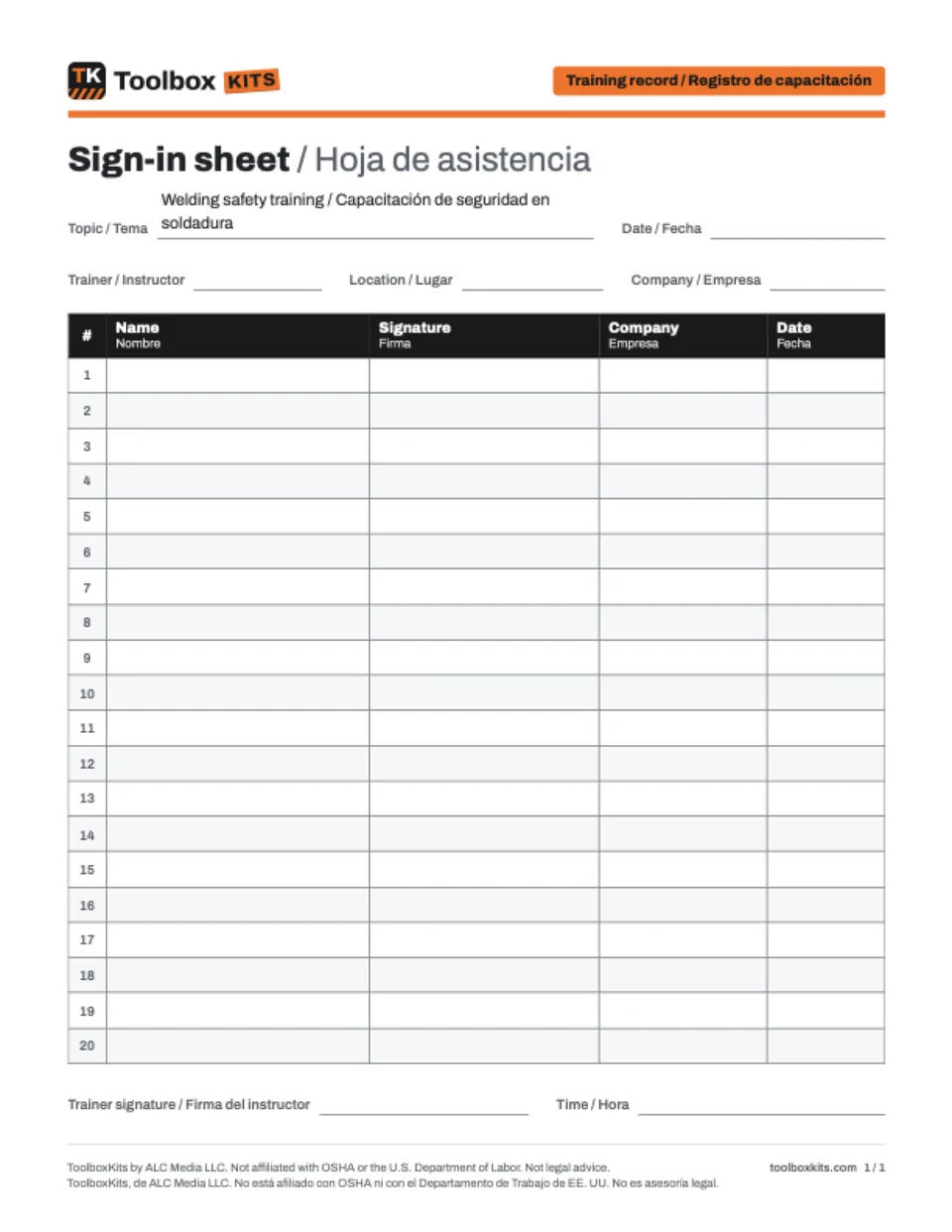 Sign-in sheet
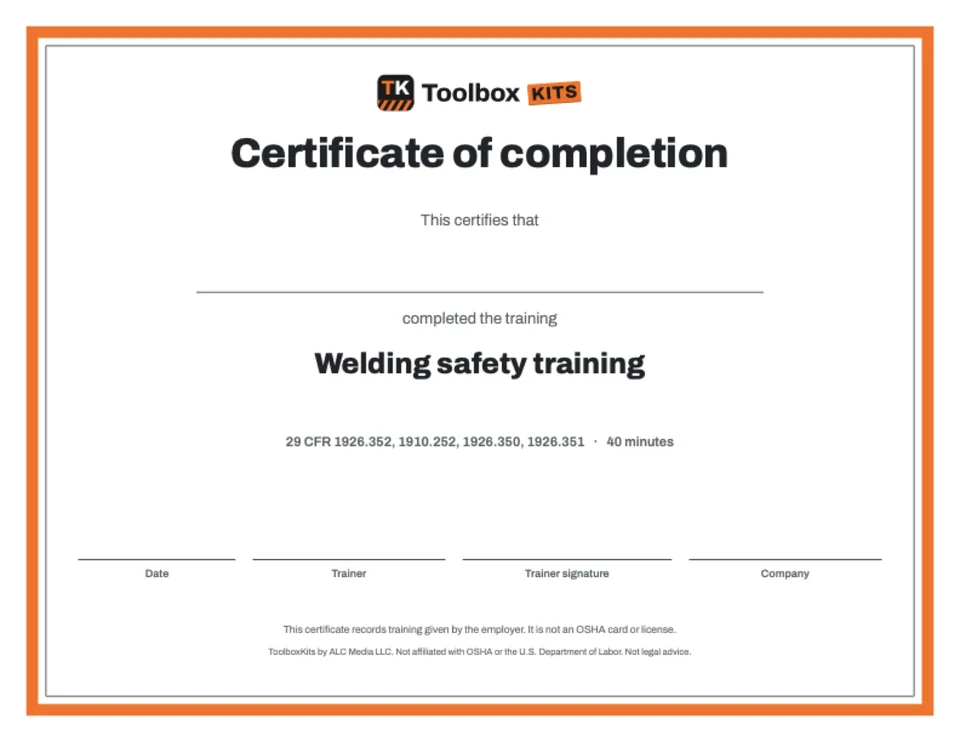 Certificate
- Crew handout
Try it
Try the quiz
Three questions from this topic. Pick an answer to see the right one and the OSHA paragraph.
Question 1 of 3
In general industry, how long must a fire watch continue after welding or cutting is finished?
The rule
What OSHA requires
Plain-language summary. Each line links to the exact paragraph of the regulation.
In construction, when practical, objects to be welded, cut or heated must be moved to a designated safe location. If they cannot be readily moved, all movable fire hazards nearby must be taken to a safe place or otherwise protected.
“all movable fire hazards in the vicinity shall be taken to a safe place, or otherwise protected”
In construction, when normal fire prevention precautions are not sufficient, additional personnel must be assigned to guard against fire during the work and for a sufficient period afterward to ensure that no possibility of fire exists. They must be instructed on the specific fire hazards expected and how to use the firefighting equipment provided.
“additional personnel shall be assigned to guard against fire while the actual welding, cutting, or heating operation is being performed”
In general industry, fire watchers must have fire extinguishing equipment readily available, be trained in its use and know how to sound an alarm. The fire watch must be kept for at least a half hour after welding or cutting is completed.
“A fire watch shall be maintained for at least a half hour after completion of welding or cutting operations to detect and extinguish possible smoldering fires.”
In general industry, when the object cannot be moved and not all fire hazards can be removed, certain additional precautions may be necessary (29 CFR 1910.252(a)(2)). Where practicable, all combustibles must be relocated at least 35 feet (10.7 m) from the work site (29 CFR 1910.252(a)(2)(vii)). Where that is impracticable, they must be protected with flameproofed covers or otherwise shielded.
“Where practicable, all combustibles shall be relocated at least 35 feet (10.7 m) from the work site.”
In general industry, before cutting or welding is permitted, the area must be inspected by the person responsible for authorizing cutting and welding. That person designates the precautions to follow, preferably in the form of a written permit.
“Before cutting or welding is permitted, the area shall be inspected by the individual responsible for authorizing cutting and welding operations.”
In general industry, helmets or hand shields must be used during all arc welding and arc cutting, except submerged arc welding. Helpers and attendants must be provided with proper eye protection.
“Helmets or hand shields shall be used during all arc welding or arc cutting operations, excluding submerged arc welding.”
The employer must include the hazardous materials in fluxes, coatings, coverings and filler metals in its hazard communication program, and make sure each employee has access to their labels and safety data sheets and is trained under the hazard communication standard.
“The employer shall ensure that each employee has access to labels on containers of such materials and safety data sheets, and is trained in accordance with the provisions of § 1910.1200.”
In construction, welding, cutting or heating in enclosed spaces that involves zinc-bearing metals or metals coated with zinc-bearing materials, lead base metals, cadmium-bearing filler materials, or chromium-bearing metals or metals coated with chromium-bearing materials must be done with general mechanical or local exhaust ventilation.
“Welding, cutting, or heating in any enclosed spaces involving the metals specified in this subparagraph shall be performed with either general mechanical or local exhaust ventilation”
In construction, employers must instruct employees in safe arc welding and cutting, including removing electrodes from holders left unattended, never dipping hot electrode holders in water, opening the power supply switch when leaving or stopping work for any appreciable length of time or moving the machine, and reporting faulty or defective equipment to the supervisor.
“Employers shall instruct employees in the safe means of arc welding and cutting”
In construction, compressed gas cylinders must be secured upright at all times, except for short periods while they are actually being hoisted or carried, if necessary. Oxygen cylinders in storage must be separated from fuel-gas cylinders or combustible materials by at least 20 feet (6.1 m), or by a noncombustible barrier at least 5 feet (1.5 m) high with a fire-resistance rating of at least one-half hour (29 CFR 1926.350(a)(10)).
“Compressed gas cylinders shall be secured in an upright position at all times except, if necessary, for short periods of time while cylinders are actually being hoisted or carried.”
Who must be trained
In general industry, management must insist that cutters or welders and their supervisors are suitably trained in the safe operation of their equipment and the safe use of the process (29 CFR 1910.252(a)(2)(xiii)(C)). Workers designated to operate arc welding equipment must be properly instructed and qualified (29 CFR 1910.254(a)(3)), and workers designated to operate resistance welding equipment must be properly instructed and judged competent (29 CFR 1910.255(a)(3)). Fire watchers must be trained in the use of their fire extinguishing equipment (29 CFR 1910.252(a)(2)(iii)(B)). In construction, employers must instruct employees in the safe means of arc welding and cutting (29 CFR 1926.351(d)) and thoroughly instruct them in the safe use of fuel gas (29 CFR 1926.350(d)), and fire watch personnel must be instructed on the specific fire hazards expected and how to use the firefighting equipment provided (29 CFR 1926.352(e)). Employees must also be trained under the hazard communication standard on the hazardous materials in fluxes, coatings, coverings and filler metals (29 CFR 1910.252(c)(1)(iv)).

Common questions
Questions people ask
Is there a welding safety PowerPoint presentation?
The free talk on this page is written to be read aloud, so you can present it at a safety meeting without a projector. If you want a welding safety PowerPoint for a longer training session, use the training kit option on this page. Either way, finish by walking the work area and pointing out the extinguisher, the cylinders and anything that could catch a spark.
Is there a printable welding toolbox talk PDF?
Yes. This welding safety toolbox talk is free to print as a PDF in English and Spanish, with a sign-in table for your crew. Read it aloud in about five minutes and keep the signed sheet with your safety records.
What are good welding safety meeting topics?
Good topics include hot work permits and fire watch, fumes and ventilation, welding on coated or galvanized metal, eye and skin protection from the arc, electric shock from cables and electrode holders, gas cylinder storage and handling, hose and torch checks, and welding in confined spaces. Pick one topic per meeting and connect it to the hot work planned that week.
What should a toolbox talk for welding work cover?
Cover the hazards in the order the job meets them: clearing fire hazards and setting up a fire watch, controlling fumes, protecting eyes and skin, preventing shock and handling cylinders. In general industry, the area must be inspected by the person responsible for authorizing cutting and welding before the work is permitted, and that person designates the precautions, preferably in a written permit (29 CFR 1910.252(a)(2)(iv)).
What welding safety training does OSHA require?
In general industry, management must insist that cutters or welders and their supervisors are suitably trained in the safe operation of their equipment and the safe use of the process (29 CFR 1910.252(a)(2)(xiii)(C)). Workers designated to operate arc welding equipment must be properly instructed and qualified (29 CFR 1910.254(a)(3)). In construction, employers must instruct employees in the safe means of arc welding and cutting and thoroughly instruct them in the safe use of fuel gas (29 CFR 1926.351(d) and 1926.350(d)). A short talk supports that training but does not replace it.
Free to share
Use this talk for free
You can print, share and adapt this talk at no cost under the Creative Commons BY-NC-SA 4.0 license. Please credit ToolboxKits with a link.