

Free 5-minute toolbox talkDrivingEnglish and Spanish
Distracted driving toolbox talk
Distraction is anything that takes your eyes off the road, your hands off the wheel or your mind off driving, and texting does all three at once. What OSHA requires: OSHA has no specific standard for distracted driving on the road; the general duty to train still applies (29 CFR 1926.21(b)(2)).
A free distracted driving toolbox talk on phones, loose items, passengers and other distractions, on the road and on the job. Read it aloud in about five minutes as a distracted driving safety talk, or use one point as a distracted driving safety moment.
Updated October 29, 2026 · Based on 29 CFR 1926.601
Read it out loud
Free 5-minute toolbox talk
Read it out loud to your crew. It takes about 5 minutes.
Start with a question
Be honest: when did you last look at your phone while you were driving?
Why it matters
A vehicle covers a lot of ground in the short time you look away. Distraction is anything that takes your eyes off the road, your hands off the wheel or your mind off driving, and texting does all three at once. Whether you drive a pickup, a van, a forklift or a crane, your attention is one of your most important safety tools.
Key points
Put the phone away before you roll
Set your GPS, music and touch screen before you move. Then silence the phone, turn on its driving mode or put it where you cannot reach it. If a call or text cannot wait, find a safe place to park and handle it there.
More
Follow your company's phone policy and any state or local phone laws where you drive.
Secure loose items in the cab
Things sliding around the cab can pull your eyes and hands away from driving, and they can fly forward in a hard stop. On construction jobsites closed to public traffic, tools and material must be secured to prevent movement when they ride in the same compartment as workers.
More
Stow lunch, paperwork and tools before you start, and never reach for something that falls while the vehicle is moving.
Get set before the shift, not on the road
Adjust your seat and mirrors and buckle up before you put it in gear. On construction jobsites closed to public traffic, vehicles in use must be checked at the beginning of each shift, and defects must be corrected before the vehicle is placed in service.
More
Fiddling with a mirror or a wiper while driving is one more distraction.
Stay focused when you run equipment
Distraction is not only a road problem. On construction jobs, a crane operator must not do anything that diverts attention while operating, such as using a cell phone, except for signal communications.
More
In general industry, a forklift driver must look in the direction of travel and keep a clear view of the path. Make it a habit on every machine: no phone while it is moving.
29 CFR 1926.1417(d) · 29 CFR 1910.178(n)(6)
Manage passengers, food and drowsiness
Ask passengers to help with directions and to keep the talk light when traffic gets heavy. Eat before or after the drive, not during it. Drowsiness can pull your mind off the road too, so if you catch yourself drifting or missing turns, pull over somewhere safe and rest or switch drivers.
Do not call a coworker who is driving
If you know someone is on the road, wait to call or text until they arrive. Supervisors and dispatchers should not expect an instant reply from a driver. As a passenger, offer to handle the phone and the GPS, and speak up if the driver starts texting.
Scenario
Picture this: A foreman is driving the crew truck to the next site. The office texts him for a material count, and a loose toolbox slides off the seat onto the floor. He glances down to answer the text and reaches for the toolbox just as traffic ahead slows for a work zone. What could he, his crew and the office have done differently?
Ask the crew
- What distracts you most when you drive for work?
- Where can we keep phones in our trucks so nobody is tempted to grab them?
- How should the office reach a crew that is on the road?
- What loose items ride in our vehicles, and how can we secure them?
Takeaway
When you drive or run equipment, driving is your only job: phone away, eyes on your path and mind on the road.
Trainer: ______________________ Date: ____________
Credit: ToolboxKits, https://toolboxkits.com/topics/distracted-driving/ (CC BY-NC-SA 4.0)
The poster is also inside the paid kits.
Audit-ready records in 60 seconds
Fill in your crew and download a filled sign-in sheet for this talk. Everything is made in your browser. Names are never uploaded or stored.
Start a sign-off
Crew scan a QR code on their own phones, type their name and sign with a finger. You see the names arrive and download the signed sheet. Free, no account.
Kits
Get the kit
No subscription needed. Buy only the kit you need.
Toolbox talk kit
$4.99
- 5-minute talk, English PDF
- 5-minute talk, Spanish PDF
- Editable mini-deck (English and Spanish)
- One-page crew handout (English and Spanish)
- Bilingual sign-in sheet
- 3-question quiz with answer key (English and Spanish)
- One-page bilingual poster
- Audit-ready records in 60 seconds: fill in your crew and get a sign-in sheet and a certificate for every worker
Training kit
$9
Editable PowerPoint, 29 slides
- Editable PowerPoint with trainer notes on every slide
- Trainer guide PDF with timing and discussion tips
- 10-question quiz and answer key
- Sign-in sheet and certificate of completion with fillable fields
- One-page crew handout
- Full Spanish version of everything
- One-page bilingual poster
- Audit-ready records in 60 seconds: fill in your crew and get a sign-in sheet and a certificate for every worker
- Instant download
- Secure checkout by Stripe
- 30-day refund, no questions
Need many topics? All Access gives you every kit for $99 a year.
Inside the kit
See what is in the kit
What is in the kit
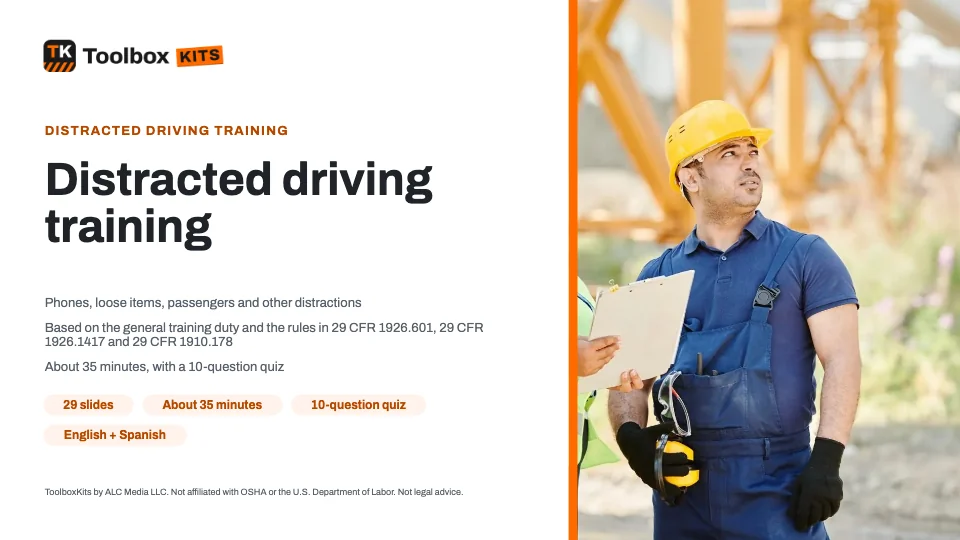 Editable PowerPoint
- Trainer guide
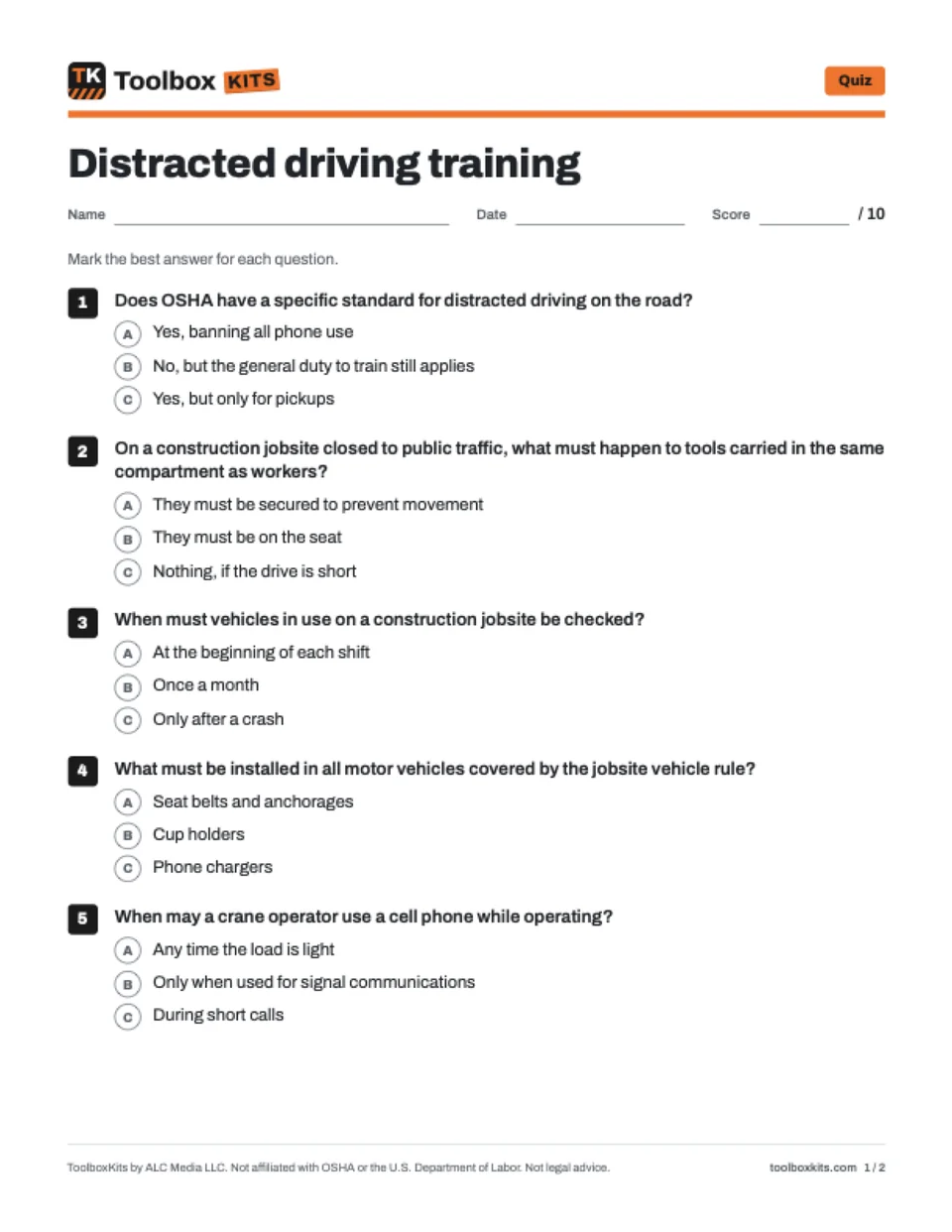 Quiz
- Answer key
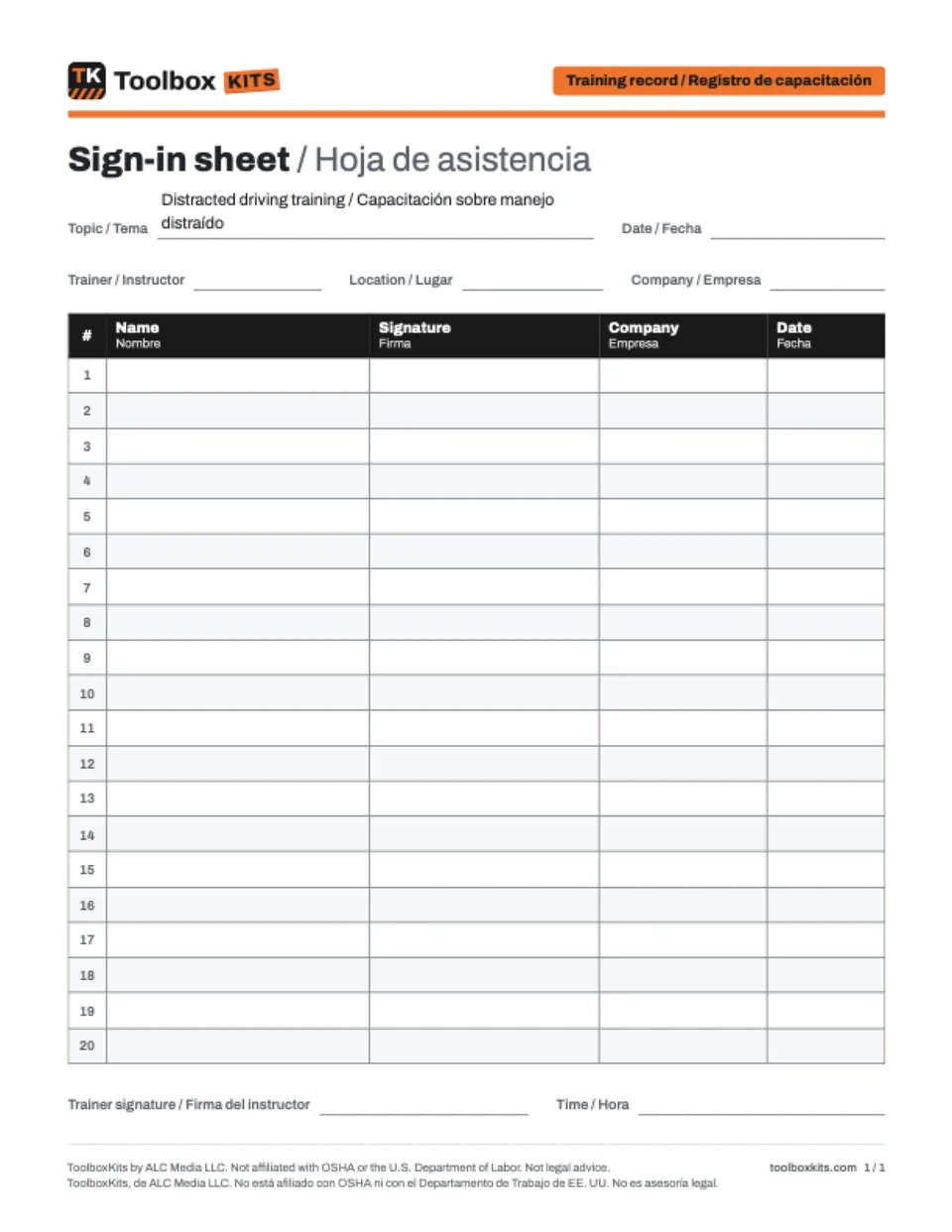 Sign-in sheet
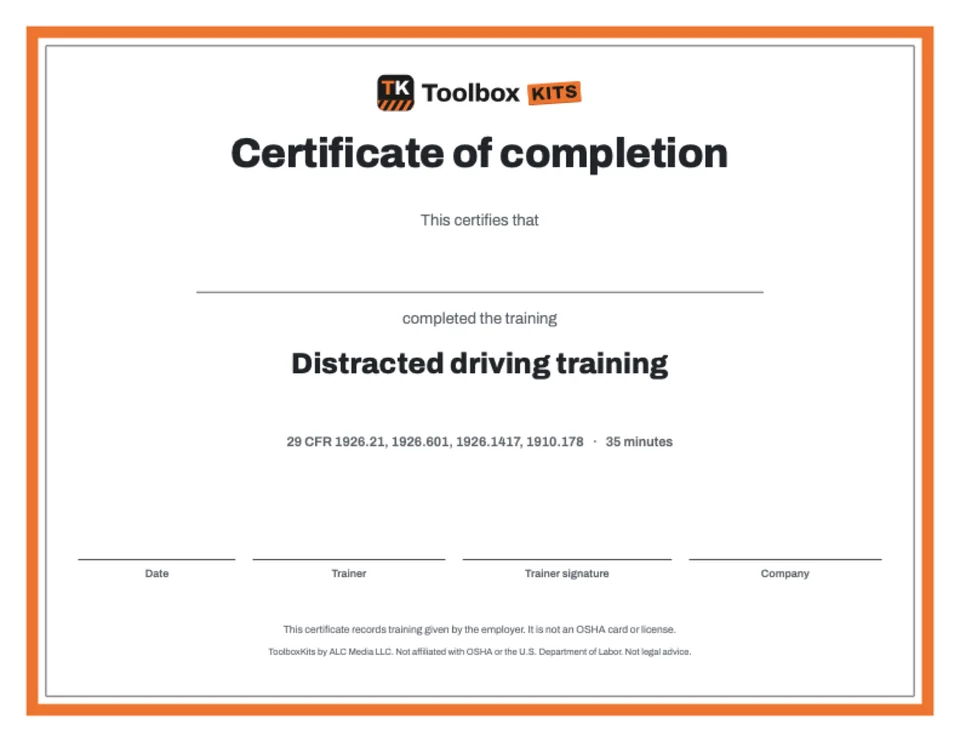 Certificate
- Crew handout
Try it
Try the quiz
Three questions from this topic. Pick an answer to see the right one and the OSHA paragraph.
Question 1 of 3
What is the safe way to handle a text that comes in while you are driving?
The rule
What OSHA requires
Plain-language summary. Each line links to the exact paragraph of the regulation.
OSHA has no specific standard for distracted driving on the road; the general duty to train still applies. In construction, the employer must instruct each employee in recognizing and avoiding unsafe conditions and the rules that apply to their work environment.
“The employer shall instruct each employee in the recognition and avoidance of unsafe conditions and the regulations applicable to his work environment to control or eliminate any hazards or other exposure to illness or injury.”
In construction, a crane operator must not do anything that diverts attention while actually operating the equipment, such as using a cell phone, except when the phone is used for signal communications.
“The operator must not engage in any practice or activity that diverts his/her attention while actually engaged in operating the equipment, such as the use of cellular phones (other than when used for signal communications).”
In general industry, a forklift driver must look in the direction of travel and keep a clear view of the path of travel.
“The driver shall be required to look in the direction of, and keep a clear view of the path of travel.”
OSHA's construction motor vehicle rule covers vehicles that operate within an off-highway jobsite not open to public traffic. It does not apply to equipment covered by 29 CFR 1926.602.
“Motor vehicles as covered by this part are those vehicles that operate within an off-highway jobsite, not open to public traffic.”
On construction jobsites closed to public traffic, tools and material must be secured to prevent movement when they are carried in the same compartment as workers.
“Tools and material shall be secured to prevent movement when transported in the same compartment with employees.”
On construction jobsites closed to public traffic, vehicles in use must be checked at the beginning of each shift to make sure brakes, tires, horn, steering, coupling devices, seat belts, operating controls and safety devices are in safe operating condition. All defects must be corrected before the vehicle is placed in service.
“All defects shall be corrected before the vehicle is placed in service.”
Seat belts and anchorages that meet the federal motor vehicle safety standards must be installed in all motor vehicles covered by the rule.
“Seat belts and anchorages meeting the requirements of 49 CFR part 571 (Department of Transportation, Federal Motor Vehicle Safety Standards) shall be installed in all motor vehicles.”
Common questions
Questions people ask
Is there a printable distracted driving toolbox talk PDF?
Yes. This distracted driving toolbox talk is free to print as a PDF in English and Spanish, with a sign-in table for your crew. Read it aloud in about five minutes before crews head out, and keep the signed sheet with your safety records.
What is a good distracted driving safety moment?
Pick one habit and spend a few minutes on it, such as where everyone keeps their phone while driving or how the office should reach a crew on the road. Ask each driver to name one distraction they struggle with and one fix that works for them. Any key point in this talk also works as a quick safety moment on distracted driving.
When is Distracted Driving Awareness Month?
In the United States, April is Distracted Driving Awareness Month. It is a good time for a distracted driving awareness month toolbox talk like this one. Distraction is a hazard on every trip, though, so repeat the message all year.
What should a cell phone distraction safety talk cover at work?
A cell phone distraction toolbox talk should cover phones behind the wheel, on equipment and while walking through traffic areas. On construction jobs, a crane operator must not use a cell phone or do anything else that diverts attention while operating, except for signal communications (29 CFR 1926.1417(d)). Agree as a crew on when phones get put away and how people can still be reached in an emergency.
Is there a distracted driving safety presentation?
This free talk is written to be read aloud, so you do not need slides. For a longer distracted driving safety presentation, the paid training kit for this topic is an editable PowerPoint in English and Spanish with trainer notes, a quiz and a sign-in sheet. If the kit is not ready to buy yet, you can request it from this page.
Free to share
Use this talk for free
You can print, share and adapt this talk at no cost under the Creative Commons BY-NC-SA 4.0 license. Please credit ToolboxKits with a link.