

Free 5-minute toolbox talkDrivingEnglish and Spanish
Truck driver safety training: a toolbox talk
A mistake with a brake, a chock or a load can hurt someone fast. What OSHA requires: OSHA's powered industrial truck rule covers forklifts at docks and in yards. Rules for driving trucks on public roads come from the Department of Transportation, not OSHA (29 CFR 1926.21(b)(2)).
A free truck driver safety toolbox talk for yards, docks and the road. Read it aloud in about five minutes in English or Spanish.
Updated October 29, 2026 · Based on 29 CFR 1910.178
Read it out loud
Free 5-minute toolbox talk
Read it out loud to your crew. It takes about 5 minutes.
Start with a question
What is the first thing you check before you move your truck or trailer?
Why it matters
A truck is heavy, hard to stop and hard to see around. Drivers share yards and docks with forklifts and people on foot. A mistake with a brake, a chock or a load can hurt someone fast. Good habits at the dock and on the road keep drivers and everyone around them safe.
Key points
Do the walk-around every time
Walk around the truck and trailer before each trip. Check tires, lights, brakes, mirrors, coupling, load and anything that looks loose or leaking. Do not drive a vehicle that is not safe. Report problems and get them fixed.
More
The same idea applies to forklifts, which must be examined before being placed in service and at least daily.
Set the brakes and chock the wheels
At the dock, the brakes of highway trucks must be set and wheel chocks placed under the rear wheels to keep them from rolling while forklifts board them. Brakes must be set and wheel blocks in place while loading or unloading. A trailer not coupled to a tractor may need fixed jacks.
Keep clear of forklifts and dock edges
Stay out of the forklift's path and make eye contact with the operator before you cross. No one may stand or pass under the elevated part of a forklift, loaded or empty. Keep a safe distance from the edge of an elevated dock or platform.
Back up slowly and get out and look
Backing is a risky move. Walk around and check the path first. Use a spotter if you can, and agree on hand signals. If you lose sight of your spotter, stop. Sound the horn and use your mirrors and cameras. Slow down and sound the horn where vision is blocked.
Secure the load
Make sure the load is stable and safely arranged. Use the right straps, chains or tie-downs for the load and check them at the start and during the trip. For forklifts, only stable or safely arranged loads should be handled.
More
Load securement rules for trucks on public roads come from the Department of Transportation, not OSHA.
Plan the journey
OSHA has no specific standard for a journey management plan; the general duty to train still applies. Plan the route, stops and rest breaks before you go. Note low bridges, weather and sites with special rules. Tell dispatch your plan, and speak up if the schedule is not safe.
Scenario
Picture this: A driver backs into a dock in a hurry. He does not set the brakes or place chocks because the forklift driver is waiting. As the forklift enters the trailer, the truck shifts and the trailer creeps forward. The forklift tips at the gap, and a coworker barely steps out of the way. What should have been done before the forklift boarded the trailer, and who could have stopped it?
Ask the crew
- What is on your walk-around checklist, and what do you check last?
- Who sets the brakes and chocks at our dock, and how do we confirm it?
- What is your backing routine, and when do you use a spotter?
- How do we plan a trip so we are not rushed or tired?
Takeaway
Inspect, set the brakes, chock the wheels, back up with care and secure the load before you roll.
Trainer: ______________________ Date: ____________
Credit: ToolboxKits, https://toolboxkits.com/topics/truck-driver-safety/ (CC BY-NC-SA 4.0)
The poster is also inside the paid kits.
Audit-ready records in 60 seconds
Fill in your crew and download a filled sign-in sheet for this talk. Everything is made in your browser. Names are never uploaded or stored.
Start a sign-off
Crew scan a QR code on their own phones, type their name and sign with a finger. You see the names arrive and download the signed sheet. Free, no account.
Kits
Get the kit
No subscription needed. Buy only the kit you need.
Toolbox talk kit
$4.99
- 5-minute talk, English PDF
- 5-minute talk, Spanish PDF
- Editable mini-deck (English and Spanish)
- One-page crew handout (English and Spanish)
- Bilingual sign-in sheet
- 3-question quiz with answer key (English and Spanish)
- One-page bilingual poster
- Audit-ready records in 60 seconds: fill in your crew and get a sign-in sheet and a certificate for every worker
Training kit
$9
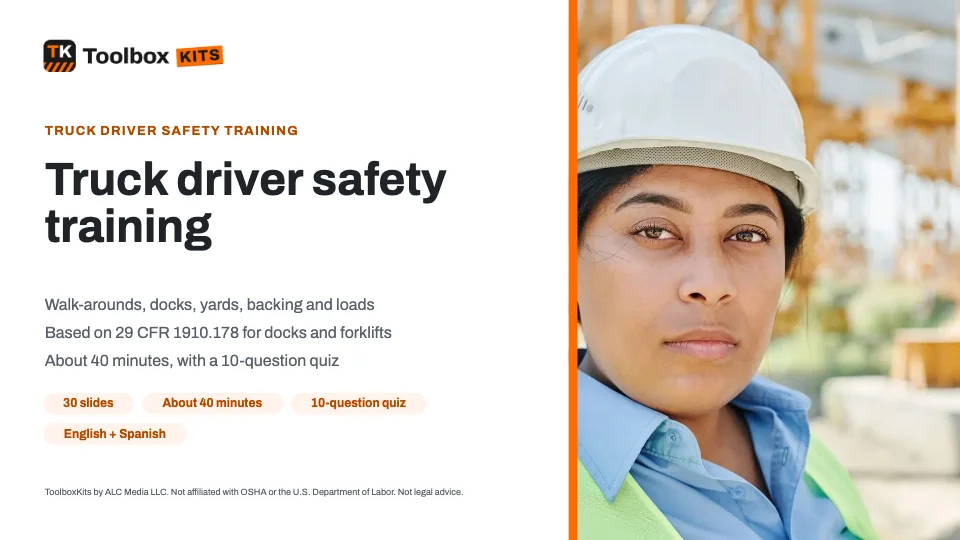
Editable PowerPoint, 30 slides
- Editable PowerPoint with trainer notes on every slide
- Trainer guide PDF with timing and discussion tips
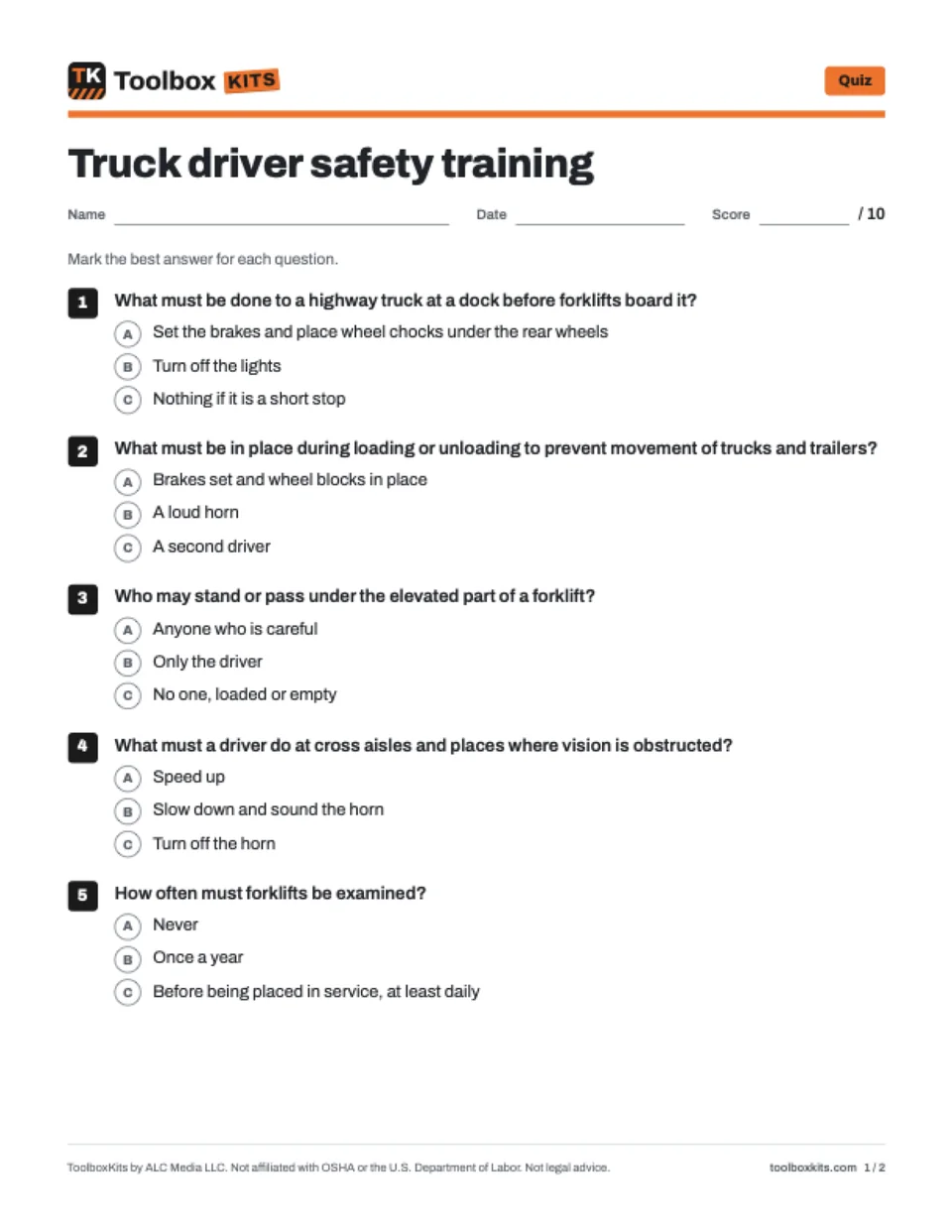
- 10-question quiz and answer key
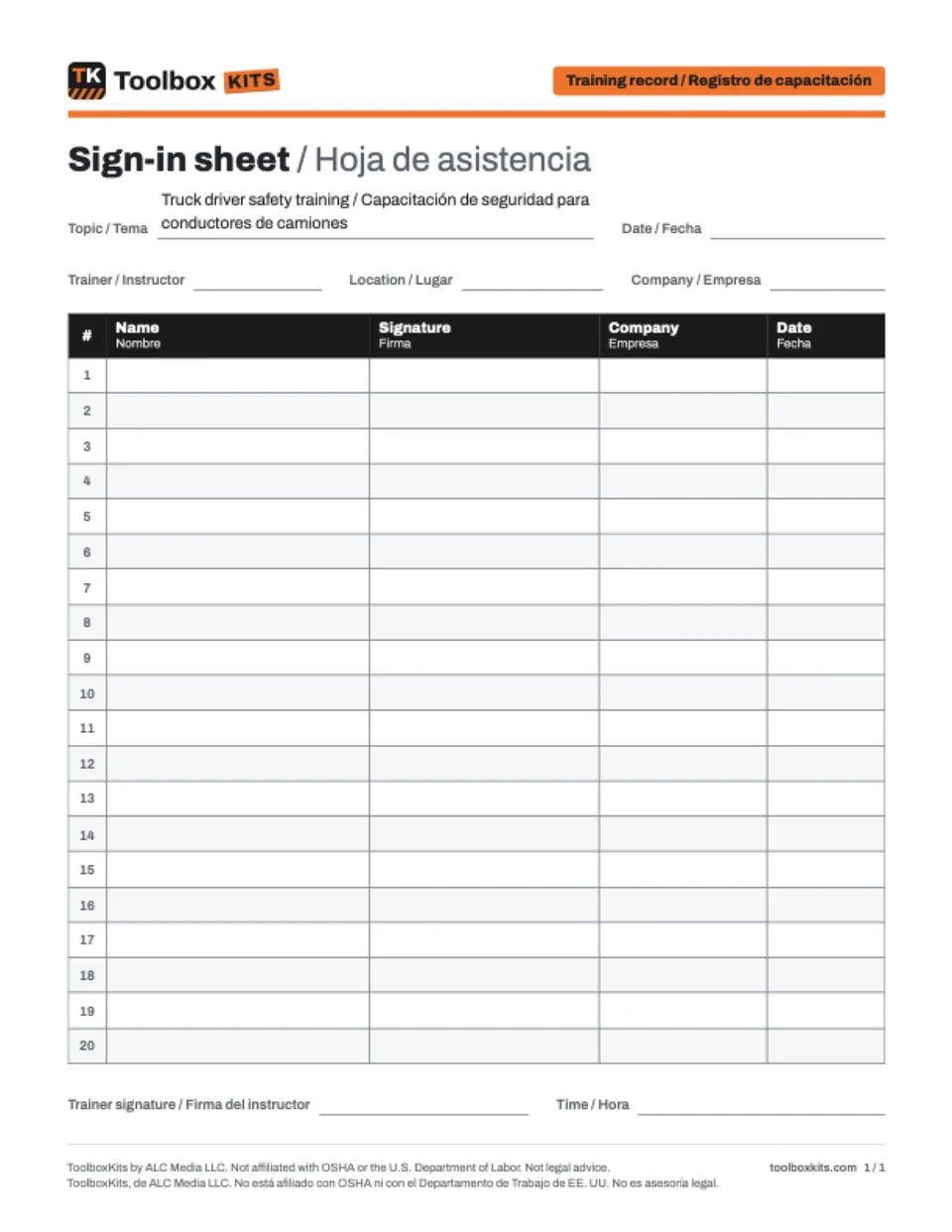
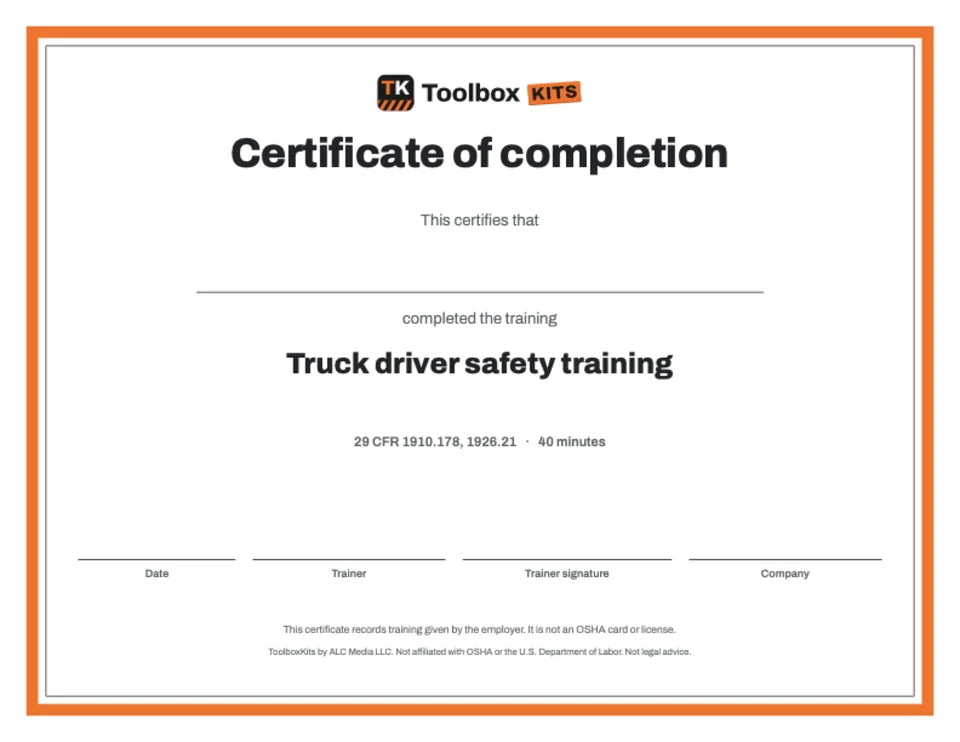
- Sign-in sheet and certificate of completion with fillable fields
- One-page crew handout
- Full Spanish version of everything
- One-page bilingual poster
- Audit-ready records in 60 seconds: fill in your crew and get a sign-in sheet and a certificate for every worker
- Instant download
- Secure checkout by Stripe
- 30-day refund, no questions
Need many topics? All Access gives you every kit for $99 a year.
Inside the kit
See what is in the kit
What is in the kit
 Editable PowerPoint
- Trainer guide
 Quiz
- Answer key
 Sign-in sheet
 Certificate
- Crew handout
Try it
Try the quiz
Three questions from this topic. Pick an answer to see the right one and the OSHA paragraph.
Question 1 of 3
What must be done before a forklift boards a highway truck at the dock?
The rule
What OSHA requires
Plain-language summary. Each line links to the exact paragraph of the regulation.
OSHA's powered industrial truck rule covers forklifts at docks and in yards. Rules for driving trucks on public roads come from the Department of Transportation, not OSHA. The general duty to train still applies: in construction, the employer must instruct each employee in recognizing and avoiding unsafe conditions and the rules that apply to their work environment.
“The employer shall instruct each employee in the recognition and avoidance of unsafe conditions and the regulations applicable to his work environment to control or eliminate any hazards or other exposure to illness or injury.”
Highway truck brakes must be set and wheel chocks placed under the rear wheels so the truck does not roll while forklifts board it.
“The brakes of highway trucks shall be set and wheel chocks placed under the rear wheels to prevent the trucks from rolling while they are boarded with powered industrial trucks.”
Brakes must be set and wheel blocks in place to prevent movement of trucks and trailers while loading or unloading. Fixed jacks may be needed for an uncoupled semitrailer.
“Brakes shall be set and wheel blocks shall be in place to prevent movement of trucks, trailers, or railroad cars while loading or unloading.”
No person is allowed to stand or pass under the elevated part of a forklift, loaded or empty.
“No person shall be allowed to stand or pass under the elevated portion of any truck, whether loaded or empty.”
Forklift operators must slow down and sound the horn at cross aisles and other places where vision is obstructed.
“The driver shall be required to slow down and sound the horn at cross aisles and other locations where vision is obstructed.”
Forklifts must be examined before being placed in service, at least daily, and not placed in service if the examination shows a condition that affects safety.
“Industrial trucks shall be examined before being placed in service, and shall not be placed in service if the examination shows any condition adversely affecting the safety of the vehicle.”
Only stable or safely arranged loads may be handled on a forklift.
“Only stable or safely arranged loads shall be handled.”
Forklift operators must be trained and evaluated and competent to operate the truck safely.
“The employer shall ensure that each powered industrial truck operator is competent to operate a powered industrial truck safely, as demonstrated by the successful completion of the training and evaluation specified in this paragraph (l).”
Who must be trained
Each powered industrial truck operator must be competent to operate the truck safely, as shown by successful completion of training and evaluation (29 CFR 1910.178(l)(1)(i)).
When to retrain
Refresher training in relevant topics must be given when the operator has been seen operating the truck unsafely, has been in an accident or near miss, gets an evaluation showing unsafe operation, is assigned to a different type of truck, or when a workplace condition changes in a way that could affect safe operation (29 CFR 1910.178(l)(4)(ii)). Each operator's performance must be evaluated at least once every three years (29 CFR 1910.178(l)(4)(iii)).

Common questions
Questions people ask
Is there a printable truck driver safety training PDF?
Yes. This page is a free printable truck driver safety talk in English and Spanish with a sign-in table. For slides, a quiz and a trainer guide, order the training kit or request a custom one.
What are good DOT safety meeting topics?
Good topics are pre-trip inspections, backing, dock safety, load securement, distracted driving, fatigue, weather and journey planning. Check the Department of Transportation rules that apply to your fleet, since those rules are not OSHA's and are not covered on this page.
What should a journey management toolbox talk cover?
Cover the route, stops, rest breaks, weather, hazards at the destination and who to call. OSHA has no specific standard for a journey management program, but the general duty to train applies.
What should a load securement safety talk cover?
Cover choosing the right tie-downs, checking them at the start and on the road, balancing the load and keeping it stable. For forklifts, only stable or safely arranged loads may be handled. Road load rules come from the Department of Transportation.
Is there a truck driver safety training PowerPoint?
The free talk on this page works as a short spoken presentation. The paid training kit adds slides for a longer session with notes, a quiz and a handout.
Free to share
Use this talk for free
You can print, share and adapt this talk at no cost under the Creative Commons BY-NC-SA 4.0 license. Please credit ToolboxKits with a link.