

Free 5-minute toolbox talkDrivingEnglish and Spanish
Winter driving toolbox talk
Snow, ice and early darkness change how a vehicle stops, steers and is seen. What OSHA requires: Vehicles with cabs must have windshields and powered wipers, and cracked or broken glass must be replaced. Vehicles that operate where conditions fog or frost the windshield must have operable defogging or defrosting devices (29 CFR 1926.601(b)(5)).
A free winter driving toolbox talk for anyone who drives for work when roads turn snowy, icy or dark. Read it aloud in about five minutes, or use it as a quick winter driving safety moment.
Updated October 29, 2026 · Based on 29 CFR 1926.601
Read it out loud
Free 5-minute toolbox talk
Read it out loud to your crew. It takes about 5 minutes.
Start with a question
What is the worst stretch of road you drive in winter, and what makes it so bad?
Why it matters
Snow, ice and early darkness change how a vehicle stops, steers and is seen. Habits that work fine in summer can put you in a ditch or into the back of another vehicle in winter. A little planning and slower, smoother driving are what get you there and back safely.
Key points
Ask if the trip can wait
When the roads are bad, the safest trip is the one you do not take. Check the forecast and road conditions before you leave, and ask your supervisor if the trip can be delayed.
More
If you must go, fill the tank, plan your route, tell someone when you expect to arrive and leave extra time so you are not tempted to rush.
Get the vehicle ready
Clear all snow and ice from every window, the mirrors, the lights and the roof before you move. Check your tires, battery, wipers, washer fluid and defroster, because a fogged or frosted windshield is like driving blind.
More
On a construction jobsite closed to public traffic, vehicles in use must be checked at the beginning of each shift, and the check also covers lights, windshield wipers and defrosters where that equipment is necessary.
Slow down and leave more room
Stopping distances get much longer on snow and ice, so drive well below the speed limit and leave far more space than usual. Speed up, brake and turn gently, because sudden moves can cause skids. Do not use cruise control on slick roads, and keep a steady speed going up hills.
More
If you are pulling a trailer or hauling equipment, go even slower, and watch for other drivers who are going too fast for the conditions.
Watch for black ice
Black ice is a thin, clear layer of ice that can look like wet pavement. It often forms first on bridges, overpasses, shaded spots and low areas, especially early in the morning and at night. If the road looks wet and it is near freezing, treat it as ice.
Know what to do in a skid
If your vehicle starts to slide, stay calm and ease off the gas. Do not slam on the brakes. Look and steer gently in the direction you want to go. If you have anti-lock brakes and need to stop, press firmly and hold steady pressure, even if the pedal pulses.
Be seen, and be ready if you get stuck
Turn on your headlights in snow, fog and at dusk so others can see you. On a construction jobsite closed to public traffic, vehicles in use must have at least two headlights and two taillights in operable condition whenever visibility conditions warrant additional light.
More
Carry a winter kit with a scraper, small shovel, blanket, warm clothes, water, snacks, a flashlight and a phone charger, and secure it so it cannot slide around the cab. If you get stuck, stay with the vehicle, call for help and keep the exhaust pipe clear of snow so fumes do not build up inside.
Scenario
Picture this: It snowed overnight, and a worker is running late for an early start across town. They scrape a small patch of the frosted windshield, leave snow on the roof and lights, and drive at their usual speed. On a shaded bridge, the truck starts to slide toward the guardrail. What should the driver have done before leaving, and what should they do right now?
Ask the crew
- Which roads or spots on our routes ice up first?
- What is in your vehicle right now in case you get stuck?
- At what point would you decide it is too dangerous to drive, and who would you call?
- When did you last check your tire tread, battery, wipers and defroster?
Takeaway
In winter, clear every window, slow down, leave more room and plan the trip before you turn the key.
Trainer: ______________________ Date: ____________
Credit: ToolboxKits, https://toolboxkits.com/topics/winter-driving/ (CC BY-NC-SA 4.0)
The poster is also inside the paid kits.
Audit-ready records in 60 seconds
Fill in your crew and download a filled sign-in sheet for this talk. Everything is made in your browser. Names are never uploaded or stored.
Start a sign-off
Crew scan a QR code on their own phones, type their name and sign with a finger. You see the names arrive and download the signed sheet. Free, no account.
Kits
Get the kit
No subscription needed. Buy only the kit you need.
Toolbox talk kit
$4.99
- 5-minute talk, English PDF
- 5-minute talk, Spanish PDF
- Editable mini-deck (English and Spanish)
- One-page crew handout (English and Spanish)
- Bilingual sign-in sheet
- 3-question quiz with answer key (English and Spanish)
- One-page bilingual poster
- Audit-ready records in 60 seconds: fill in your crew and get a sign-in sheet and a certificate for every worker
Training kit
$9
Editable PowerPoint, 35 slides
- Editable PowerPoint with trainer notes on every slide
- Trainer guide PDF with timing and discussion tips
- 10-question quiz and answer key
- Sign-in sheet and certificate of completion with fillable fields
- One-page crew handout
- Full Spanish version of everything
- One-page bilingual poster
- Audit-ready records in 60 seconds: fill in your crew and get a sign-in sheet and a certificate for every worker
- Instant download
- Secure checkout by Stripe
- 30-day refund, no questions
Need many topics? All Access gives you every kit for $99 a year.
Inside the kit
See what is in the kit
What is in the kit
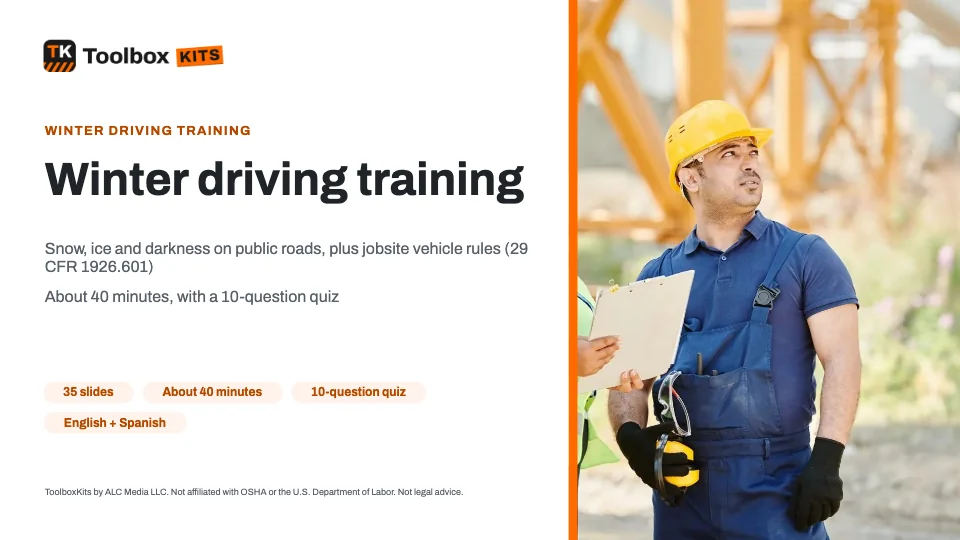 Editable PowerPoint
- Trainer guide
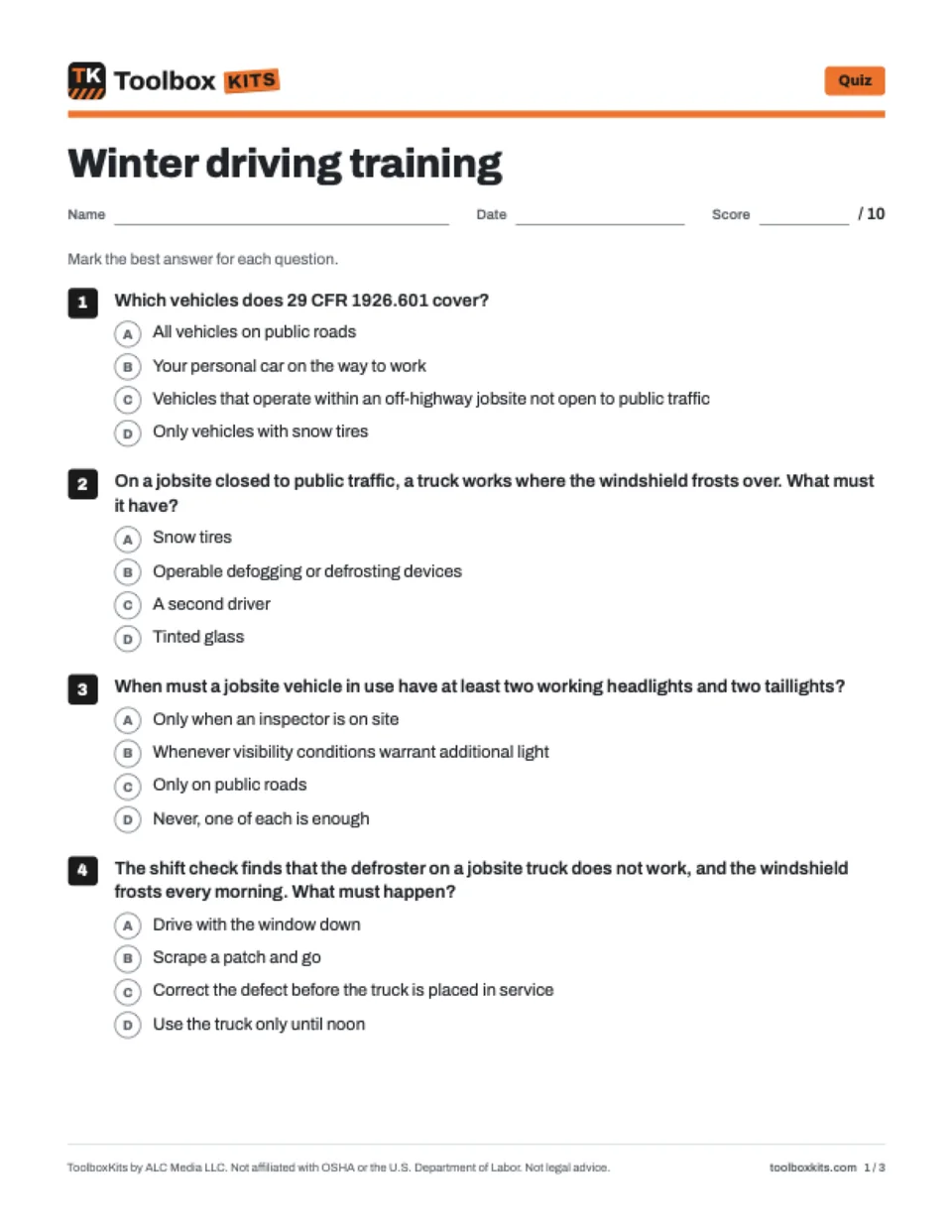 Quiz
- Answer key
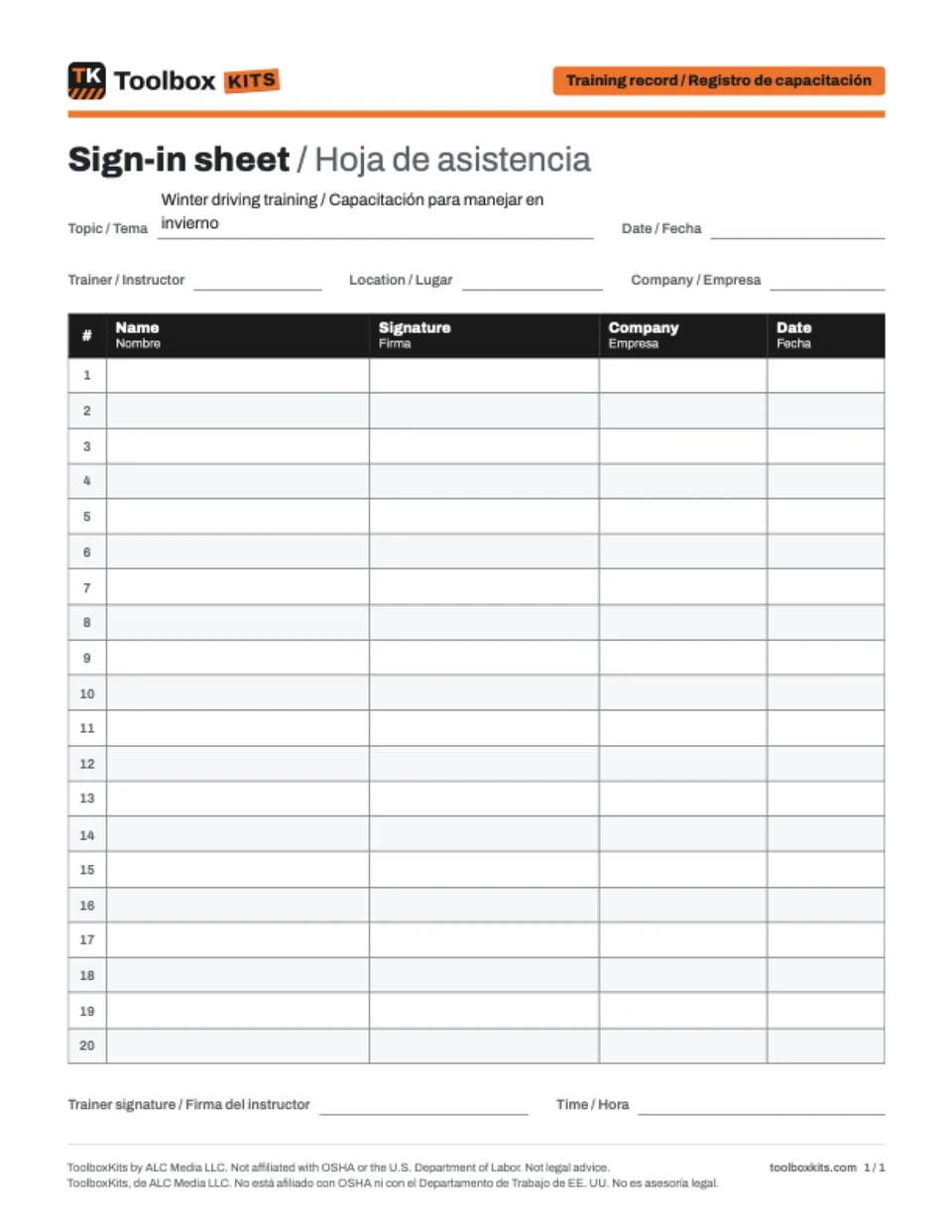 Sign-in sheet
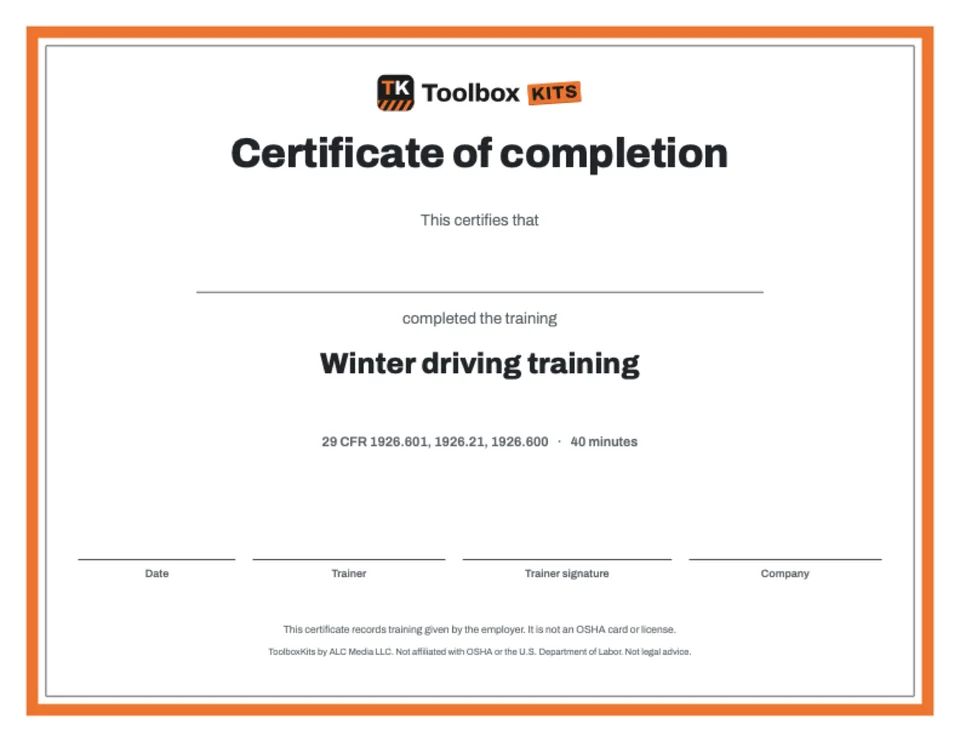 Certificate
- Crew handout
Try it
Try the quiz
Three questions from this topic. Pick an answer to see the right one and the OSHA paragraph.
Question 1 of 3
On a construction jobsite closed to public traffic, what must vehicles have if they operate where windshields fog or frost?
The rule
What OSHA requires
Plain-language summary. Each line links to the exact paragraph of the regulation.
OSHA's construction motor vehicle rule covers vehicles that operate within an off-highway jobsite not open to public traffic, not vehicles on public roads.
“those vehicles that operate within an off-highway jobsite, not open to public traffic”
Vehicles with cabs must have windshields and powered wipers, and cracked or broken glass must be replaced. Vehicles that operate where conditions fog or frost the windshield must have operable defogging or defrosting devices.
“Vehicles operating in areas or under conditions that cause fogging or frosting of the windshields shall be equipped with operable defogging or defrosting devices.”
Whenever visibility conditions warrant additional light, all vehicles in use must have at least two headlights and two taillights in operable condition.
“Whenever visibility conditions warrant additional light, all vehicles, or combinations of vehicles, in use shall be equipped with at least two headlights and two taillights in operable condition.”
All vehicles must have brake lights in operable condition, no matter the light conditions.
“All vehicles, or combination of vehicles, shall have brake lights in operable condition regardless of light conditions.”
Every vehicle must have a service brake system, an emergency brake system and a parking brake system, maintained in operable condition.
“All vehicles shall have a service brake system, an emergency brake system, and a parking brake system.”
Vehicles in use must be checked at the beginning of each shift, including service brakes, the parking brake, the emergency stopping system, tires, horn, steering, coupling devices, seat belts, operating controls and safety devices. The check also applies to lights, reflectors, windshield wipers, defrosters and fire extinguishers where that equipment is necessary, and all defects must be corrected before the vehicle is placed in service.
“These requirements also apply to equipment such as lights, reflectors, windshield wipers, defrosters, fire extinguishers, etc., where such equipment is necessary.”
Tools and material must be secured so they cannot move when they ride in the same compartment as workers.
“Tools and material shall be secured to prevent movement when transported in the same compartment with employees.”
Seat belts and anchorages that meet federal motor vehicle safety standards must be installed in all motor vehicles.
“Seat belts and anchorages meeting the requirements of 49 CFR part 571 (Department of Transportation, Federal Motor Vehicle Safety Standards) shall be installed in all motor vehicles.”
OSHA has no specific standard for winter driving; the general duty to train still applies. In construction, the employer must instruct each employee in the recognition and avoidance of unsafe conditions and the regulations that apply to their work environment.
“The employer shall instruct each employee in the recognition and avoidance of unsafe conditions”
Common questions
Questions people ask
What should a winter driving toolbox talk cover?
Cover whether the trip can wait, getting the vehicle ready, slowing down and leaving more room, black ice, what to do in a skid, being seen and what to carry in case you get stuck. For vehicles on an off-highway construction jobsite not open to public traffic, add the shift check, which also covers lights, windshield wipers and defrosters where that equipment is necessary (29 CFR 1926.601(b)(14)). Tie the talk to the roads and weather your crew actually drives in.
Is there a winter driving safety PowerPoint presentation?
This free talk is written to be read aloud, so you can run it without slides. If you want a winter driving safety presentation with slides for a longer session, use the training kit option on this page. You can also print this talk as a PDF in English and Spanish with a sign-in table.
What is a good winter driving safety moment?
Pick one habit and practice it, such as clearing every window and light before you move, or what to do when you start to slide. A safety moment on driving in snow can be as simple as asking each driver which stretch of road worries them most and how they handle it. Keep it short and tie it to today's forecast.
What should a winter tires safety moment cover?
Check tread depth and look for damage, and check tire pressure often, since cold weather can lower it. Make sure the tires suit the vehicle and the conditions, and know the chain and traction rules for the roads you drive. On an off-highway construction jobsite not open to public traffic, tires are part of the vehicle check required at the beginning of each shift (29 CFR 1926.601(b)(14)).
Can I use this as a 5 minute safety talk on winter driving?
Yes. The talk reads aloud in about five minutes and ends with discussion questions and a one-line takeaway. Print the free PDF in English or Spanish with a sign-in sheet so you have a record of who attended.
Free to share
Use this talk for free
You can print, share and adapt this talk at no cost under the Creative Commons BY-NC-SA 4.0 license. Please credit ToolboxKits with a link.