

Free 5-minute toolbox talkDrivingEnglish and Spanish
Safe driving toolbox talk: defensive driving
You cannot control how other people drive, but you can control your speed, your space and where you look. What OSHA requires: OSHA's construction motor vehicle rule covers vehicles that operate within an off-highway jobsite not open to public traffic (29 CFR 1926.601(a)).
A free safe driving toolbox talk on defensive driving: expecting other drivers' mistakes and always leaving yourself a way out. Read it aloud in about five minutes, or use it as a defensive driving safety moment.
Updated October 29, 2026 · Based on 29 CFR 1926.601
Read it out loud
Free 5-minute toolbox talk
Read it out loud to your crew. It takes about 5 minutes.
Start with a question
Have you ever avoided a crash because you saw another driver's mistake coming before it happened?
Why it matters
You cannot control how other people drive, but you can control your speed, your space and where you look. Defensive driving means driving to prevent crashes even when someone else does something wrong. It protects you, your crew and everyone else on the road.
Key points
Expect other drivers to make mistakes
Assume the other driver has not seen you, might run the light or might pull out in front of you. Watch for clues like a car drifting in its lane, front wheels starting to turn or a driver looking down at a phone. When you expect a mistake, you have time to react instead of being caught by surprise.
Keep a space cushion
Leave enough room ahead of you to stop if the vehicle in front stops suddenly. Add more room in rain, fog, darkness and heavy traffic, and when you are pulling a trailer. Try to keep an open lane or shoulder beside you so you have somewhere to steer.
More
If someone is tailgating you, ease off a little or change lanes and let them pass.
Scan ahead and check your mirrors
Look well down the road, not just at the bumper in front of you, so you spot brake lights, work zones and hazards early. Check your mirrors often, and turn your head to check blind spots before you change lanes or turn.
More
At intersections, cover the brake and look left, right and left again before you go, even on a green light, and watch for pedestrians and red light runners.
Stay focused and fit to drive
Put the phone out of reach and set the GPS before you move. Never drive drowsy or impaired by alcohol, drugs or medication that makes you sleepy. If you start yawning, drifting or missing turns, pull over somewhere safe and rest or switch drivers.
More
Wear your seat belt on every trip, and make sure everyone riding with you does too.
Do not take the bait from angry drivers
If another driver honks, gestures or cuts you off, let it go. Do not make eye contact, gesture back, brake check them or speed up to block them. Slow down, give them room and let them go by.
More
If someone follows you, do not drive home; drive to a police station or a busy public place and call for help, and never get out of your vehicle to argue.
Check the vehicle and back up with care
Do a quick walk-around before you drive, and report problems with brakes, tires, lights or mirrors. On a construction jobsite closed to public traffic, vehicles in use must be checked at the beginning of each shift.
More
A vehicle there with an obstructed view to the rear may be used only if it has a reverse signal alarm audible above the surrounding noise, or if it backs up only when an observer signals that it is safe.
29 CFR 1926.601(b)(4) · 29 CFR 1926.601(b)(14)
Scenario
Picture this: A worker is driving a company van on a busy road, a little over the limit and close behind a pickup. A car waiting at a side street starts to roll forward, and the pickup brakes hard. The van driver has no room to stop and nowhere to steer. What could the driver have done earlier to give themselves time and space?
Ask the crew
- What specific driving hazards on our routes should we look out for?
- What do you do when someone is tailgating you or driving angry?
- Where are the blind spots on the vehicles we drive, and how do you check them?
- What makes it hard to keep a safe following distance, and how can we fix that?
Takeaway
Drive as if other drivers will make mistakes, and always leave yourself time, space and a way out.
Trainer: ______________________ Date: ____________
Credit: ToolboxKits, https://toolboxkits.com/topics/defensive-driving/ (CC BY-NC-SA 4.0)
The poster is also inside the paid kits.
Audit-ready records in 60 seconds
Fill in your crew and download a filled sign-in sheet for this talk. Everything is made in your browser. Names are never uploaded or stored.
Start a sign-off
Crew scan a QR code on their own phones, type their name and sign with a finger. You see the names arrive and download the signed sheet. Free, no account.
Kits
Get the kit
No subscription needed. Buy only the kit you need.
Toolbox talk kit
$4.99
- 5-minute talk, English PDF
- 5-minute talk, Spanish PDF
- Editable mini-deck (English and Spanish)
- One-page crew handout (English and Spanish)
- Bilingual sign-in sheet
- 3-question quiz with answer key (English and Spanish)
- One-page bilingual poster
- Audit-ready records in 60 seconds: fill in your crew and get a sign-in sheet and a certificate for every worker
Training kit
$9
Editable PowerPoint, 35 slides
- Editable PowerPoint with trainer notes on every slide
- Trainer guide PDF with timing and discussion tips
- 10-question quiz and answer key
- Sign-in sheet and certificate of completion with fillable fields
- One-page crew handout
- Full Spanish version of everything
- One-page bilingual poster
- Audit-ready records in 60 seconds: fill in your crew and get a sign-in sheet and a certificate for every worker
- Instant download
- Secure checkout by Stripe
- 30-day refund, no questions
Need many topics? All Access gives you every kit for $99 a year.
Inside the kit
See what is in the kit
What is in the kit
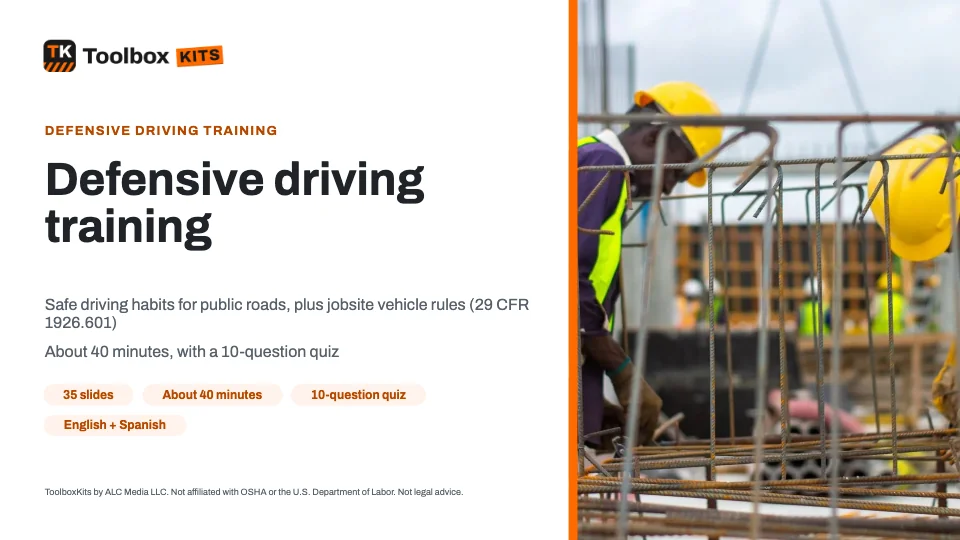 Editable PowerPoint
- Trainer guide
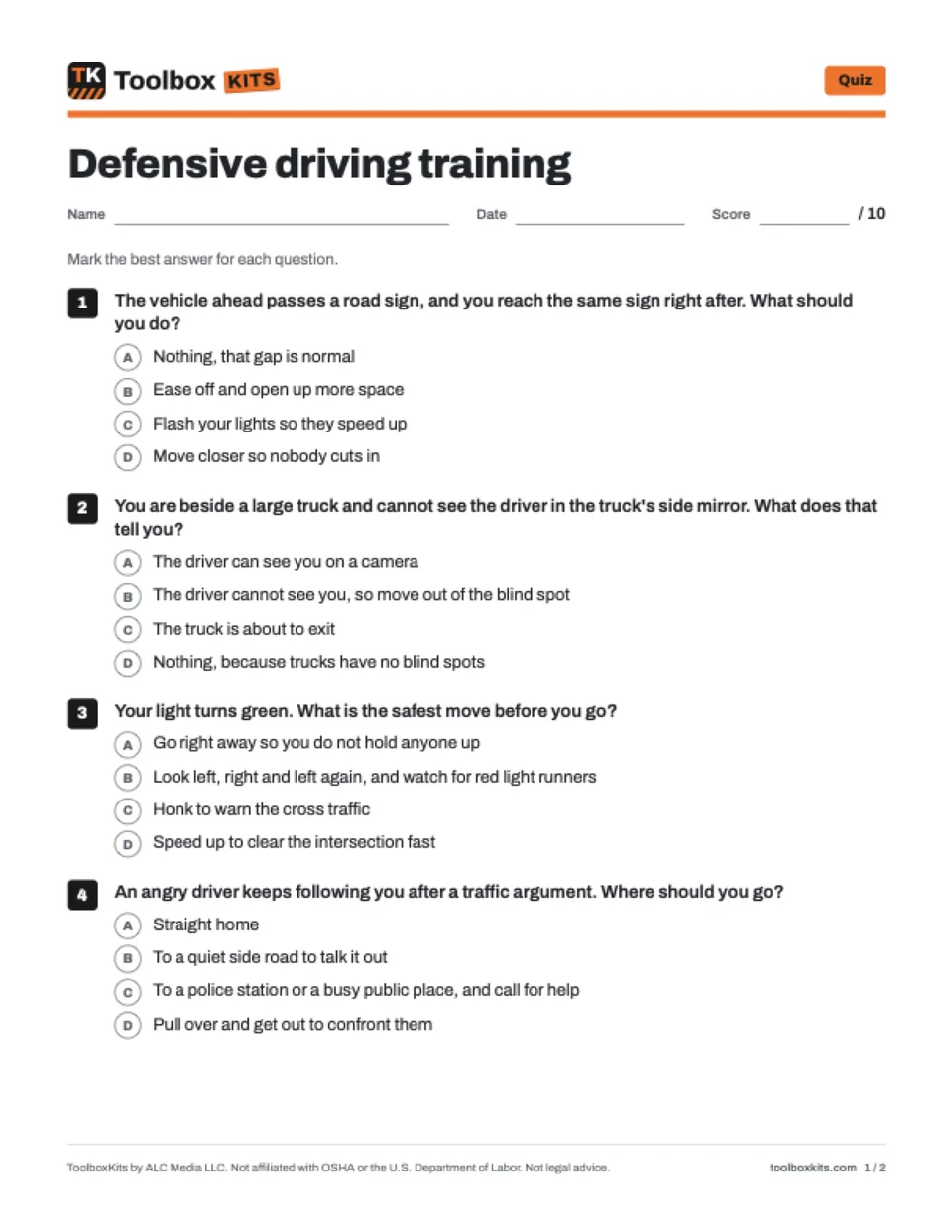 Quiz
- Answer key
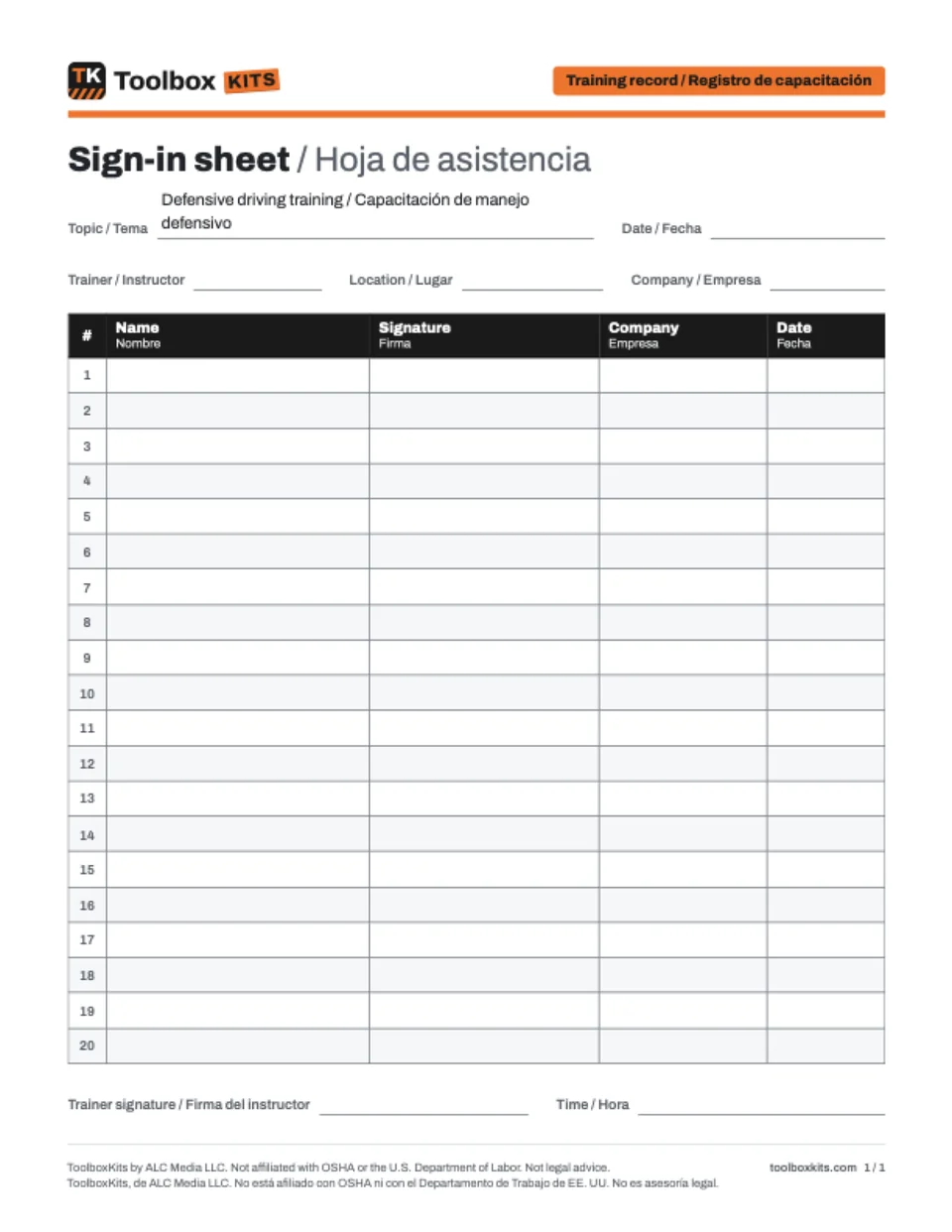 Sign-in sheet
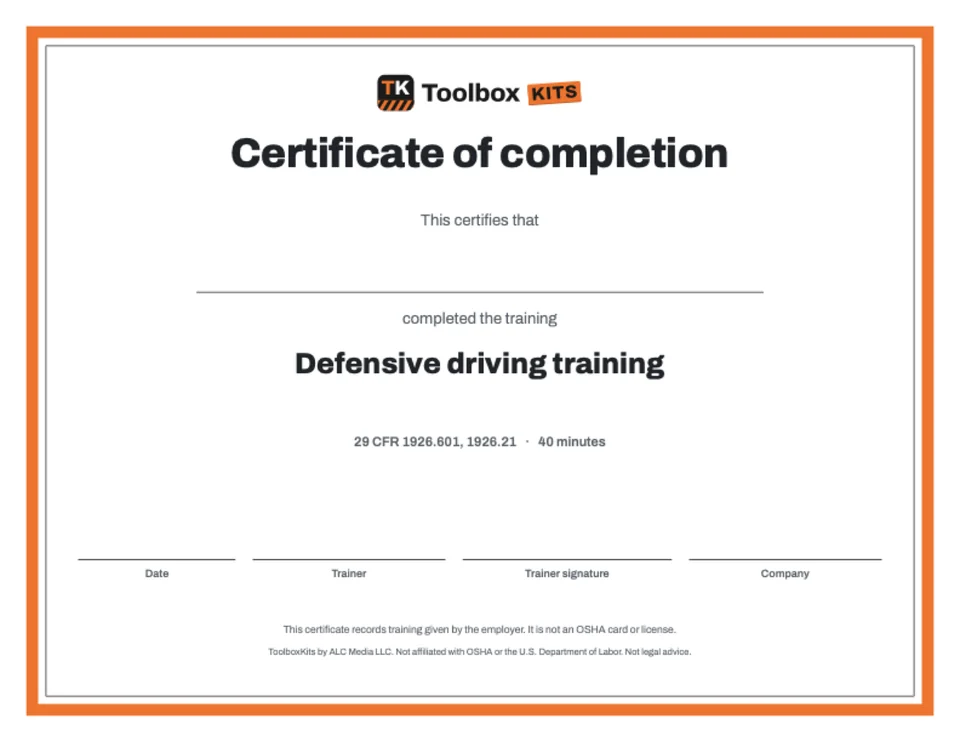 Certificate
- Crew handout
Try it
Try the quiz
Three questions from this topic. Pick an answer to see the right one and the OSHA paragraph.
Question 1 of 3
What does defensive driving mean?
The rule
What OSHA requires
Plain-language summary. Each line links to the exact paragraph of the regulation.
OSHA's construction motor vehicle rule covers vehicles that operate within an off-highway jobsite not open to public traffic. Equipment covered by OSHA's material handling equipment rule (29 CFR 1926.602) falls under that rule instead.
“Motor vehicles as covered by this part are those vehicles that operate within an off-highway jobsite, not open to public traffic.”
Every vehicle must have a service brake system, an emergency brake system and a parking brake system. These systems may share components and must be kept in operable condition.
“These systems may use common components, and shall be maintained in operable condition.”
Every vehicle must have working brake lights, regardless of light conditions.
“All vehicles, or combination of vehicles, shall have brake lights in operable condition regardless of light conditions.”
Every vehicle must have an adequate audible warning device, such as a horn, at the operator's station, in operable condition.
“All vehicles shall be equipped with an adequate audible warning device at the operator's station and in an operable condition.”
No employer may use a vehicle with an obstructed view to the rear unless it has a reverse signal alarm audible above the surrounding noise level, or it is backed up only when an observer signals that it is safe to do so.
“No employer shall use any motor vehicle equipment having an obstructed view to the rear unless”
Vehicles used to carry workers must have seats that are firmly secured and adequate for the number of workers carried.
“Vehicles used to transport employees shall have seats firmly secured and adequate for the number of employees to be carried.”
Tools and material must be secured to prevent movement when they are carried in the same compartment as workers.
“Tools and material shall be secured to prevent movement when transported in the same compartment with employees.”
All motor vehicles must have seat belts and anchorages installed that meet the federal motor vehicle safety standards.
“Seat belts and anchorages meeting the requirements of 49 CFR part 571 (Department of Transportation, Federal Motor Vehicle Safety Standards) shall be installed in all motor vehicles.”
Vehicles in use must be checked at the beginning of each shift to make sure brakes, tires, horn, steering, coupling devices, seat belts, operating controls and safety devices are in safe operating condition. All defects must be corrected before the vehicle is placed in service.
“All defects shall be corrected before the vehicle is placed in service.”
OSHA has no specific standard for defensive driving; the general duty to train still applies. In construction, the employer must instruct each employee in the recognition and avoidance of unsafe conditions and the regulations that apply to their work environment.
“The employer shall instruct each employee in the recognition and avoidance of unsafe conditions and the regulations applicable to his work environment to control or eliminate any hazards or other exposure to illness or injury.”
Common questions
Questions people ask
What should a safe driving toolbox talk cover?
A good safe driving safety talk covers defensive habits: expecting other drivers' mistakes, keeping a space cushion, scanning ahead, taking intersections carefully, staying focused and fit to drive, and handling angry drivers. Add a vehicle check and safe backing for work vehicles. On an off-highway construction jobsite not open to public traffic, vehicles in use must be checked at the beginning of each shift (29 CFR 1926.601(b)(14)).
What is a good defensive driving safety moment?
Pick one habit and talk about it for a few minutes, such as how much room you leave behind the vehicle ahead or how you check your blind spots. Ask each driver to name one spot on their route where other drivers tend to make mistakes. It also works as a quick safe driving safety moment before crews head out.
What should a road rage safety talk cover?
Cover how to avoid starting or feeding road rage: leave early, stay calm, use your signals and do not tailgate. If another driver gets aggressive, do not make eye contact or gesture back; give them room and let them pass. If you are followed, drive to a police station or a busy public place, call for help and stay in your vehicle. Any one of these points also makes a good road rage safety moment.
Is there a defensive driving safety training PPT?
This free talk is written to be read aloud, so you can run it without slides. If you want a defensive driving training presentation with slides for a longer session, use the training kit option on this page. Pair it with a walk-around of one of your own vehicles to point out its blind spots.
Is there a printable defensive driving toolbox talk?
Yes. This defensive driving toolbox talk is a free printable PDF in English and Spanish with a sign-in table. OSHA has no specific standard for defensive driving, but in construction the employer must still instruct each employee in recognizing and avoiding unsafe conditions (29 CFR 1926.21(b)(2)).
Free to share
Use this talk for free
You can print, share and adapt this talk at no cost under the Creative Commons BY-NC-SA 4.0 license. Please credit ToolboxKits with a link.