

Free 5-minute toolbox talkSeasonal and holidaysEnglish and Spanish
Winter safety moment
Fuel-burning heaters and generators give off carbon monoxide, a gas you cannot see or smell. What OSHA requires: OSHA has no specific standard for winter safety; the general duty to train still applies. Construction employers must instruct each employee in recognizing and avoiding unsafe conditions and in the rules that apply to their work environment (29 CFR 1926.21(b)(2)).
A free winter safety moment, or a full winter safety toolbox talk, that you can read to your crew in about five minutes. Use it any week from December through February to cover ice, cold, heaters, winter driving and short days.
Updated October 29, 2026 · Based on 29 CFR 1926.21
Read it out loud
Free 5-minute toolbox talk
Read it out loud to your crew. It takes about 5 minutes.
Start with a question
What is the one winter hazard on this job that worries you most this week?
Why it matters
Winter changes the job overnight. Walkways ice over, days get shorter, roads get slick and heaters move into closed spaces. None of these hazards are new, but they pile up at the same time and change from one morning to the next. A few minutes of planning at the start of each shift keeps small surprises from turning into injuries.
Key points
Treat every surface as slippery
Ice hides in shaded spots and on steel, ramps, stairs and truck steps. Walk slowly with short steps, keep your hands out of your pockets and use the handrail. In general industry, employers must keep walking-working surfaces free of hazards such as snow and ice.
More
Report icy spots so they get salted or sanded before someone falls.
Clear scaffolds, stairs and ladders first
Do not work on a scaffold covered with snow, ice or other slippery material, except to clear it off. Clear stairs, platforms and ladder rungs before anyone climbs. Knock the snow off your boots first and keep a firm grip.
Dress for the cold and watch each other
Wear loose layers, keep spare dry socks and gloves, and cover your head, ears and hands. Learn the early signs of hypothermia, like shivering, clumsy hands and confusion, and of frostbite, like numb, pale or waxy skin.
More
Take warm-up breaks, eat and drink something warm, and check on your buddy at each break.
Heat work areas safely
Fuel-burning heaters and generators give off carbon monoxide, a gas you cannot see or smell. When temporary heaters are used, fresh air must be supplied in sufficient quantities to maintain workers' health and safety.
More
Keep heaters level and away from tarps and anything that burns, and never run a generator indoors.
Drive for the conditions
Slow down, leave more room to stop, and clear snow and ice from every window, light and mirror before you move. On jobsites closed to public traffic, vehicles that work where windshields fog or frost must have working defogging or defrosting devices.
More
Keep a scraper, blanket, flashlight and charged phone in the truck. If you get stranded, stay with the vehicle, keep the tailpipe clear of snow and run the engine only in short bursts for heat.
Plan for short days and storms
It gets dark early, so plan the riskiest tasks for daylight and set up lights before you need them. Construction work areas must be lit to at least OSHA's minimum levels while work is in progress. Check the forecast each morning, and agree on who calls a stop when a storm rolls in.
Scenario
Picture this: the first hard freeze hit overnight. Someone has set a propane heater inside a half-closed stairwell to thaw things out, and the steps are glazed with ice. A laborer is heading up with a bucket in each hand. What would you fix first, before anyone else goes up?
Ask the crew
- Where does ice build up first on this site, and who handles salt and sand?
- Which heaters are we running, and how do those areas get fresh air?
- What is in your truck's winter kit right now?
- What will we do differently on the darkest, coldest mornings?
Takeaway
Winter hazards change overnight, so check your footing, your gear, your heaters and your drive at the start of every shift.
Trainer: ______________________ Date: ____________
Credit: ToolboxKits, https://toolboxkits.com/topics/winter-safety/ (CC BY-NC-SA 4.0)
The poster is also inside the paid kits.
Audit-ready records in 60 seconds
Fill in your crew and download a filled sign-in sheet for this talk. Everything is made in your browser. Names are never uploaded or stored.
Start a sign-off
Crew scan a QR code on their own phones, type their name and sign with a finger. You see the names arrive and download the signed sheet. Free, no account.
Kits
Get the kit
No subscription needed. Buy only the kit you need.
Toolbox talk kit
$4.99
- 5-minute talk, English PDF
- 5-minute talk, Spanish PDF
- Editable mini-deck (English and Spanish)
- One-page crew handout (English and Spanish)
- Bilingual sign-in sheet
- 3-question quiz with answer key (English and Spanish)
- One-page bilingual poster
- Audit-ready records in 60 seconds: fill in your crew and get a sign-in sheet and a certificate for every worker
Training kit
$9
Editable PowerPoint, 39 slides
- Editable PowerPoint with trainer notes on every slide
- Trainer guide PDF with timing and discussion tips
- 10-question quiz and answer key
- Sign-in sheet and certificate of completion with fillable fields
- One-page crew handout
- Full Spanish version of everything
- One-page bilingual poster
- Audit-ready records in 60 seconds: fill in your crew and get a sign-in sheet and a certificate for every worker
- Instant download
- Secure checkout by Stripe
- 30-day refund, no questions
Need many topics? All Access gives you every kit for $99 a year.
Inside the kit
See what is in the kit
What is in the kit
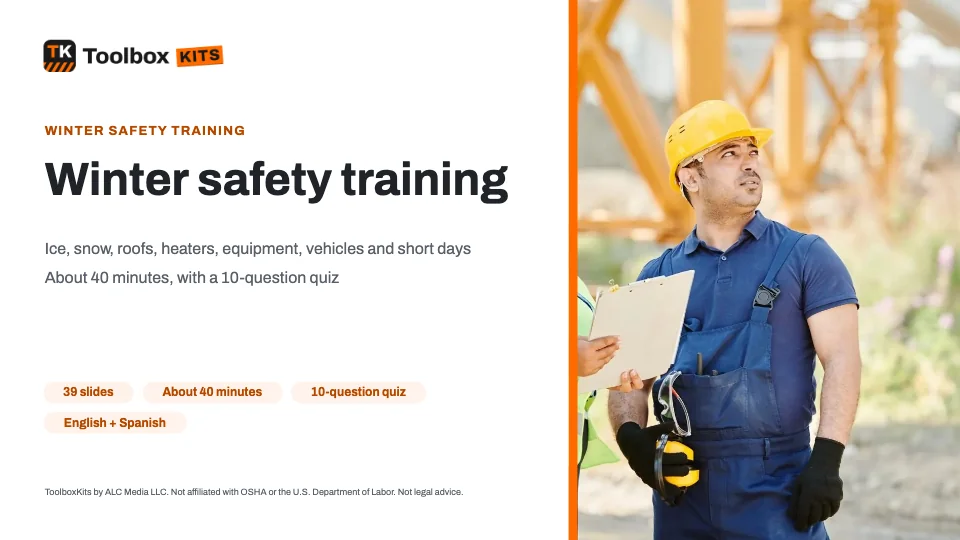 Editable PowerPoint
- Trainer guide
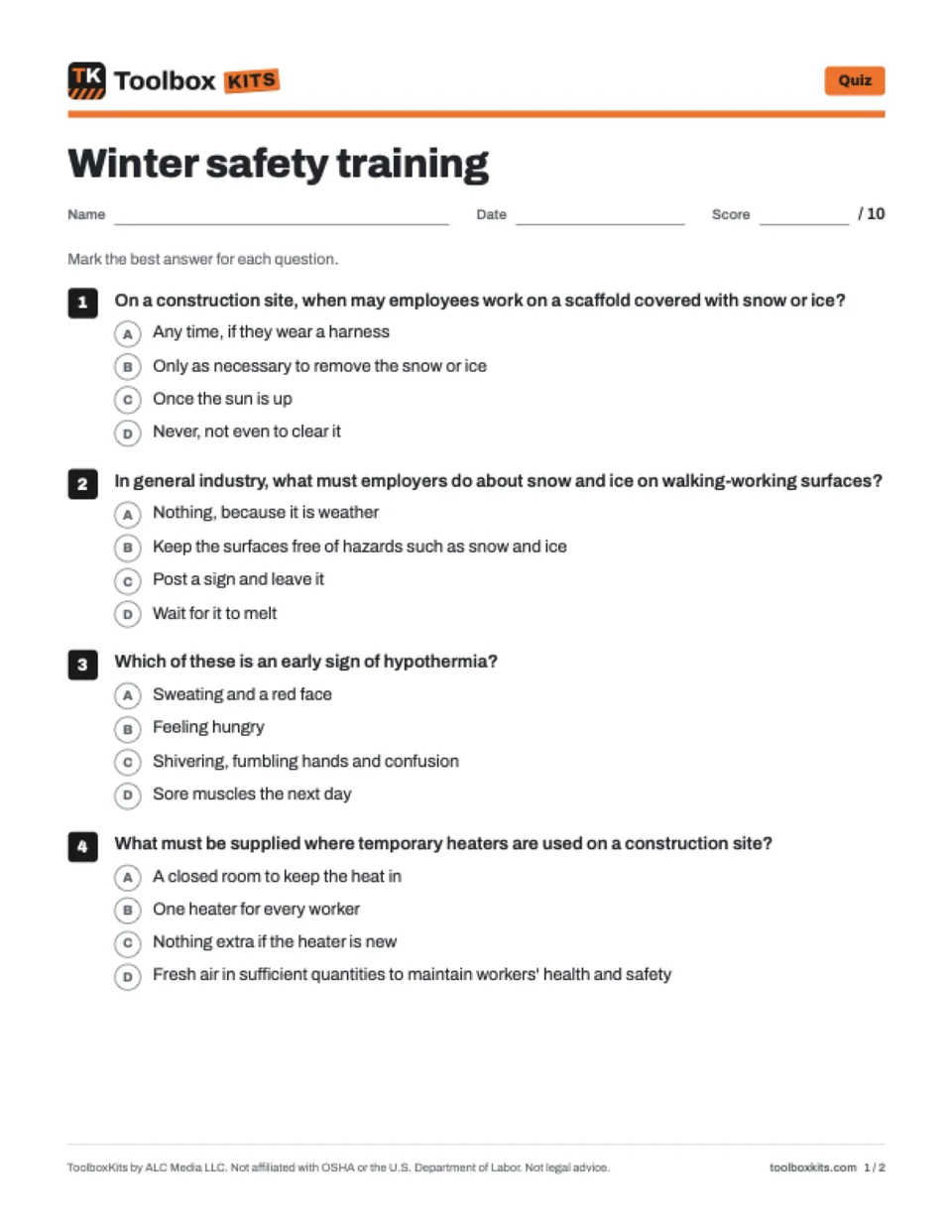 Quiz
- Answer key
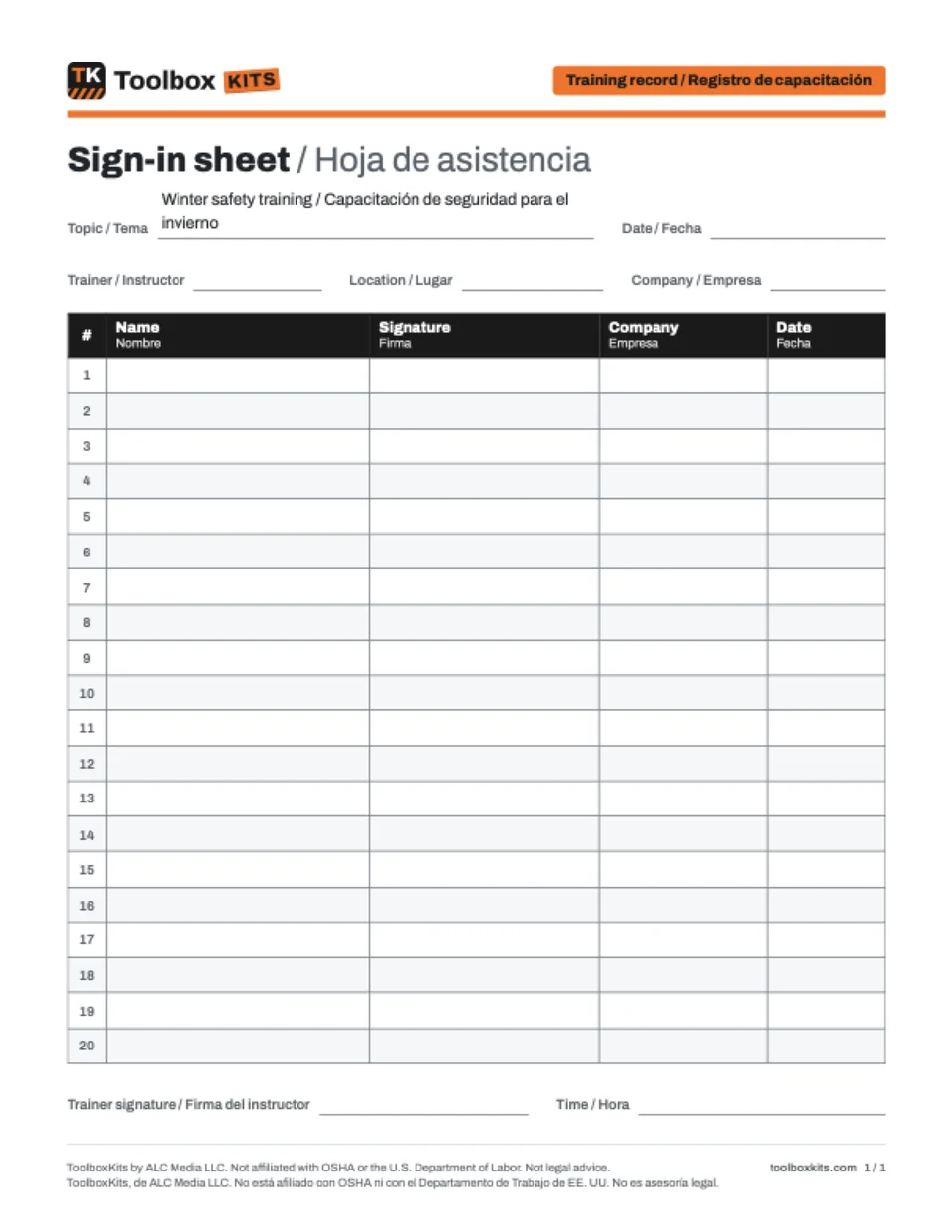 Sign-in sheet
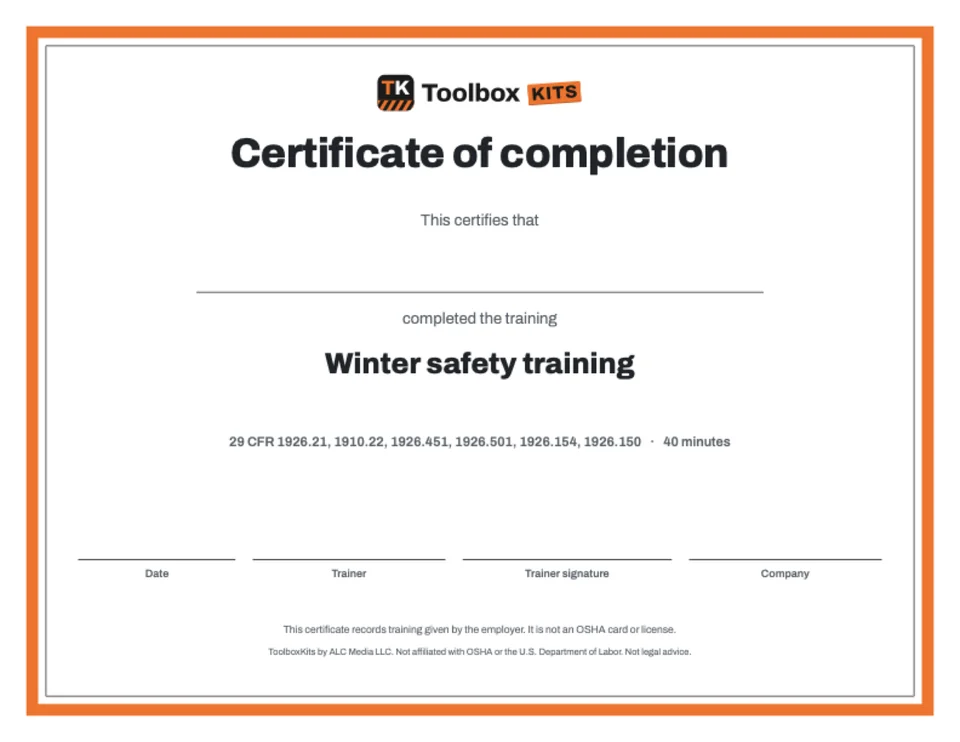 Certificate
- Crew handout
Try it
Try the quiz
Three questions from this topic. Pick an answer to see the right one and the OSHA paragraph.
Question 1 of 3
When does OSHA's scaffold rule allow work on a scaffold covered with snow or ice?
The rule
What OSHA requires
Plain-language summary. Each line links to the exact paragraph of the regulation.
OSHA has no specific standard for winter safety; the general duty to train still applies. Construction employers must instruct each employee in recognizing and avoiding unsafe conditions and in the rules that apply to their work environment.
“The employer shall instruct each employee in the recognition and avoidance of unsafe conditions and the regulations applicable to his work environment to control or eliminate any hazards or other exposure to illness or injury.”
In general industry, employers must keep walking-working surfaces free of hazards such as snow and ice.
“Walking-working surfaces are maintained free of hazards such as sharp or protruding objects, loose boards, corrosion, leaks, spills, snow, and ice.”
Employees may not work on scaffolds covered with snow, ice or other slippery material, except as needed to remove it.
“Employees shall be prohibited from working on scaffolds covered with snow, ice, or other slippery material except as necessary for removal of such materials.”
Slippery conditions on stairways must be eliminated before the stairways are used to reach other levels.
“Slippery conditions on stairways shall be eliminated before the stairways are used to reach other levels.”
Ladders may not be used on slippery surfaces unless they are secured or have slip-resistant feet to prevent accidental displacement.
“Ladders shall not be used on slippery surfaces unless secured or provided with slip-resistant feet to prevent accidental displacement.”
When temporary heaters are used, fresh air must be supplied in sufficient quantities to maintain workers' health and safety. Where natural fresh air is not enough, mechanical ventilation must be provided.
“Fresh air shall be supplied in sufficient quantities to maintain the health and safety of workmen.”
Solid fuel salamanders are not allowed in buildings or on scaffolds.
“Solid fuel salamanders are prohibited in buildings and on scaffolds.”
On off-highway jobsites not open to public traffic, vehicles operating where windshields fog or frost must have operable defogging or defrosting devices.
“Vehicles operating in areas or under conditions that cause fogging or frosting of the windshields shall be equipped with operable defogging or defrosting devices.”
Construction areas, ramps, runways, corridors, offices, shops and storage areas must be lit to at least the minimum illumination levels in OSHA's Table D-3 while any work is in progress.
Under the construction PPE payment rule, employers are not required to pay for ordinary clothing used solely for protection from weather, such as winter coats, jackets, gloves, parkas, rubber boots and hats.
“Ordinary clothing, skin creams, or other items, used solely for protection from weather, such as winter coats, jackets, gloves, parkas, rubber boots, hats, raincoats, ordinary sunglasses, and sunscreen.”
Common questions
Questions people ask
What are good safety moments and meeting topics for December, January and February?
December: early darkness, icy walkways and driving in holiday traffic. January: cold stress, frostbite and heaters in closed spaces. February: snow and ice on roofs, scaffolds and ladders, plus winter driving. Pick the one your crew actually faced this week.
What are good winter safety moment ideas?
Try the icy spot nobody has salted yet, what goes in a truck winter kit, why fuel-burning heaters need fresh air, how to spot frostbite, and handwashing during cold and flu season. Keep it short and tie it to something on your site today, whether it is a toolbox talk or a tailgate meeting.
What PPE should workers wear for winter work?
Wear warm, loose layers, a winter liner made for your hard hat, insulated waterproof boots with good tread and gloves that fit the task. When it gets dark early, add high-visibility outerwear. Under the construction PPE payment rule, employers are not required to pay for ordinary clothing used solely for protection from weather, such as winter coats, gloves, parkas and rubber boots (29 CFR 1926.95(d)(4)(ii)).
How do you give a winter preparedness toolbox talk?
Walk the site first and note icy spots, heater locations, dark areas and vehicle routes. Then cover how the crew will handle ice, cold, heaters and driving, and who to call in an emergency. Finish by checking that first aid supplies and truck winter kits are stocked.
Should a winter safety talk cover the winter blues?
It can. Short, gray days can leave some people tired and low, and tired workers make more mistakes. Encourage the crew to get daylight on breaks, keep a regular sleep schedule and talk to someone if a low mood hangs on. If your company has an employee assistance program, remind people how to reach it.
Free to share
Use this talk for free
You can print, share and adapt this talk at no cost under the Creative Commons BY-NC-SA 4.0 license. Please credit ToolboxKits with a link.